Natural Language 19th century Processing & Machine Learning - - PowerPoint PPT Presentation

natural language
SMART_READER_LITE
LIVE PREVIEW

Natural Language 19th century Processing & Machine Learning - - PowerPoint PPT Presentation

Natural Language 19th century Processing & Machine Learning for Speech Paula Buttery, Andrew Caines, Helen Yannakoudakis; NLIP Group, Dept. Computer Science & Technology, Cambridge. Source:


slide-1
SLIDE 1

Natural Language Processing & Machine Learning for Speech

Paula Buttery, Andrew Caines, Helen Yannakoudakis; NLIP Group, Dept. Computer Science & Technology, Cambridge.

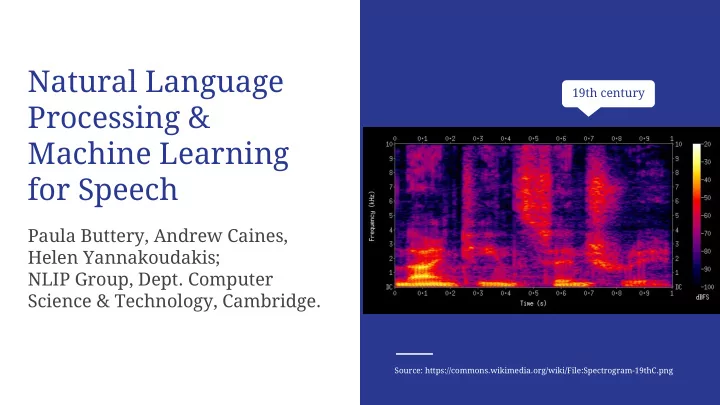
19th century

Source: https://commons.wikimedia.org/wiki/File:Spectrogram-19thC.png

slide-2
SLIDE 2

How to treat transcriptions of speech so that we can apply natural language processing techniques: more training data, test data normalisation, domain adaptation

Overview

Speech vs Writing

Speech and writing share some commonalities but exhibit many differences, not just in mode of transmission, but form, construction and grammar

Speech scoring

Example of NLP and machine learning for speech applications: automated assessment

Speech processing

slide-3
SLIDE 3

Speech vs Writing

Andrew Caines

Source: https://commons.wikimedia.org/wiki/File:Spectrogram-19thC.png

slide-4
SLIDE 4

Characteristics of Speech

  • Background reading:

○ Carter & McCarthy, 2017, ‘Spoken Grammar: Where are we and where are we going?’ Applied Linguistics. ○ Lau, Clark & Lappin, 2017, ‘Grammaticality, Acceptability, and Probability: A probabilistic view of linguistic knowledge.’ Cognitive Science. ○ Plank, 2016, ‘What to do about non-standard (or non-canonical) language in NLP.’ KONVENS. ○ Jurafsky & Martin, 2nd edn., Ch. 9 & 10.

  • Speech is very different from writing

○ mode of transmission ○ phonetics, prosody, gesture (including sign language) ○ put these aside for now: consider the aspects we can examine in transcriptions ○ i.e. the lexis, morphology, syntax, semantics, pragmatics, discourse ○ note that the default speech mode involves interaction, no editing, multimodal grounding, background noise, facial expression and gesture

slide-5
SLIDE 5
  • Spoken corpus examples

○ um he’s a closet yuppie is what he is (Leech 2000) ○ I played, I played against um (Leech 2000) ○ You’re happy to -- welcome to include it (Levelt 1989)

  • British National Corpus conversations:

○ Oi you, he's playing with your ○ Oh let's have a, is it in there? ○ (unclear) no ○ (pause) right, we'll have another cup of tea and then we'll have that nice cake ○ https://corpus.byu.edu/bnc [KGC]

  • BBC News ‘Brexit: May to make plea to

MPs for time to change deal’

https://www.bbc.co.uk/news/uk-47187491

○ Prime Minister Theresa May will ask MPs to give her more time to secure changes to the controversial part of her Brexit deal - the Northern Irish

  • backstop. Mrs May is due to report back

to MPs this week, after trying to persuade the EU to make last-minute

  • changes. Labour wants to hold Mrs May

to her word and make sure the vote is

  • held. The shadow Brexit secretary, Sir

Keir Starmer, has said Labour has drafted an amendment which, if passed this week, would guarantee a vote by the end of the month.

Characteristics of Speech
slide-6
SLIDE 6

○ That was the only thing I got in braille, pretty much, the seven years I was

  • there. So, they hooked me in and then

yeah… ○ White: And didn’t really follow through. ○ Megan: No and the sad thing was, as well, I’d emailed the disability department just before I got on the plane to Germany and I said – please, could you make the lecturers aware that I’m registered blind so that we can start those discussions early with two years to go. And when I started at the university I walked in to my lectures and I was met with dismay, indifference and my lecturers had no clue about me arriving at all.

  • BBC Radio 4 In Touch: Navigating

University

https://www.bbc.co.uk/sounds/play/m0001f1d (2:20)

○ Megan: When I started as an undergraduate, I’d chosen the University of Gloucestershire and when I went on the open days they were the

  • nly university who gave me a

prospectus in braille. I was so made up. It was interesting because I actually applied two years in advance because I took a year out to go and teach English in Germany. And by the time I came back, all the disability staff who were clued up seemed to have gone or moved

  • n and the disability department was

completely different.

Characteristics of Speech

slide-7
SLIDE 7
  • Speech is very different from writing
  • Even when viewed in writing
  • (vice versa: imagine hearing written

text read aloud, as in speeches, prayers,

  • ld-school conference papers)
  • Become an observer!
  • Problems for NLP:

○ Disfluencies ○ Tendency for long coordinated structures / Speech-unit delimitation ○ Overlap, interruption, subject-less structures, verb-less structures, acceptability appropriateness clarity

  • ver absolute grammaticality,

incomplete propositions ○ Co-construction, multimodal physical context, background inter-personal relations & common ground ○ Creativity and language play

Characteristics of Speech

slide-8
SLIDE 8
  • Caines, McCarthy, Buttery, SCNLP 2017

NLP of speech

slide-9
SLIDE 9
  • Caines, McCarthy, Buttery, SCNLP 2017

NLP of speech

slide-10
SLIDE 10

NLP of speech

  • Caines, McCarthy, Buttery, SCNLP 2017
slide-11
SLIDE 11

NLP of speech

  • Caines & Buttery, SANCL 2014

A = ‘as is’ B = less disfluency C = less morpho-syntactic error D = less lexical error

slide-12
SLIDE 12
  • Annotate more data

e.g. Switchboard, British National Corpus, CrowdED, ...

  • Bring training and test data closer

together: i.e. ‘normalisation’ of speech to written-like form

○ e.g. Moore et al 2015, 2016

https://aclanthology.info/papers/C16-1075/c16-1 075

  • Domain adaptation

○ e.g. Daumé III 2009, 2010

https://aclanthology.info/papers/W10-2608/w10- 2608

What to do about speech

slide-13
SLIDE 13

SOUND Transcription through automatic speech recognition ASR Input speech stream SEGMENT Proceed as normal with all the NLP CLEAN Speech-unit delimitation NLP Detect and remove disfluencies

The normalisation approach

slide-14
SLIDE 14

Speech Processing

Paula Buttery

Source: https://commons.wikimedia.org/wiki/File:Spectrogram-19thC.png

slide-15
SLIDE 15

Which grammar should we use?

Let’s consider grammars you’ve encountered:

  • Phrase Structure Grammars
  • Dependency Grammars
  • Categorial Grammars
  • Feature Structure Grammars
slide-16
SLIDE 16

Phrase Structure Grammars

slide-17
SLIDE 17

;;; Disable rules which deal with elliptical dialogue-like text as ;;; they tend to overapply elsewhere (defparameter +disabled-rules+ '(|V1/do_gap-r| |V1/have_gap-r| |V1/be_gap-r| |V1/mod_gap-r| |P1/prt-of| |P1/prt-r| )) pjb48$ echo "I don't want to lecture now. You'll have to" | ./scripts/rasp.sh (|I:0_PPIS1| |do:1_VD0| |not+:2_XX| |want:3_VV0| |to:4_TO| |lecture:5_VV0| |now:6_RT| |.:7_.|) 1 ; (-9.447) gr-list: 1 (|ncsubj| |want:3_VV0| |I:0_PPIS1| _) (|aux| |want:3_VV0| |do:1_VD0|) (|ncmod| _ |want:3_VV0| |not+:2_XX|) (|xcomp| |to| |want:3_VV0| |lecture:5_VV0|) (|ncmod| |prt| |lecture:5_VV0| |now:6_RT|) (|you:0_PPY| |will+:1_VM| |have:2_VH0| |to:3_TO|) 0 ; () gr-list: 1

slide-18
SLIDE 18

With speech rules deactivated: (|you:0_PPY| |will+:1_VM| |have:2_VH0| |to:3_TO|) 0 ; () gr-list: 1 With speech rules activated: (|you:0_PPY| |will+:1_VM| |have:2_VH0| |to:3_TO|) 0 ; () gr-list: 1 (|ncsubj| |have:2_VH0| |you:0_PPY| _) (|aux| |have:2_VH0| |will+:1_VM|) (|T/frag| (|S/np_vp| |you:0_PPY| (|V1/modal_bse/--| |will+:1_VM| (|V1/have_gap-r| |have:2_VH0|))) |to:3_TO|)

slide-19
SLIDE 19

Dependency Grammars

slide-20
SLIDE 20

Categorial Grammar

slide-21
SLIDE 21

Feature Structure Grammars

slide-22
SLIDE 22

Parsing can be informed by extra linguistic info

slide-23
SLIDE 23

Parsing can be informed by features

slide-24
SLIDE 24

Parsing can be informed by extra linguistic info

slide-25
SLIDE 25
slide-26
SLIDE 26

Speech-unit delimitation

slide-27
SLIDE 27

Speech-unit delimitation

slide-28
SLIDE 28

Speech-unit delimitation

slide-29
SLIDE 29

Speech-unit delimitation