NASA Fundamental Aeronautics Program Jay Dryer Director, - - PowerPoint PPT Presentation

nasa fundamental aeronautics program
SMART_READER_LITE
LIVE PREVIEW

NASA Fundamental Aeronautics Program Jay Dryer Director, - - PowerPoint PPT Presentation

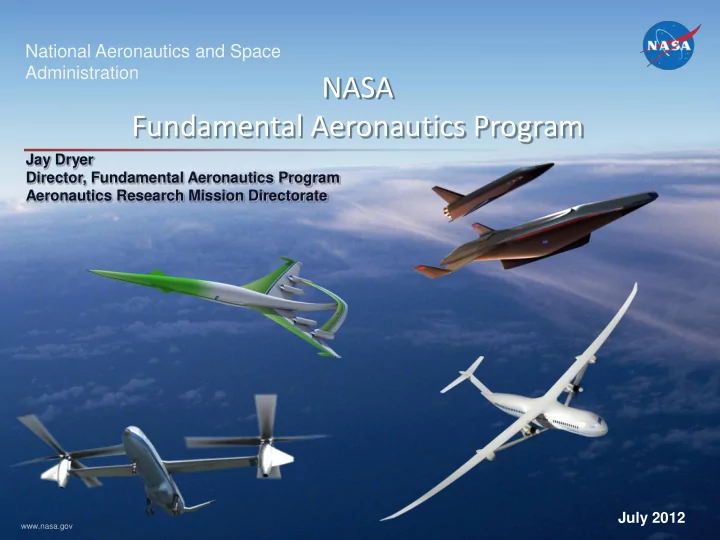
National Aeronautics and Space Administration NASA Fundamental Aeronautics Program Jay Dryer Director, Fundamental Aeronautics Program Aeronautics Research Mission Directorate July 2012 www.nasa.gov NASA Aeronautics Investment Philosophy


slide-1
SLIDE 1

National Aeronautics and Space Administration

www.nasa.gov

NASA Fundamental Aeronautics Program

Jay Dryer Director, Fundamental Aeronautics Program Aeronautics Research Mission Directorate July 2012
slide-2
SLIDE 2

Technology Transfer

Seedling Fund for New Ideas Integrated Systems Level Research

NASA Aeronautics Investment Philosophy

Technology Transfer

2

Fundamental Research

slide-3
SLIDE 3

Fundamental Aeronautics Overview

Rotary Wing (RW)

Develop and validate tools, technologies and concepts to

  • vercome key barriers for rotary wing vehicles.

3

Fixed Wing (FW)

Explore and develop technologies, and concepts for improved energy efficiency and environmental compatibility of fixed wing, subsonic transports.

High Speed (HS)

Tool and technology development and validation to address challenges in high speed flight.

Aeronautical Sciences (AS)

Enable fast, efficient design & analysis of advanced aviation systems by developing physics-based tools and methods for cross-cutting technologies.

Conduct fundamental research that will generate innovative concepts, tools, technologies and knowledge to enable revolutionary advances for a wide range of air vehicles.

slide-4
SLIDE 4

Providing a Vision for Aviation

2010 2015

(5 yrs)

2020

(10 yrs)

2030

(20 yrs)

Technology development to enable design trades Fundamental research today

The Need

  • Identify advanced airframe and

propulsion concepts and enabling technologies

  • Guidance for future NASA investments in

fundamental research NASA’s Approach

  • Stimulate thinking in industry and

academia on revolutionary aircraft solutions

  • Determine high-payoff technologies and

research opportunities

  • Address energy efficiency, environmental

compatibility, and operations goals

  • Fundamental Research portfolio robust

to many possible futures NASA’s Contribution

  • Providing the vision and focus for the

fundamental research needed today to enable the far term outcomes/products, but with possibility of near/mid term impact

Challenges for Future Commercial Aircraft

Sample Technologies

  • Engine ultra high bypass ratios
  • Small, high efficiency core engines
  • Higher aspect ratio and laminar flow wings
  • Alternative energy: conventional/biofuel/hybrid electric
slide-5
SLIDE 5

Advances in Turbulence Modeling

What are we trying to do ?

  • Develop new and improved turbulence models that overcome the existing challenges in prediction of complex

turbulent flows and significantly increase the accuracy and range of applicability of the models. Why ?

  • Current models are unable to accurately predict turbulent flow separation and free shear flows across the speed

regime, which limits the applicability of CFD codes for the design of innovative aircraft and propulsion systems. What is done today, and what are the limits of current practice ?

  • One- or two-equation Reynolds-Averaged Navier-Stokes (RANS) models work well for attached flows, but not for

prediction of complex flows including flow separation, free shear flows, and shock/boundary-layer interactions.

  • Large-Eddy Simulation (LES) lacks maturity and consistency in results, and is computationally too expensive for

application to flight relevant conditions.

  • Hybrid RANS/LES approaches show promise but lack rigor in coupling of RANS and LES and therefore provide

little confidence in flow predictions. What is new in our approach ?

  • Higher moment (2nd and 4th – order closures) Reynolds stress modeling.
  • Structured-based modeling
  • LES with wall modeling for applications to high Reynolds numbers of relevance to flight.
  • Improved interface between RANS and LES regions to increase accuracy and confidence in separated flow

predictions.

  • Direct Numerical Simulation (DNS) for canonical flows to provide data for development of the models.
  • Validation Experiments designed to provide detailed flow physics required for improvement/development of

turbulence models. Also, prediction workshops for objective assessments of models and CFD codes.

  • Substantial investments in NRA Cooperative Agreements with academia to advance the state-of-the-art of

turbulence modeling. What is the payoff if successful ?

  • Accurate and validated models for CFD codes, required for improved design of future aircraft especially those with

new concepts with much reduced reliance on physical testing.

slide-6
SLIDE 6

Transition Prediction and Modeling

What are we trying to do ?

  • Physics-based transition prediction for laminar flow wing design and development of reduced
  • rder models for routine use in CFD codes.

Why ?

  • Transition location important for accurate prediction of aircraft drag.

What is done today, and what are the limits of current practice ?

  • Boundary layer stability-based amplitude ratio (N factor) method to account for Tollmien-

Schlichting and crossflow induced transition.

  • Linear and Nonlinear Parabolized Stability Equations (PSE).
  • Empirical correlations implemented in some CFD codes for 2D transition prediction.

What is new in our approach ?

  • Absolute amplitude-based prediction, including receptivity to surface roughness, for application

to laminar flow control using Discrete Roughness Elements (DRE).

  • Adjoint-based 3D laminar flow wing design.
  • Physics-based prediction of transition in supersonic boundary layers (e.g., effect of trips).
  • DNS of transition to provide validation of lower fidelity (e.g., PSE) prediction.
  • Carefully designed validation experiments to provide confidence in prediction methods.
  • Reduced-order models implemented in CFD codes for 3D transition prediction.

What is the payoff if successful ?

  • CFD codes with simplified transition prediction modules for accurate prediction of aircraft drag.
  • Computational tools for laminar flow wing design to reduce aircraft drag.
slide-7
SLIDE 7

7

4th AIAA CFD Drag Prediction Workshop (DPW) NASA Common Research Model (CRM)

PROBLEM

Disagreement among state-of-the-art CFD tools with respect to the prediction of drag and the location and extent of separated flow regions on commercial transports.

OBJECTIVE

Indentify the reasons for this discrepancy and improve CFD tool capability. Utilize high-quality experimental data from two separate wind tunnels to guide interpretation of CFD results.

APPROACH

  • International workshop with participants from industry, government, universities, and CFD vendor

companies using a variety of state-of-the-art Reynolds-Averaged Navier-Stokes (RANS) solvers and different turbulence models to predict forces, moments, and regions of flow separation

  • n a single open geometry configuration, the NASA Common Research Model (CRM),
  • n standardized common grid families (both structured and unstructured)
  • with experimental validation data gathered after the workshop in both the
  • LaRC National Transonic Facility (NTF) 13 Jan 2010 to 16 Feb 2010 and the
  • ARC 11-foot Transonic Wind Tunnel 16 Mar 2010 to 2 Apr 2010.

RESULTS

  • CFD drag prediction still showing spread of up to 40 counts
  • Large scatter in CFD prediction of separated zones
  • Pressure Sensitive Paint (PSP) data gathered in both tunnels
  • Oil Fringe Interferometry (OFI) skin friction measurements taken in ARC 11-foot
  • Particle Image Velocimetry (PIV) off-body velocity measurements taken in ARC 11-

foot

  • Reynolds number effects assessed in LaRC NTF (static aeroelastic effects also)
  • Configuration effect data (tail, nacelle/pylon) data acquired
  • Demonstrated ability of new active damper system to acquire data at higher AOA

SIGNIFICANCE

Broadly available, extensive computational and experimental database that is enabling progress in CFD predictive capability. Higher confidence prediction enables design with less margin. Pressure Sensitive Paint Particle Image Velocimetry in 11-foot Common Research Model in NTF

slide-8
SLIDE 8

Desired Attributes of the Future CFD Code

 ACCURACY

  • Ability to compute complex unsteady flows with prescribed error tolerance
  • Requires research in modeling (e.g., transition, turbulence, chemistry,

combustion), numerical methods, boundary/initial conditions, etc.

  • Experimental validation is a critical element

 SPEED

  • Ability to exceed trend of reducing computer time by 2x every 1 ½ years
  • Requires algorithmic (e.g., solvers) and computer science (e.g., ports,
  • ptimizers) research on latest hardware.

 ROBUSTNESS

  • Ability to generate results with error bounds on every try, by a ‘novice’ user
  • Requires research in solver technology, code validation/applicability range

determination, uncertainty quantification

A CFD code with above attributes will enable:

  • Aero database generation for full flight envelope, faster than wind tunnels
  • Use of CFD in MDAO
  • Use of CFD for novel configurations, with confidence, for all NASA missions

– Aircraft, Rotorcraft – Launch Vehicles, Aerospace Planes – Entry, Descent, Landing

slide-9
SLIDE 9

FA Program - Making an Impact

9

Producing world-class data Creating the next generation of tools and capabilities to process information Generating knowledge to advance the field of aeronautics Developing advanced technologies that make a difference

Inflatable Re-Entry Systems UH-60 Airloads N+3 Studies Advanced Design Tools Analytical/ Computational Ground Test Flight Test FAST-MAC SCAMP

slide-10
SLIDE 10

10

1