Strategy for the Sikh community to manage
Narendra Modi’s visit to the UK 12-14 November 2015
Federation of Sikh Organisations (FSO)
Supported by UK Gurdwaras
Meeting held at Sri Guru Singh Sabha, Southall
- n Saturday 3 October 2015
Narendra Modis visit to the UK Meeting held at Sri Guru Singh Sabha, - - PowerPoint PPT Presentation
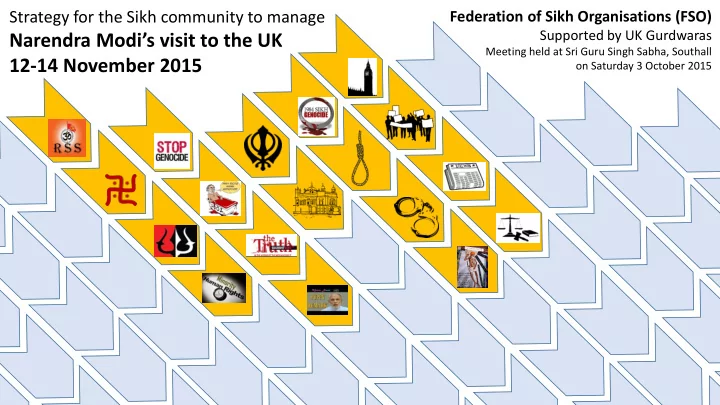
Strategy for the Sikh community to manage Federation of Sikh Organisations (FSO) Supported by UK Gurdwaras Narendra Modis visit to the UK Meeting held at Sri Guru Singh Sabha, Southall 12-14 November 2015 on Saturday 3 October 2015
These included rare and priceless manuscripts of Guru Granth Sahib Ji, Hukamnamas carrying signatures of the Sikh Gurus, documents related to the Sikh Raj and Sikh contribution during the independence movement and books on Sikhi and
There are 84 known Sikhs political prisoners languishing in India's prisons some have been in prison for over 25 years. The list consists of 1 death row conflict, 20 life term prisoners who are mainly in Punjab's prisons and many have served their minimum terms, 8 senior citizens whose health has deteriorated and 55 other Sikhs held in various states around India, such as UP, Haryana, Jammu and
conflicts is the release of all political prisoners and a general amnesty for those that have cases pending.
The Union Home Minister Rajnath Singh in late December 2014 referred to what happen to the Sikhs in November 1984 as ‘Genocide’ and that ‘justice would be meted out to the victims only when the perpetrators of the crime are punished’ and ‘that until these persons are punished, victims will not get relief’. This is at odds with the recent decision in September 2015 by the Central Bureau of Investigation to give a clean chit to Jagdish Tytler.
To resolve the political conflict with the Sikhs international admission of the truth around widespread human rights violations by India is
independent experts as well as Amnesty International have been denied access to Punjab to investigate widespread allegations of torture, disappearances, false encounters and extra-judicial executions. If India wishes to be taken seriously it must allow the truth to emerge by removing such restrictions, allowing independent investigations followed by prosecutions.
Backing for a UN-led inquiry into the atrocities committed by the Congress Party in June 1984 , the killings and disappearances in the months that followed and the systematic and deliberate killing of innocent Sikhs in November 1984. The UN inquiry should also look into the use by the police of criminals, goons, gangsters and smugglers to impersonate Sikh ‘militants’, widely known as Black Cats.
In 2010, the Narendra Modi-led Gujarat government had over 20,000 acres of land belonging to Sikh farmers in Gujarat confiscated. These Sikh farmers migrated there about five decades ago. They were being uprooted under a law enacted by the Gujarat government that stopped Sikhs from owning land in the state. The Sikh farmers won their case in the Gujarat High Court but the state government challenged the order in the Supreme Court. In the run-up to the Lok Sabha polls, Narendra Modi had assured that no Sikh farmer in Gujarat would ever be
attacks by land mafia and goons have increased and charges have brought against Sikh farmers for defending themselves. These attacks have forced many to flee the land they had successfully made their home.
Acceptance by India of the general principle that self- determination is a basic human right founded in international law and it applies to the Sikhs. Withdrawal of India’s ‘reservation’ at the UN Human Rights Council that self-determination does not apply to the people of India. Internal self-determination by Sikhs since 1947 has been violently rejected and crushed with state terror so remedy via external self- determination is possible. The persecution of Sikhs in 1984 and in the years that followed and the lack of justice is the basis on which the Sikhs continue to raise the legitimate demand for an independent Sikh homeland.
Narendra Modi has limited time, provided no indication he is prepared to meet and given his track record a meeting is very unlikely to take place.
Narendra Modi has limited time and it is even more unlikely he will risk visiting a Gurdwara. He visited a Gurdwara in Vancouver with the Canadian PM, but in the UK he will face massive protests from Sikhs.
Narendra Modi will need to take concrete steps if he wants to try and change the relationship with Sikhs, but not on petty matters like getting rid of blacklists.
Attempts have been made to try and compromise specific individuals and Sikh organisations into attending ‘pre-meetings’ with the promise that Modi might agree to some Sikh demands. Those close to the Indian High Commission are using the opportunity to make a name for themselves by trying to discredit Sikhs calling for self- determination/independence and highlighting human rights violations.
We have seen this happen to Sikhs during Modi’s recent visit to the US. There will be a reception at the Indian High Commission, Wembley Stadium and/or Hindu Temple and individual Sikhs will be hand-picked to be seen shaking hands with Modi.