
SLIDE 1
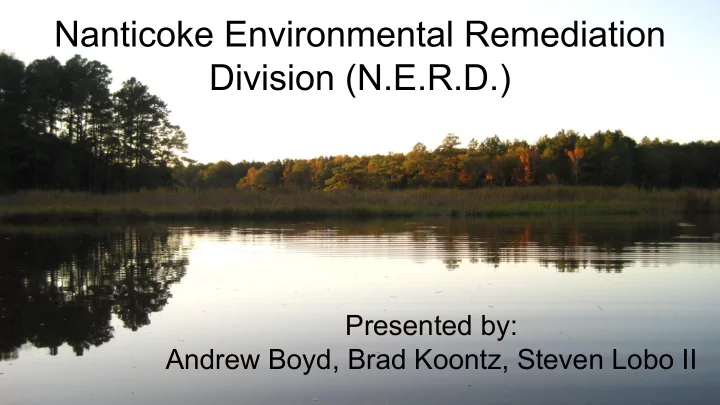
Nanticoke Environmental Remediation Division (N.E.R.D.) Presented - - PowerPoint PPT Presentation
Nanticoke Environmental Remediation Division (N.E.R.D.) Presented by: Andrew Boyd, Brad Koontz, Steven Lobo II Overview Mission Statement History and Characteristics Population Land Use Water Use Environmental
Figure 1: Nanticoke River during Winter
❏ The Nanticoke River is a historically “dirty” river but, conditions are improving. ❏ This watershed is home to more than 250 endangered plant and animal species as well as containing the most significant wetlands of the Delmarva peninsula. ❏ Nitrogen and phosphorous are causing algal blooms. Also, the sandy soil is allowing groundwater pollution to travel faster. ❏ We seek to reduce nitrogen and phosphorus levels by 50% in the next 20 years, as well as reduce groundwater pollution transport by 25%.
Figure 2: Nanticoke River during Summer
❏ 10th C: evidence of fishing, farming, and hunting by Nanticoke Indians ❏ Early 17th C: estimate of 1,000 acres of agriculture in watershed when Captain John Smith explored ❏ Mid 17th C: Nanticoke Indians have been removed to three reservations ❏ 1660’s: land patents are first filed by settlers- primarily for use as tobacco fields ❏ Sharptown, Vienna, and Bethel become shipbuilding hubs and remained so until the early 20th C saw the forests cleared ❏ British attacked Vienna during the War of 1812 because it was considered a major port
Figure 3: Outline of Nanticoke Watershed with Nearby Watersheds
This map displays the Nanticoke DEM after the Fill tool has been run on it. This map displays the Naticoke DEM after the Flow Direction tool has been run on it. This map displays the sub-basin areas that drain to each of the targeted stream links.
Figure 4: DEM Fill Figure 5: Flow Direction Figure 6: Sub-basin Drainage
❏ Area: 725,000 acres or 1,130 square miles ❏ Length: 88.5 miles ❏ Channel Depth: Dredged to 12 ft to Seaford, DE ❏ Maximum Elevation: 19.8 ft ❏ Features generally very flat terrain ❏ Span: 2 States and 5 Counties (Kent & Sussex in DE; Caroline, Dorchester & Wicomico in MD)
Figure 7: Nanticoke River Watershed is shaded in green
Population: 42353
Source: U.S. Census
Major Cities Seaford, DE (2013)- 7,325 Laurel, DE (2013)- 3,912
Figure 8: Population Density Map of Delaware and Maryland, Nanticoke River Watershed is roughly captured in the black boxes, Laurel and Seaford are marked with black crosses
❏ Approximately 20% of Watershed is protected ❏ Blackwater Wildlife Refuge: 27,000 acres ❏ State and Local Parks: 32,000 acres ❏ Primarily agricultural with large forested areas near the bay and along waterways. ❏ Heavily residential and commercial near port cities such as Seaford and Federalsburg. ❏ Major decline in wetlands from approximately 50% historically to just
Figure 9: Land Use Map of Nanticoke River Watershed
❏ With the exception of blue crabs, commercial fishing has been reduced due to poor stream health. ❏ Overfishing of oysters in the past has all but eliminated them. ❏ Recreational fishing remains very popular. ❏ It is free of dams which supports the remaining fisheries. ❏ Popular for boating and supports a number of marinas and yacht clubs.
Figure 10: Aerial View of the Nanticoke River and Surrounding Areas
Figure 11 (Top Left): Graph depicting sea level rise over 100 years in Baltimore, MD. Figure 12 (Bottom Left): Graph showing average water temperature increase in the Chesapeake Bay. Figure 13 (Above): Graph showing low-lying areas around mouth of the Nanticoke River.
This map displays agricultural areas extracted from the Landuse raster. This map displays the integer output map showing flow accumulations from agricultural cells only. This map displays a better indication of the vulnerability of streams to agricultural runoff.
Figure 14: Agricultural Raster Figure 15: Integer Flow Accumulation Figure 16: Runoff Vulnerability
This image displays the normalized difference vegetation index map of the watershed. Runoff abatement map based on vegetation density weights. Slope map from raster calculation
Figure 18: Vegetation Index Figure 19: Runoff Abatement Figure 20: Slope Raster Calculation
Figure 17: Impervious cover in the Chesapeake Bay area
Problem Effect Solution Excess nutrients (Nitrogen & Phosphorus) from poultry and crop farms Algal blooms that result in decreasing dissolved
Agricultural programs or legislation to minimize runoff into the river Sandy soil conditions in the watershed lead to groundwater pollution negatively impacting the river Nitrates in groundwater flow in Nanticoke River Regular emptying and maintenance of septic systems
Table 1: Problem, Effect and Solution table
❏ Envirocorp Labs ❏ Delaware Department of Natural Resources and Environmental Control ❏ Johns Hopkins University ❏ Chesapeake Bay Foundation ❏ National Park Service ❏ MD Department of Natural Resources ❏ Salisbury University ❏ Friends of the Nanticoke River ❏ Wicomico Environmental Trust ❏ Nanticoke Watershed Preservation Committee ❏ Nanticoke Resource Coalition ❏ The Nature Conservancy, Salisbury, MD Office ❏ Nanticoke River Conservation Directory
http://delawarewatersheds.org/chesapeake-bay/nanticoke-river/ ftp://131.252.97.79/Transfer/WetlandsES/Articles/weller_wetland_landscapeindicators.pdf http://nanticokeriver.org/programs/atlas/ https://upload.wikimedia.org/wikipedia/commons/f/f5/Maryland_population_map.png http://ldecola.net/edu/jhu/sp09/final/kbarrett.jpg http://www.arcgis.com/home/webmap/viewer.html?basemapUrl=http://tiles.arcgis. com/tiles/I6k5a3a8EwvGOEs3/arcgis/rest/services/MyMapService/MapServer http://www.dnrec.delaware.gov/Admin/DelawareWetlands/Documents/Nanticoke%20Wetland%20Profile_final.pdf http://imblackeagle.tripod.com/index-8.html