Multiplication Overview Multiplication approaches: Sequential: - - PowerPoint PPT Presentation

multiplication overview
SMART_READER_LITE
LIVE PREVIEW

Multiplication Overview Multiplication approaches: Sequential: - - PowerPoint PPT Presentation

2c.1 2c.2 Multiplication Overview Multiplication approaches: Sequential: Shift-and-Add produces one product bit per clock cycle time (usually slow) EE 457 Unit 2c Combinational: Array multiplier uses an array of adders Can be


slide-1
SLIDE 1

2c.1

EE 457 Unit 2c

Fast Multipliers

2c.2

Multiplication Overview

  • Multiplication approaches:

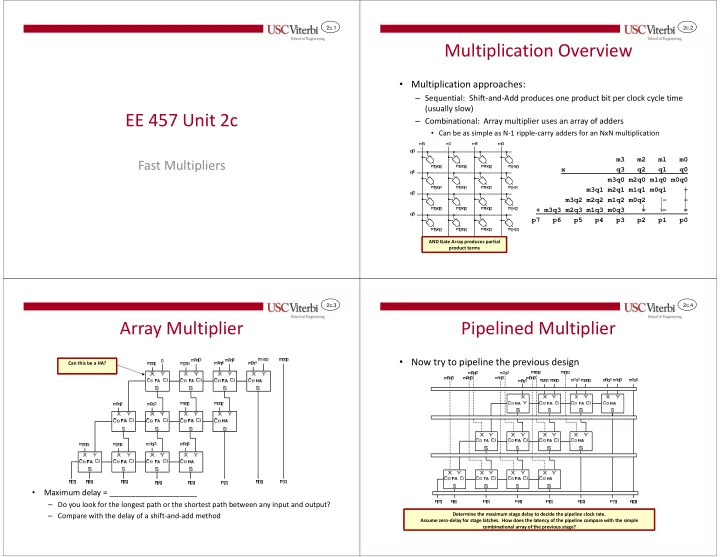
– Sequential: Shift-and-Add produces one product bit per clock cycle time (usually slow) – Combinational: Array multiplier uses an array of adders

  • Can be as simple as N-1 ripple-carry adders for an NxN multiplication

m3 m2 m1 m0 x q3 q2 q1 q0 m3q0 m2q0 m1q0 m0q0 m3q1 m2q1 m1q1 m0q1 - m3q2 m2q2 m1q2 m0q2 -

  • + m3q3 m2q3 m1q3 m0q3 -
  • p7 p6 p5 p4 p3 p2 p1 p0

AND Gate Array produces partial product terms 2c.3

Array Multiplier

  • Maximum delay = ____________________

– Do you look for the longest path or the shortest path between any input and output? – Compare with the delay of a shift-and-add method

Can this be a HA? 2c.4

Pipelined Multiplier

  • Now try to pipeline the previous design

Determine the maximum stage delay to decide the pipeline clock rate. Assume zero-delay for stage latches. How does the latency of the pipeline compare with the simple combinational array of the previous stage?

slide-2
SLIDE 2

2c.5

Carry-Save Multiplier

  • Instead of propagating the carries to the left in the same row, carries are

now sent down to the next stage to reduce stage delay and facilitate pipelining

The upper three stages are 3-bit Carry Save Adders (CSA’s) each with 2-gate delays. The last stage is a Ripple Carry Adder (RCA) which requires longer delay. It can be replaced by a CLA for larger multipliers.

FA

X Y S Ci Co

FA

X Y S Ci Co

FA

X Y S Co

m3q0 m2q0 m1q0 m0q0 FA

X Y S Ci Co

FA

X Y S Ci Co

FA

X Y S Co

FA

X Y S Ci Co

FA

X Y S Ci Co

FA

X Y S Co

m2q3 m1q3 m0q3 P[1] P[0] P[3] P[2] P[4] P[5] P[6] P[7]

Ci

m2q1 m1q1 m0q1

Ci

m2q2 m1q2 m0q2 FA

X Y S Ci Co

FA

X Y S Ci Co

FA

X Y S Co Ci Ci

m3q2 m3q3 m3q1

RCA CSA’s

2c.6

Carry Save Adders

  • Consider the decimal addition of

47 + 96 + 58 = 201

  • One way is to add ________ to get ____ and _____
  • Here the _____ column cannot be added ___________ is produced
  • In the carry-save style, we add the ____ column and _____ column

simultaneous 4 7 + 9 6 1 4 3 + 5 8 2 0 1 4 7 9 6 + 5 8 2 1 + 1 8 _ 2 0 1

1

1 1

2

1

3 4 5 6 1 2 3 4 2c.7

Carry-Save (3,2) Adders

  • A carry save adder is also called a (3,2)

adder or a (3,2) counter (refer to Computer Arithmetic Algorithms by Israel Koren) as it takes three vectors, adds them up, and reduces them to two vectors, namely a sum vector and a carry vector

  • CSA’s are based on the principle that

carries do not have to be added _______________, but can be combined ______________

  • An n-bit CSA consist of n disjoint full

adders

0 1 0 1 1 0 0 1 + 1 0 1 1 1 0 0 1 _ 0 1 1 1

Carry vector Sum vector

2c.8

1-bit FA vs. 1-bit CSA

  • Any difference between an ordinary full adder and 1-

bit CSA?

  • 16-bit wide CSA takes (more / equal / less) time to

produce its outputs compared to an 8-bit wide CSA

  • Carry-save adder (is / is not) useful in adding only 2

numbers

slide-3
SLIDE 3

2c.9

CSA Organization

  • We can arrange our

CSA’s in a _______ manner where ____ partial product is added per CSA (after the first level)

2c.10

Wallace Tree Multiplier

  • Using the previous example as a

template, to build an NxN multiplier you need (n-1) of (n-1) bit CSAs followed by a final (n-1)-bit RCA

  • Delay = Delay of (n-1) CSA’s

+ Delay of (n-1) bit RCA

= ______________________

  • We can reduce the CSA component
  • f the delay by organizing the CSA’s

in a _____ (i.e. ___________ delay)

CSA CSA

q7·M q6·M q2·M q1·M q0·M

CSA

q3·M q4·M q5·M

CSA CSA CSA Propagation Adder

Product

Note: The vectors (partial products) need to be aligned before summing. These details are not shown in the block diagram. 2c.11

Logic Delay

  • Consider the gate

arrangement for OR’ing 8 bits

  • Linear:

– Delay = __ gates

  • Tree

– Depth of tree = ____ = __ levels

  • Consider OR’ing 16-bits

using 4-bit OR gates, how many levels would you need?

2c.12

Wallace Tree Discussion

  • A 4-input OR gate reduces 4 literals to 1 (i.e. a factor of 4

reduction)

  • A CSA reduces 3 vectors to 2 vectors (i.e. a factor of 1.5)

– This reduction factor may not be convenient to develop an efficient tree to sum 16 or 32 partial products – Wallace tree may not achieve a great reduction in delay due to wastage of an extra level

  • Also not the Wallace tree shown earlier does not show…

– Size of buses – What bits are “retired” progressivley – Relative significance (alignment) of partial products – Size of the carry-propagate adder (e.g. RCA or CLA) needs to be figured

  • ut and overall delay estimated
slide-4
SLIDE 4

2c.13 2c.14 10 9 8 7 6 5 4 3 2 1 10 9 8 7 6 5 4 3 2 1 10 9 8 7 6 5 4 3 2 1 10 9 8 7 6 5 4 3 2 1 10 9 8 7 6 5 4 3 2 1 11 10 9 8 7 6 5 4 3 2 1

Original 6x6 Matrix Reorganized 6x6 matrix Level 1 CSA Level 2 CSA Results of Level 1 Level 3 CSA

2c.15

Credits

  • These slides were derived from Gandhi

Puvvada’s EE 457 Class Notes