Multinational Clinical trials in Europe and the Voluntary - - PowerPoint PPT Presentation

multinational clinical trials in europe and the voluntary
SMART_READER_LITE
LIVE PREVIEW

Multinational Clinical trials in Europe and the Voluntary - - PowerPoint PPT Presentation

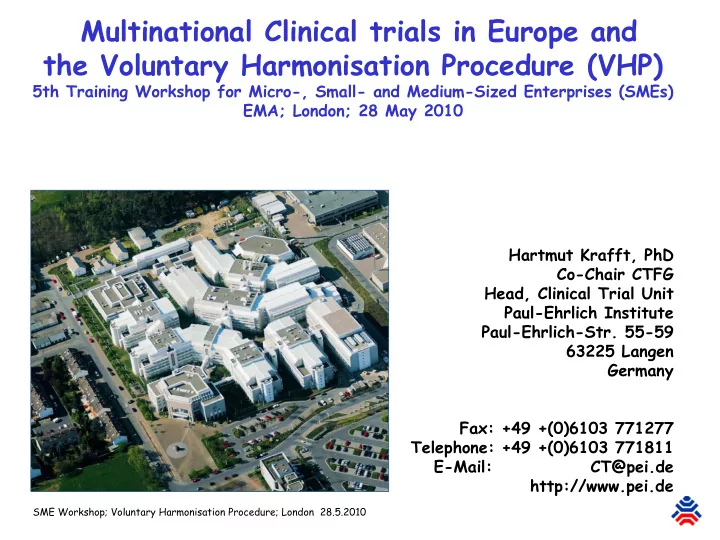
Multinational Clinical trials in Europe and the Voluntary Harmonisation Procedure (VHP) 5th Training Workshop for Micro-, Small- and Medium-Sized Enterprises (SMEs) EMA; London; 28 May 2010 Hartmut Krafft, PhD Co-Chair CTFG Head, Clinical


slide-1
SLIDE 1

SME Workshop; Voluntary Harmonisation Procedure; London 28.5.2010

Multinational Clinical trials in Europe and the Voluntary Harmonisation Procedure (VHP)

5th Training Workshop for Micro-, Small- and Medium-Sized Enterprises (SMEs) EMA; London; 28 May 2010 Hartmut Krafft, PhD Co-Chair CTFG Head, Clinical Trial Unit Paul-Ehrlich Institute Paul-Ehrlich-Str. 55-59 63225 Langen Germany Fax: +49 +(0)6103 771277 Telephone: +49 +(0)6103 771811 E-Mail: CT@pei.de http://www.pei.de

slide-2
SLIDE 2

SME Workshop; Voluntary Harmonisation Procedure; London 28.5.2010

  • H. Krafft Page 2
  • H. Krafft Page 2

15 different national approaches of the Member States Differences between approval and notification systems Completely different documentation Different timelines Languages ………… …………

Situation of clinical trials in Europe before the implementation of the Clinical Trials Directive in 2004

slide-3
SLIDE 3

SME Workshop; Voluntary Harmonisation Procedure; London 28.5.2010

  • H. Krafft Page 3

Situation of clinical trials in Europe before CTD

slide-4
SLIDE 4

SME Workshop; Voluntary Harmonisation Procedure; London 28.5.2010

  • H. Krafft Page 4
  • H. Krafft Page 4

15/27 Member States working with the same english versions of documents like

  • Investigational Medicinal Product Dossier (IMPD)
  • Protocol
  • Investigators Brochure
  • SmPCs

but

Situation of clinical trials after the implementation of the Clinical Trials Directive in 2004

slide-5
SLIDE 5

SME Workshop; Voluntary Harmonisation Procedure; London 28.5.2010

  • H. Krafft Page 5
  • H. Krafft Page 5
  • not harmonised are
  • Assessments
  • Treatment options and standards
  • Some documents related to the clinical trial

applications due to different interpretations of guidance documents

  • Application times at the national Competent

Authorities

Situation of clinical trials after the implementation of the Clinical Trials Directive in 2004

slide-6
SLIDE 6

SME Workshop; Voluntary Harmonisation Procedure; London 28.5.2010

  • H. Krafft Page 6
  • H. Krafft Page 6

The Voluntary Harmonisation Procedure

  • ffers a solution to address

these points within the existing European legal framework

slide-7
SLIDE 7

SME Workshop; Voluntary Harmonisation Procedure; London 28.5.2010

  • H. Krafft Page 7

EU Voluntary Harmonisation Procedure (VHP) for a multinational Clinical Trials

+ + + +

  • +

+ + + +

  • Time

Competent Authorities Ethics Committees

Result of Clinical Trial Application

30 60 90 120

+

nat.approval

Present situation for the approval of a multinational Clinical Trial

slide-8
SLIDE 8

SME Workshop; Voluntary Harmonisation Procedure; London 28.5.2010

  • H. Krafft Page 8
  • H. Krafft Page 8

The HMAs Clinical Trials Facilitation Group (CTFG) voluntary harmonisation procedure (VHP) http://www.hma.eu/77.html

Contact and submissions: VHP-CTFG@VHP-CTFG.EU

  • r Tel.:+ 49 6103 771811
slide-9
SLIDE 9

SME Workshop; Voluntary Harmonisation Procedure; London 28.5.2010

  • H. Krafft Page 9

Ideal situation of clinical trials in Europe after VHP?

slide-10
SLIDE 10

SME Workshop; Voluntary Harmonisation Procedure; London 28.5.2010

  • H. Krafft Page 10

Key features of the Voluntary Harmonisation Procedure Only electronic documents sent to one address (one stop shop) Only general documents required, which are part of any clinical trial application (Protocol, Investigators brochure, Investigational Med. Product Dossier) Reliable timelines for Sponsor and Member States Harmonised scientific discussion resulting in harmonised applications in the Member States

  • no tracking of Member States specific modifications

necessary

  • consolidated lists of grounds for non-acceptance, if needed
slide-11
SLIDE 11

SME Workshop; Voluntary Harmonisation Procedure; London 28.5.2010

  • H. Krafft Page 11

Max. 5 Days

The VHP consists of three phases

  • VHP-Phase 1:Request for a VHP at any time
  • Request by sponsors including the identification of the

participating NCAs and submission of a full dossier

  • Decision by Member States to participate in the VHP
  • VHP-Phase 2: the assessment phase
  • Review of the CTA by all the participating NCAs
  • 1st common position around D30, total period maximum 60 days
  • Administrative co-ordination by the VHP coordinator
  • VHP-Phase 3: the national Member States step
  • Formal CTA applications to NCAs.
  • CTA approval

by NCAs within short timelines (after positive VHP)

Max. 60 Days 10 Days

slide-12
SLIDE 12

SME Workshop; Voluntary Harmonisation Procedure; London 28.5.2010

  • H. Krafft Page 12

Development of VHP-versions and Substantial Amendments

VHP Version 1 VHP Substantial Amendments Pro-Phase AssessmentAddressing GNA Re- Assessment

  • Nat. Applic.

Approv

  • Nat. Applic.

Approv

  • Nat. Applic.

Approv 5th each month only GNA

VHP Version 2

Any time Assessment

+ + +

slide-13
SLIDE 13

SME Workshop; Voluntary Harmonisation Procedure; London 28.5.2010

  • H. Krafft Page 13

Documents to be submitted for the VHP

VHP Application dossier :

  • 1. General Information

1.1 Covering Letter including EudraCT number 1.2 Application form, if available 1.3 List of NCAs concerned

  • 2. Protocol related folder

2.1 Current Protocol (including the summary/synopsis)

  • 3. IMP related folder

3.1 IB 3.2 IMPD (including viral safety data if applicable) 3.3 Scientific advises and PIP summary report (if applicable)

  • 4. NIMP related folder, if applicable
slide-14
SLIDE 14

SME Workshop; Voluntary Harmonisation Procedure; London 28.5.2010

  • H. Krafft Page 14
  • H. Krafft Page 14

Details of the of the VHP Guidance – Version 2

slide-15
SLIDE 15

SME Workshop; Voluntary Harmonisation Procedure; London 28.5.2010

  • H. Krafft Page 15
  • H. Krafft Page 15

Criteria for application/selection

  • During the pilot phase, only MN-CTs with the following criteria would

undergo the VHP:

  • Applications involving not less than 3 MS

and any of the following :

  • FIH MN-CTs

and particularly with investigational medicinal products with known

  • r anticipated risk factors as described in EMEA/CHMP/SWP/294648/2007.
  • MN-CTs

with “Critical” investigational medicinal products (limited community expertise e.g. IMP with novel modes of action, novel manufacturing process, novel administration and storage requirements, links to a class of medicinal product with recognised safety concerns, unresolved pre-clinical abnormal findings, for instance monoclonal interfering with immune regulation, advanced therapies) or “Critical” MN-CTs (e.g. for limited trial populations e.g. orphan diseases, less common types of cancer, paediatrics diseases with small numbers, adult diseases with small numbers or unmet medical needs), based on NCA’s judgement, endorsed by the CTFG

  • MN-CTs

with very large population and where the sponsor indicates a need for harmonisation (e.g. large phase III CTs and many MS concerned)

*

Exceptions for multinational FIH possible

effective from March 2010

*
slide-16
SLIDE 16

SME Workshop; Voluntary Harmonisation Procedure; London 28.5.2010

  • H. Krafft Page 16
  • H. Krafft Page 16

Features of the VHP introduced with version 2

  • Addition of substantial amendment for

successful Voluntary Harmonisation Procedures

  • Guidance for NIMPs

Documentation

effective from March 2010

slide-17
SLIDE 17

SME Workshop; Voluntary Harmonisation Procedure; London 28.5.2010

  • H. Krafft Page 17
  • H. Krafft Page 17

VHP phases

Phase 1 Request for VHP Any time Electronic submission of request and CTA documentation to VHP-C via E-Mail/Eudralink (VHP-CTFG@VHP-CTFG.eu) Forwarding of the CTA documentation to the P-NCA Within 5 working days after receipt at VHP-C Information to the applicant on the acceptance by NCAs and on the date of start (DAY 1) of the VHP phase 2 Or, Compilation of formal deficiencies of the VHP dossier, if applicable: if needed, the missing information will be requested by the VHP-C and should be submitted within 3 days

slide-18
SLIDE 18

SME Workshop; Voluntary Harmonisation Procedure; London 28.5.2010

  • H. Krafft Page 18
  • H. Krafft Page 18

VHP phase 2 (part 1)

Phase 2 VHP CTA assessment step I Day 1 Start of VHP Day 30 Day 30 If no GNA or RFI: information (VHP-C) of the applicant on acceptance End of VHP and start of phase 3 National step In case of GNA and/or RFI: transfer of GNA/RFI by VHP-C to the applicant and the P-NCAs (Response has to be submitted within 10 days) Day 40 – Day 50 VHP assessment step II Day 40 Deadline for electronic submission of additional documentation and revised CTA to VHP-C by the applicant

slide-19
SLIDE 19

SME Workshop; Voluntary Harmonisation Procedure; London 28.5.2010

  • H. Krafft Page 19
  • H. Krafft Page 19

VHP phase 2 (part 2)

Day 50 If the revised CTA is considered approvable: information (by the VHP-C) of the applicant on acceptance End of VHP and start

  • f Phase 3

National step Day 60 If a revised CTA approvable after internal discussion :

  • Information of the applicant by the VHP-C on

acceptance End of VHP and start

  • f Phase 3

National step Revised CTA not approvable :

  • End of the VHP: Letter to the applicant with details of GNAs

Disagreement between MS on GNAs:

  • List of MS that are ready to approve the CTA and list of MS with open

points

slide-20
SLIDE 20

SME Workshop; Voluntary Harmonisation Procedure; London 28.5.2010

  • H. Krafft Page 20
  • H. Krafft Page 20

National phase after VHP

Phase 3 National step Within 20 days of receipt of approvability statement Submission of the formal CTA (as agreed during the VHP with the requested changes, where applicable) to each P-NCA with the letter

  • f decision on VHP

Within 10 days of valid CTA[1] Procedure and decision according to national laws After P-NCA’s decision Information of the VHP-C by the applicant on the outcome of the national CTAs (with respect to the VHP decisions)

[1] The 10 days can relate to CA decisions only.

In MS where the CAs have to forward the CTA to EC or other committees different timelines for the decisions might result.

slide-21
SLIDE 21

SME Workshop; Voluntary Harmonisation Procedure; London 28.5.2010

  • H. Krafft Page 21
  • H. Krafft Page 21

Summary

  • f VHP-Substantial

Amendments (VHP-SA)

Offered for successful VHPs after national approval

  • f the initial Clinical Trial Applications

One-stop-shop for submission VHP-SA accepts electronic submissions only Approval after 20 days, if none of participating Member State raises internally GNAs Approval after 35 days, if GNAs are resolved after the final internal discussion Rejection after 35 days giving reasons for GNA to the applicant Resubmission after rejection in shorter time lines possible

slide-22
SLIDE 22

SME Workshop; Voluntary Harmonisation Procedure; London 28.5.2010

  • H. Krafft Page 22
  • H. Krafft Page 22

VHP for substantial amendments

Phase 1 Request for VHP-SA Any time Electronic submission of request and substantial amendment documentation to VHP-C via E- mail/Eudralink (VHP-CTFG@VHP-CTFG.eu) Forwarding of the SA to the P-NCA Within 5 working days after receipt at VHP-C Information to the applicant on the date of start of the VHP-SA phase 2,. Or, Compilation of formal deficiencies of the VHP-SA dossier, if applicable (if needed the missing information will be requested by the VHP-C and should be submitted within 3 days) Phase 2 VHP-SA CTA assessment step Day 1 Start of the VHP for substantial amendments Day 20 If no GNA within the assessment of the VHP-SA were raised by the P-NCA: information (via VHP-C) of the applicant on positive decision

End of VHP SA and start

  • f phase 3

National step

Day 35 If GNA existed, but were resolved after internal discussion: information (via VHP-C) of the applicant on positive decision

End of VHP SA and start

  • f phase 3

National step

Day 35 In case of rejection: transfer of reasons (GNA) by VHP-C to the applicant and the P-NCAs.

slide-23
SLIDE 23

SME Workshop; Voluntary Harmonisation Procedure; London 28.5.2010

  • H. Krafft Page 23
  • H. Krafft Page 23

VHP for substantial amendments national step

Phase 3 National step Within 10 days of receipt of approvability statement Submission of the formal substantial amendment to every P-NCA including the letter of decision on VHP SA Within 7 days of valid SA[1] Procedure and decision on SA according to national laws After P-NCA’s decision Information of the VHP-C on the outcome of the national CTAs (with respect to the VHP SA decisions)

Shorter timelines are possible for resubmissions

[1] The 7 days can relate to CA decisions only.

In MS where the CAs have to forward the CTA to EC or other committees different timelines for the decisions might result.

slide-24
SLIDE 24

SME Workshop; Voluntary Harmonisation Procedure; London 28.5.2010

  • H. Krafft Page 24
  • H. Krafft Page 24

Points of the VHP I tend to forget to mention

In those MS declining participation in the VHP, a national CTA in parallel to the VHP or after the VHP is possible During the pilot phase no fees will be charged for VHPs or VHP-SAs; the costs of the NCAs will be covered by the national applications to the NCAs All timelines in the VHP are calendar days with one exception: the 5 working days between initial submission and confirmation by the VHP-C (0) and the 5 working days when submitting VHP-substantial amendment (VHP-SA) Please give a list of the leading Ethics Committees of the suggested Member States (some assessments of the NCA are performed by the Ethics Committees, therefore this information is crucial for these countries. This does not mean that an Ethics Committees approval is included!

slide-25
SLIDE 25

SME Workshop; Voluntary Harmonisation Procedure; London 28.5.2010

  • H. Krafft Page 25

Experience with VHP

slide-26
SLIDE 26

SME Workshop; Voluntary Harmonisation Procedure; London 28.5.2010

  • H. Krafft Page 26

Participating Member States in 28 VHPs

Country

  • No. of VHP

Germany 20 France 16 Spain 16 Belgium 9 UK 8 Austria 7 Sweden 7 Czech Republic 7 Portugal 6 Hungary 6 Romania 5 Greece 4 Finland 4 Denmark 4 Italy 2 Norway 2 Ireland 2 The Netherlands 1 Bulgaria 1 Lativia 1 Iceland 1 Country reject joining VHP Poland (The Netherlands until 2010) The following MS weren‘t selected for a VHP: Estonia Malta Cyprus Luxemburg Slovenia Lithuania

slide-27
SLIDE 27

SME Workshop; Voluntary Harmonisation Procedure; London 28.5.2010

  • H. Krafft Page 27

VHP numbers (March 2009-April 2010)

30 applications

  • 19 standard VHP
  • 11 accelerated VHP (Pandemic Influenza

Vaccines)

23 finished positive

  • 1 negative (GNA not addressed)
  • 2 withdrawals (before dossier subm.)
  • 4 ongoing
slide-28
SLIDE 28

SME Workshop; Voluntary Harmonisation Procedure; London 28.5.2010

  • H. Krafft Page 28

Summary results

  • f the

standard VHP

Average time used for a VHP: 52 days Mean of 8 Member States per standard VHP

  • Range

2-18 Member States

Time until national CTA by applicant: mean ~18d

  • Range 1-45 days

Time for national approval by NCAs: mean ~12d

  • Range 1-80 days
  • Commercial applicants

80%,

  • Non-commercial applicants

20%

  • Biologicals

20%

  • Chemicals

80%

slide-29
SLIDE 29

SME Workshop; Voluntary Harmonisation Procedure; London 28.5.2010

  • H. Krafft Page 29

244 189 142 643 174 224 345 176 172 393 328 328 190 265 460 782 426 177 560 734 119 240 358 69 250 500 750 1000

V H P

clinical trials

Days

Comparison of approval times of multinational clinical trials with 18 Member States

from the first application date to the last approval date by the national Competent Authorities

slide-30
SLIDE 30

SME Workshop; Voluntary Harmonisation Procedure; London 28.5.2010

  • H. Krafft Page 30
  • H. Krafft Page 30

Conclusions

  • n VHP

The Voluntary Harmonisation Procedure is an efficient tool to achieve harmonised and quick approvals of clinical trials in many Member States of the EU in one procedure VHP offers a one-stop-shop for CTAs VHP accepts electronic submissions only Time lines for applicants and Competent Authorities are reliable and are met Substantial Amendments are now included in the VHP

slide-31
SLIDE 31

SME Workshop; Voluntary Harmonisation Procedure; London 28.5.2010

  • H. Krafft Page 31
  • H. Krafft Page 31

Thanks to all the Sponsors, who dared to jump in the cold water! Thanks to all the Clinical Trials Facilitation Group members, the HMAs, and especially the assessors, who do the scientific work and finally the VHP-coordinator, who keeps us all in line

slide-32
SLIDE 32

SME Workshop; Voluntary Harmonisation Procedure; London 28.5.2010

  • H. Krafft Page 32
  • H. Krafft Page 32
  • H. Krafft Page 32

Paul Ehrlich in his study Might VHP reduce the Work-load? Thank you for your attention!