Metagenomic analysis of spoiled potato and tomato and the use of the - - PowerPoint PPT Presentation

metagenomic analysis of spoiled potato and tomato and the
SMART_READER_LITE
LIVE PREVIEW

Metagenomic analysis of spoiled potato and tomato and the use of the - - PowerPoint PPT Presentation

Metagenomic analysis of spoiled potato and tomato and the use of the dominant bacterial species in plant growth studies Khaya Ntushelo Department of Agriculture and Animal Health, University of South Africa, Science Campus, Florida, 1710, South


slide-1
SLIDE 1

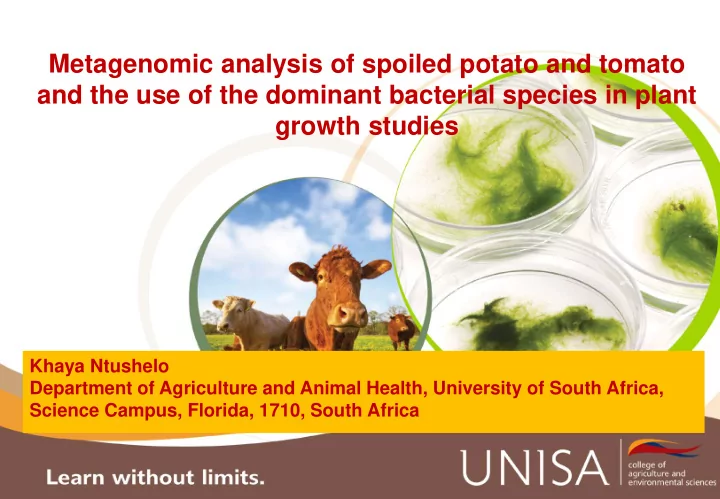
Metagenomic analysis of spoiled potato and tomato and the use of the dominant bacterial species in plant growth studies

Khaya Ntushelo Department of Agriculture and Animal Health, University of South Africa, Science Campus, Florida, 1710, South Africa

slide-2
SLIDE 2

Unisa Science Campus

Research

  • Metagenomics
  • Plant-microbe interactions
  • Potato diseases
slide-3
SLIDE 3

Metagenomics: Introduction

  • Metagenome – Handelsman 1988

– University of Wisconsin–Madison

  • As applicable to bacteria
  • Popular – gut, soil, extreme environments, ocean water, sewage
  • Direct study of genetic material from environmental samples
  • Prominence with high-throughput genomic sequencing
slide-4
SLIDE 4

Known metagenomics projects

  • Sargasso Sea and Global Ocean Survey

Metagenomics

– genetic diversity in marine microbial communities

  • Human Microbiome Project
slide-5
SLIDE 5

Rationale for our study

slide-6
SLIDE 6

Introduction: Bacterial metagenomics of potato and tomato

Laphalale Polokwane Hoedspruit Skeerpoort Ladanna Warden Bothaville Petrusburg Vryburg

slide-7
SLIDE 7

Metagenomics: Sample preparation

slide-8
SLIDE 8

PCR products of the 16S rRNA gene run through agarose gel

pAF:AGAGTTTGATCCTGGCTCAG/ pHR:AAGGAGGTGATCCAGCCGCA Edwards et al., 1989

slide-9
SLIDE 9

Analysis of the 16S rRNA gene

pAF:AGAGTTTGATCCTGGCTCAG/pHR:AAGGAGGTGATCCAGCCGCA Edwards et al.,

amplified ~ 550 bp of the 16S region targeting the v3-v4 region with Illumina MiSeq 300 x 300 pair-end reads

slide-10
SLIDE 10

MALDI-TOF

slide-11
SLIDE 11

MALDI-TOF compared with sequence analysis of the 16S rRNA gene

Sample code Source Locality Identification by MALDI-TOF Identification by sequence analysis of the 16S rRNA gene GeneBank Accession number Comment on mismatch identification

Unisa1a

Potato Bothaville Myroides odoratimimus Myroides odoratimimus KP823022 Unisa2a Potato Bothaville Myroides odoratimimus Myroides odoratimimus KP823024 Unisa3a Potato Bothaville Myroides odoratimimus Myroides odoratimimus KP823030 Unisa4a Potato Bothaville Myroides odoratimimus Myroides odoratimimus KP823036 Unisa5b Potato Bothaville Myroides odoratimimus Myroides odoratimimus KP823029

slide-12
SLIDE 12

Results of the 16S rRNA gene-based metagenomics

Organism/Hit name Cluster size Result count Comment Acinetobacter sp. 1 1 Acricotopus lucens 1 1 Non bacterial hit Alicyclobacillus acidoterrestris 1 1 Non bacterial hit Allenhyphes flinti 1 1 Spoilage bacterium Anaplasma platys 1 1 Canine pathogen Antheraea pernyi 1 1 Non bacterial hit Aphidius ervi 1 1 Non bacterial hit Asterias forbesii 1 1 Non bacterial hit Bacillus halodurans 18 1 Bacillus licheniformis 11 2 Bacillus sp. 9 3 Bacillus subtilis 3336 4 Clastoptera testacea 1 1 Non bacterial hit Danaus affinis 1 1 Non bacterial hit Geobacillus thermoleovorans 279 2 Enterobacter sp. 7377 5 Eucalyptus tereticornis 1 1 Non bacterial hit Fusarium equiseti 1 1 Non bacterial hit Fusarium oxysporum 1 1 Non bacterial hit Galleria mellonella 4 3 Non bacterial hit Geobacillus sp. 69 3 Geobacillus stearothermophilus 566 2 Myroides sp. 3 1 Nicotiana tabacum 18 3 Non bacterial hit

slide-13
SLIDE 13

Results of the 16S rRNA gene-based metagenomics: Summary Dominant genera

  • Bacillus
  • Geobacillus
  • Enterobacter
slide-14
SLIDE 14

Bacillus and plants

  • Growth promoter
  • Control of pathogens
  • Effect on germination and on potato growth

scanty

  • Bacillus – an antagonist of the blackleg

pathogen Pbcb

  • New tools, and a variety of combined

treatments

slide-15
SLIDE 15

Bacillus and plants

Seed germination AND seedling vigour experiment

  • Okra
  • Seed coated with Bacillus subtilis
  • 5 x 3 x 2 factorial experiment (rep 5x in 3 cycles)

– Aluminium toxicity, temperature and B & No B – In total 450 Petri plates were examined in the data collection, 50 plates for the chemical analysis

slide-16
SLIDE 16

Seed germination assays

Germination percentage, Coleoptile length Chemistries of the germination medium and the germinated seed Secondary metabolite shifts in the germinated seed

Cations quantified in the 50 samples

K mg/kg P mg/kg Mg mg/kg Ca mg/kg Na mg/kg Al mg/kg Fe mg/kg Zn mg/kg Mn mg/kg B mg/kg Cu mg/kg Avearage (Bacillus) 8467.400 5703.200 3414.280 1425.776 769.064 3143.028 70.020 60.210 18.560 21.134 11.455 Avearage (No Bacillus) 8196.120 5628.800 3355.040 1437.152 604.252 3308.372 65.164 59.859 18.580 20.960 11.247

Anions quantified in the 50 samples

PO4

3- mg/kg

Fl- mg/kg Cl- mg/kg SO4

2- mg/kg

NO3

  • mg/kg

NO2

  • mg/kg

Avearage (Bacillus) 3358.940 968.550 2166.400 643.780 131.400 40.360 Avearage (No Bacillus) 4172.370 606.200 2106.870 629.290 169.830 16.600

slide-17
SLIDE 17

Seed germination assays

Germination percentage, Coleoptile length Chemistries of the germination medium and the germinated seed

Cations quantified in the 50 samples

K mg/kg P mg/kg Mg mg/kg Ca mg/kg Na mg/kg Al mg/kg Fe mg/kg Zn mg/kg Mn mg/kg B mg/kg Cu mg/kg Avearage (Bacillus) 8467.400 5703.200 3414.280 1425.776 769.064 3143.028 70.020 60.210 18.560 21.134 11.455 Avearage (No Bacillus) 8196.120 5628.800 3355.040 1437.152 604.252 3308.372 65.164 59.859 18.580 20.960 11.247

Anions quantified in the 50 samples

PO4

3- mg/kg

Fl- mg/kg Cl- mg/kg SO4

2- mg/kg

NO3

  • mg/kg

NO2

  • mg/kg

Avearage (Bacillus) 3358.940 968.550 2166.400 643.780 131.400 40.360 Avearage (No Bacillus) 4172.370 606.200 2106.870 629.290 169.830 16.600

No differences in the ionic composition of Bacillus-treated and Bacillus-untreated samples: conclusion

slide-18
SLIDE 18

Effect of Bacillus on the germination on okra

slide-19
SLIDE 19

Effect of Bacillus on the germination on okra

slide-20
SLIDE 20

Secondary metabolite shifts due to Bacillus treatment

slide-21
SLIDE 21

Secondary metabolite shifts due to Bacillus treatment

Data output was NMR intensity values Phase correction and baseline correction of the NMR spectra were done using ACD/NMR Processor. NMR intensities were selected from the range zero to 14 ppm. PCA was done using Multibase 2014

slide-22
SLIDE 22

Bacillus and plants Potato growth, yield and disease suppression studies

slide-23
SLIDE 23

Data collected in the plant growth studies

  • Growth parameters
  • Stomatal conductance
  • Chlorophyll content
  • Chemical analysis
  • Will extend to a whole range of molecular data
slide-24
SLIDE 24

Effect of Bacillus on the growth of potato

slide-25
SLIDE 25

Effect of Bacillus on the growth of potato

slide-26
SLIDE 26

Preliminary findings

  • A few bacterial species dominate potato and tomato
  • Sequence analysis of the 16S rRNA gene and MALDI-TOF

give the same result of bacterial species IDs

  • Bacillus – one of the dominant species promotes germination
  • f okra growth of potato
  • Not much bacterial cells are needed to cause germination and

growth effects

  • Bacillus ineffective in high temperature
  • A small portion of the okra germinating seed chemistry is

altered to boost germination

slide-27
SLIDE 27

Still to come

  • Tuber yield data
  • Bacterial antagonism
  • Molecular interactions between Bacillus and

bacterial plant pathogens

slide-28
SLIDE 28

Acknowledgements

  • Postdoctoral researcher – Sheku Kanu
  • MSc student – Taboga Mathiba
  • BTech students –Livhuwani Nemutandani and Mpho

Nematswerani

  • PPRI for providing the Bacillus strains used
  • Inqaba Biotech and the ARC Biotechnology Platform for their

facilities and expertise shared

  • University of Pretoria for MALDI-TOF
  • Unisa for funding
slide-29
SLIDE 29