Metadata Working Group Report People Convener Tomoteru Yoshie - - PowerPoint PPT Presentation

metadata working group report
SMART_READER_LITE
LIVE PREVIEW

Metadata Working Group Report People Convener Tomoteru Yoshie - - PowerPoint PPT Presentation

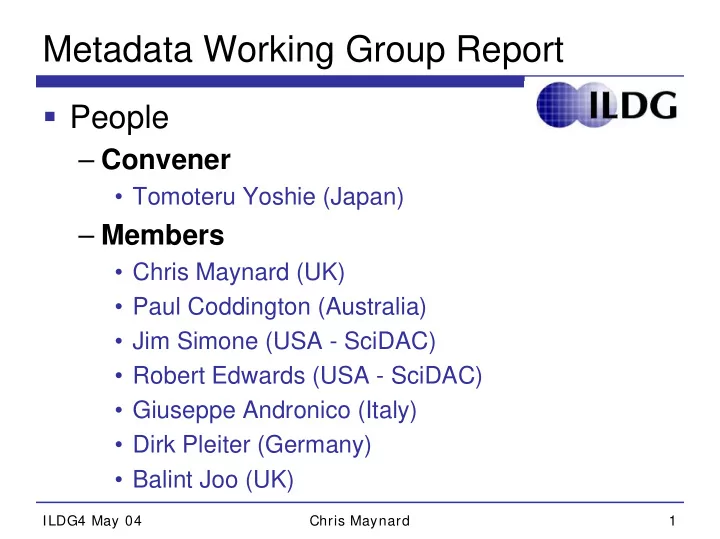
Metadata Working Group Report People Convener Tomoteru Yoshie (Japan) Members Chris Maynard (UK) Paul Coddington (Australia) Jim Simone (USA - SciDAC) Robert Edwards (USA - SciDAC) Giuseppe Andronico (Italy)


slide-1
SLIDE 1

ILDG4 May 04 Chris Maynard 1

Metadata Working Group Report

People

– Convener

  • Tomoteru Yoshie (Japan)

– Members

  • Chris Maynard (UK)
  • Paul Coddington (Australia)
  • Jim Simone (USA - SciDAC)
  • Robert Edwards (USA - SciDAC)
  • Giuseppe Andronico (Italy)
  • Dirk Pleiter (Germany)
  • Balint Joo (UK)
slide-2
SLIDE 2

ILDG4 May 04 Chris Maynard 2

Contents

QCDML0.4 design and schema Propose ILDG adopt this schema

– QCDML1.0

How we might proceed to extend QCDML

– Derived lattice data – Gauge fixed cfgs

BinX

– Uses and examples

slide-3
SLIDE 3

ILDG4 May 04 Chris Maynard 3

Ensemble and configuration

Most metadata is common to all configurations in an ensemble Separate metadata into

– Ensemble XML <markovChain> – Configuration XML <gaugeConfiguration>

QCDML is made from two schemata Some metadata does not unambiguously belong to either namespace

slide-4
SLIDE 4

ILDG4 May 04 Chris Maynard 4

Ensemble XML

UML representation

  • f XML schema
slide-5
SLIDE 5

ILDG4 May 04 Chris Maynard 5

markovChainLFN

URI uniquely identifies the ensemble in the ILDG namespace

slide-6
SLIDE 6

ILDG4 May 04 Chris Maynard 6

Management of the ensemble

Who, when, and what changes to the ensemble. The management information is split between ensemble and configuration

slide-7
SLIDE 7

ILDG4 May 04 Chris Maynard 7

Changing the ensemble

slide-8
SLIDE 8

ILDG4 May 04 Chris Maynard 8

Archive history

An array of …

slide-9
SLIDE 9

ILDG4 May 04 Chris Maynard 9

Action

Most searched metadata Critical that data is …

– Readily searchable – Easily extensible – Complete

  • All the information required to specify what a

gauge configuration is

Structure required

– In the schema rather than XML ID

slide-10
SLIDE 10

ILDG4 May 04 Chris Maynard 10

Generic action

slide-11
SLIDE 11

ILDG4 May 04 Chris Maynard 11

Gluon inheritance

slide-12
SLIDE 12

ILDG4 May 04 Chris Maynard 12

Quark Inheritance

slide-13
SLIDE 13

ILDG4 May 04 Chris Maynard 13

Non-degenerate quarks

XML chunk from Nf=2+1 clover <parameters> is array valued count <numberOfFlavours> with XPath query

slide-14
SLIDE 14

ILDG4 May 04 Chris Maynard 14

Algorithm

Algorithmic metadata split between ensemble and algorithm Most metadata is unconstrained parameter <name/> <value/> pairs Relevant information can be found Hierarchical structure for algorithms is

– difficult to create – difficult to make extenisble – not that useful

slide-15
SLIDE 15

ILDG4 May 04 Chris Maynard 15

Configuration

Contains the management information for individual configurations Same structure as the ensemble management

slide-16
SLIDE 16

ILDG4 May 04 Chris Maynard 16

Implementation

Machine and code details In principle these could be different for configurations in the same ensemble

slide-17
SLIDE 17

ILDG4 May 04 Chris Maynard 17

Algorithm

Algorithmic metadata specific to an individual configuration For instance, step size or solver residue

slide-18
SLIDE 18

ILDG4 May 04 Chris Maynard 18

Precision

Debate as to whether an ensemble with configurations generated with different precision is valid

slide-19
SLIDE 19

ILDG4 May 04 Chris Maynard 19

markovStep

Logical File name of the ensemble in the ILDG namespace

slide-20
SLIDE 20

ILDG4 May 04 Chris Maynard 20

dataLFN

Logical File name of the configuration in the ILDG namespace

slide-21
SLIDE 21

ILDG4 May 04 Chris Maynard 21

The markov chain

Where the configuration is in the trajectory of markov chain

slide-22
SLIDE 22

ILDG4 May 04 Chris Maynard 22

avePlaquette

Very useful metadata, can be used to check data transformations are correct

slide-23
SLIDE 23

ILDG4 May 04 Chris Maynard 23

QCDML1.0

Schema marked up as version 0.4

– Requires some tidying

Remaining issues

– Can a configuration for which a paper has not been published be part of ILDG?

Remaining work

– Inheritance trees for actions

Move to QCDML1.0 and release

slide-24
SLIDE 24

ILDG4 May 04 Chris Maynard 24

Extending QCDML

Data format and packing of configs

– See Yoshie talk

Gauge fixed configurations

– Should be fairly straightforward

Propagators/correlators

– Will need more work but basis laid in gauge configs

slide-25
SLIDE 25

ILDG4 May 04 Chris Maynard 25

BinX

XML markup for binary data Library for manipulating marked up data Production codes do not use BinX library

– But easy to mark up data format in BinX style – ILDG middleware can use BinX for data manipulations – Gauge configuration format – correlators

slide-26
SLIDE 26

ILDG4 May 04 Chris Maynard 26

Gauge config BinX

Small Written once per ensemble write code on top of BinX library Change array order 2x3 3x3 average plaquette ILDG BinX based gauge config manipulator?

slide-27
SLIDE 27

ILDG4 May 04 Chris Maynard 27

Correlator data

  • Compact. No standard shape to

correlators BinX will read in any shape

slide-28
SLIDE 28

ILDG4 May 04 Chris Maynard 28

Array stripper

BinX + BJ’s Xpath reader Code reads this XML Produces single slice array in text/XML From any size/shape array Schema for correlator channels ILDG middleware extract channel from any correlator

slide-29
SLIDE 29

ILDG4 May 04 Chris Maynard 29

Conclusions

QCDML0.4 finished

– Go to QCDML1.0 – Start using

Extend QCDML to other data CMM recommend BinX as an extremely useful tool Easy to create ILDG data manipulation based on BinX + schema