Memory Hierarchy Design Chapter 5 and Appendix C 1 Overview - - PDF document

memory hierarchy design
SMART_READER_LITE
LIVE PREVIEW

Memory Hierarchy Design Chapter 5 and Appendix C 1 Overview - - PDF document

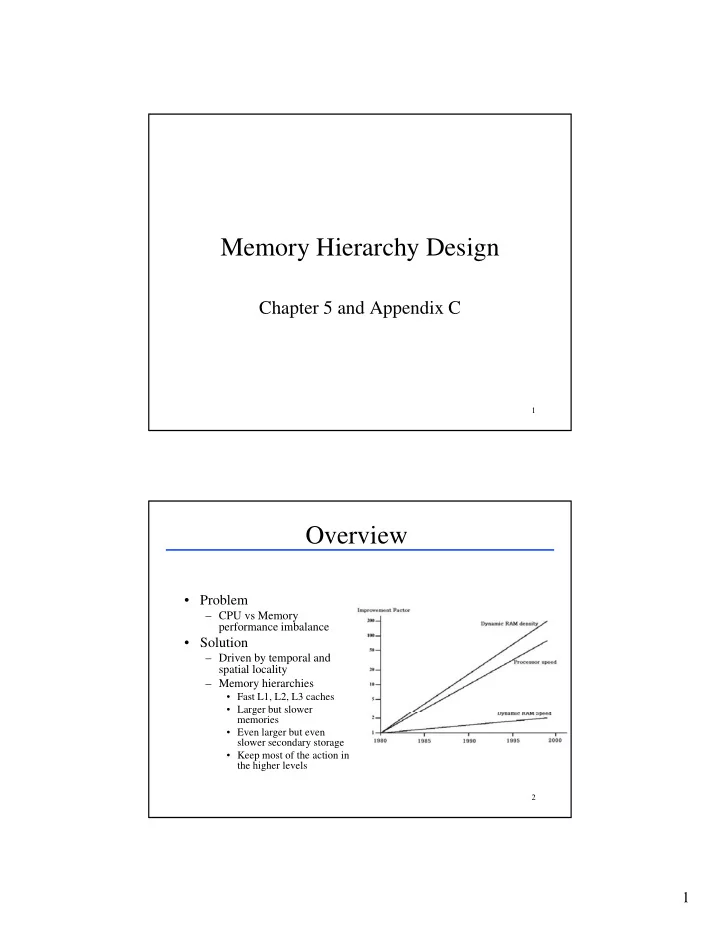
Memory Hierarchy Design Chapter 5 and Appendix C 1 Overview Problem CPU vs Memory performance imbalance Solution Driven by temporal and spatial locality Memory hierarchies Fast L1, L2, L3 caches Larger but


slide-1
SLIDE 1

1

Memory Hierarchy Design

Chapter 5 and Appendix C

1

Overview

  • Problem

– CPU vs Memory performance imbalance

  • Solution

– Driven by temporal and spatial locality – Memory hierarchies

  • Fast L1, L2, L3 caches
  • Larger but slower

2

Larger but slower memories

  • Even larger but even

slower secondary storage

  • Keep most of the action in

the higher levels

slide-2
SLIDE 2

2

Locality of Reference

  • Temporal and Spatial
  • Sequential access to memory
  • Unit-stride loop (cache lines = 256 bits)
  • Non-unit stride loop (cache lines = 256 bits)

for (i = 1; i < 100000; i++) sum = sum + a[i];

3

p ( )

for (i = 0; i <= 100000; i = i+8) sum = sum + a[i];

Cache Systems

CPU 400MH Main Memory Main Memory CPU D t bj t 400MHz y 10MHz y 10MHz Bus 66MHz Bus 66MHz Cache

4

CPU Cache Main Memory

Data object transfer Block transfer

slide-3
SLIDE 3

3

Example: Two-level Hierarchy

T1+T2 Access Time

1 2

5

1 T1 Hit ratio

Basic Cache Read Operation

  • CPU requests contents of memory location
  • Check cache for this data
  • If present, get from cache (fast)
  • If not present, read required block from

main memory to cache

  • Then deliver from cache to CPU

6

Then deliver from cache to CPU

  • Cache includes tags to identify which block
  • f main memory is in each cache slot
slide-4
SLIDE 4

4

Elements of Cache Design

  • Cache size
  • Line (block) size

Line (block) size

  • Number of caches
  • Mapping function

– Block placement – Block identification

7

  • Replacement Algorithm
  • Write Policy

Cache Size

  • Cache size << main memory size
  • Small enough

– Minimize cost – Speed up access (less gates to address the cache) – Keep cache on chip

  • Large enough

– Minimize average access time

8

e ave age access t e

  • Optimum size depends on the workload
  • Practical size?
slide-5
SLIDE 5

5

Line Size

  • Optimum size depends on workload
  • Small blocks do not use locality of reference

principle

  • Larger blocks reduce the number of blocks

– Replacement overhead

  • Practical sizes?

Cache Main Memory Tag

9

Number of Caches

  • Increased logic density => on-chip cache

– Internal cache: level 1 (L1) – External cache: level 2 (L2)

  • Unified cache

– Balances the load between instruction and data fetches – Only one cache needs to be designed / implemented

10

  • Split caches (data and instruction)

– Pipelined, parallel architectures

slide-6
SLIDE 6

6

Mapping Function

  • Cache lines << main memory blocks
  • Direct mapping

– Maps each block into only one possible line – (block address) MOD (number of lines)

  • Fully associative

– Block can be placed anywhere in the cache

11

  • Set associative

– Block can be placed in a restricted set of lines – (block address) MOD (number of sets in cache)

Cache Addressing

Block address Block offset Index Tag

Block offset – selects data object from the block Index – selects the block set

12

Tag – used to detect a hit

slide-7
SLIDE 7

7

Direct Mapping

13

Associative Mapping

14

slide-8
SLIDE 8

8

K-Way Set Associative Mapping

15

Replacement Algorithm

  • Simple for direct-mapped: no choice
  • Random

– Simple to build in hardware

  • LRU

Associativity Two-way Four-way Eight-way

16

Size

LRU Random LRU Random LRU Random 16KB 5.18% 5.69% 4.67% 5.29% 4.39% 4.96% 64KB 1.88% 2.01% 1.54% 1.66% 1.39% 1.53% 256KB 1.15% 1.17% 1.13% 1.13% 1.12% 1.12%

slide-9
SLIDE 9

9

Write Policy

  • Write is more complex than read

– Write and tag comparison can not proceed i lt l simultaneously – Only a portion of the line has to be updated

  • Write policies

– Write through – write to the cache and memory – Write back – write only to the cache (dirty bit)

17

  • Write miss:

– Write allocate – load block on a write miss – No-write allocate – update directly in memory

Alpha AXP 21064 Cache

Tag Index offset 21 8 5 Address Data data

CPU

In out Valid Tag Data (256) Write

18

Lower level memory =? buffer

slide-10
SLIDE 10

10

Write Merging

Write address V V V V 100 1 Write address V V V V 104 108 112 1 1 1

19

100 1 1 1 1

DECstation 5000 Miss Rates

25 30 5 10 15 20 1 KB 2 KB 4 KB 8 KB 16 KB 32 KB 64 KB 128 KB %

  • Instr. Cache

Data Cache Unified 20 1 KB 2 KB 4 KB 8 KB 16 KB 32 KB 64 KB 128 KB Cache size

Direct-mapped cache with 32-byte blocks Percentage of instruction references is 75%

slide-11
SLIDE 11

11

Cache Performance Measures

  • Hit rate: fraction found in that level

– So high that usually talk about Miss rate – Miss rate fallacy: as MIPS to CPU performance,

  • Average memory-access time

= Hit time + Miss rate x Miss penalty (ns)

  • Miss penalty: time to replace a block from lower

level, including time to replace in CPU

21

– access time to lower level = f(latency to lower level) – transfer time: time to transfer block =f(bandwidth)

Cache Performance Improvements

  • Average memory-access time

= Hit time + Miss rate x Miss penalty

  • Cache optimizations

– Reducing the miss rate – Reducing the miss penalty – Reducing the hit time

22

slide-12
SLIDE 12

12

Example

Which has the lower average memory access time: A 16-KB instruction cache with a 16-KB data cache or A 32-KB unified cache Hit time = 1 cycle Miss penalty = 50 cycles Load/store hit = 2 cycles on a unified cache Given: 75% of memory accesses are instruction references. Overall miss rate for split caches

0 75*0 64% + 0 25*6 47% 2 10%

23

Overall miss rate for split caches = 0.75*0.64% + 0.25*6.47% = 2.10% Miss rate for unified cache = 1.99% Average memory access times: Split = 0.75 * (1 + 0.0064 * 50) + 0.25 * (1 + 0.0647 * 50) = 2.05 Unified = 0.75 * (1 + 0.0199 * 50) + 0.25 * (2 + 0.0199 * 50) = 2.24

Cache Performance Equations

CPUtime = (CPU execution cycles + Mem stall cycles) * Cycle time Mem stall cycles = Mem accesses * Miss rate * Miss penalty CPUtime = IC * (CPIexecution + Mem accesses per instr * Miss rate * Miss penalty) * Cycle time Misses per instr = Mem accesses per instr * Miss rate CPUtime = IC * (CPIexecution + Misses per instr * Miss penalty) * Cycle time

24

y

slide-13
SLIDE 13

13

Reducing Miss Penalty

  • Multi-level Caches
  • Critical Word First and Early Restart

y

  • Priority to Read Misses over Writes
  • Merging Write Buffers
  • Victim Caches

25

Multi-Level Caches

  • Avg mem access time = Hit time(L1) + Miss Rate

(L1) X Miss Penalty(L1)

  • Miss Penalty (L1) = Hit Time (L2) + Miss Rate

Miss Penalty (L1) Hit Time (L2) Miss Rate (L2) X Miss Penalty (L2)

  • Avg mem access time = Hit Time (L1) + Miss

Rate (L1) X (Hit Time (L2) + Miss Rate (L2) X Miss Penalty (L2)

  • Local Miss Rate: number of misses in a cache

divided by the total number of accesses to the

26

y cache

  • Global Miss Rate: number of misses in a cache

divided by the total number of memory accesses generated by the cache

slide-14
SLIDE 14

14

Performance of Multi-Level Caches

27

Critical Word First and Early Restart

  • Critical Word First: Request the missed

word first from memory

  • Early Restart: Fetch in normal order, but as

soon as the requested word arrives, send it to CPU

28

slide-15
SLIDE 15

15

Giving Priority to Read Misses over Writes SW R3, 512(R0) LW R1, 1024 (R0) , ( ) LW R2, 512 (R0)

  • Direct-mapped, write-through cache

mapping 512 and 1024 to the same block and a four word write buffer

29

  • Will R2=R3?
  • Priority for Read Miss?

Victim Caches

30

slide-16
SLIDE 16

16

Reducing Miss Rates: Types of Cache Misses

  • Compulsory

– First reference or cold start misses

C i

  • Capacity

– Working set is too big for the cache – Fully associative caches

  • Conflict (collision)

– Many blocks map to the same block frame (line)

31

– Affects

  • Set associative caches
  • Direct mapped caches

Miss Rates: Absolute and Distribution

32

slide-17
SLIDE 17

17

Reducing the Miss Rates

  • 1. Larger block size
  • 2. Larger Caches
  • 2. Larger Caches
  • 3. Higher associativity
  • 4. Pseudo-associative caches
  • 5. Compiler optimizations

33

  • 1. Larger Block Size
  • Effects of larger block sizes

– Reduction of compulsory misses

  • Spatial locality

– Increase of miss penalty (transfer time) – Reduction of number of blocks

  • Potential increase of conflict misses
  • Latency and bandwidth of lower-level memory

34

  • Latency and bandwidth of lower-level memory

– High latency and bandwidth => large block size

  • Small increase in miss penalty
slide-18
SLIDE 18

18

Example

35

  • 2. Larger Caches
  • More blocks
  • Higher probability of getting the data

g p y g g

  • Longer hit time and higher cost
  • Primarily used in 2nd level caches

36

slide-19
SLIDE 19

19

  • 3. Higher Associativity
  • Eight-way set associative is good enough
  • 2:1 Cache Rule:

2:1 Cache Rule:

– Miss Rate of direct mapped cache size N = Miss Rate 2-way cache size N/2

  • Higher Associativity can increase

– Clock cycle time

37

– Hit time for 2-way vs. 1-way external cache +10%, internal + 2%

  • 4. Pseudo-Associative Caches
  • Fast hit time of direct mapped and lower conflict

misses of 2-way set-associative cache? Di id h i h k th h lf f h

  • Divide cache: on a miss, check other half of cache

to see if there, if so have a pseudo-hit (slow hit)

  • Drawback:

Hit time Pseudo hit time Miss penalty

38

  • Drawback:

– CPU pipeline design is hard if hit takes 1 or 2 cycles – Better for caches not tied directly to processor (L2) – Used in MIPS R1000 L2 cache, similar in UltraSPARC

slide-20
SLIDE 20

20

Pseudo Associative Cache

Address

CPU

Data Data in out Tag

Data 1 1 2 2 3

=?

39

Write buffer Lower level memory

2 2

=?

  • 5. Compiler Optimizations
  • Avoid hardware changes
  • Instructions

– Profiling to look at conflicts between groups of instructions

  • Data

– Loop Interchange: change nesting of loops to access data in order stored in memory

40

access data in order stored in memory – Blocking: Improve temporal locality by accessing “blocks” of data repeatedly vs. going down whole columns or rows

slide-21
SLIDE 21

21

Loop Interchange

/* Before */ for (j = 0; j < 100; j = j+1) for (i = 0; i < 5000; i = i+1) x[i][j] 2 * x[i][j]; x[i][j] = 2 * x[i][j]; /* After */ for (i = 0; i < 5000; i = i+1) for (j = 0; j < 100; j = j+1) x[i][j] = 2 * x[i][j];

  • Sequential accesses instead of striding through

41

Sequential accesses instead of striding through memory every 100 words; improved spatial locality

  • Same number of executed instructions

Blocking (1/2)

/* Before */ for (i = 0; i < N; i = i+1) for (j = 0; j < N; j = j+1){ r = 0; r 0; for (k = 0; k < N; k = k+1) r = r + y[i][k]*z[k][j]; x[i][j] = r; };

  • Two Inner Loops:

–Read all NxN elements of z[] –Read N elements of 1 row of y[] repeatedly

42

Read N elements of 1 row of y[] repeatedly –Write N elements of 1 row of x[]

  • Capacity Misses a function of N & Cache Size:

–3 NxNx4 => no capacity misses

–Idea: compute on BxB submatrix that fits

slide-22
SLIDE 22

22

Blocking (2/2)

/* After */ for (jj = 0; jj < N; jj = jj+B) for (kk = 0; kk < N; kk = kk+B) for (i = 0; i < N; i = i+1) for (i 0; i < N; i i+1) for (j = jj; j < min(jj+B-1,N); j=j+1){ r = 0; for(k=kk; k<min(kk+B-1,N);k =k+1) r = r + y[i][k]*z[k][j]; x[i][j] = x[i][j] + r; };

B called Blocking Factor

43

  • B called Blocking Factor

Reducing Cache Miss Penalty or Miss Rate via Parallelism

  • 1. Nonblocking Caches
  • 2. Hardware Prefetching
  • 2. Hardware Prefetching
  • 3. Compiler controlled Prefetching

44

slide-23
SLIDE 23

23

  • 1. Nonblocking Cache
  • Out-of-order
  • Out-of-order

execution

– Proceeds with next fetches while waiting for data to come

45

  • 2. Hardware Prefetching
  • Instruction Prefetching

– Alpha 21064 fetches 2 blocks on a miss Extra block placed in stream buffer – Extra block placed in stream buffer – On miss check stream buffer

  • Works with data blocks too:

– 1 data stream buffer gets 25% misses from 4KB DM cache; 4 streams get 43% – For scientific programs: 8 streams got 50% to 70% of i f 2 64KB 4 t i ti h

46

misses from 2 64KB, 4-way set associative caches

  • Prefetching relies on having extra memory

bandwidth that can be used without penalty

slide-24
SLIDE 24

24

  • 3. Compiler-Controlled Prefetching
  • Compiler inserts data prefetch instructions

– Load data into register (HP PA-RISC loads) – Cache Prefetch: load into cache (MIPS IV, PowerPC) – Special prefetching instructions cannot cause faults; a form of speculative execution

  • Nonblocking cache: overlap execution with prefetch
  • Issuing Prefetch Instructions takes time

I f f h i i i d d i ?

47

– Is cost of prefetch issues < savings in reduced misses? – Higher superscalar reduces difficulty of issue bandwidth

Reducing Hit Time

  • 1. Small and Simple Caches
  • 2. Avoiding address Translation during
  • 2. Avoiding address Translation during

Indexing of the Cache

48

slide-25
SLIDE 25

25

Small and Simple Caches

49

Avoiding Address Translation during Indexing

  • Virtual vs. Physical Cache
  • What happens when address translation is

What happens when address translation is done

  • Page offset bits to index the cache

50

slide-26
SLIDE 26

26

TLB and Cache Operation

Hit Virtual address TLB Operation Page# Offset TLB Tag Remainder Cache Miss Hit Value Real address Cache Operation

+

51

Miss Main Memory Value Page Table

Main Memory Background

  • Performance of Main Memory:

– Latency: Cache Miss Penalty

  • Access Time: time between request and word arrives

C l T i b

  • Cycle Time: time between requests

– Bandwidth: I/O & Large Block Miss Penalty (L2)

  • Main Memory is DRAM: Dynamic Random Access Memory

– Dynamic since needs to be refreshed periodically – Addresses divided into 2 halves (Memory as a 2D matrix):

  • RAS or Row Access Strobe
  • CAS or Column Access Strobe
  • Cache uses SRAM: Static Random Access Memory

52

  • Cache uses SRAM: Static Random Access Memory

– No refresh (6 transistors/bit vs. 1 transistor /bit, area is 10X) – Address not divided: Full addreess

  • Size: DRAM/SRAM - 4-8

Cost & Cycle time: SRAM/DRAM - 8-16

slide-27
SLIDE 27

27

Main Memory Organizations

CPU CPU CPU

Simple Wide Interleaved

Cache bus Memory Cache bus Memory bank 0 Memory bank 1 Memory bank 2 Memory bank 3 Memory Cache bus Multiplexor

53

32/64 bits 256/512 bits

sp

Interleaved Memory

54

slide-28
SLIDE 28

28

Performance

  • Timing model (word size is 32 bits)

– 1 to send address, 6 access time 1 to send data – 6 access time, 1 to send data – Cache Block is 4 words

  • Simple M.P.

= 4 x (1+6+1) = 32

  • Wide M.P.

= 1 + 6 + 1 = 8

  • Interleaved M.P. = 1 + 6 + 4x1 = 11

55