medicine Recognized Participant in Cardiac and Metabolic Diseases - - PowerPoint PPT Presentation

medicine
SMART_READER_LITE
LIVE PREVIEW

medicine Recognized Participant in Cardiac and Metabolic Diseases - - PowerPoint PPT Presentation

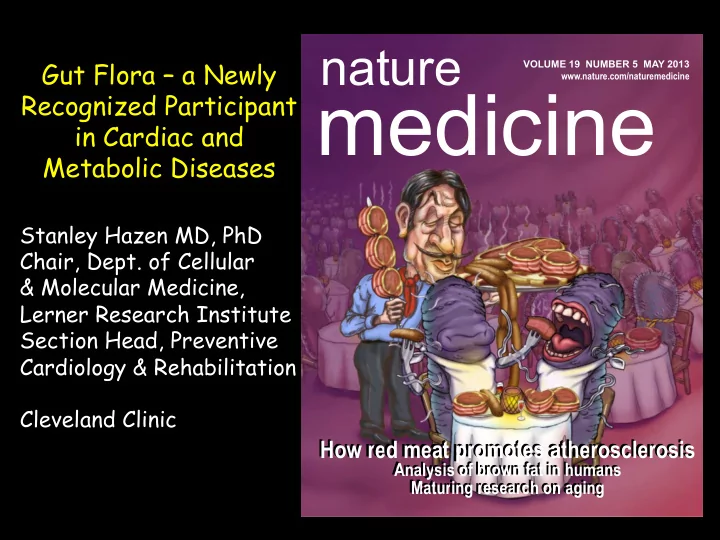
nature Gut Flora a Newly VOLUME 19 NUMBER 5 MAY 2013 www.nature.com/naturemedicine medicine Recognized Participant in Cardiac and Metabolic Diseases Stanley Hazen MD, PhD Chair, Dept. of Cellular & Molecular Medicine, Lerner


slide-1
SLIDE 1

Gut Flora – a Newly Recognized Participant in Cardiac and Metabolic Diseases

Stanley Hazen MD, PhD Chair, Dept. of Cellular & Molecular Medicine, Lerner Research Institute Section Head, Preventive Cardiology & Rehabilitation Cleveland Clinic

VOLUME 19 NUMBER 5 MAY 2013 www.nature.com/naturemedicine

nature

medicine

H How

  • w r

re ed me d mea at t pr promot

  • mote

es s a at the her ros

  • sc

cle ler ros

  • sis

is

A Ana naly lys sis is of

  • f br

brow

  • wn f

n fa at t in huma in humans ns M Ma at tur uring r ing re es se ea ar rc ch on a h on aging ging

slide-2
SLIDE 2

Take home summary: Gut microbiota participates in atherosclerosis in the presence of specific dietary exposures

Carnitine Choline

Wang Z et al, Nature (2011). Koeth RA et al, Nature Medicine (2013). Tang WHW et al, NEJM (2013)

slide-3
SLIDE 3
  • The microbiome can

be considered as our largest endocrine organ

  • The micrbiome is a

“drugable” target

  • The microbiome is a

filter of our largest environmental exposure – what we eat

Additional take home concepts: Additional take home concepts:

slide-4
SLIDE 4

Phase 1: Discovery-based investigations Metabolomics screening and structural identification

Phase 2: Clinical validation Replication and demonstration of clinical utility Phase 3: Mechanistic studies Demonstration of causality for a novel pathway

slide-5
SLIDE 5

Strategy of metabolomics study design for identifying unbiased small molecule profiles predictive of incident risks for major adverse cardiovascular events

GeneBank (N=10,000)

slide-6
SLIDE 6

Choline, betaine and trimethylamine-N-oxide are plasma analytes associated with CVD

m/z 104 m/z 76 m/z 118 Betaine Identities confirmed by: LC-MSn , 1H,13C,15N NMR GC/MS/MS, Isotope tracer studies

(TMAO)

(TMAO)

slide-7
SLIDE 7

Intestinal Microbial Organisms Play an Obligatory Role in TMAO Generation from Dietary Egg Yolk PC in Mice

2 weeks

TMAO

Wang Z et al, Nature (2011)

slide-8
SLIDE 8

85 66

3 6 9

Time (min)

3 6 9

Time (min) 85 66

e

d9-TMAO 76 58 TMAO

3 6 9

Time (min)

b

100 50 100 50 3 6 9

Time (min) 85 66 d9-TMAO

100 50

76 58 TMAO

100 50

h k

3 6 9

Time (min) 85 66

d f

d9-TMAO d9-TMAO

100 50 100 50

76 58 76 58 TMAO TMAO

3 6 9

Time (min)

3 6 9

Time (min)

a c

100 50 100 50

Plasma

3 6 9

Time (min)

3 6 9

Time (min) 85 66 d9-TMAO 85 66 d9-TMAO

100 50 100 50

76 58 76 58 TMAO TMAO

100 50 100 50

Urine

g i j l Ion extracted LC chromatograms in positive MRM MS in human plasma and urine after oral taking d9-DPPC and two hard boiled eggs Pre-antibiotics (visit 1)

Antibiotics Suspension of gut flora

Post-antibiotics (visit 2)

Acquisition

  • f gut flora

visit 3

TMAO is a gut flora dependent metabolite in humans : PC challenge - Oral d9-PC and 2 hard boiled eggs at each visit

6 h post PC challenge 24 h post PC challenge

Tang, Wang et al, NEJM (2013)

Suppression

slide-9
SLIDE 9

Z Wang et al, Nature (2011)

Plasma choline, TMAO and betaine levels predict CVD risks (N=1865)

Odds ratio (95%CI) adjusted for age, sex, DM, HTN, smoking, LDL, HDL, TG, CRP, eGFR

Prospective Cohort: N=1865 Sequential Cardiology Patients

slide-10
SLIDE 10

Plasma levels of the gut flora dependent metabolite TMAO predict incident (3 year) CVD risks

Tang, Wang et al, NEJM (2013)

100 90 80 70 Log-Rank p<0.001 500 1000 1500 Time (days)

TMANO

Q1 Q2 Q3 Q4

Adjusted for age, sex, DM, HTN, smoking, LDL, HDL, TG, CRP, eGFR

TMAO TMAO

New Independent Cohort: N=4007 Sequential Subjects

slide-11
SLIDE 11

Suppression of gut flora inhibits TMAO formation and dietary choline induced atherosclerosis

Intact flora Abx TMAO: 8 0 77 0

slide-12
SLIDE 12

Macrophage Foam cell

Cholesterol metabolism in cells of the artery wall:

Forward Cholesterol Transport Reverse Cholesterol Transport (RCT)

MPO Nascent “discoidal” HDL Spherical HDL

LDL-R

slide-13
SLIDE 13

TMAO alters cholesterol and sterol metabolism in multiple compartments - net effect - increased atherosclerosis

Koeth, et al, Nature Med., 2013

slide-14
SLIDE 14

One ¡serving ¡= ¡3 ¡oz. ¡steak ¡

An Pan, PhD et al, Red Meat Consumption and Mortality: Results from 2 Prospective Cohort Studies, Archives of Internal Medicine. 2012; 172(7):555-563.

Health Professionals Follow-up Study (n=37,698) men, 40-75 yo 1986 - 2008 Nurses Health Study (n=83,644) women, 35-55 yo 1980 - 2008 Combined - 2.96 million years of follow-up 23,926 deaths 1 serving per day increase in red meat corresponds to: 13% increase in total mortality (unprocessed red meat) 20% increase in total mortality (processed red meat)

Epidemiology studies show red meat ingestion is associated with increased mortality risk

slide-15
SLIDE 15

Carnitine (from carnis (carnivore), meaning flesh) participates in fatty acid translocation into mitochondria for β-oxidation

H

Mitochondria Cytoplasm

Long-chain acylcarnitine Acylcarnitine Carnitine Long-chain acylcarnitine Fatty acid Fatty acid

slide-16
SLIDE 16

Robert Koeth et al, Nature Medicine (2013)

There is an obligatory role for gut flora in TMAO formation from dietary carnitine in mice

d3-(methyl)-carnitine oral dose

slide-17
SLIDE 17

Human carnitine tolerance study: There is an obligatory role for gut flora in TMAO production from oral carnitine

12h post challenge

slide-18
SLIDE 18

Carnitine supplementation accelerates atherosclerosis in apoE-/- mice, but not with suppression of intestinal flora (and suppression of TMA/TMAO formation)

2-fold Robert Koeth et al, Nature Medicine (2013)

slide-19
SLIDE 19

Robert Koeth et al, Nature Medicine (2013)

Production of the gut flora metabolite TMAO from carnitine is inducible

d3-(methyl)-carnitine oral dose

Chronic dietary exposure to carnitine alters gut microbial composition and thus, host metabolism of carnitine

slide-20
SLIDE 20

Scheme of human gut microbiota analysis

Omnivore and Vegans/Vegetarians Gut Microbiota Composition TMAO measured by mass spectrometry Stool Collected Blood Collected N=30 N=23

slide-21
SLIDE 21

Robert Koeth et al, Nature Med (2013)

TMAO is formed from dietary carnitine in

  • mnivors, but minimally in vegans

Carnitine challenge: 8oz tenderloin + d3(methyl)-carnitine

slide-22
SLIDE 22

Chronic dietary exposure significantly influences carnitine metabolism

Robert Koeth et al, Nature Medicine (2013)

d3-carnitine challenge

slide-23
SLIDE 23

Omnivores Vegan/ Vegetarian

Specific microbiota taxa are associated with long- term dietary patterns and plasma TMAO levels

Robert Koeth et al, Nature Medicine (2013)

slide-24
SLIDE 24

Freedom from Death, MI, and Stroke Carn TMAO Hazard Ratios

Plasma levels of carnitine in subjects predict cardiovascular risks - only if TMAO is high

Robert Koeth et al, Nature Medicine (2013)

(N=2595)

slide-25
SLIDE 25

Diet and Intestinal Microbes are Mechanistically Linked to Atherosclerotic Heart Disease Take Home Summary:

carnitine (TMAO) carnitine

Wang Z et al (2011) Nature Koeth RA et al (2013) Nature Medicine Tang WHW et al (2013) New Engl J Med Bennett B et al (2013) Cell Metab

slide-26
SLIDE 26

Actually, >600 mg carnitine/can

Other carnitine sources - are there long term adverse health effects ?

slide-27
SLIDE 27

UCLA Brian Bennett Jake Lusis Elin Org USC Hooman Allayee U Penn Rick Bushman Jun Chen Gary Wu James Lewis Hongzhe Li The Cleveland Clinic Zeneng Wang Beth Klipfell Robert Koeth Bruce Levison Jonathan Smith Wilson Tang Joe DiDonato

Acknowledgments

National Institutes of Health (NHLBI) Office of Dietary Supplements