SLIDE 1
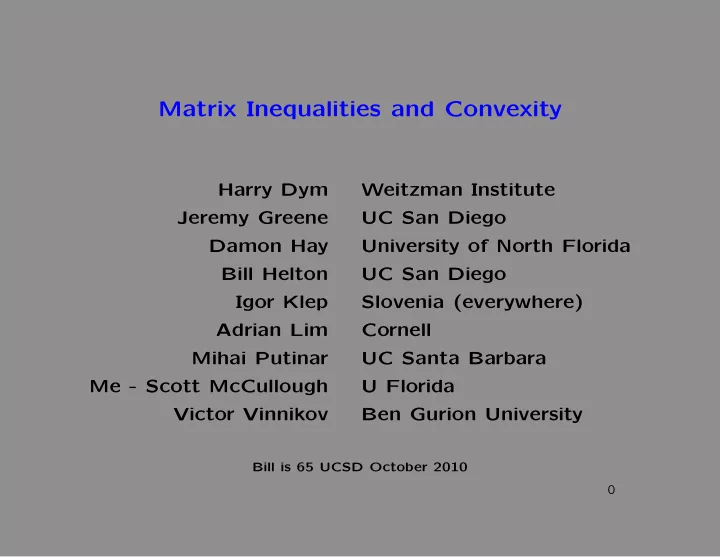
Matrix Inequalities and Convexity
Harry Dym Weitzman Institute Jeremy Greene UC San Diego Damon Hay University of North Florida Bill Helton UC San Diego Igor Klep Slovenia (everywhere) Adrian Lim Cornell Mihai Putinar UC Santa Barbara Me - Scott McCullough U Florida Victor Vinnikov Ben Gurion University
Bill is 65 UCSD October 2010
SLIDE 2
NC polynomials
Rx - polynomials in the freely non-commuting variables
x = (x1, . . . , xg) - nc polys.
The variables are symmetric, xT
j = xj and (pq)T = qT pT .
p ∈ Rx is symmetric if pT = p. q = q(x1, x2) =3 − 2x1 + 5x1x2x1 r = r(x1, x2) =3 − 2x1x2 + 5x2x1 rT = rT (x1, x2) =3 − 2x2x1 + 5x1x2. p is symmetric if p = pT . In particular, q is symmetric, but r
is not.
1
SLIDE 3
Evaluating NC polynomials
Sg(n) - g-tuples X = (X1, . . . , Xg) of symmetric n × n ma- trices.
X ∈ Sg(n) corresponds to a repn Rx → Mn, p → p(X)
For instance, with
q(x1, x2) = 3 − 2x1 + 5x1x2x1,
and X = (X1, X2) ∈ S2(n),
q(X) = q(X1, X2) = 3In − 2X1 + 5X1X2X1.
If p ∈ Rx is symmetric, then so is the matrix p(X).
2
SLIDE 4 Convex nc polynomials
Divide x = (a, x) into two classes of variables. A symmetric p ∈ Ra, x is convex in x (on some domain) if
p(A, tX + (1 − t)Y ) tp(A, X) + (1 − t)p(A, Y ).
The polynomial p(x) = x4 (g = 1 and no a) is not convex. It is not too hard to find X, Y ∈ M2 (not commuting of course) for which (X+Y
2
)4 1
2(X4 + Y 4).
- Theorem. If p(a, x) is convex in x, then
p = ℓ(a, x) + V (a, x)T M(a)V (a, x),
where ℓ has degree at most one in x; V (a, x) is linear in x; and M(A) ≻ 0 for all A. In particular, p has degree two in
- x. The converse holds also.
3
SLIDE 5 Convex nc polys, rational functions, and LMI sets
Sample Theorem. If p(a, x) is convex in x and concave in
a, then p = ℓ(a, x) + P (x)T P (x) − Q(a)T Q(a), where P, Q are
linear and ℓ has degree at most one in a and x separately. In case there are no a variables, convexity of p near 0 implies
p = ℓ(x) + P (x)T P (x). In particular, −p(X) ≻ 0 ↔ L(X) =
P (X) P (X)T −ℓ(X)
If −p(0) = I, then L is a monic affine linear pencil. In particular, p(x) = x4 is not convex.
- A similar result holds for nc rational functions r(x).
4
SLIDE 6
Matrix convex nc semialgebraic sets
Given p ∈ Rx symmetric, and p(0) = I, let
Pp(n) = {X ∈ Sg(n) : p(X) ≻ 0}.
The sequence
Pp = (Pp(n))
is a nc basic semialgebraic set. The set P is convex if each Pp(n) is - Pp is matrix convex.
5
SLIDE 7 Matrix convex nc semialgebraic sets
If p is concave, then Pp = {X : p(X) ≻ 0} is a convex nc basic semialgebriac set. If p ∈ Rx symmetric, and r = I + X2, then Pp = Prpr. Theorem. Given a symmetric p ∈ Rx, if Pp is bounded and convex and p satisfies certain irreducibility and smooth- ness (at the boundary of Pp) conditions, then −p is in fact
- convex. So convexity of one level set implies convexity of
all. The nc set {1 − x4
1 − x4 2 ≻ 0} is not convex.
6
SLIDE 8 The middle matrix and border vector
The proofs exploit the fact that convexity corresponds to some positivity (and not much is needed) of the Hessian,
p′′(x)[h]
The Hessian has a representation
V (x)T hM(x)hV (x).
Positivity of the Hessian implies M(x) is some positive by the Camino-Helton-Skelton-Yi Lemma. Because of its structure, if M(x) some positive iff p has degree two (and M is constant).
7
SLIDE 9 Matrix-valued polynomials
Given a symmetric
p =
pT =
j ⊗ pT j = p,
and X ∈ Sg(n),
p(X) =
As an example, given Aj ∈ Sd
L(x) = I −
is a monic affine linear pencil.
8
SLIDE 10 Nc convex semialgebraic sets are LMI domains
Given, L(x) = I − Ajxj, the nc set
PL = {X : L(X) ≻ 0}
is convex. It is an LMI domain.
- Theorem. Suppose p = Cj ⊗ pj ∈ Sℓ ⊗ Rx is symmetric,
and p(0) ≻ 0. If Pp is bounded and convex, then there is an L such that Pp = PL; i.e., Pp is an LMI domain.
- The existence of an L with operator coefficients (Aj) is
standard; the challenge is to get matrix coefficients.
- There is a bound on the size of L depending only on the
number of variables, ℓ, and the degree of p.
9
SLIDE 11 TV screen example
The nc set Pp = {1 − x4
1 − x4 2 ≻ 0} is not convex. If it were,
then it would be an LMI domain and Pp(1) would have an LMI representation, contradicting the real zeros condition
Moreover, if D is the projection of an LMI domain PL; i.e.,
D = {X : ∃Y s.t. L(X, Y ) ≻ 0}
and D(1) = PL(1), then D is not a nc basic semialgebraic set since D is convex and D(1) is not LMI representable. Hence projections of LMI domains need not be basic nc semialgebraic.
10
SLIDE 12 What’s next
- Fully incorporate a variables.
- What if all sublevel sets for p are convex?
- Projections of LMI domains, {X : ∃Y s.t. L(X, Y ) ≻ 0}.
- Change variables to achieve convexity.
11