SLIDE 5 Metropolis–Hastings
Transition operator
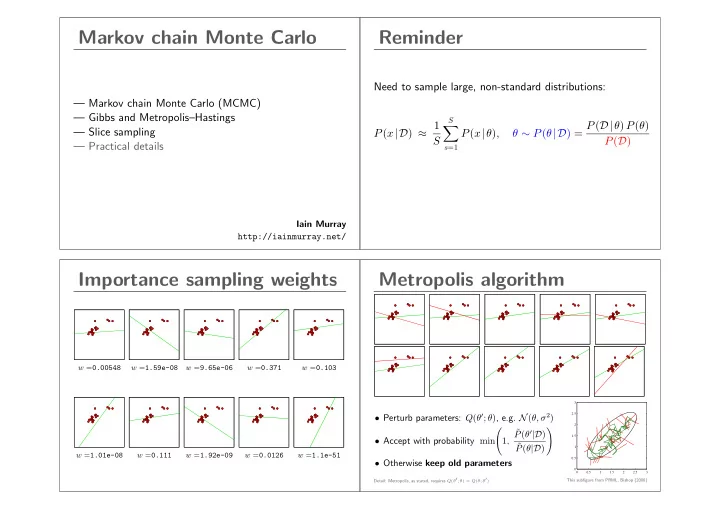
- Propose a move from the current state Q(x′; x), e.g. N(x, σ2)
- Accept with probability min
- 1, P (x′)Q(x;x′)
P (x)Q(x′;x)
- Otherwise next state in chain is a copy of current state
Notes
- Can use P ∗ ∝ P(x); normalizer cancels in acceptance ratio
- Satisfies detailed balance (shown below)
- Q must be chosen so chain is ergodic
P (x) · T (x′ ←x) = P (x) · Q(x′; x) min
P (x)Q(x′; x)
- = min
- P (x)Q(x′; x), P (x′)Q(x; x′)
- = P (x′) · Q(x; x′) min
- 1,
P (x)Q(x′; x) P (x′)Q(x; x′)
Matlab/Octave code for demo
function samples = dumb_metropolis(init, log_ptilde, iters, sigma) D = numel(init); samples = zeros(D, iters); state = init; Lp_state = log_ptilde(state); for ss = 1:iters % Propose prop = state + sigma*randn(size(state)); Lp_prop = log_ptilde(prop); if log(rand) < (Lp_prop - Lp_state) % Accept state = prop; Lp_state = Lp_prop; end samples(:, ss) = state(:); end
Step-size demo
Explore N(0, 1) with different step sizes σ
sigma = @(s) plot(dumb_metropolis(0, @(x)-0.5*x*x, 1e3, s));
sigma(0.1)
100 200 300 400 500 600 700 800 900 1000 −4 −2 2 4
99.8% accepts
sigma(1)
100 200 300 400 500 600 700 800 900 1000 −4 −2 2 4
68.4% accepts
sigma(100)
100 200 300 400 500 600 700 800 900 1000 −4 −2 2 4
0.5% accepts
Diffusion time
Q P L
Generic proposals use Q(x′; x) = N(x, σ2) σ large → many rejections σ small → slow diffusion: ∼(L/σ)2 iterations required
Adapted from MacKay (2003)