Logics Definition A logic is a consequence relation over the set of - - PowerPoint PPT Presentation

logics
SMART_READER_LITE
LIVE PREVIEW

Logics Definition A logic is a consequence relation over the set of - - PowerPoint PPT Presentation

Logics Definition A logic is a consequence relation over the set of formulas Fm of The computational complexity of the Leibniz an algebraic language,which is substitution invariant in the sense hierarchy that if , then ( )


slide-1
SLIDE 1

The computational complexity of the Leibniz hierarchy

Tommaso Moraschini

Institute of Computer Science of the Czech Academy of Sciences

June 28, 2017

1 / 14

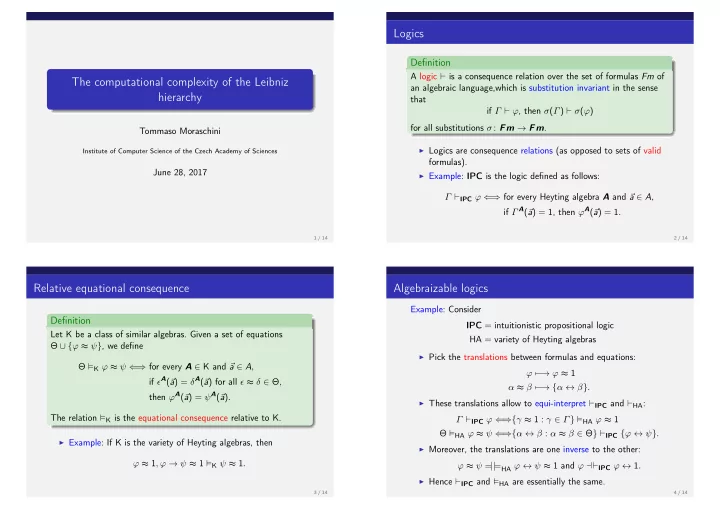
Logics

Definition

A logic ⊢ is a consequence relation over the set of formulas Fm of an algebraic language,which is substitution invariant in the sense that if Γ ⊢ ϕ, then σ(Γ) ⊢ σ(ϕ) for all substitutions σ: Fm → Fm.

◮ Logics are consequence relations (as opposed to sets of valid

formulas).

◮ Example: IPC is the logic defined as follows:

Γ ⊢IPC ϕ ⇐ ⇒ for every Heyting algebra A and a ∈ A, if Γ A( a) = 1, then ϕA( a) = 1.

2 / 14

Relative equational consequence

Definition

Let K be a class of similar algebras. Given a set of equations Θ ∪ {ϕ ≈ ψ}, we define Θ K ϕ ≈ ψ ⇐ ⇒ for every A ∈ K and a ∈ A, if ǫA( a) = δA( a) for all ǫ ≈ δ ∈ Θ, then ϕA( a) = ψA( a). The relation K is the equational consequence relative to K.

◮ Example: If K is the variety of Heyting algebras, then

ϕ ≈ 1, ϕ → ψ ≈ 1 K ψ ≈ 1.

3 / 14

Algebraizable logics

Example: Consider IPC = intuitionistic propositional logic HA = variety of Heyting algebras

◮ Pick the translations between formulas and equations:

ϕ − → ϕ ≈ 1 α ≈ β − → {α ↔ β}.

◮ These translations allow to equi-interpret ⊢IPC and ⊢HA:

Γ ⊢IPC ϕ ⇐ ⇒{γ ≈ 1 : γ ∈ Γ} HA ϕ ≈ 1 Θ HA ϕ ≈ ψ ⇐ ⇒{α ↔ β : α ≈ β ∈ Θ} ⊢IPC {ϕ ↔ ψ}.

◮ Moreover, the translations are one inverse to the other:

ϕ ≈ ψ = || =HA ϕ ↔ ψ ≈ 1 and ϕ ⊣⊢IPC ϕ ↔ 1.

◮ Hence ⊢IPC and HA are essentially the same.

4 / 14

slide-2
SLIDE 2

◮ Intuitive idea: a logic ⊢ is algebraizable when it can be

essentially identified with a relative equational consequence K.

Definition

A logic ⊢ is algebraizable when there exists:

  • 1. A class of algebras K (of the same type as ⊢);
  • 2. A set of equations τ(x) in one variable x;
  • 3. A set of formulas ρ(x, y) in two variables x and y

such that τ and ρ equi-interpret ⊢ and K: Γ ⊢ ϕ ⇐ ⇒τ(Γ) K τ(ϕ) Θ K ϕ ≈ ψ ⇐ ⇒ρ(Θ) ⊢ ρ(ϕ, ψ) and the two interpretations are one inverse to the other: ϕ ≈ ψ = || =K τρ(ϕ, ψ) and ϕ ⊣⊢ ρτ(ϕ).

5 / 14

Algebraization Problem

◮ We study the computational aspects of the following problem:

Algebraization Problem

Given a logic ⊢, determine whether ⊢ is algebraizable or not.

◮ Logic can be presented (at least) in two ways:

syntactically = by means of Hilbert calculi semantically = by means of collections of logical matrices.

Theorem (M. 2015)

The Algebraization Problem for logics presented by finite consistent Hilbert calculi is undecidable.

6 / 14

Semantic Algebraization Problem

Given a finite reduced logical matrix A, F of finite type, determine whether its induced logic is algebraizable or not.

◮ There is an easy decision procedure for this problem because:

Theorem

Let A, F be a finite reduced matrix and ⊢ its induced logic. ⊢ is algebraizable iff there is a finite set of equations τ(x) and a finite set of formulas ρ(x, y) such that a = b ⇐ ⇒ ρ(a, b) ⊆ F a ∈ F ⇐ ⇒ A τ(a).

◮ Since finitely generated free algebras over V(A) are finite, we

can just check the existence of the sets ρ(x, y) and τ(x).

◮ Hence the Semantic Algebraization Problem is in EXPTIME.

7 / 14

A useful EXPTIME-complete problem

◮ We want to prove that the Semantic Algebraization Problem is

complete for EXPTIME.

◮ We need to construct a polynomial-time reduction to such a

complete problem.

The Problem Gen-Clo

Given a finite algebra A of finite type and a function h: An → A, determine whether h belongs to the clone of A or not.

◮ Gen-Clo1 3 is the same problem, restricted to the case where h

is unary and the operations of A are at most ternary.

Theorem (Bergman, Juedes, and Slutzki)

Both Gen-Clo and Gen-Clo1

3 are complete for EXPTIME. ◮ We will construct a polynomial reduction of Gen-Clo1 3 to the

Semantic Algebraization Problem.

8 / 14

slide-3
SLIDE 3

Reduction

Pick an input A, h for Gen-Clo1

  • 3. We define a new algebra A♭ as:

◮ The universe of A♭ is eight disjoint copies A1, . . . , A8 of A:

An arbitrary finite set of elements in A♭ can be denote as {am1

1 , . . . , amn n }

for some a1, . . . , an ∈ A and m1, . . . , mn ≤ 8.

◮ The basic operation of A♭ are as follows:

  • 1. For every n-ary basic f of A, we add an operation ˆ

f on A♭ as ˆ f (am1

1

. . . , amn

n ) := f A(a1, . . . , an)5.

  • 2. Then we add to A♭ the following operation ✷:

✷(am) :=    am if m = 1 or m = 2 am−1 if m is even and m ≥ 3 am+1 if m is odd and m ≥ 3.

9 / 14

  • 3. Finally we add to A♭ the following operation ♥:

♥(am, bn, ck) :=                        a1 if am = ck and h(a)5 = bn and m ∈ {1, 3, 4} a2 if am = ck and h(a)5 = bn and m ∈ {2, 5, 6, 7, 8} a4 if m, k ∈ {1, 3, 4} and (either am = ck or h(a)5 = bn) a7 if {m, k} ∩ {2, 5, 6, 7, 8} = ∅ and (either am = ck or h(a)5 = bn).

◮ Then define F ⊆ A♭ as follows: F := A1 ∪ A2. ◮ The pair A♭, F is a finite reduced matrix of finite type, and

thus an input for the Semantic Algebraization Problem!

Remark

Since the arity of the operations of A is bounded by 3, the matrix A♭, F can be constructed in polynomial time.

10 / 14

Hardness result

Theorem

There is a polynomial-time reduction of Gen-Clo1

3 to the Semantic

Algebraization Problem, i.e. given a finite algebra A of finite type, whose basic operations are at most ternary, and a unary map h: A → A, TFAE:

  • 1. h belongs to the clone of A.
  • 2. The logic induced by the matrix A♭, F is algebraizable.

Corollary

The Semantic Algebraization Problem is complete for EXPTIME.

11 / 14

◮ Variants of the construction A −

→ A♭, F can be used to show that

Theorem

The problem of determining whether the logic of a finite reduced matrix of finite type belongs to any of the following classes            algebraizable logics protoalgebraic logics equivalential logics truth-equational logics

  • rder algebraizable logics,

is hard for EXPTIME.

◮ For all the above classes of logics (except the one of

truth-equational logics), the problem is complete for EXPTIME.

12 / 14

slide-4
SLIDE 4

Further questions

◮ A similar situation appears in the study of Malsetv conditions:

Theorem (Freese and Valeriote)

The problem of determining whether a finite algebra A of finite type generates a congruence distributive (resp. modular) variety is complete for EXPTIME.

◮ However, the above problems become tractable when A is

idempotent, i.e when for every operation f of A and a ∈ A f A(a, . . . , a) = a

Open Problem

Find tractability conditions for Semantic Algebraization Problem.

◮ Remark: idempotency will not work here, since no idempotent

non-trivial matrix determines an algebraizable logic.

13 / 14

Finally...

...thank you for coming!

14 / 14