Light-shows from Supermassive Black Hole Mergers Pablo Laguna - - PowerPoint PPT Presentation

light shows from supermassive black hole mergers
SMART_READER_LITE
LIVE PREVIEW

Light-shows from Supermassive Black Hole Mergers Pablo Laguna - - PowerPoint PPT Presentation

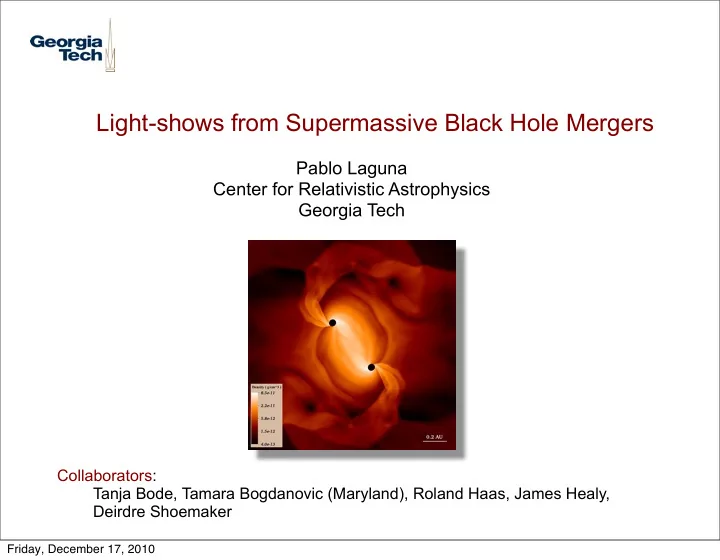
Light-shows from Supermassive Black Hole Mergers Pablo Laguna Center for Relativistic Astrophysics Georgia Tech Collaborators: Tanja Bode, Tamara Bogdanovic (Maryland), Roland Haas, James Healy, Deirdre Shoemaker Friday, December 17, 2010


slide-1
SLIDE 1

Light-shows from Supermassive Black Hole Mergers

Pablo Laguna Center for Relativistic Astrophysics Georgia Tech

Collaborators: Tanja Bode, Tamara Bogdanovic (Maryland), Roland Haas, James Healy, Deirdre Shoemaker

Friday, December 17, 2010

slide-2
SLIDE 2

The Driving Force behind Numerical Relativity

Numerical waveforms are essential on assisting to predict what to expect

Friday, December 17, 2010

slide-3
SLIDE 3

The Driving Force behind Numerical Relativity

Numerical waveforms are essential on assisting to predict what to expect

Friday, December 17, 2010

slide-4
SLIDE 4

The Driving Force behind Numerical Relativity

Numerical waveforms are essential on assisting to predict what to expect

Friday, December 17, 2010

slide-5
SLIDE 5

Template Banks & Matches

M1 (solar masses) M2 (solar masses) Matches to a M1 = 1.4, M2 = 1.4 template

BBH Parameter Space:

  • Masses
  • Spins
  • Eccentricity
  • Orientation
  • Time of arrival
  • Phase at arrival

Dirty Laundry & Needs:

  • Efficiency of codes
  • Accuracy needs not known
  • Limited parameter exploration
  • On demand simulations

Friday, December 17, 2010

slide-6
SLIDE 6

Synergy of EM & GW signatures in SMBH Mergers

GW Data:

  • Masses, spins (initial and final),
  • Luminosity Distance
  • Merger rates
  • Mapping the spacetime

EM + GW Data:

  • Improves sky localization
  • Identify host galaxy morphology
  • Tests of galaxy merger scenarios
  • Improves GW detection rates
  • Luminosity distance (GWs) and redshift (EM)

yield cosmological standard sirens.

  • Understanding BH accretion physics.
  • Test ground for GR (e.g. graviton’s speed)

LISA

SMBH binaries are one of the prime sources for LISA.

Friday, December 17, 2010

slide-7
SLIDE 7

Supermassive BH Mergers

Mergers of galaxies will very often lead to SMBH coalescences.

  • Galactic mergers scales: 102 kpc scales
  • BH binaries scales: few pc when binding and AU near coalescence
  • How do BHs reach the gravitational wave inspiral regime?
  • What is the role of the environment?

NGC 6240 Tremendous computational modeling grand challenge! 105 pc 10-5 pc

Friday, December 17, 2010

slide-8
SLIDE 8

SMBBH History in Gas-rich Environments

Colpi, Callegeri, Dotti & Mayer

rsep ~ 10 kpc:

  • Galactic cores drag the BHs with them.
  • Each BH (e.g.106 Msun) is surrounded

by a stellar and gaseous disk (108 Msun).

  • As disks merge, gas-dynamical friction

sinks the BHs to the center to form a pair.

Friday, December 17, 2010

slide-9
SLIDE 9

SMBBH History in Gas-rich Environments

Colpi, Callegeri, Dotti & Mayer

rsep ~ 10 pc: When the mass within their separation is less than the pair mass, the BHs bind and form a Keplerian binary. rsep ~ 1 pc:

  • 3-body interactions with the

surrounding stars help shrinking the binary.

  • Shrinking stalls when reservoir of

stars is depleted (Last parsec problem).

Friday, December 17, 2010

slide-10
SLIDE 10

Mayer+ 07

SMBBH History in Gas-rich Environments

rsep ~ 0.01pc:

  • Disk assisted binary shrinkage
  • Requires thin circumbinary disks.
  • More effective for un-equal mass binaries.
  • Maybe a retrograde disk is more effective.

Cuadra+ 09

rsep < 10-4 pc:

  • Gravitational radiation dominates the dynamics.
  • The most luminous sources of gravitational

radiation in the universe (∼ 1057 erg s−1)

  • An opportunity for variable or transient EM signal

(multi-messenger astrophysics).

Bode+ 10

Friday, December 17, 2010

slide-11
SLIDE 11

Relativistic mergers of SBHs

Surrounded by EM fields Surrounded by matter

(Palenzuela+ 09, 10; Mösta+ 10) (Bode+ 10; Farris+ 10)

Surrounded by test particles

(van Meter+ 09)

Friday, December 17, 2010

slide-12
SLIDE 12

What is the environment in the vicinity of BBHs?

  • Not well know at scales < 0.01 pc
  • Two physically motivated scenarios

depending on the balance of heating and cooling: Radiatively Inefficient Hot Gas: If cooling is inefficient, the BBH is immersed in a pressure supported, geometrically thick torus or cloud. kT ∼10−100 eV (UV,

  • ptical)

Circumbinary Disk: If cooling is relatively efficient, the gas settles into a rotationally supported geometrically accretion disk around the BBH. kT ∼ 0.1−1 MeV (hard X- ray, γ-ray) Chaotic Central Accretion: sequence of randomly oriented disks.

Friday, December 17, 2010

slide-13
SLIDE 13

We focus first on the hot gas cloud

Computational Infrastructure (Maya):

  • BSSN form of Einstein Eqs
  • 4th order accurate
  • CACTUS (parallelization)
  • CARPET (AMR, 9 refinement levels)
  • WHISKY (Hydro)
  • Horizon trackers
  • BH spin from killing vectors
  • No AGN feedback, no magnetic fields, no

radiative transfer.

q spins 1 1 1 q spins 1 1/2 1/2 Dirty Laundry & Need:

  • ~ 75% is spent on the Hydro
  • Bottle neck, resolving BHs
  • Hydro + BH AMR

Friday, December 17, 2010

slide-14
SLIDE 14

Gas Density

s1 = s2 = 0.6 s1 = -0.4 s2 = 0.4

Friday, December 17, 2010

slide-15
SLIDE 15

(Bode+ 09)

Bremsstrahlung luminosity

LBrem (1045 erg/s) t(M) s1= s2= 0.6

  • 700 -600 -500 -400 -300 -200 -100 0 100 200

10-3 10-2 10-2 10-1 100 rise sudden drop off quasi-periodic variability

Friday, December 17, 2010

slide-16
SLIDE 16

EM & GW emission

EM variability is due to relativistic beaming and boosting

(Bode+ 09)

  • 500 -400 -300 -200 -100 0

t(M) LBrem (1045 erg/ s) 10-1 100 101 100 101 102 s1= s2= +0.6 s1= s2= +0.4

Friday, December 17, 2010

slide-17
SLIDE 17

Dependence on Temperature

Friday, December 17, 2010

slide-18
SLIDE 18

Dependence on Mass Ratios and Spins

Friday, December 17, 2010

slide-19
SLIDE 19

Effects of unequal mass ratio and spin orientations

q=1/2 0.6

0.6

Friday, December 17, 2010

slide-20
SLIDE 20

Effects of unequal mass ratio and spin orientations

q=1/2 0.6

0.6

Friday, December 17, 2010

slide-21
SLIDE 21

Effects of unequal mass ratio and spin orientations

q=1/2 0.6

0.6

Friday, December 17, 2010

slide-22
SLIDE 22

Preview: Merger of SBHs in a circumbinary disk

  • Late inspiral and merger (BH separation

8M)

  • Equal and unequal mass, spinning BHs
  • Initially, orbital plane in the plane of the

disk

  • Pressure supported disk, h/r = 0.2, inner

edge at 16M

  • Not modeled: AGN feedback, radiative

cooling, magnetic fields, viscosity.

q spins 1 1/2 1/2

Friday, December 17, 2010

slide-23
SLIDE 23

BBH + Circumbinary Disk

Bode, Bogdanovic, Haas, Healy, Laguna, Shoemaker, in preparation

Friday, December 17, 2010

slide-24
SLIDE 24

BBH + Circumbinary Disk

Bode, Bogdanovic, Haas, Healy, Laguna, Shoemaker, in preparation

Friday, December 17, 2010

slide-25
SLIDE 25

BBH + Circumbinary Disk

Bode, Bogdanovic, Haas, Healy, Laguna, Shoemaker, in preparation

Friday, December 17, 2010

slide-26
SLIDE 26

Luminosity

Friday, December 17, 2010

slide-27
SLIDE 27

Conclusions

  • Hot accretion flow:

– Correlated EM+GW chirp-like oscillations. – Luminosity drop-off a robust signature.

  • Circumbinary disk:

– Binary promptly clears the gas from the central region,more pronounced for generic binary configurations. – Comparable luminosity from the gap region between BBH and single BH case.

  • Current (lack of) observational evidence equally favors

circumbinary disk.

Friday, December 17, 2010

slide-28
SLIDE 28

Conclusions

  • We carried out fully general relativistic simulations of generic

SMBH binary mergers in different astrophysical environments.

  • In the absence of information regarding the environment

surrounding the binary, our best option is to explore a range of scenarios and look for characteristic features (flares, variability).

  • These are prototype simulations. Follow-up work is needed to

explore more astrophysically plausible configurations (MHD, cooling, radiative transfer)

  • The marriage between GR and Hydro needs to be improved

(e.g. AMR, implicit-explicit time-stepping)

Friday, December 17, 2010