
SLIDE 1
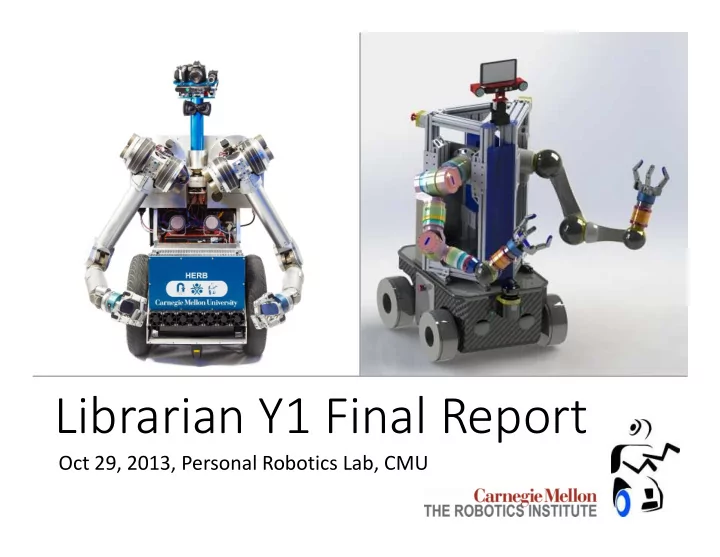
Librarian Y1 Final Report
Oct 29, 2013, Personal Robotics Lab, CMU
Librarian Y1 Final Report Oct 29, 2013, Personal Robotics Lab, CMU - - PowerPoint PPT Presentation
Librarian Y1 Final Report Oct 29, 2013, Personal Robotics Lab, CMU Y1 Statement of Work Trimester 1: Infrastructure Setup and Initial Evaluation D1-1: Planning environment with kinematic model of Toyota robot, objects and
Oct 29, 2013, Personal Robotics Lab, CMU
Y1 Statement of Work
based actions”
Pregrasp Manipulation as Trajectory Optimization
Jennifer King, Matthew Klingensmith, Christopher Dellin, Mehmet Dogar, Prasanna Velagapudi, Nancy Pollard, and Siddhartha Srinivasa, "Pregrasp Manipulation as Trajectory Optimization," In Proc. of Robotics: Science and Systems, June, 2013.
1 2 3 4 5 6 7 8
Seconds (s)
Computation Time
100 200 300 400 500 600 700
Cost
10 20 30 40 50 60 70 80 90 100
Percentage (%)
Success Rate
606.67 531.11 64.28 83.33 6.643 3.91
reconfiguration and transport in multistage plans
Non-prehensile push
Pick-and-place
Pregrasp Manipulation as Trajectory Optimization
Reconfiguration (pushing) Transport (pick-and-place)
Reconfiguration Cost Transport Cost
Pregrasp Manipulation as Trajectory Optimization
to a Dubins car
Pregrasp Manipulation as Trajectory Optimization
Hybrid Symbolic/Physical planning for manipulation
wrapper for task planning
execution with symbolic representations
art FastDownward planner
HERB and TIM
Initial state:
aware_of_object(bookcase) &
is_loc(test_loc3) & is_loc(bookcase_place) & aware_of_object(dracula) & is_clear(bookcase)…
Plan:
grasp_from_bookshelf('dracula') goto_place_obj_at('dracula','hando ff') hand_obj_at('dracula','handoff') teleport_book('dracula','table') edge_grasp('dracula','table') goto('bookcase_place') place_in_bookcase('dracula')
Goals:
Machine Learning for Error Avoidance
Predicting Errors using Machine Learning
Hypothesis: some errors can be avoided by learning relationships with single physical variables
Predicting Errors using Machine Learning
Hypothesis: some errors can be avoided by learning relationships with single physical variables Classification tree:
Constraint Learning from Subactions
'sub-action‘ within each PDDL action
constraints or costs in CBiRRT, CHOMP, etc.
Learned constraints for grasp_from_bookshelf (Dataset of 20 trials on HERB):
======================================================= Action: PlanToNamedConfiguration1_start robot|relative|dracula|locX<=-1.120: False (100.00%) robot|relative|dracula|locX>-1.120 | robot|locY>1.655: True (100.00%) | robot|locY<=1.655 | | robot|relative|dracula|locX<=-1.075: True (100.00%) | | robot|relative|dracula|locX>-1.075: False (100.00%) ======================================================= Action: PlanToNamedConfiguration1_end right_ee|locX<=-1.025: False (100.00%) right_ee|locX>-1.025 | right_ee|relative|dracula|locY>-0.435: True (100.00%) | right_ee|relative|dracula|locY<=-0.435 | | right_ee|relative|dracula|locZ<=-0.925: True (100.00%) | | right_ee|relative|dracula|locZ>-0.925 | | | right_ee|locX<=-1.005: True (100.00%) | | | right_ee|locX>-1.005: False (100.00%)
grasp_from_bookshelf:
PlanToNamedConfiguration RotateSegway right_arm.PlanToConfiguration DriveStraightUntilForce …
PDDLpy w/ Backtracking
Current symbolic state Current PDDL Plan Execution History
State Estimation with Contact Sensors
physical interaction with objects
introduce uncertainty
suffer from hand occlusions
discriminative:
no contact
Using sensor feedback to track the object’s belief state
Michael C. Koval, Mehmet R. Dogar, Nancy S. Pollard, Siddhartha S. Srinivasa . “Pose Estimation for Contact Manipulation with Manifold Particle Filters ,” In Proc. of IEEE/RSJ International Conference on Intelligent Robots and Systems, 2013
Conventional Particle Filter
Represents using a set of weighted samples Algorithm: 1. Sample from 2. Weight by 3. Resample according to the particles’ weights “Forward simulate, then weight using the observation”
Degenerate Proposal Distribution
x y θ
Manifold Particle Filter
Algorithm: 1. Decide if there was contact 2. If , then sample from the dual proposal 3. Otherwise, sample from the conventional proposal “Sample from the observation, then weight using history”
Results: CPF vs MPF
TIMpy/HERBpy/PrPy Infrastructure
and HERB
between platforms
to allow remote development
HERB/Tim Infrastructure
OWD/Schunk controller segwayrmp/ neobotix moped3d ROS Nodes OWD/IPA BHD Controller Base Controller Marker System OpenRAVE OpenRAVE Multicontroller Grab PushGrasp OpenDoor HerbPy PrPy PDDLPy PressButton Python API Task Planning HERBpy/TIMpy PrPy
OpenRAVE URDF Loader
import of URDF files
OpenRAVE Kinbody
Positioning relative joints
manual
parameter file
Personal Robotics APT server
(packages.personalrobotics.ri.cmu.edu)
Y2 - Timeline
Task Nov-Jan Feb Book Manipulation Multi-hand Grasping
with dual arm control Evaluation Reflection TIM integration Error Handling Showing error recovery and improvement
planning) Evaluation Reflection TIM integration Multimodal Manipulation Investigation of tactile sensors and finger variations
and grasping Evaluation Reflection TIM integration
Phase 2.1 Nov 2013-Feb 2014
Y2 - Timeline
Task Mar-May Jun Book Manipulation Multi-hand Grasping
Evaluation Reflection TIM integration Error Handling Streamline error handling and learned feedback
planning) Evaluation Reflection TIM integration Multimodal Manipulation Investigation of tactile sensors and finger variations
simulation) Evaluation Reflection TIM integration
Phase 2.2 Mar 2014-June 2014
Y2 - Timeline
Task July-September October General Manipulation Multi-hand Grasping
grasping Evaluation Reflection TIM integration FINAL REPORT Error Handling Showing error recovery and improvement
improvements
processes for dealing with errors Evaluation Reflection TIM integration FINAL REPORT Multimodal Manipulation Investigation of tactile sensors and finger variations
errors (e.g. increase gripping force and /or bringing a second hand to support the object from dropping) Evaluation Reflection TIM integration FINAL REPORT
Phase 2.3 July 2014-Oct 2014
Y2 – Statement of Work
Generalized pushing across object shapes
Error avoidance task-based framework
Preliminary results on MPF with tactile sensing
Multi-hand primitives for physics-based manipulation
Physics-aware symbolic planning
Full book manipulation, grocery bag pipeline on HERB and TEMA robot
Integrated task and primitive planning framework
Y2 - Personnel
Oct 29, 2013, Personal Robotics Lab, CMU