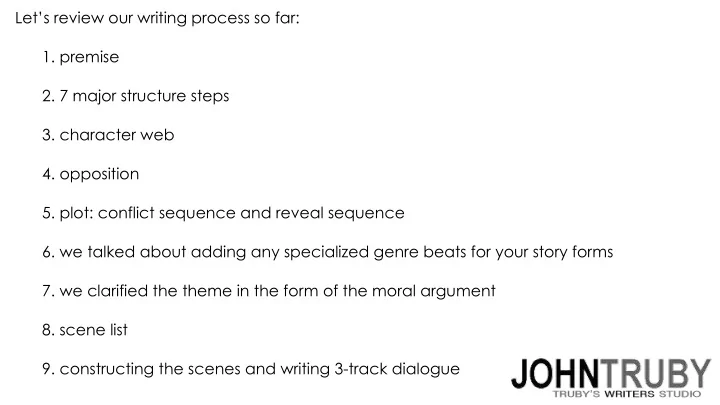
SLIDE 1 Let’s review our writing process so far:
- 1. premise
- 2. 7 major structure steps
- 3. character web
- 4. opposition
- 5. plot: conflict sequence and reveal sequence
- 6. we talked about adding any specialized genre beats for your story forms
- 7. we clarified the theme in the form of the moral argument
- 8. scene list
- 9. constructing the scenes and writing 3-track dialogue
SLIDE 2
- how to mix genres the right way
- multiple hero stories and multiple POVs
- character web and 4-point opposition
- key techniques for writing a successful multi-hero, multi-POV story
- branching story shape
- writers’ work
- questions
SLIDE 3
Problem: you can't write a popular story without combining two or three major genres.
SLIDE 4
Key point: almost every writer in this group is combining 2-4 genres.
SLIDE 5
Make sure you use all the beats from your main genre.
SLIDE 6
How do you choose the primary genre? Rule of thumb: the technical genres are usually primary.
SLIDE 7
Use the first two scenes to establish the two heroes, preferably with a crisis.
SLIDE 8
Set up an outside desire – this is the action goal. The desire for each other in love will come as they go after the outside goal together.
SLIDE 9
The conflict between the two lovers is the gold of the buddy picture love story.
SLIDE 10
This is the dance, why they must go through life together, and they dance really well.
SLIDE 11
Instead of tracking the development of a single character, ensemble stories compare what many heroes are doing and feeling at about the same time.
SLIDE 12
Key point: everyone is trapped in the system in some way, even the most powerful characters.
SLIDE 13
A story about a team is not structured like a multi-hero story. Examples: Seven Samurai, Guardians of the Galaxy, The Avengers, Galaxy Quest
SLIDE 14
Caution: the vast majority of you are not writing multi-hero stories.
SLIDE 15
Key point: if you want your multi-hero story to be successful, the same premise checklist applies.
SLIDE 16
The Help: When a naïve Southern white woman sees how white bosses treat their African American maids, she decides to secretly write a book about the maids, only to face harsh reprisals by the social elite that turn the town upside down.
SLIDE 17
When writing a multi-hero story, the essential technique to use is at least a 4-point opposition, and probably more.
SLIDE 18 Instead of 1 hero vs. 1 main and at least 2 secondary opponents, you have at least 4 main characters set in
- pposition or in contrast to each other.
SLIDE 19
Make sure every character plays a key role in some larger system. The Help: racist America Traffic: the drug business LA Confidential: the justice system
SLIDE 20
Key to success: you must keep multiple heroes and multiple POVs from killing narrative drive. It’s all about creating a plot that builds.
SLIDE 21
The 7 steps for each character should converge at a vortex point.
SLIDE 22 Make the hero of one storyline the
For example, Hannah and Her Sisters, L.
- A. Confidential, Pulp Fiction
SLIDE 23
Caution: you don’t have to use all 7 of these techniques.
SLIDE 24
Multiple hero stories use one of the advanced story structures, known as a branching story shape.
SLIDE 25
Caution: watch out for too many characters and/or storytellers.
SLIDE 26
Key rule: the more storytellers you have, the more you risk distancing the audience.
SLIDE 27 Assignment for next class IF YOU ARE WRITING SCENES FOR YOUR STORY:
- 1. write the next three scenes in the story where there is dialogue
Be sure to start by listing the premise in 1 line
- 2. write your hero’s weakness in 1 line
- 3. write the endpoint of your hero’s character change
ie, his or her self-revelation
SLIDE 28 Assignment for next class IF YOUR STORY IS AT ANY OTHER STEP OF THE WRITING PROCESS
- 4. follow the instructions for that month’s assignment
- 5. send in any question about story in general or
about your story in particular.
SLIDE 29
Caution: don’t skip a step in the writing process! For each new story idea, start with the Premise assignment and work through the steps in order.
SLIDE 30
Remember: hand in only one assignment at a time.
SLIDE 31
Next class: Wednesday, October 18
SLIDE 32
Hawaii Anatomy of Story Class May 18–20, 2018 Honolulu, Hawaii Reserve your seat at: https:// writerscoloringbook.com/