Legislative Water Commission April 23, 2018 Co-chairs: Senator - - PowerPoint PPT Presentation

legislative water commission april 23 2018
SMART_READER_LITE
LIVE PREVIEW

Legislative Water Commission April 23, 2018 Co-chairs: Senator - - PowerPoint PPT Presentation

Legislative Water Commission April 23, 2018 Co-chairs: Senator Wiger Representative Torkelson Jim Stark, Director Straight River, Becker County 1 Agenda Approve minutes -- March 26 Geologic atlas program Clean


slide-1
SLIDE 1

1

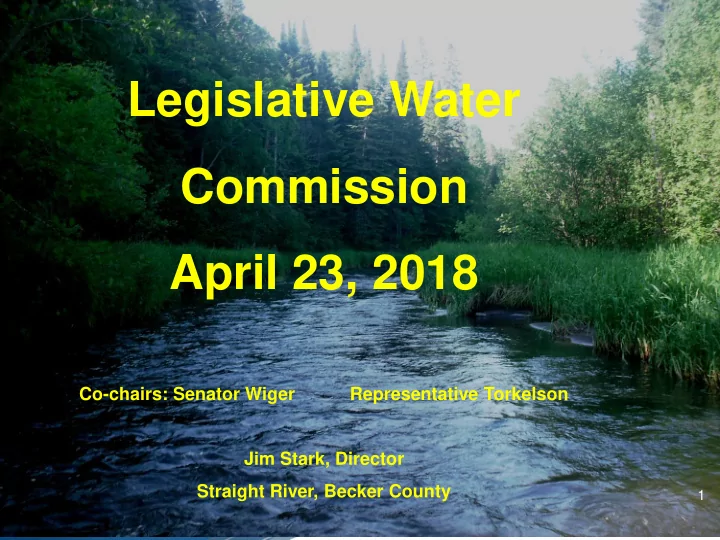
Legislative Water Commission April 23, 2018

Co-chairs: Senator Wiger Representative Torkelson Jim Stark, Director Straight River, Becker County
slide-2
SLIDE 2

Agenda

  • Approve minutes -- March 26
  • Geologic atlas program
  • Clean Water Fund: performance report
  • 2018 LWC recommendations
  • 2019 LWC process
  • Summer tour
  • Updates on water legislation
  • Next meetings: June 19
slide-3
SLIDE 3

Issue Presentation: Geologic Atlas Program

  • Dale Setterholm–

Minnesota Geological Survey

  • Paul Putzier– DNR
  • Ray Wuolo- Barr

Engineering

slide-4
SLIDE 4

County Geologic Atlas Program

Dale Setterholm Minnesota Geological Survey University of Minnesota

slide-5
SLIDE 5

Foundational information essential to water management:

Geology determines:

  • Where can we obtain water? Aquifer depths and

boundaries

  • Connections from the land surface to aquifers

(recharge)

  • Connections from aquifers to the land surface

(discharge) or surface water bodies

  • Who shares an aquifer (database of wells)?
  • Composition and age of ground water in aquifer

systems

slide-6
SLIDE 6

Information used in water management at all levels:

To support:

  • water appropriation decisions (DNR)
  • wellhead protection plans and well construction

practices (MDH)

  • meaningful monitoring (multiple parties)
  • spill response and design of remediation (MPCA)
  • groundwater models (Met Council, DNR, others)
  • permit decisions (including local government)
  • land use planning
  • mineral resource management
slide-7
SLIDE 7

Information used by cities, counties, businesses, and citizens

  • What aquifers are available to me, how deep?
  • Where is our water most vulnerable?
  • User’s Guide to Geologic Atlases- non-

technical explanation especially helpful to decision-makers

  • Maps and databases available in digital or

paper formats

  • Information that does not lose value over time
  • A framework for more detailed investigations
slide-8
SLIDE 8
slide-9
SLIDE 9

Program Status

  • Striving for 4 or 5 completed counties

per year (each project takes 3 to 4 years)

  • Part A requires about $2.1 million/year
  • MGS relies on funding from LCCMR,

CWF, DNR contract, federal cost- sharing, and in-kind service from counties.

  • Projected to finish statewide coverage

about 2026.

slide-10
SLIDE 10
slide-11
SLIDE 11
slide-12
SLIDE 12

County Geologic Atlas Program

12

April 2018

slide-13
SLIDE 13

Who Uses the County Geologic Atlas?

  • Private Citizens
  • Business & Industry
  • Agriculture
  • Environmental Consultants
  • Counties
  • County Planning Commission/Planning Staff, Water Plan Task Force,

Environmental Services Department staff, Public Works, County Engineer

  • Soil Water Conservation District (SWCD) & County Conservation Districts (CD)
  • SWCD Managers, Technical Service staff, Watershed Project Managers
  • Cities
  • Planning Commission/Planning Staff, City Engineering Staff, Public Works

Staff – Waterworks

  • Townships
  • Township Board of Supervisors, Township Planning Commission
  • State & Federal Agencies
  • MPCA, MNDOT, MDA, MDH, BWSR, USGS

13

slide-14
SLIDE 14

How are the County Geologic Atlases Being Used?

14

County Projects Jerry Spetzman, Administrator Chisago Lakes-Lake Improvement District, Chisago County “Chisago County uses the County Atlas to help inform land use policy

  • decisions. Specific examples include: the Pollution Sensitivity of Near-

Surface Materials map was used to help determine the location of a natural burial cemetery; the Bedrock Geology map was used to determine if sufficient quantities of ground water was available to cool a natural gas power plant; the sand distribution model was used to inform frac sand mining policy. The maps (in the Atlas) provide an abundance of useful information. The map layers have been added to the Chisago County website as part of the interactive GIS map and are available for public use.” Geothermal & Agricultural Projects Rob Vix, Drilling Manager, Traut Companies, Inc. “For agriculture projects the atlas helps when looking for potential high capacity wells or difficult sites by giving us some ideas of how much unconsolidated geology is available. I use digital copies of the county atlas on a regular basis. The county atlas maps provides some idea of how feasible a geothermal project is.

slide-15
SLIDE 15

How are the County Geologic Atlases Being Used?

Consulting Hydrogeologist

Kristi Anderson, Hydrogeologist, Northwest AqwaTek Solutions “The majority of what I do is working with the agricultural community

  • n water appropriation permits for crop irrigation systems; which are

critical to successful farming in Minnesota. I typically look to the County Geologic Atlas (CGA)….as the starting point in my work.”

15

County Projects Amanda Guertin, Benton SWCD Water Plan Technician, Benton County. “I have been using the Atlas pretty frequently. After the Atlas was released we created a Sensitive Areas Management Plan (SAMP) to identify sensitive areas of the County that should be protected from development or disturbance due to critical, vulnerable, or rare water resources. The SAMP overlays the County Atlas data … to create a map showing the degree of sensitivity throughout the County. Our office uses this plan, along with the Water Plan extensively to guide our focus for project implementation and the County Department of Development also uses the plans regularly.”

slide-16
SLIDE 16
slide-17
SLIDE 17

Hydrogeologic Cross-Section

Recharge Zone

slide-18
SLIDE 18

Pollution Sensitivity of the cse aquifer

slide-19
SLIDE 19

Rainfall Runoff Runoff Evapotranspiration Evaporation water table Groundwater flow

Water Balance Water In = Water Out

slide-20
SLIDE 20

Rainfall Evapotranspiration Evaporation water table Groundwater flow

X

Water Balance Key to Understanding Water Sustainability

slide-21
SLIDE 21

Rainfall/Snow evapotranspiration runoff runoff infiltration (Recharge to Groundwater) Geology, Groundwater Levels stream baseflow

Geology is important BUT it

  • nly one part of the puzzle

The groundwater “container”

slide-22
SLIDE 22

Mississippi River at Clearwater, MN (September 2012)

Clean Water Fund Performance

slide-23
SLIDE 23

CWF FY18-19-- Funding

  • Implementation: $105 M
  • Planning/Tech Assist. $67 M
  • Monitoring/Mapping/Data:

$41 M

  • Research/Evaluation $8 M
  • Total: $221 M/biennium
  • Emphasis on impaired water
  • Entire state assessed
  • Focus on local implementation
slide-24
SLIDE 24

CWF Goals and Expectations - 2034

Lake Quality: + 7-8% Acceptable Lake Tropic Status: from 62% to 70% Rivers: Fish IBI: from 60% to 67% Wells-arsenic standard: (reduce by 50%) Wells: nitrate standard (reduce by 20 %) GW declines (less than 10% declining)

slide-25
SLIDE 25

Progress and Citizen Expectations

Improvements seem small ? Lag-time External drivers: (land use, climate, economy,

trade, population)

2034 is coming/Citizen expectations Can outcomes be improved? Can LWC support additional change?

slide-26
SLIDE 26

Katie Pratt

Director of Communications and Public Engagement katie.pratt@state.mn.us

#25by25MN

Minnesota’s Water Quality Improvement Goal

slide-27
SLIDE 27

Citizens Said:

+ Education and engagement

+ Water retention + More GOV/public involvement + Local planning Focus on drinking water Reduce salt Inadequate septic systems Focus funding Focus on incentives

slide-28
SLIDE 28

2019 Focus for the LWC Recommendations-2018

From a sustainability perspective, a key point is that decisions today may not be fully realized for many years

slide-29
SLIDE 29

Alternatives for WWTPs Peer review of waste-water standards Promote WWTP efficiency/alternatives PFA Bonding request $167M

slide-30
SLIDE 30

Agenda: Discussion--2019 LWC Process

30

slide-31
SLIDE 31

2019 LWC Recommendation Discussion

  • Water trading- Storm water for wastewater
  • Water for the future
  • Water retention
  • Private wells
  • Public drinking water
  • Evaluate past BMPs
  • Evaluate water management
  • Many more………………..
slide-32
SLIDE 32

Schedule 2019?

  • Issues with narratives: April
  • LWC Consensus--top 3: after session

(short and long term issues)

  • Expert input: summer
  • Recommendation by issue: Fall
  • Recommendation consensus: Fall
  • Document to support legislation:

(December)

slide-33
SLIDE 33

Discussion: LWC summer issue tour

  • One day?
  • Select an issue:

* Water retention/infiltration * Lakes with problems * Drinking water * Groundwater/surface water * Others? Poll LAs for possible dates Watch for email

33

slide-34
SLIDE 34

Updates on Water Legislation Announcements: Water Day at the Capitol

slide-35
SLIDE 35

Thanks

The well was dry beside the door, And so we went with pail and can Across the fields behind the house To seek the brook if it still ran. “Going for Water”-- Robert Frost