Legislative Updates FY 2021 Regular Appropriations NASCSP and other - - PDF document

legislative updates
SMART_READER_LITE
LIVE PREVIEW

Legislative Updates FY 2021 Regular Appropriations NASCSP and other - - PDF document

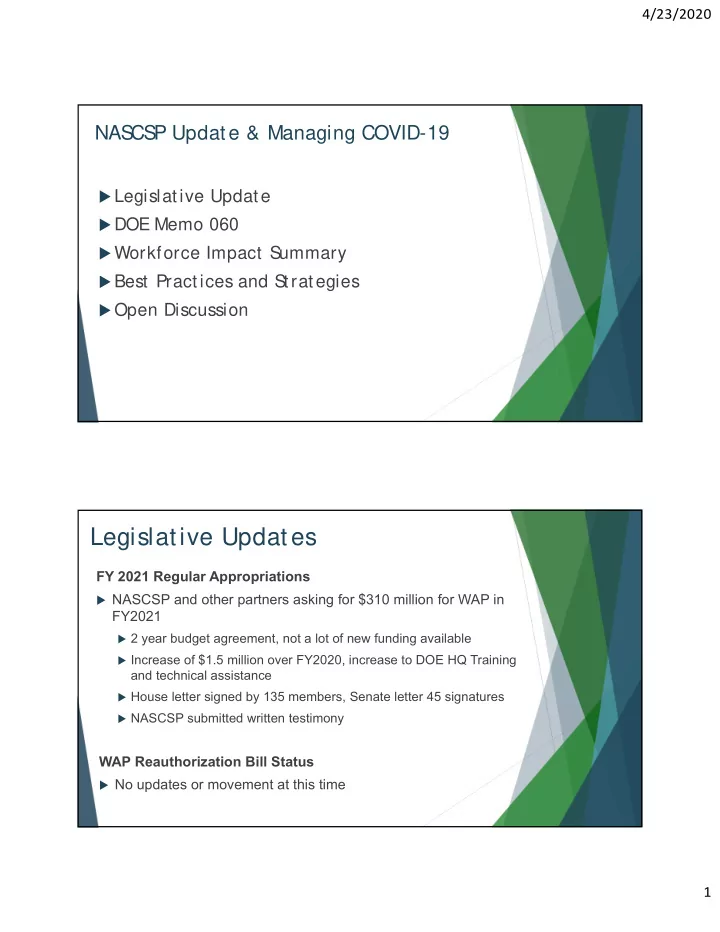
4/23/2020 NAS CS P Update & Managing COVID-19 Legislative Update DOE Memo 060 Workforce Impact S ummary Best Practices and S trategies Open Discussion Legislative Updates FY 2021 Regular Appropriations NASCSP and


slide-1
SLIDE 1

4/23/2020 1

NAS CS P Update & Managing COVID-19

 Legislative Update  DOE Memo 060  Workforce Impact S

ummary

 Best Practices and S

trategies

 Open Discussion

Legislative Updates

FY 2021 Regular Appropriations

 NASCSP and other partners asking for $310 million for WAP in

FY2021

 2 year budget agreement, not a lot of new funding available  Increase of $1.5 million over FY2020, increase to DOE HQ Training

and technical assistance

 House letter signed by 135 members, Senate letter 45 signatures  NASCSP submitted written testimony

WAP Reauthorization Bill Status

 No updates or movement at this time

slide-2
SLIDE 2

4/23/2020 2

Legislative Updates

NASCSP asked Congressional champions for the provisions

  • below. Did not make it into Package #3, but hopefully future bill.

Primary

Increase the average cost per unit (ACPU) for the current grant cycle (including 2020). Provide authority for the S ecretary to adj ust or waive the ACPU in times of emergency, disaster, pandemic, economic crisis or other event impact ing weatherization. Secondary

Increase allowable administrative costs percentage from 10% to 15%

Change re-weatherization date to 15 year rolling to allow WAP staff to begin reviewing previously weatherized lists, doing intake with potential clients, and building wait lists while production is stopped.

Double the cost cap for solar to incentivize solar training and building organizational capacity for future solar installs while production is shut down.

DOE Memo 60

Options DOE will allow in response to Coronavirus and the pause in production:

 Carryover of PY 2019 funds and extend grant periods  Shift units and expenditures to another funding source such as LIHEAP  Roll PY 2019 and 2020 into one budget period (including extensions) and use of $7,669

for the ACPU for entire budget period

 Work with Grantees on an individual basis to adjust performance periods, as needed  Extend flexibility in meeting on-site monitoring requirements  Continue to review and approve 2020 plan submissions and awards as scheduled  Extend HEP certification timeframes – August 2020  Work with network to develop and promote online training resources
slide-3
SLIDE 3

4/23/2020 3

Grantee Guidance and Management

Developed state-specific guidance for COVID-19 operations

S hared DOE Memo 60, CAPLAW guidance, NAS CS P and other resources

Holding regular virtual meetings or teleconferences with subgrantees (weekly)

Temporarily changed policy to allow for partial draws to pay contractors but requiring 10% holdback if j obs have not been QCI inspected

Encouraging subgrantees invest in workforce development and use T&TA for salaries

  • Each agency created employee-specific training plans and client safety protocols
  • Providing daily training webinars and topics accessible by laptop and smart phone

Allowing use of Admin and Operations funds to pay staff while working remote

  • First use available T&TA, then program operations while staying within ACPU

Utilizing alternative funding sources and leave to pay for salaries

Utilize more LIHEAP funds to stay under ACPU.

Workforce Impacts

Grantee & subgrantee staff working remotely

Moving to virtual application intake and allowing for electronic signatures

S

  • me subgrantees are able to redirect their weatherization crews to assist with other

duties, such as working on other federal programs

S

  • me subgrantees opting for furloughs, layoffs and unemployment
  • We do not anticipate many lay offs if the workforce is able to S

AFEL Y enter homes soon

Concern about loss of contractors and contractor staff

  • A prolonged stoppage will likely put some out of business

Moving toward a new normal: planning for re-entry into client homes

  • Updating client education tools and safety protocols
  • None of our subgrantees want to put their workforce in danger
  • Concern about availability of Personal Protective Equipment
slide-4
SLIDE 4

4/23/2020 4

Production & Workforce Impacts

Are subgrantee WAP staff being asked to use earned leave? Are subgrantee WAP staff currently furloughed? Y es 3 11 No 26 32 Unsure 17 3

Are WAP workers entering client homes in your state or territory?

38 10 5

No Yes Only Emergencies

Best Practices and S trategies – COVID-19

 Grantee training on state specific guidance documents

 Health and S

afety plan

 S

tate Plan

 S

tate Field Guides

 Deferral data gathering and tracking

  • Work with S

ubgrantees

  • Work with system providers

 Energy Audit Approval S

ubmissions

  • Annual update to audit libraries
  • Attend software specific trainings
slide-5
SLIDE 5

4/23/2020 5

Best Practices and S trategies – COVID-19

 Complete online training – see NAS

CS P COVID page

 Procurement and purchase of increased PPE  Equipment and Inventory

  • Vehicle Maintenance
  • Vehicle Purchase

 Client Education  Development of success stories  S

trategic planning to meet production goals

 Increase contractor base for ramp up  Train staff

https:/ / nascsp.org/ coronavirus-resources/ nascsp-resources-on-covid/

slide-6
SLIDE 6

4/23/2020 6

Open Discussion

Thanks for attending!

Amy Klusmeier, WAP Director aklusmeier@ nascsp.org | 202-370-3661 Andrea S chroer, WAP Program Manager aschroer@ nascsp.org | 202-370-3666