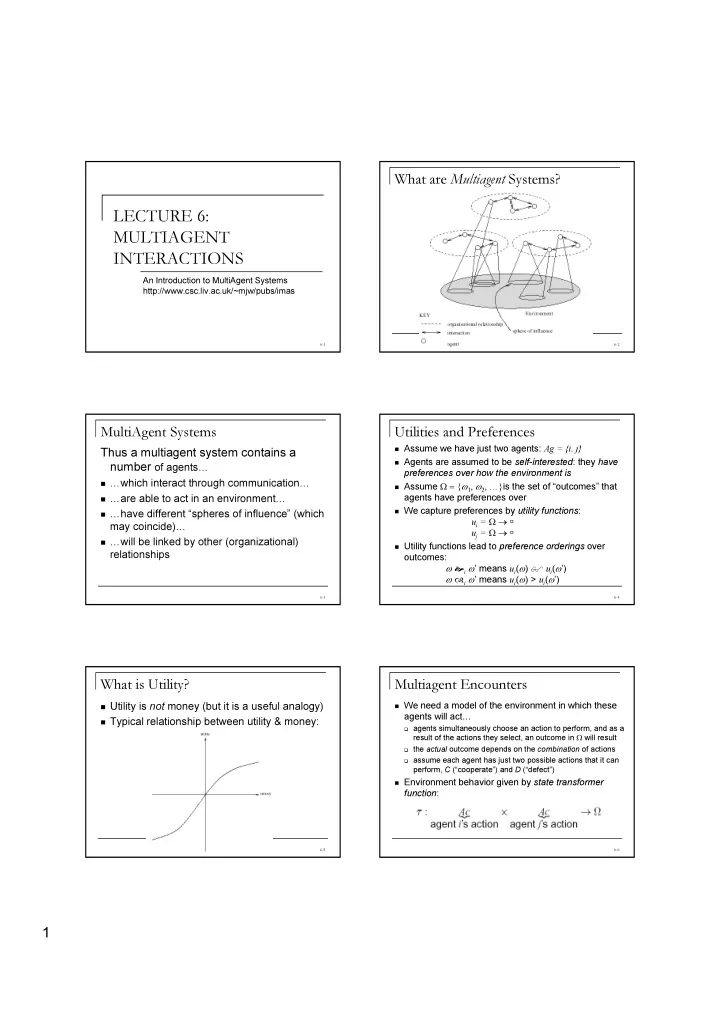
LECTURE 6: MULTIAGENT INTERACTIONS An Introduction to MultiAgent - - PDF document

lecture 6 multiagent interactions
SMART_READER_LITE
LIVE PREVIEW

LECTURE 6: MULTIAGENT INTERACTIONS An Introduction to MultiAgent - - PDF document

What are Multiagent Systems? LECTURE 6: MULTIAGENT INTERACTIONS An Introduction to MultiAgent Systems http://www.csc.liv.ac.uk/~mjw/pubs/imas 6-1 6-2 MultiAgent Systems Utilities and Preferences Assume we have just two agents: Ag = {i,


slide-1
SLIDE 1

1

6-1

LECTURE 6: MULTIAGENT INTERACTIONS

An Introduction to MultiAgent Systems http://www.csc.liv.ac.uk/~mjw/pubs/imas

6-2

What are Multiagent Systems?

6-3

MultiAgent Systems

Thus a multiagent system contains a number of agents…

…which interact through communication… …are able to act in an environment… …have different “spheres of influence” (which

may coincide)…

…will be linked by other (organizational)

relationships

6-4

Utilities and Preferences

Assume we have just two agents: Ag = {i, j} Agents are assumed to be self-interested: they have

preferences over how the environment is

Assume Ω = {ω1, ω2, …}is the set of “outcomes” that

agents have preferences over

We capture preferences by utility functions:

ui = Ω → uj = Ω →

Utility functions lead to preference orderings over

  • utcomes:

ω i ω’ means ui(ω) ui(ω’) ω i ω’ means ui(ω) > ui(ω’)

6-5

What is Utility?

Utility is not money (but it is a useful analogy) Typical relationship between utility & money:

6-6

Multiagent Encounters

We need a model of the environment in which these

agents will act…

agents simultaneously choose an action to perform, and as a

result of the actions they select, an outcome in Ω will result

the actual outcome depends on the combination of actions assume each agent has just two possible actions that it can

perform, C (“cooperate”) and D (“defect”)

Environment behavior given by state transformer

function:

slide-2
SLIDE 2

2

6-7

Multiagent Encounters

Here is a state transformer function:

(This environment is sensitive to actions of both agents.)

Here is another:

(Neither agent has any influence in this environment.)

And here is another:

(This environment is controlled by j.)

6-8

Rational Action

Suppose we have the case where both agents can

influence the outcome, and they have utility functions as follows:

With a bit of abuse of notation: Then agent i’s preferences are: “C” is the rational choice for i.

(Because i prefers all outcomes that arise through C

  • ver all outcomes that arise through D.)

6-9

Payoff Matrices

We can characterize the previous scenario in

a payoff matrix:

Agent i is the column player Agent j is the row player

6-10

Dominant Strategies

Given any particular strategy (either C or D) of agent

i, there will be a number of possible outcomes

We say s1 dominates s2 if every outcome possible by i

playing s1 is preferred over every outcome possible by i playing s2

A rational agent will never play a dominated strategy So in deciding what to do, we can delete dominated

strategies

Unfortunately, there isn’t always a unique

undominated strategy

6-11

Nash Equilibrium

  • In general, we will say that two strategies s1 and s2

are in Nash equilibrium if:

1.

under the assumption that agent i plays s1, agent j can do no better than play s2; and

2.

under the assumption that agent j plays s2, agent i can do no better than play s1.

  • Neither agent has any incentive to deviate from a

Nash equilibrium

  • Unfortunately:

1.

Not every interaction scenario has a Nash equilibrium

2.

Some interaction scenarios have more than one Nash equilibrium

6-12

Competitive and Zero-Sum Interactions

Where preferences of agents are

diametrically opposed we have strictly competitive scenarios

Zero-sum encounters are those where utilities

sum to zero: ui(ω) + uj(ω) = 0 for all ω Ω

Zero sum implies strictly competitive Zero sum encounters in real life are very rare

… but people tend to act in many scenarios as if they were zero sum

slide-3
SLIDE 3

3

6-13

The Prisoner’s Dilemma

Two men are collectively charged with a

crime and held in separate cells, with no way

  • f meeting or communicating. They are told

that:

if one confesses and the other does not, the

confessor will be freed, and the other will be jailed for three years

if both confess, then each will be jailed for two

years

Both prisoners know that if neither confesses,

then they will each be jailed for one year

6-14

The Prisoner’s Dilemma

Payoff matrix for

prisoner’s dilemma:

Top left: If both defect, then both get

punishment for mutual defection

Top right: If i cooperates and j defects, i gets

sucker’s payoff of 1, while j gets 4

Bottom left: If j cooperates and i defects, j

gets sucker’s payoff of 1, while i gets 4

Bottom right: Reward for mutual cooperation

6-15

The Prisoner’s Dilemma

The individual rational action is defect

This guarantees a payoff of no worse than 2, whereas cooperating guarantees a payoff of at most 1

So defection is the best response to all

possible strategies: both agents defect, and get payoff = 2

But intuition says this is not the best outcome:

Surely they should both cooperate and each get payoff of 3!

6-16

The Prisoner’s Dilemma

This apparent paradox is the fundamental

problem of multi-agent interactions. It appears to imply that cooperation will not

  • ccur in societies of self-interested agents.

Real world examples:

nuclear arms reduction (“why don’t I keep mine. . . ”) free rider systems — public transport; in the UK — television licenses.

The prisoner’s dilemma is ubiquitous. Can we recover cooperation?

6-17

Arguments for Recovering Cooperation

Conclusions that some have drawn from this

analysis:

the game theory notion of rational action is wrong! somehow the dilemma is being formulated

wrongly

Arguments to recover cooperation:

We are not all Machiavelli! The other prisoner is my twin! The shadow of the future…

6-18

The Iterated Prisoner’s Dilemma

One answer: play the game more than once If you know you will be meeting your

  • pponent again, then the incentive to defect

appears to evaporate

Cooperation is the rational choice in the

infinititely repeated prisoner’s dilemma (Hurrah!)

slide-4
SLIDE 4

4

6-19

Backwards Induction

But…suppose you both know that you will

play the game exactly n times On round n - 1, you have an incentive to defect, to gain that extra bit of payoff… But this makes round n – 2 the last “real”, and so you have an incentive to defect there, too. This is the backwards induction problem.

Playing the prisoner’s dilemma with a fixed,

finite, pre-determined, commonly known number of rounds, defection is the best strategy

6-20

Axelrod’s Tournament

Suppose you play iterated prisoner’s dilemma

against a range of opponents… What strategy should you choose, so as to maximize your overall payoff?

Axelrod (1984) investigated this problem, with

a computer tournament for programs playing the prisoner’s dilemma

6-21

Strategies in Axelrod’s Tournament

  • ALLD:
  • “Always defect” — the hawk strategy;
  • TIT-FOR-TAT:

1.

On round u = 0, cooperate

2.

On round u > 0, do what your opponent did on round u – 1

  • TESTER:
  • On 1st round, defect. If the opponent retaliated, then play

TIT-FOR-TAT. Otherwise intersperse cooperation and defection.

  • JOSS:
  • As TIT-FOR-TAT, except periodically defect

6-22

Recipes for Success in Axelrod’s Tournament

Axelrod suggests the following rules for

succeeding in his tournament:

Don’t be envious:

Don’t play as if it were zero sum!

Be nice:

Start by cooperating, and reciprocate cooperation

Retaliate appropriately:

Always punish defection immediately, but use “measured” force — don’t overdo it

Don’t hold grudges:

Always reciprocate cooperation immediately

6-23

Game of Chicken

Consider another type of encounter — the game of

chicken: (Think of James Dean in Rebel without a Cause: swerving = coop, driving straight = defect.)

Difference to prisoner’s dilemma:

Mutual defection is most feared outcome. (Whereas sucker’s payoff is most feared in prisoner’s dilemma.)

Strategies (c,d) and (d,c) are in Nash equilibrium

6-24

Other Symmetric 2 x 2 Games

Given the 4 possible outcomes of (symmetric)

cooperate/defect games, there are 24 possible

  • rderings on outcomes

CC i CD i DC i DD

Cooperation dominates

DC i DD i CC i CD

  • Deadlock. You will always do best by defecting

DC i CC i DD i CD

Prisoner’s dilemma

DC i CC i CD i DD

Chicken

CC i DC i DD i CD

Stag hunt