Lecture 17: Final Review CSE 123: Computer Networks Chris Kanich - - PDF document

lecture 17 final review
SMART_READER_LITE
LIVE PREVIEW

Lecture 17: Final Review CSE 123: Computer Networks Chris Kanich - - PDF document

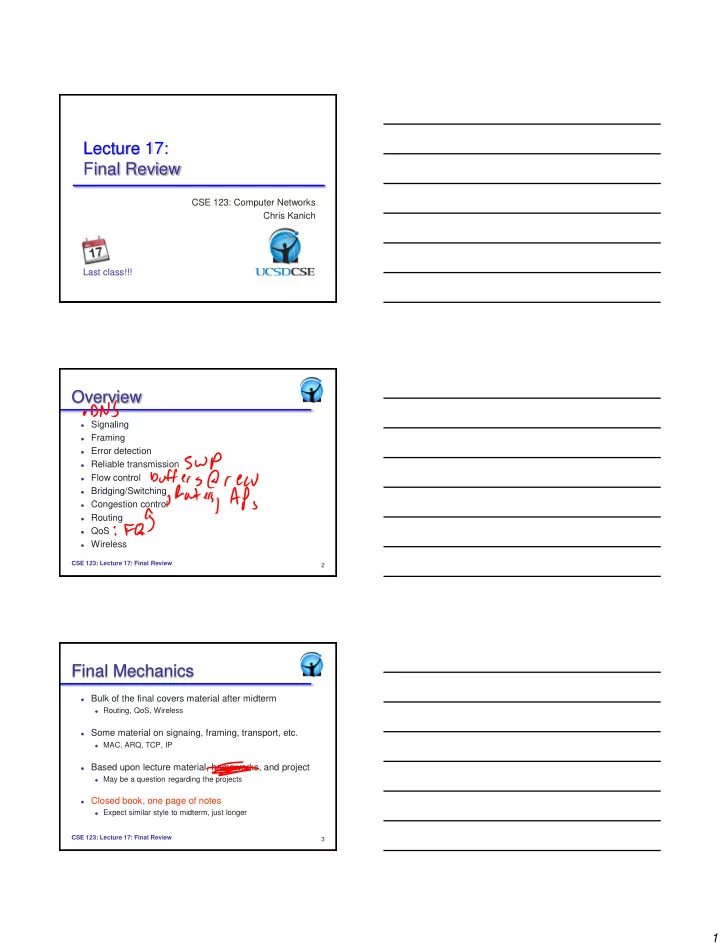
Lecture 17: Final Review CSE 123: Computer Networks Chris Kanich Last class!!! Overview Signaling Framing Error detection Reliable transmission Flow control Bridging/Switching Congestion control Routing QoS


slide-1
SLIDE 1

1

CSE 123: Computer Networks Chris Kanich

Lecture 17: Final Review

Last class!!!

Overview

 Signaling  Framing  Error detection  Reliable transmission  Flow control  Bridging/Switching  Congestion control  Routing  QoS  Wireless

2 CSE 123: Lecture 17: Final Review 3

Final Mechanics

 Bulk of the final covers material after midterm

 Routing, QoS, Wireless

 Some material on signaing, framing, transport, etc.

 MAC, ARQ, TCP, IP

 Based upon lecture material, homeworks, and project

 May be a question regarding the projects

 Closed book, one page of notes

 Expect similar style to midterm, just longer

CSE 123: Lecture 17: Final Review

slide-2
SLIDE 2

2

TCP/IP Protocol Stack

HTTP TCP I P

Ethernet interface

HTTP TCP I P

Ethernet interface

I P I P

Ethernet interface Ethernet interface SONET interface SONET interface host host router router

CSE 123: Lecture 17: Final Review 4 Application Layer Transport Layer Network Layer Link Layer

Signals and Channels

 A signal is some form of energy (light, voltage, etc)

 Varies with time (on/off, high/low, etc.)  Can be continuous or discrete  We assume it is periodic with a fixed frequency

 A channel is a physical medium that conveys energy

 Any real channel will distort the input signal as it does so  How it distorts the signal depends on the signal

CSE 123: Lecture 17: Final Review 5

Channel Properties

 Bandwidth-limited

 Range of frequencies the channel will transmit  Means the channel is slow to react to change in signal

 Power attenuates over distance

 Signal gets softer (harder to “hear”) the further it travels  Different frequencies have different response (distortion)

 Background noise or interference

 May add or subtract from original signal

 Different physical characteristics

 Point-to-point vs. shared media  Very different price points to deploy

CSE 123: Lecture 17: Final Review 6

slide-3
SLIDE 3

3

Signaling

 Digital modulation

 FSK, ASK, PSK

 Dealing with noise

 Shannon’s law

 Sampling at the receiver

 Intersymbol Inteference: Nyquist Limit

 Synchronous vs. Asynchronous coding

 Clock recovery  NRZ, Manchester, 4B/5B

CSE 123: Lecture 17: Final Review 7

(Data) Link Layer

 Framing

 Break stream of bits up into discrete chunks

 Error handling

 Detect and/or correct errors in received frames

 Media access

 Arbitrate which nodes can send frames at any point in time  Not always necessary; e.g. point-to-point duplex links

 Multiplexing

 Determine appropriate destination for a given frame  Also not always required; again, point-to-point

CSE 123: Lecture 17: Final Review 8

Framing

 Framing determines when payload starts/stops

 Lots of different ways to do it, various efficiencies

 Sentinel-based framing requires stuffing

 Increases the size of the packet  Alternatives include fixed size frames

CSE 123: Lecture 17: Final Review 9 Payload Header Trailer

slide-4
SLIDE 4

4

CSE 123: Lecture 17: Final Review 10

Error Detection

 Error handling through redundancy

 Adding extra bits to the frame

 Hamming Distance

 When we can detect  When we can correct

 Checksum  Cyclic Remainder Check (CRC)

Reliable Transmission

 Automatic Repeat Request (ARQ)

 Acknowledgements (ACKs) and timeouts

 Stop-and-Wait  Sliding Window  Forward Error Correction

11 CSE 123: Lecture 17: Final Review

Sliding Window

 Single mechanism that supports:

 Multiple outstanding packets  Reliable delivery  In-order delivery  Flow control

 At the core of all modern ARQ protocols  Go-Back-N is a special case

 Receive window size of one

12 CSE 123: Lecture 17: Final Review

slide-5
SLIDE 5

5

Media Access Control

 Methods to share physical media: multiple access

 Fixed partitioning  Random access

 Channelizing mechanisms  Contention-based mechanisms

 Aloha  Ethernet

13 CSE 123: Lecture 17: Final Review

Partitioning Visualization

FDMA TDMA CDMA power power power

Courtesy Takashi Inoue

14 CSE 123: Lecture 17: Final Review

 Aloha transmits even if another host is transmitting

 Thus guaranteeing a collision

 Instead, listen first to make sure channel is idle

 Useful only if channel is frequently idle  Why?

 If nodes can detect collisions, abort!

 Requires a minimum frame size (“acquiring the medium”)  Requires a full duplex channel

 Binary exponential back-off balances delay w/load

15 CSE 123: Lecture 17: Final Review

Carrier Sense (CSMA) + CD

slide-6
SLIDE 6

6

Transport Layer

 Provides process naming/demultiplexing

 Port numbers

 Two main protocols in use on the Internet

 User Datagram Protocol (UDP)

» Unreliable, datagram service

 Transport Control Protocol (TCP)

» Reliable byte-stream » Requires connection establishment/three-way handshake

16 CSE 123: Lecture 17: Final Review

Transmission Control Protocol

 Reliable bi-directional bytestream between processes

 Uses a sliding window protocol for efficient transfer

 Connection-oriented

 Conversation between two endpoints with beginning and end

 Flow control

 Prevents sender from over-running receiver buffers

 Congestion control

 Prevents sender from over-running network capacity

17 CSE 123: Lecture 17: Final Review

 How fast should a sending host transmit data?

 Not to fast, not to slow, just right…

 Should not be faster than the sender’s share

 Bandwidth allocation

 Should not be faster than the network can process

 Congestion control

 Congestion control & bandwidth allocation are

separate ideas, but frequently combined

CSE 123: Lecture 17: Final Review 18

Congestion Control

slide-7
SLIDE 7

7

 Window-based congestion control

 Unified congestion control and flow control mechanism  rwin: advertised flow control window from receiver  cwnd: congestion control window

» Estimate of how much outstanding data network can deliver in a round-trip time

 Sender can only send MIN(rwin,cwnd) at any time

 Complicated with slow start and fast recovery

 Ramp up quickly  Avoid backing all the way down on isolated loss events

CSE 123: Lecture 17: Final Review 19

TCP’s Algorithm Hubs/Repeaters

 Physical layer device

 One “port” for each LAN  Repeat received bits on one port out all other ports

LAN1 Hub LAN2 LAN3

20 CSE 123: Lecture 17: Final Review

 Store and forward device

 Data-link layer device  Buffers entire packet and then rebroadcasts it on other ports

 Creates separate collision domains

 Uses CSMA/CD for access to each LAN (acts like a host)  Improves throughput

 Some bridges can learn topology

 Spanning Tree Algorithm

21 CSE 123: Lecture 17: Final Review

Bridges

slide-8
SLIDE 8

8

internetworking

 Switching still only moves frames on common link layer

 MAC addresses are unique but flat

 Routers forward packets from source to destination

 May cross many separate networks along the way

 All packets use a common Internet Protocol

 Any underlying data link protocol  Any higher layer transport protocol

22 CSE 123: Lecture 17: Final Review

Routers

 A router is a store-and-forward device

 Routers are connected to multiple networks  On each network, looks just like another host  A lot like a switch, except at the network layer

 Must be explicitly addressed by incoming frames

 Not at all like a switch, which is transparent  Removes link-layer header, parses IP header

 Looks up next hop, forwards on appropriate network

 Each router need only get one step closer to destination

23 CSE 123: Lecture 17: Final Review

IP Addresses

 32-bits in an IPv4 address

 Dotted decimal format a.b.c.d  Each represent 8 bits of address

 Hierarchical: Network part and host part

 E.g. IP address 128.54.70.238  128.54 refers to the UCSD campus network  70.238 refers to the host ieng6.ucsd.edu

 Subnetting/CIDR aggregation

 Network mask/prefix

24 CSE 123: Lecture 17: Final Review

slide-9
SLIDE 9

9

Layers of Identifiers

 Host name (e.g., www.ucsd.edu)

 Used by humans to specify host of interest  Unique, selected by host administrator  Hierarchical, variable-length string of alphanumeric carachters

 IP address (e.g., 128.54.70.238)

 Used by routers to forward packets  Unique, topologically meaningful locator  Hierarchical namespace of 32 bits

 MAC address (e.g., 58:B0:35:F2:3C:D9)

 Used by network adaptors to identify interesting frames  Unique, hard-coded identifier burned into network adaptor  Flat name space (of 48 bits in Ethernet)

25 CSE 123: Lecture 17: Final Review

Naming Protocols

 Domain Name System

 Distributed, hierarchical database  Distributed collection of servers  Caching to improve performance

 IP to MAC Address mapping

 Dynamic Host Configuration Protocol (DHCP)  Address Resolution Protocol (ARP)

CSE 123: Lecture 17: Final Review 26

 How to choose best path?

 Defining “best” can be slippery

 How to scale to millions of users?

 Minimize control messages and routing table size

 How to adapt to failures or changes?

 Node and link failures, plus message loss

CSE 123: Lecture 17: Final Review 27

Routing

slide-10
SLIDE 10

10

 Source routing

 Complete path listed in packet

 Virtual circuits

 Set up path out-of-band and store path identifier in routers  Local path identifier in packet

 Destination-based forwarding

 Router looks up address in forwarding table  Forwarding table contains (address, next-hop) tuples

CSE 123: Lecture 17: Final Review 28

Forwarding Options

 Routing within a network/organization

 A single administrative domain  The administrator can set edge costs

 Overall goals

 Provide intra-network connectivity  Adapt quickly to failures or topology changes  Optimize use of network resources

 Non-goals

 Extreme scalability  Lying, and/or disagreements about edge costs

CSE 123: Lecture 17: Final Review 29

Intra-domain Routing

 Static

 Type in the right answers and hope they are always true  …So far

 Link state

 Tell everyone what you know about your neighbors  Dijkstra’s Algorithm

 Distance vector

 Tell your neighbors when you know about everyone  Bellman-Ford Algorithm

CSE 123: Lecture 17: Final Review 30

Basic Routing Approaches

slide-11
SLIDE 11

11

 Graph algorithm for single-source shortest path tree

S  {} Q  <remaining nodes keyed by distance> While Q != {} u  extract-min(Q) S  S plus {u} for each node v adjacent to u “relax” the cost of v  u is done

CSE 123: Lecture 17: Final Review 31

Dijkstra’s Shortest Path

 Define distances at each node X

 dx(y) = cost of least-cost path from X to Y

 Update distances based on neighbors

 dx(y) = min {c(x,v) + dv(y)} over all neighbors V

3 2 2 1 1 4 1 4 5 3

u v w x y z s t

du(z) = min{c(u,v) + dv(z), c(u,w) + dw(z)}

Bellman-Ford Algorithm

CSE 123: Lecture 17: Final Review 32

Message complexity

LS: with n nodes, E links, O(nE) messages sent

DV: exchange between neighbors only

Speed of Convergence

LS: relatively fast

DV: convergence time varies

 May be routing loops  Count-to-infinity problem

Robustness: what happens if router malfunctions? LS:

Node can advertise incorrect link cost

Each node computes only its

  • wn table

DV:

Node can advertise incorrect path cost

Each node’s table used by

  • thers (error propagates)

Link-state vs. Distance-vector

CSE 123: Lecture 17: Final Review 33

slide-12
SLIDE 12

12

Border routers summarize and advertise internal routes to external neighbors and vice- versa

Border routers apply policy

Internal routers can use notion of default routes

Core is default-free; routers must have a route to all networks in the world

R1 Autonomous system 1 R2 R3 Autonomous system 2 R4 R5 R6

AS1 AS2

Border router Border router

Inter-domain Routing

CSE 123: Lecture 17: Final Review 34

 Neighboring ASes have business contracts

 How much traffic to carry  Which destinations to reach  How much money to pay

 Common business relationships

 Customer-provider

» E.g., Princeton is a customer of USLEC » E.g., MIT is a customer of Level3

 Peer-peer

» E.g., UUNET is a peer of Sprint » E.g., Harvard is a peer of Harvard Business School

Business Relationships

CSE 123: Lecture 17: Final Review 35

 Extension of distance-vector routing  Support flexible routing policies  Avoid count-to-infinity problem  Key idea: advertise the entire path  Distance vector: send distance metric per destination  Path vector: send the entire path for each destination

3 2 1

d

“d: path (2,1)” “d: path (1)” data traffic data traffic

Path-vector Routing

CSE 123: Lecture 17: Final Review 36

slide-13
SLIDE 13

13

 Implement inter-domain routing on the Internet

 Used and abused to model business practices

 Default decision process for route selection

 Highest local pref, shortest AS path, lowest MED, prefer

eBGP over iBGP, lowest IGP cost, router id

 Many policies built on default decision process, but…

 Possible to create arbitrary policies in principal

» Any criteria: BGP attributes, source address, prime number of bytes in message,

Border Gateway Protocol

CSE 123: Lecture 17: Final Review 37

QoS

CSE 123: Lecture 17: Final Review 38

 Routers manage their own resources

 Buffer management may entail marking/dropping  Scheduling discipline determines outgoing packet order

 Token bucket and RED

 Mechanisms to control traffic flowing through routers

 Networks can provide quality of service

 Combines per-router traffic policing with network signalling  IntServ and DiffServ are contrasting approaches

Wireless

CSE 123: Lecture 17: Final Review 39

 New challenges

 Hidden terminal problem  Asymmetric ranges  Half-duplex radios (can’t do CD)

 802.11/WiFi

 Common technology for local-area wireless  Uses CSMA/CA  RTS/CTS and NAV for virtual carrier sense

slide-14
SLIDE 14

14

For next time…

 There is no next time!  Study hard, sleep well, don’t be late!

 8 AM, 3 hr exam!

 It’s been a pleasure teaching you all!

 Feel free to contact if you have questions/need advice

 If you haven’t already, please complete your CAPE!

40 CSE 123: Lecture 17: Final Review