Lecture 12: Planning algorithms Solution Initial state s 0 - - PowerPoint PPT Presentation

lecture 12 planning algorithms
SMART_READER_LITE
LIVE PREVIEW

Lecture 12: Planning algorithms Solution Initial state s 0 - - PowerPoint PPT Presentation

Classical Planning CS440/ECE448: Intro to Artificial Intelligence State transition system ! = (S,A, ! ) Lecture 12: Planning algorithms Solution Initial state s 0 Planner (= sequence of actions) (a 1 ,a 2


slide-1
SLIDE 1

Lecture 12:
 Planning algorithms

  • Prof. Julia Hockenmaier

juliahmr@illinois.edu

  • http://cs.illinois.edu/fa11/cs440
  • CS440/ECE448: Intro to Artificial Intelligence

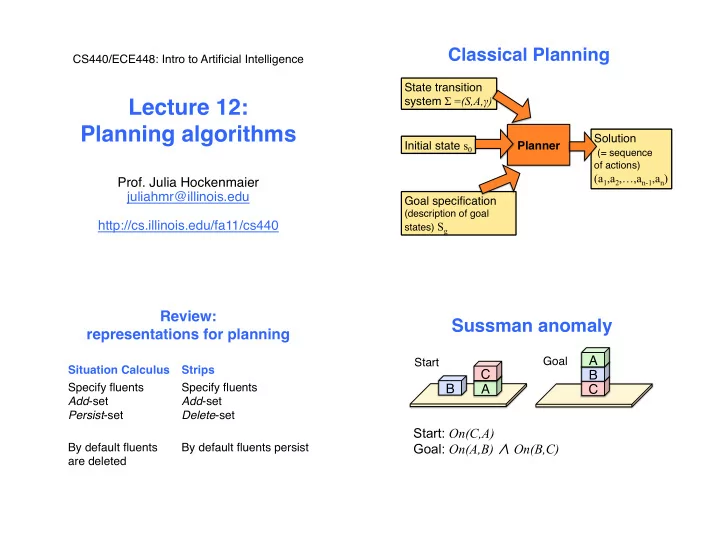
State transition 
 system ! =(S,A,!)

Classical Planning

Planner Solution
 (= sequence 


  • f actions)

(a1,a2,…,an-1,an) Initial state s0 Goal specification

(description of goal states) Sg

Operators

  • Review: 


representations for planning

Situation Calculus Strips Specify fluents
 Add-set
 Persist-set

  • Specify fluents

Add-set Delete-set By default fluents 
 are deleted By default fluents persist

Sussman anomaly

B A C

Start

C B A

Goal

Start: On(C,A) Goal: On(A,B) ∧ On(B,C)

slide-2
SLIDE 2

B A C C B A

Solve On(A,B) first:

B A C B A C B A C A C B C B A Start: On(C,A) Goal: On(A,B)∧ On(B,C)

B A C C B A

Solve On(B,C) first:

A C B B A C A C B C B A A C B Start: On(C,A) Goal: On(A,B)∧ On(B,C)

B A C C B A

Most efficient solution requires interleaved planning: B A C A C B C B A Start: On(C,A) Goal: On(A,B)∧ On(B,C)

Planning algorithms

State space search (DFS, BFS, etc.) Nodes = states; edges = actions; Heuristics (make search more efficient) Compute h() using relaxed version of the problem Plan space search (refinement of partial plans) Nodes = partial plans; edges: fix flaws in plan SATplan (encode plan in propositional logic) Solution = true variables in a model for the plan Graphplan (reduce search space to planning graph) Planning graph: levels = literals and actions

8

CS440/ECE448: Intro AI

slide-3
SLIDE 3

State space search

I

I,a2,a34

Planning as state space search

I,a2 I,a17 I,a4 I,a15

Search tree:

– Nodes: states – Root: initial state – Edges: actions (ground instances of operators – Solutions: paths from initial state to goal.

I,a4,a3 I,a15,a4

Forward search

Breadth-first forward search is sound and complete, but may require lots of memory

  • Depth-first forward search can be better in

practice (needs graph-search to be complete)

  • Problem: branching factor is very large (need

good heuristic: which actions may lead to goal?)

Initial State

...

...

DFS and loops: 
 iterative deepening

Loops (si "…"si) in the search graph lead to infinite branches in the search tree.

  • The tree-search variant of DFS never

terminates if it goes down an infinite branch

  • Remedy (iterative deepening):

– Try to find solution of length l with DFS – If this fails, l := l + #; try again.

12

CS440/ECE448: Intro AI

slide-4
SLIDE 4

Backward search

Start with goal; ʻundoʼ actions until initial state 
 Edges = inverse actions a"1: 
 Result(a"1,s) =s\ effects(a)∪ precond(a) 
 Large branching factor: many possible actions;
 not every Result(a"1, s) leads back to initial state

Goal

...

...

Plan-space search

State space search is inefficient

Observation 1: many actions are independent.

e.g.: move(A,B,C) and move(D,E,F)

We donʼt want to have to commit to specific order.

  • Observation 2: naïve backward search requires

fully instantiated actions. We often donʼt know/care how to instantiate variables.

move(A,B,?C) is prerequisite for move(B,D,E), but we donʼt care which C A moves to.

  • 15

CS440/ECE448: Intro AI

Searching plan-space

States in plan-space are partial plans: = sets of partially instantiated actions with constraints on precedence and variable (in)equality move(A,B,x) < move(B,y,z); z # A Solution is (partially ordered) complete plan with fully instantiated actions

  • 16

CS440/ECE448: Intro AI

slide-5
SLIDE 5

Searching plan-space

  • 1. Start with the empty plan 


= {start state, goal state}

  • 2. Iteratively refine current plan to resolve flaws


(refine = add new actions and constraints)

  • 3. Solution = a plan without flaws

17

CS440/ECE448: Intro AI

Flaws: open goals

Open goal: a precondition that is not yet met move(A,B,x) requires clear(x) 
 Solution: add new action and precedence constraint:
 move(A,B,x) needs to be preceded by
 some new action A with effect clear(x).

  • 18

CS440/ECE448: Intro AI

Flaws: threats

C is a threat if A is a precondition for B
 and C undoes the effect of A. move(A,B,x) establishes precondition clear(B) for move (C,D,B). move(E,F,B) undoes clear(B) 
 Solution: add new precedence constraint: move(E,F,B) has to precede move(A,B,x), or follow move(C,D,B).

19

CS440/ECE448: Intro AI

SATplan

slide-6
SLIDE 6

SATplan: basic idea

We can encode a plan of fixed length n 
 (n time steps required for solution)
 as a formula in propositional logic.

  • There is a solution if this formula is
  • satisfiable. Use existing tools (SAT solvers)
  • If there is no solution of length n, try n+1.

From plans to propositional logic

– Fluents are ground literals:
 clear(B)t: block B is clear at time t


  • – Actions are ground implications: 


(preconditionst ∧ actiont )" effect t+1 
 Operator move(x,y,z):

PRE: on(x,y), clr(z) EFFECT: on(x,z),clr(y)

Action move(A,B,C)23

(on(A,B)23∧clr(C)23∧move(A,B,C)23 )$on(A,C)24∧clr(B)24 22

CS440/ECE448: Intro AI

Graphplan

Basic idea

  • 1. Create an easier, relaxed problem Pʼ:

– can be solved in polynomial time – relax = remove some restrictions – Solutions to Pʼ ⊃ solutions to P

  • 2. Solve this relaxed problem Pʼ
  • 3. Search among solutions to Pʼ for solutions to P
  • Iterative deepening: try to solve Pʼ in 1,…,n steps
slide-7
SLIDE 7

Basic idea

Relaxed problem Pʼ: can we satisfy some necessary precondition for the goal of P in k steps?

(N.B.: this only solves P if all necessary preconditions can be achieved in k steps)

  • Solve Pʼ: build a planning graph of depth (2)k
  • Solve P: do backward search on the planning graph

to extract solution to P. If this fails, set k to k+1.

  • Planning graph: nodes

Two kinds of levels alternate: State level Si: 
 Node at level Si: a ground fluent (pos. or

  • neg. literal) which may hold i actions after S0
  • Action level Ai:

Node at level Ai: a ground action (incl. noop) whose preconditions might be satisfied at Si

26

CS440/ECE448: Intro AI

Have your cake and eat it too!

Init: Have(Cake) Goal: Have(Cake)∧ Eaten(Cake)

  • Action Eat(Cake):

PRECOND: Have(Cake) EFFECT: ¬Have(Cake) ∧ Eaten(Cake) Action Bake(Cake): PRECOND: ¬Have(Cake) EFFECT: Have(Cake)

27

CS440/ECE448: Intro AI

Preconditions/effects: 
 edges between levels

From state level Si to action level Ai: 
 the node (fluent) at level Si is a precondition for the node (action) at level Ai


  • From action level Ai to state level Si+1

the node (fluent) at level Si+1 is an effect 


  • f the node (action) at level Ai
  • 28

CS440/ECE448: Intro AI

Si Have(cake) Si+1 ¬Have(cake) Ai Eat(cake)

slide-8
SLIDE 8

Persistence (no-op) actions

For each literal Ci at state level Si:

– add a persistence action NoopC 
 at action level Ai – Link from Ci to NoopC – Also add C(i+1) to state level Si+1 – Link from NoopC to Ci+1 – 


  • 29

CS440/ECE448: Intro AI

Si Have(cake) Si+1 Have(cake) Ai

Mutually exclusive actions:
 mutex links within action levels

– Inconsistent effects: 
 effect of A1 negates effect of A2
 eat(cake) negates bake(cake)


  • – Interference: 


effect of A1 negates precondition of A2
 eat(cake) interferes with no-op for have(cake)


  • – Competing needs: 


preconditions of A1, A2 are mutex
 eat(cake) competes with bake(cake)

30

CS440/ECE448: Intro AI

Mutually exclusive fluents: edges within state levels

Mutex within state level Si: F1 and F2 cannot hold at the same time. – Negation: 
 have(Cake) negates ¬have(Cake) – Inconsistent support:
 all actions a1 to achieve F1 are mutex 
 with any action a2 that achieves F2.
 have(Cake) and eaten(Cake)

31

CS440/ECE448: Intro AI

The initial planning graph

Action Eat(Cake) PC: Have(Cake) EF: ¬Have(Cake)∧Eaten(Cake) Action Bake(Cake) PC.:¬Have(Cake) EF: Have(Cake)

  • 32

CS440/ECE448: Intro AI Eat(Cake)

S0 A0 S1

Have(Cake) Have(Cake) Have(Cake) Eaten(Cake) Eaten(Cake) Eaten(Cake)

¬ ¬ ¬

slide-9
SLIDE 9

The size of the planning graph

The original planning problem P has l literals and a actions

  • Size of planning graph with n levels: 


polynomial in l and a

– State levels: at most l nodes and l2 mutex links – Action levels: at most a+l nodes, (a+l)2 mutex;

33

CS440/ECE448: Intro AI

Solution extraction

If all literals in goal(P) hold at Sn and are not mutex with each other, we may be able to find a solution by backward search:

– States in backward search tree: 
 conjunction of (a subset of the) literals at Si – Actions in backward search tree:
 conflict-free subset of actions at Ai-1 – Goals of Sn: all literals in goal(P) – At each state level Si, select

34

CS440/ECE448: Intro AI

The search tree 
 for solution extraction

– State: conjunction of (subset of the) literals at Si – Initial state: all literals in goal(P) – Goal state: all literals in init(P)


  • – Actions: a conflict-free subset a of actions at Ai-1

– Result of a set of actions from Ai-1:
 the conjunction of all literals in Si-1 
 that are preconditions for some action in a

35

CS440/ECE448: Intro AI

Heuristics for planning

slide-10
SLIDE 10

Using the planning graph to estimate heuristics

What is the cost of a goal literal g? Minimum cost (level cost) 
 = minimum number of steps required to achieve g 
 = first state level at which g


  • What is the cost of a conjunction of goal literals?

Max level cost: max. of level costs of each literal Level sum: sum of level costs (inadmissible) Set level cost: level at which all are true and each pair of literals is non mutex

  • 37

CS440/ECE448: Intro AI

Todayʼs key concepts

State space search (DFS, BFS, etc.) Nodes = states; edges = actions; Heuristics (make search more efficient) Compute h() using relaxed version of the problem Plan space search (refinement of partial plans) Nodes = partial plans; edges: fix flaws in plan SATplan (encode plan in propositional logic) Solution = true variables in a model for the plan Graphplan (reduce search space to planning graph) Planning graph: levels = literals and actions

38

CS440/ECE448: Intro AI