
SLIDE 1
Course Introduction & History of Database Systems
@ Andy_Pavlo // 15- 721 // Spring 2018
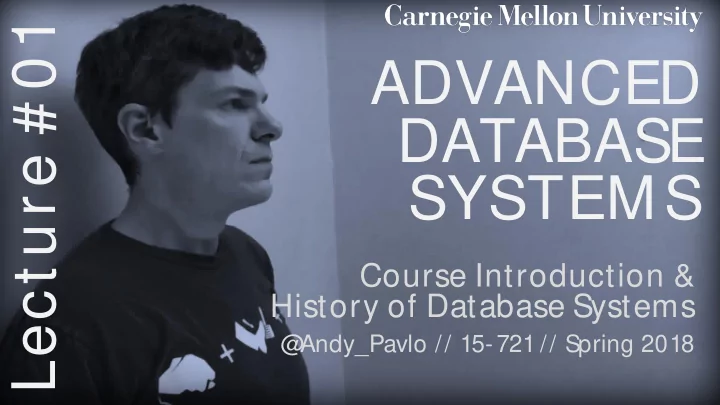
Lect ure # 01 ADVANCED DATABASE SYSTEMS Course Introduction & - - PowerPoint PPT Presentation
Lect ure # 01 ADVANCED DATABASE SYSTEMS Course Introduction & History of Database Systems @ Andy_Pavlo // 15- 721 // Spring 2018 2 WH Y YO U SH O ULD TAKE TH I S CO URSE DBMS developers are in demand and there are many challenging
@ Andy_Pavlo // 15- 721 // Spring 2018
CMU 15-721 (Spring 2018)
WH Y YO U SH O ULD TAKE TH I S CO URSE
DBMS developers are in demand and there are many challenging unsolved problems in data management and processing. If you are good enough to write code for a DBMS, then you can write code on almost anything else.
2
CMU 15-721 (Spring 2018)
CMU 15-721 (Spring 2018)
Wait List Course Outline History of Database Systems
4
CMU 15-721 (Spring 2018)
WAIT LIST
There are 73 people on the waiting list. Max capacity of the course is 40. There are currently 12 free slots. I will pull people off of the waiting list in the order that you complete Project #1.
5
CMU 15-721 (Spring 2018)
CO URSE O BJ ECTIVES
Learn about modern practices in database internals and systems programming. Students will become proficient in:
→ Writing correct + performant code → Proper documentation + testing → Code reviews → Working on a large code base
6
CMU 15-721 (Spring 2018)
CO URSE TO PICS
The internals of single node systems for in- memory databases. We will ignore distributed deployment problems. We will cover state-of-the-art topics. This is not a course on classical DBMSs.
7
CMU 15-721 (Spring 2018)
CO URSE TO PICS
Concurrency Control Indexing Storage Models, Compression Parallel Join Algorithms Networking Protocols Logging & Recovery Methods Query Optimization, Execution, Compilation New Hardware (NVM, FPGA, GPU)
8
https://boards.420chan.org/prog/res/36964.php
https://news.ycombinator.com/item?id=16145520
CMU 15-721 (Spring 2018)
BACKGRO UN D
I assume that you have already taken an intro course on databases (e.g., 15-445/645). We will discuss modern variations of classical algorithms that are designed for today’s hardware. Things that we will not cover: SQL, Serializability Theory, Relational Algebra, Basic Algorithms + Data Structures.
11
CMU 15-721 (Spring 2018)
BACKGRO UN D
All projects will be written in C++11. Be prepared to debug, profile, and test a multi- threaded program. First two projects can be done entirely with gdb. Your third project may require our special debugging tools for the LLVM engine.
12
CMU 15-721 (Spring 2018)
CO URSE LO GISTICS
Course Policies + Schedule:
→ Refer to course web page.
Academic Honesty:
→ Refer to CMU policy page. → If you’re not sure, ask me. → I’m serious. Don’t plagiarize or I will wreck you.
13
CMU 15-721 (Spring 2018)
O FFICE H O URS
Before class in my office:
→ Mon/Wed: 2:00 – 3:00 → Gates-Hillman Center 9019
Things that we can talk about:
→ Issues on implementing projects → Paper clarifications/discussion → Tips for Tinder/Bumble
14
CMU 15-721 (Spring 2018)
TEACH IN G ASSISTAN TS
Head TA: Prashanth Menon
→ 3rd Year PhD Student (CSD) → University of Toronto (BS/MS) → Lead architect/developer of
→ Trill as fuck.
15
CMU 15-721 (Spring 2018)
CO URSE RUBRIC
Reading Assignments Programming Projects Mid-term Exam Final Exam Extra Credit
16
CMU 15-721 (Spring 2018)
One mandatory reading per class ( ★ ). You can skip four readings during the semester. You must submit a synopsis before class:
→ Overview of the main idea (three sentences). → System used and how it was modified (one sentence). → Workloads evaluated (one sentence).
Submission Form: http://cmudb.io/15721-s18-submit
READIN G ASSIGN M EN TS
17
CMU 15-721 (Spring 2018)
PLAGIARISM WARN IN G
Each review must be your own writing. You may not copy text from the papers or other sources that you find on the web. Plagiarism will not be tolerated. See CMU's Policy on Academic Integrity for additional information.
18
CMU 15-721 (Spring 2018)
PRO GRAM M IN G PRO J ECTS
Projects will be implemented in CMU’s new DBMS Peloton.
→ In-memory, hybrid DBMS → Modern code base (C++11, Multi-threaded, LLVM) → Open-source / Apache v2.0 License → Postgres-wire protocol compatible
19
CMU 15-721 (Spring 2018)
PRO GRAM M IN G PRO J ECTS
Do all development on your local machine.
→ Peloton only builds on Linux + OSX. → We will provide a Vagrant configuration.
Do all benchmarking using DB Lab cluster.
→ We will provide login details later in semester.
Sponsored by Snowflake Computing
20
CMU 15-721 (Spring 2018)
PRO J ECTS # 1 AN D # 2
We will provide you with test cases and scripts for the first two programming projects. Project #1 will be completed individually. Project #2 will be done in a group of three.
→ 40 people in the class → ~13 groups of 3 people
21
CMU 15-721 (Spring 2018)
PRO J ECT # 1
SQL String Functions
→ UPPER, LOWER, CONCAT → Introduction to our code generation engine. → We will provide more details next class.
Special Recitation / Tutorial:
→ Tuesday January 23rd @ 5:00pm → GHC 9115
22
CMU 15-721 (Spring 2018)
PLAGIARISM WARN IN G
These projects must be all of your own code. You may not copy source code from other groups
Plagiarism will not be tolerated. See CMU's Policy on Academic Integrity for additional information.
23
CMU 15-721 (Spring 2018)
PRO J ECT # 3
Each group will choose a project that is:
→ Relevant to the materials discussed in class. → Requires a significant programming effort from all team members. → Unique (i.e., two groups can’t pick same idea). → Approved by me.
You don’t have to pick a topic until after you come back from Spring Break. We will provide sample project topics.
24
CMU 15-721 (Spring 2018)
PRO J ECT # 3
Project deliverables:
→ Proposal → Project Update → Code Reviews → Final Presentation → Code Drop
25
CMU 15-721 (Spring 2018)
PRO J ECT # 3 PRO PO SAL
Five minute presentation to the class that discusses the high-level topic. Each proposal must discuss:
→ What files you will need to modify. → How you will test whether your implementation is correct. → What workloads you will use for your project.
26
CMU 15-721 (Spring 2018)
PRO J ECT # 3 STATUS UPDATE
Five minute presentation to update the class about the current status of your project. Each presentation should include:
→ Current development status. → Whether anything in your plan has changed. → Any thing that surprised you.
27
CMU 15-721 (Spring 2018)
PRO J ECT # 3 CO DE REVIEWS
Each group will be paired with another group and provide feedback on their code at least two times during the semester. Grading will be based on participation.
28
CMU 15-721 (Spring 2018)
PRO J ECT # 3 FIN AL PRESEN TATIO N
10 minute presentation on the final status of your project during the scheduled final exam. You’ll want to include any performance measurements or benchmarking numbers for your implementation. Demos are always hot too…
29
CMU 15-721 (Spring 2018)
PRO J ECT # 3 CO DE DRO P
A project is not considered complete until:
→ The code can merge into the master branch without any conflicts. → All comments from code review are addressed. → The project includes test cases that correctly verify that implementation is correct. → The group provides documentation in both the source code and in separate Markdown files.
30
CMU 15-721 (Spring 2018)
M ID- TERM EXAM
Written long-form examination on the mandatory readings and topics discussed in class. Closed notes. Exam will be given on the last day of class before spring break (Wednesday March 5th).
31
CMU 15-721 (Spring 2018)
FIN AL EXAM
Take home exam. Harder than the mid-term. Written long-form examination on the mandatory readings and topics discussed in class. Will be given out on the last day of class (Wednesday May 2nd) in this room.
32
CMU 15-721 (Spring 2018)
EXTRA CREDIT
We are writing an encyclopedia of DBMSs. Each student can earn extra credit if they write an entry about one DBMS.
→ Must provide citations and attributions.
Additional details will be provided later. This is optional.
33
CMU 15-721 (Spring 2018)
PLAGIARISM WARN IN G
The extra credit article must be your own writing. You may not copy text/images from papers or
Plagiarism will not be tolerated. See CMU's Policy on Academic Integrity for additional information.
34
CMU 15-721 (Spring 2018)
GRADE BREAKDOWN
Reading Reviews (10%) Project #1 (5%) Project #2 (25%) Project #3 (40%) Mid-term Exam (10%) Final Exam (15%) Extra Credit (+10%)
35
CMU 15-721 (Spring 2018)
CO URSE M AILIN G LIST
On-line Discussion through Piazza: http://piazza.com/cmu/spring2018/15721 If you have a technical question about the projects, please use Piazza.
→ Don’t email me or TAs directly.
All non-project questions should be sent to me.
36
CMU 15-721 (Spring 2018)
37
WHAT GOES AROUND COMES AROUND Readings in DB Systems, 4th Edition, 2006. NEWSQL? SIGMOD Record, vol. 45, iss. 2, 2016
CMU 15-721 (Spring 2018)
H ISTO RY REPEATS ITSELF
Old database issues are still relevant today. The “SQL vs. NoSQL” debate is reminiscent of “Relational vs. CODASYL” debate. Many of the ideas in today’s database systems are not new.
38
CMU 15-721 (Spring 2018)
19 6 0 s IDS
Integrated Data Store Developed internally at GE in the early 1960s. GE sold their computing division to Honeywell in 1969. One of the first DBMSs:
→ Network data model. → Tuple-at-a-time queries.
39
CMU 15-721 (Spring 2018)
19 6 0 s CO DASYL
COBOL people got together and proposed a standard for how programs will access a database. Lead by Charles Bachman.
→ Network data model. → Tuple-at-a-time queries.
Bachman also worked at Culliane Database Systems in the 1970s to help build IDMS.
Bachman
40
CMU 15-721 (Spring 2018)
N ETWO RK DATA M O DEL
SUPPLY
(qty, price)
SUPPLIER
(sno, sname, scity, sstate)
PART
(pno, pname, psize)
41
Schema
SUPPLIES SUPPLIED_BY
CMU 15-721 (Spring 2018)
N ETWO RK DATA M O DEL
SUPPLY
(qty, price)
SUPPLIER
(sno, sname, scity, sstate)
PART
(pno, pname, psize)
41
Schema
SUPPLIES SUPPLIED_BY
CMU 15-721 (Spring 2018)
N ETWO RK DATA M O DEL
SUPPLY
(qty, price)
SUPPLIER
(sno, sname, scity, sstate)
PART
(pno, pname, psize)
41
Schema
SUPPLIES SUPPLIED_BY
CMU 15-721 (Spring 2018)
19 6 0 S IBM IM S
Information Management System Early database system developed to keep track of purchase orders for Apollo moon mission.
→ Hierarchical data model. → Programmer-defined physical storage format. → Tuple-at-a-time queries.
42
CMU 15-721 (Spring 2018)
H IERARCH ICAL DATA M O DEL
SUPPLIER
(sno, sname, scity, sstate)
PART
(pno, pname, psize, qty, price)
Schema Instance
43 sno sname scity sstate parts 1001 Dirty Rick New York NY 1002 Squirrels Boston MA pno pname psize qty price 999 Batteries Large 10 $100 pno pname psize qty price 999 Batteries Large 14 $99
CMU 15-721 (Spring 2018)
H IERARCH ICAL DATA M O DEL
SUPPLIER
(sno, sname, scity, sstate)
PART
(pno, pname, psize, qty, price)
Schema Instance
43 sno sname scity sstate parts 1001 Dirty Rick New York NY 1002 Squirrels Boston MA pno pname psize qty price 999 Batteries Large 10 $100 pno pname psize qty price 999 Batteries Large 14 $99
CMU 15-721 (Spring 2018)
19 70 s RELATIO N AL M O DEL
Ted Codd was a mathematician working at IBM Research. He saw developers spending their time rewriting IMS and Codasyl programs every time the database’s schema or layout changed. Database abstraction to avoid this maintenance:
→ Store database in simple data structures. → Access data through high-level language. → Physical storage left up to implementation.
Codd
44
CMU 15-721 (Spring 2018)
RELATIO N AL DATA M O DEL
SUPPLY
(sno, pno, qty, price)
SUPPLIER
(sno, sname, scity, sstate)
PART
(pno, pname, psize)
45
Schema
CMU 15-721 (Spring 2018)
19 70 s RELATIO N AL M O DEL
Early implementations of relational DBMS:
→ System R – IBM Research → INGRES – U.C. Berkeley → Oracle – Larry Ellison
Ellison Gray Stonebraker
47
CMU 15-721 (Spring 2018)
19 8 0 s RELATIO N AL M O DEL
The relational model wins.
→ IBM comes out with DB2 in 1983. → “SEQUEL” becomes the standard (SQL).
Many new “enterprise” DBMSs but Oracle wins marketplace. Stonebraker creates Postgres.
48
CMU 15-721 (Spring 2018)
19 8 0 s O BJ ECT- O RI EN TED DATABASES
Avoid “relational-object impedance mismatch” by tightly coupling objects and database. Few of these original DBMSs from the 1980s still exist today but many of the technologies exist in
49
CMU 15-721 (Spring 2018)
O BJ ECT- O RIEN TED M O DEL
Application Code
class Student { int id; String name; String email; String phone[]; }
Relational Schema
STUDENT
(id, name, email)
STUDENT_PHONE
(sid, phone)
50
CMU 15-721 (Spring 2018)
O BJ ECT- O RIEN TED M O DEL
Application Code
class Student { int id; String name; String email; String phone[]; }
Relational Schema
STUDENT
(id, name, email)
STUDENT_PHONE
(sid, phone)
id name email 1001 M.O.P. ante@up.com sid phone 1001 444-444-4444 1001 555-555-5555 50
CMU 15-721 (Spring 2018)
O BJ ECT- O RIEN TED M O DEL
Application Code
class Student { int id; String name; String email; String phone[]; }
Student { “id”: 1001, “name”: “M.O.P.”, “email”: “ante@up.com”, “phone”: [ “444-444-4444”, “555-555-5555” ] } 50
CMU 15-721 (Spring 2018)
O BJ ECT- O RIEN TED M O DEL
Application Code
class Student { int id; String name; String email; String phone[]; }
Student { “id”: 1001, “name”: “M.O.P.”, “email”: “ante@up.com”, “phone”: [ “444-444-4444”, “555-555-5555” ] } 50
CMU 15-721 (Spring 2018)
19 9 0 s BO RIN G DAYS
No major advancements in database systems or application workloads.
→ Microsoft forks Sybase and creates SQL Server. → MySQL is written as a replacement for mSQL. → Postgres gets SQL support. → SQLite started in early 2000.
57
CMU 15-721 (Spring 2018)
20 0 0 s IN TERN ET BO O M
All the big players were heavyweight and
important features. Many companies wrote their own custom middleware to scale out database across single- node DBMS instances.
58
CMU 15-721 (Spring 2018)
20 0 0 s DATA WAREH O USES
Rise of the special purpose OLAP DBMSs.
→ Distributed / Shared-Nothing → Relational / SQL → Usually closed-source.
Significant performance benefits from using Decomposition Storage Model (i.e., columnar)
59
CMU 15-721 (Spring 2018)
20 0 0 s N o SQ L SYSTEM S
Focus on high-availability & high-scalability:
→ Schemaless (i.e., “Schema Last”) → Non-relational data models (document, key/value, etc) → No ACID transactions → Custom APIs instead of SQL → Usually open-source
60
CMU 15-721 (Spring 2018)
20 10 s N ew SQ L
Provide same performance for OLTP workloads as NoSQL DBMSs without giving up ACID:
→ Relational / SQL → Distributed → Usually closed-source
61
CMU 15-721 (Spring 2018)
20 10 s H YBRID SYSTEM S
Hybrid Transactional-Analytical Processing. Execute fast OLTP like a NewSQL system while also executing complex OLAP queries like a data warehouse system.
→ Distributed / Shared-Nothing → Relational / SQL → Mixed open/closed-source.
62
CMU 15-721 (Spring 2018)
20 10 s CLO UD SYSTEM S
First database-as-a-service (DBaaS) offerings were "containerized" versions of existing DBMSs. There are new DBMSs that are designed from scratch explicitly for running in a cloud environment.
63
CMU 15-721 (Spring 2018)
20 10 s SPECIALIZED SYSTEM S
Shared-disk DBMSs Embedded DBMSs Times Series DBMS Multi-Model DBMSs Blockchain DBMSs
64
CMU 15-721 (Spring 2018)
PARTIN G TH O UGH TS
There are many innovations that come from both industry and academia:
→ Lots of ideas start in academia but few build complete DBMSs to verify them. → IBM was the vanguard during 1970-1980s but now there is no single trendsetter. → Oracle borrows ideas from anybody.
The relational model has won for operational databases.
65
CMU 15-721 (Spring 2018)
N EXT CLASS
Disk vs. In-Memory DBMSs Project #1 Discussion Reminder: First reading review is due at 12:00pm
Reminder: Project #1 recitation is Tuesday January 23rd @ 5:00pm in GHC 9115.
66