Learning Wi-Fi Connection Loss Predictions for Seamless Vertical - - PowerPoint PPT Presentation

learning wi fi connection loss predictions for seamless
SMART_READER_LITE
LIVE PREVIEW

Learning Wi-Fi Connection Loss Predictions for Seamless Vertical - - PowerPoint PPT Presentation

Learning Wi-Fi Connection Loss Predictions for Seamless Vertical Handovers Using Multipath TCP Jonas Hchst, Artur Sterz, Alexander Frmmgen, Denny Stohr, Ralf Steinmetz, Bernd Freisleben TU Darmstadt and Philipps-Universitt Marburg 1 |


slide-1
SLIDE 1

1 | 44th IEEE LCN Conference, Osnabrück, Germany, 15.10.2019

Jonas Höchst, Artur Sterz, Alexander Frömmgen, Denny Stohr, Ralf Steinmetz, Bernd Freisleben

TU Darmstadt and Philipps-Universität Marburg
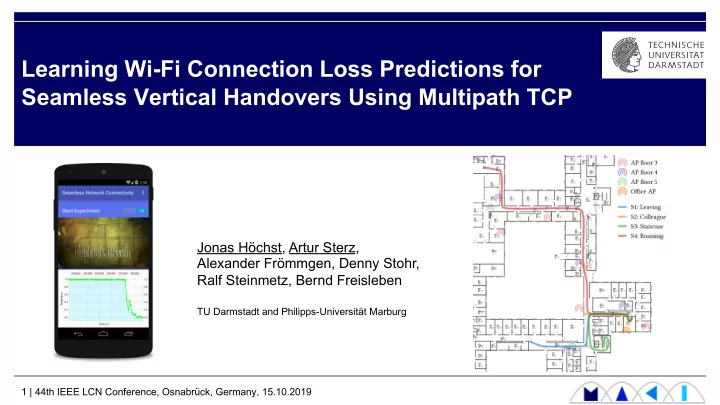
Learning Wi-Fi Connection Loss Predictions for Seamless Vertical Handovers Using Multipath TCP

slide-2
SLIDE 2

2 | 44th IEEE LCN Conference, Osnabrück, Germany, 15.10.2019

Communication Information Entertainment

Introduction: Smartphones - Daily Companions

Wi-Fi Cellular à Handover

slide-3
SLIDE 3

3 | 44th IEEE LCN Conference, Osnabrück, Germany, 15.10.2019

Introduction: Vertical Handovers Today

§ Handovers are performed reactively:

§ Based on weak RSSI or high packet loss § Change of default gateway

§ Application has to deal with connection loss

§ Multipath-TCP enables seamless handovers

§ Multiple subflows on all available network interfaces § Drawback: energy usage, use of limited data plans

slide-4
SLIDE 4

4 | 44th IEEE LCN Conference, Osnabrück, Germany, 15.10.2019

Introduction: Contributions

§ Novel data-driven, proactive approach for seamless vertical Wi-Fi/cellular handovers § Multiple heterogeneous smartphone sensors to predict Wi-Fi connection loss § Multipath-TCP based seamless connection handover § Experimental evaluation based on Quality of Experience § Open demo implementation and experimental artifacts

slide-5
SLIDE 5

5 | 44th IEEE LCN Conference, Osnabrück, Germany, 15.10.2019

Conceptual Overview

slide-6
SLIDE 6

6 | 44th IEEE LCN Conference, Osnabrück, Germany, 15.10.2019

Smartphone Sensor Readings

Wi-Fi Properties Linear Acceleration Spatial Orientation Ringer Mode Wi-Fi Access Points Power State Magnetic Field Audio State Step Counter Bluetooth Neighborhood Gravity Atmospheric Pressure

slide-7
SLIDE 7

7 | 44th IEEE LCN Conference, Osnabrück, Germany, 15.10.2019

Sensor Data Example

slide-8
SLIDE 8

8 | 44th IEEE LCN Conference, Osnabrück, Germany, 15.10.2019

Data Collection

§ 20 GB of sensor data from five different users

§ Running for the whole day – daily lives of users

§ 900,000 unique samples, collected in three months § Training and test set

a) Random split of all available samples (70:30) b) User-based split: learn with some users, test with the

  • thers
slide-9
SLIDE 9

9 | 44th IEEE LCN Conference, Osnabrück, Germany, 15.10.2019

Feature Selection: Observation & Prediction

slide-10
SLIDE 10

10 | 44th IEEE LCN Conference, Osnabrück, Germany, 15.10.2019

Feature Selection: Input Vectors

§ Full Feature Vector

§ All 25 available sensors, 25 x 60 = 1500 features

§ Reduced Feature Vector

§ Atmospheric pressure, linear acceleration, power, step counter, gravity, Wi-Fi (frequency, speed, RSSI) 8 x 60 = 480 features

§ Ground Truth

§ Wi-Fi RSSI > -70 dBm, shifted

slide-11
SLIDE 11

11 | 44th IEEE LCN Conference, Osnabrück, Germany, 15.10.2019

Machine Learning: Random Forest

§ Requires equally distributed samples: down-sampling, 10 random trees

Event Prec. Recall F1-score Support Loss 0.86 0.98 0.91 52503 No Loss 1.00 0.98 0.99 438772 Total 0.98 0.98 0.98 491275

Table: Random Data Split, Reduced Feature Vector

slide-12
SLIDE 12

12 | 44th IEEE LCN Conference, Osnabrück, Germany, 15.10.2019

Machine Learning: Neural Networks

§ Input Layer: up to 1500 neurons, depending on feature vector § Hidden Layers in different configurations:

§ NN 1: 1 hidden layer of (100) neurons § NN 2: 3 hidden layers of (300, 200, 100) § NN 3: 5 hidden layers of (400, 400, 400, 400, 400)

§ Output Layer: 1 neuron, indicating loss probability

slide-13
SLIDE 13

13 | 44th IEEE LCN Conference, Osnabrück, Germany, 15.10.2019

Model Evaluation: Random Data Split

Table: Reduced Feature Vector, Random Data Split Metric Forest NN 1 NN 2 NN 3 Loss Prec. 0.89 0.95 0.97 0.97 Loss Recall 0.98 0.94 0.95 0.95 F1-score 0.93 0.94 0.96 0.96

slide-14
SLIDE 14

14 | 44th IEEE LCN Conference, Osnabrück, Germany, 15.10.2019

Model Evaluation: Example

slide-15
SLIDE 15

15 | 44th IEEE LCN Conference, Osnabrück, Germany, 15.10.2019

Online Prediction: Mobile Application

On-Device Model Execution DASH.js Video Playback MPTCP Handovers

slide-16
SLIDE 16

16 | 44th IEEE LCN Conference, Osnabrück, Germany, 15.10.2019

Online Prediction: DASH.js Video

§ Dynamic Adaptive Streaming over HTTP(s)

§ Configuration: BOLA adaptation algorithm, 10 s buffer § H.264 video, AAC audio § Segments of 2 seconds § Available bandwidths: 1, 2, and 4 Mbit/s

§ Base metrics: Stalls, Bitrate, Adaptations, Buffer levels

Open Movie: Elephants Dream

slide-17
SLIDE 17

17 | 44th IEEE LCN Conference, Osnabrück, Germany, 15.10.2019

Online Prediction: MPTCP Handovers

§ Toggle LTE state based on online prediction § MPTCP kernel implementation (v0.86) for Android § MultipathControl (De Coninck et al.) § Video server: MPTCP v0.92

§ redundant scheduler § fullmesh path manager

slide-18
SLIDE 18

18 | 44th IEEE LCN Conference, Osnabrück, Germany, 15.10.2019

Experimental Evaluation: Scenarios

§ Four scenarios:

§ Leaving the office (1) § Visiting a colleague (2) § Using the staircase (3) § Wi-Fi roaming support (4)

§ Three connectivity modes:

§ Android, MPTCP, Seamless

§ Nexus 5, Android 4.4.2

slide-19
SLIDE 19

19 | 44th IEEE LCN Conference, Osnabrück, Germany, 15.10.2019

Online Prediction

Demo

https://youtu.be/E0CFLk82s6s

slide-20
SLIDE 20

20 | 44th IEEE LCN Conference, Osnabrück, Germany, 15.10.2019

slide-21
SLIDE 21

21 | 44th IEEE LCN Conference, Osnabrück, Germany, 15.10.2019

Experimental Evaluation

(a) Scenario 1: Leaving

Mode # St. ∅ St. # A. HQ ∅ TD Stock 3 1.46 s 23 87 % 21.75 MB MPTCP 0 s 20 89 % 41.32 MB Seamless 0 s 27 88 % 36.11 MB

(b) Scenario 2: Colleague

Mode # St. ∅ St. # A. HQ ∅ TD Stock 0 s 10 92 % 0 MB MPTCP 0 s 10 91 % 9.98 MB Seamless 0 s 17 92 % 9.59 MB

(c) Scenario 3: Staircase (d) Scenario 4: Wi-Fi Roaming (c) Scenario 3: Staircase

Mode # St. ∅ St. # A. HQ ∅ TD Stock 3 2.06 s 49 80 % 0 MB MPTCP 0 s 32 87 % 33.92 MB Seamless 0 s 28 85 % 16.81 MB

(d) Scenario 4: Wi-Fi Roaming

Mode # St. ∅ St. # A. HQ ∅ TD Stock 18 14.98 s 42 53 % 0.89 MB MPTCP 0 s 38 86 % 71.99 MB Seamless 15 5.47 s 23 84 % 15.50 MB

Overview of Experimental Results

slide-22
SLIDE 22

22 | 44th IEEE LCN Conference, Osnabrück, Germany, 15.10.2019

Experimental Evaluation: QoE Results

MOScombined values grouped to connectivity modes and scenarios

slide-23
SLIDE 23

23 | 44th IEEE LCN Conference, Osnabrück, Germany, 15.10.2019

§ Novel data-driven approach for Wi-Fi loss prediction

§ Precision of up to 0.97; Recall of up to 0.98

§ Promising results with MPTCP-based handovers

§ QoE improvements of 2.7 to 3.8 in certain scenarios § Lower cellular data usage (50%) compared to traditional MPTCP handovers

Conclusion

slide-24
SLIDE 24

24 | 44th IEEE LCN Conference, Osnabrück, Germany, 15.10.2019

§ Enlarge sensor variety: from contextual sensors to domain specific sensors, i.e., to detect high network load § Online learning on smartphones

§ User-specific models, e.g., user / access point combinations

§ Multi-RAT handover predictions (Wi-Fi, 3G, LTE, 5G, …) § Hardware / low-level implementations

§ Smartphone sensor hub, lightweight neural networks

Future Work

slide-25
SLIDE 25

25 | 44th IEEE LCN Conference, Osnabrück, Germany, 15.10.2019

One more thing…

https://umr-ds.github.io/seamcon/

slide-26
SLIDE 26

26 | 44th IEEE LCN Conference, Osnabrück, Germany, 15.10.2019

The End

Time for

Questions

slide-27
SLIDE 27

27 | 44th IEEE LCN Conference, Osnabrück, Germany, 15.10.2019

Model Evaluation: User-based Data Split

§ Full Feature Vector: 0.91, 0.72, and 0.68 precision in the Wi-Fi loss class § Reduced Feature Vector: 0.93, 0.92, and 0.79 precision in the Wi-Fi loss class § Neural networks are capable of predicting Wi-Fi loss.

§ The Reduced Feature Vector generalizes better; § per-user training significantly improves the results.

§ Overall best performance: NN 3 with the Reduced Feature Vector

slide-28
SLIDE 28

28 | 44th IEEE LCN Conference, Osnabrück, Germany, 15.10.2019

Experimental Evaluation

Mean Opinion Score as QoE Metric

slide-29
SLIDE 29

29 | 44th IEEE LCN Conference, Osnabrück, Germany, 15.10.2019

Experimental Evaluation: QoE Results

Stock and Seamless in Scenario 3 a) Stock Android b) Seamless

slide-30
SLIDE 30

30 | 44th IEEE LCN Conference, Osnabrück, Germany, 15.10.2019

Experimental Evaluation: Power consumption

Power consumption across different connectivity modes