
SLIDE 1
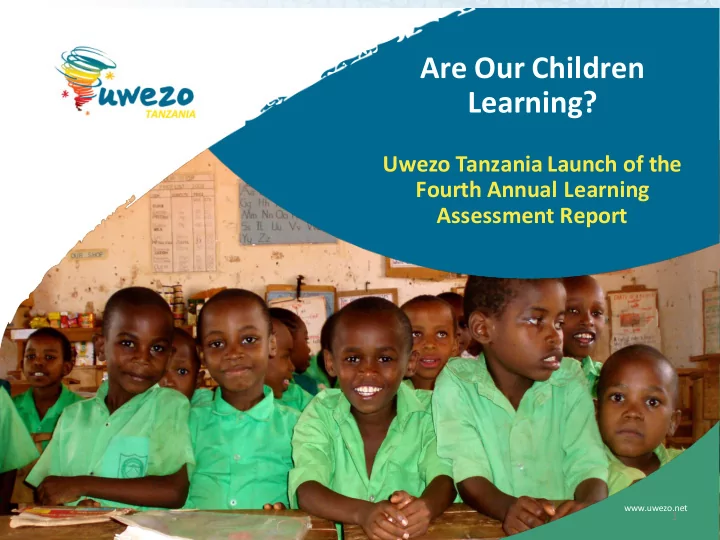
Are Our Children Learning?
Uwezo Tanzania Launch of the Fourth Annual Learning Assessment Report
www.uwezo.net
1
Learning? Uwezo Tanzania Launch of the Fourth Annual Learning - - PowerPoint PPT Presentation
Are Our Children Learning? Uwezo Tanzania Launch of the Fourth Annual Learning Assessment Report www.uwezo.net 1 Introduction Tremendous progress has been made in the education sector: Huge investment in the Education
Uwezo Tanzania Launch of the Fourth Annual Learning Assessment Report
www.uwezo.net
1
beyond 95%)
3
4
Design and Sampling
(Tanzania)
included
primary school and households
Test Development
Tests developed with experts from relevant institutions (Tanzania Institute
national curriculum/ syllabus for Standard 2, and guided by test development framework and Uwezo standards. All tests are pre-tested in three different communities.
5
Addition 13 + 12 = 65 + 14 = 24 + 16 = Subtraction 48 – 25 = 78 – 38 = 65 – 27 = Multiplication 2 x 3 = 4 x 7 = 2 x 10 = 9 x 3 =
English story
Amina is a very good girl. She wakes up early in the morning. She brushes her teeth and washes her face. She cooks tea and drinks it. She goes to school with her brother. She sweeps her classroom every day. She likes English lessons. In the evening she plays netball with her friends.
Kiswahili story
Hapo zamani paka alikuwa na pete ya dhahabu. Panya alikuwa rafiki yake wakiishi pamoja. Siku moja paka alitaka kuvaa pete yake hakuiona. Aliamua kumuuliza rafiki yake kama alijua pete
Paka aliamua kufanya upekuzi ili kuitafuta pete. Panya alipoona anashikwa alimeza pete na kukimbia. Paka aliamua kumkimbiza panya paka amshike. Akimshika atamtoboa tumbo achukuwe pete. Hiyo ndiyo sababu paka anakula panya
researchers visited 20 households per village
aged 7-16 tested at home
witness the assessment
feedback to parents
6
collection.
7
children are enrolled to school (NER)
equally enrolled
8
9
PERCENTAGE OF STUDENTS IN STANDARDS 1-7 WHO WERE ABLE TO READ A STANDARD 2 LEVEL STORY IN KISWAHILI, 2013
story.
that 20% of pupils complete Standard 7 without having mastered basic Kiswahili literacy.
10
PERCENTAGE OF CHILDREN AGED 9-13 YEARS WHO PASSED THE LITERACY TEST IN KISWAHILI, BY REGION, 2013
11
PERCENTAGE OF CHILDREN AGED 7 TO 16 YEARS WHO PASSED THE LITERACY TEST IN KISWAHILI, BY GENDER AND AGE, 2013
12
PERCENTAGE OF STUDENTS IN STANDARDS 1-7 WHO WERE ABLE TO READ A STANDARD 2 LEVEL STORY IN ENGLISH, 2013
Almost half of Standard 7 students are not literate in English, which is the language of instruction in secondary school.
13
PERCENTAGE OF CHILDREN AGED 9-13 YEARS WHO PASSED THE LITERACY TEST IN ENGLISH, BY REGION, 2013
14
PERCENTAGE OF CHILDREN AGED 7 TO 16 YEARS WHO PASSED THE LITERACY TEST IN ENGLISH, BY GENDER AND AGE, 2013
15
PERCENTAGE OF STUDENTS IN STANDARDS 1-7 WHO PASSED THE STANDARD 2 NUMERACY TEST, 2013
multiplication.
16
PERCENTAGE OF CHILDREN AGED 9-13 YEARS WHO PASSED THE NUMERACY, BY REGION, 2013
17
PERCENTAGE OF CHILDREN AGED 7 TO 16 YEARS WHO PASSED THE NUMERACY TEST, BY GENDER AND AGE, 2013
18
On average 5 out of 10 children aged 7-16 from urban districts passed both literacy and numeracy tests compared to about 3 out of 10 children of their peers from the rural districts.
19
PERCENTAGE OF CHILDREN AGED 7-16 YEARS WHO PASSED ALL THREE UWEZO TESTS BY LOCALITY (URBAN-RURAL), 2013
20
21
40% of children from ultra- poor households and 57% from non-poor households can read a Standard 2 Kiswahili story 20% of children from ultra- poor households and 35% from non-poor households can read a Standard 2 English story 31% of children from ultra- poor households and 46% from non-poor households can do Standard 2 multiplication
22
75%. In other words, 1 out of 4 teachers were absent on the Uwezo assessment day. This has dropped since 2012 when 82% of teachers were in school.
absent from school in Pwani and Mwanza regions. Contrarily, in Kilimanjaro, Arusha and Kagera regions only about one out of 10 teachers were absent from school on the assessment day.
literacy and numeracy. It is learning that matters and not only sitting in the classroom.So what can be done to get better learning results and value for money?
increase teaching time and quality?
Urban vs Rural, and Poor vs Non- poor settings. What is the implications?
mothers did not attend school
equally not performing well.
23
7/29/2015 24
25