Learning Several cars are driving straight on the freeway - - PowerPoint PPT Presentation

learning
SMART_READER_LITE
LIVE PREVIEW

Learning Several cars are driving straight on the freeway - - PowerPoint PPT Presentation

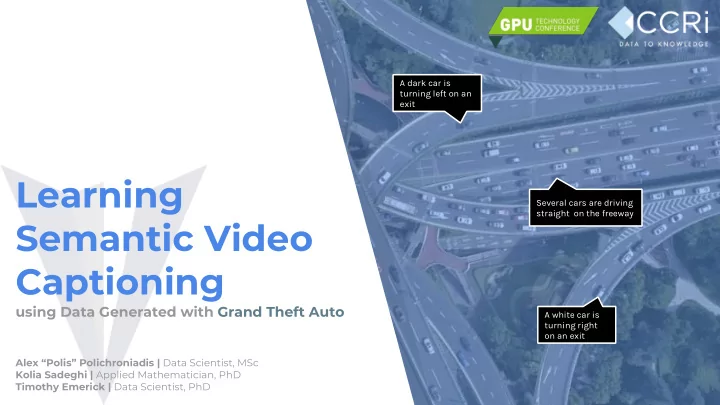
A dark car is turning left on an exit Learning Several cars are driving straight on the freeway Semantic Video Captioning using Data Generated with Grand Theft Auto A white car is turning right on an exit Alex Polis Polichroniadis


slide-1
SLIDE 1

Several cars are driving straight on the freeway A white car is turning right

  • n an exit

A dark car is turning left on an exit

Learning Semantic Video Captioning

using Data Generated with Grand Theft Auto

Alex “Polis” Polichroniadis | Data Scientist, MSc Kolia Sadeghi | Applied Mathematician, PhD Timothy Emerick | Data Scientist, PhD

slide-2
SLIDE 2

Several cars are driving straight on the freeway A white car is turning right

  • n an exit

A dark car is turning left on an exit

1.

THE VIDEO LEARNING PROBLEM

slide-3
SLIDE 3

THE PROBLEM

▸ Machine vision algorithms require large amounts of labeled data to train. ▸ Models trained on non-domain relevant data do not transfer to desired domain. ▸ Often, domain relevant labeled data isn’t available.

slide-4
SLIDE 4

Sample of Large Computer Vision Datasets

ImageNet (http://www.image-net.org/) >14M images of >21K concepts

Olga Russakovsky*, Jia Deng*, Hao Su, Jonathan Krause, Sanjeev Satheesh, Sean Ma, Zhiheng Huang, Andrej Karpathy, Aditya Khosla, Michael Bernstein, Alexander C. Berg and Li Fei-Fei. (* = equal contribution) ImageNet Large Scale Visual Recognition Challenge. IJCV, 2015. Abu-El-Haija, Sami, et al. "YouTube-8M: A large-scale video classification benchmark." arXiv preprint arXiv:1609.08675 (2016).

YouTube-8M (https://research.google.com/youtube8m/) >450K hours of video of >4700 classes

slide-5
SLIDE 5

OUR APPROACH USE VIDEO GAMES

Wow, that looks good.

slide-6
SLIDE 6

Our Approach: Use Video Games

▸ With the advent of extremely powerful GPUs, graphics have become extremely realistic over the years. ▸ Video games encode realistic movements such as walking gaits and vehicle routing. ▸ Video games are controllable via code, and can expose semantic labels.

slide-7
SLIDE 7

Our Approach: Use GTA V

▸ Extremely realistic graphics. ▸ Huge modding community. ▸ GPU-intensive visual mods for more realism. ▸ Of specific interest: script-hook-v has thousands of function calls.

slide-8
SLIDE 8

...with some quirks.

slide-9
SLIDE 9

Programmatically configurable options

▸ Vehicles ▹ Activities: driving, turning, waiting at stop light. ▹ Describers: color, type, damage... ▸ People ▹ Activities: entering/exiting vehicle, walking, standing still, talking, waiting to cross the street, parking, smoking, talking

  • n a cell phone, carrying a

firearm, planting a bomb. ▹ Describers: number of people, clothing color, gender. ▸ Environment ▹ Weather: rainy, sunny, hazy... ▹ Time of day. ▹ Camera elevation and zoom. ▸ Buildings ▹ Activities: people going into,

  • ut of, and walking close to

buildings. ▹ Describers: type of building (church, mall, police station, etc).

slide-10
SLIDE 10
slide-11
SLIDE 11
slide-12
SLIDE 12

VIDEO

slide-13
SLIDE 13
slide-14
SLIDE 14

A simple test: YOLO 9000

Redmon, Joseph, and Ali

  • Farhadi. "YOLO9000: better,

faster, stronger." arXiv preprint arXiv:1612.08242 (2016).

Before training with annotated synthetic footage

slide-15
SLIDE 15

A simple test: YOLO 9000

After training with annotated synthetic footage

slide-16
SLIDE 16

A simple test: YOLO 9000

slide-17
SLIDE 17

A simple test: YOLO 9000

slide-18
SLIDE 18

Several cars are driving straight on the freeway A white car is turning right

  • n an exit

A dark car is turning left on an exit

2.

VIDEO CAPTIONING

and other cool stuff.

slide-19
SLIDE 19

Architecture

We employ cutting edge deep learning methods; Convolutional Neural Networks (CNNs) that capture localised information in frames and Long Short Term Memory networks (LSTMs), with demonstrated state-of-the-art performance in sequence captioning. We train our models using hours of fully annotated synthetic footage produced using our in-house Photorealistic Synthetic Video Generator (PSVG) and we

  • bserve domain translation between synthetic and real-world footage
slide-20
SLIDE 20

Attention

▸ Focus semantic representation of frames on objects of interest, in our case pedestrians and vehicles. ▸ We corrupt input frames at train time to match real world noise. ▸ Speedy model training thanks to a fully GPU based architecture that takes full advantage of 8 latest gen NVIDIA GTX1080Ti GPUs. A modified version of YOLO9000 was developed and trained to produce attention labels in video.

slide-21
SLIDE 21

Attention

Attention Result

slide-22
SLIDE 22

Attention

Input Frame Attention Result

slide-23
SLIDE 23

Attention

▸ We test domain translation by applying our attention model to the open VIRAT overhead video dataset. Results presented confirm our hypothesis that the model is able to produce attention labels in real world video based purely on training from simulated data.

slide-24
SLIDE 24

Captioning

We use a recurrent Long-Short Term Memory Network (LSTM) to translate sequences of feature representations computed from video frames into text. Why LSTMs? ▸ Map a sequence of frames to a sequence of words. ▸ Use multi-frame information. ▸ Capture language structure. Inference using the combination of an LSTM and a convolutional attention model runs in faster-than-real-time on a single NVIDIA GTX TitanX (Pascal).

slide-25
SLIDE 25

“A male wearing a white shirt and dark pants is walking.” “A Male is crossing the street” “A white service vehicle is parked”

Captioning

slide-26
SLIDE 26

Captioning Applications

Semantic Video Search Extracting captions from video and storing them in a semantic index allows for fast and flexible video search by text query over large amounts of video.

slide-27
SLIDE 27

VIDEO

slide-28
SLIDE 28
slide-29
SLIDE 29

Captioning Applications

Real Time Alerting Our scalable pipeline infers captions faster than 30fps on a single NVIDIA GTX1080Ti GPU. This allows for indexing of live video streams and providing real-time alerts for user-defined events.

slide-30
SLIDE 30

Search by example

A user-defined bounding box on a video frame can be used as a query for a search for similar objects of interest in the entirety of a video dataset, at a frame level. We highlight relevant frames in the form of a heatbar.

slide-31
SLIDE 31

VIDEO

slide-32
SLIDE 32
slide-33
SLIDE 33

Conclusion

▸ Using GTAV with latest generation NVIDIA GPUs allows us to create fully annotated, custom tailored, photorealistic datasets, programmatically. ▸ Cutting edge neural network architectures that run on the GPU allow us to train fast and efficiently. ▸ We observe domain translation between synthetic footage and real-world footage. ▸ Latest generation GPU technology allows us to process frames in faster-than-realtime. ▸ We use this to achieve: ▹ Captioning video ▹ Text search in a large video corpus ▹ Live video captioning ▹ Real-time notifications ▹ Search by example

slide-34
SLIDE 34

Future steps

▸ Use localisation in frame to thread entities temporally and produce “action tubelets” to be captioned. ▸ Improve counting of entities. ▸ Captioning with geolocation information of the camera to extract information about entities. ▹ “At what coordinates have I seen over 200 people?” ▹ “At what coordinates have I seen this vehicle?” ▹ “At what coordinates have I seen red trucks?” ▸ Fuse different sensor modalities for tracking and geo-localisation of entities.

slide-35
SLIDE 35

Several cars are driving straight on the freeway A white car is turning right

  • n an exit

A dark car is turning left on an exit

Thank You

Questions?