Learning Non-Isomorphic Tree Mappings for Machine Translation - - PDF document

learning non isomorphic tree mappings for machine
SMART_READER_LITE
LIVE PREVIEW

Learning Non-Isomorphic Tree Mappings for Machine Translation - - PDF document

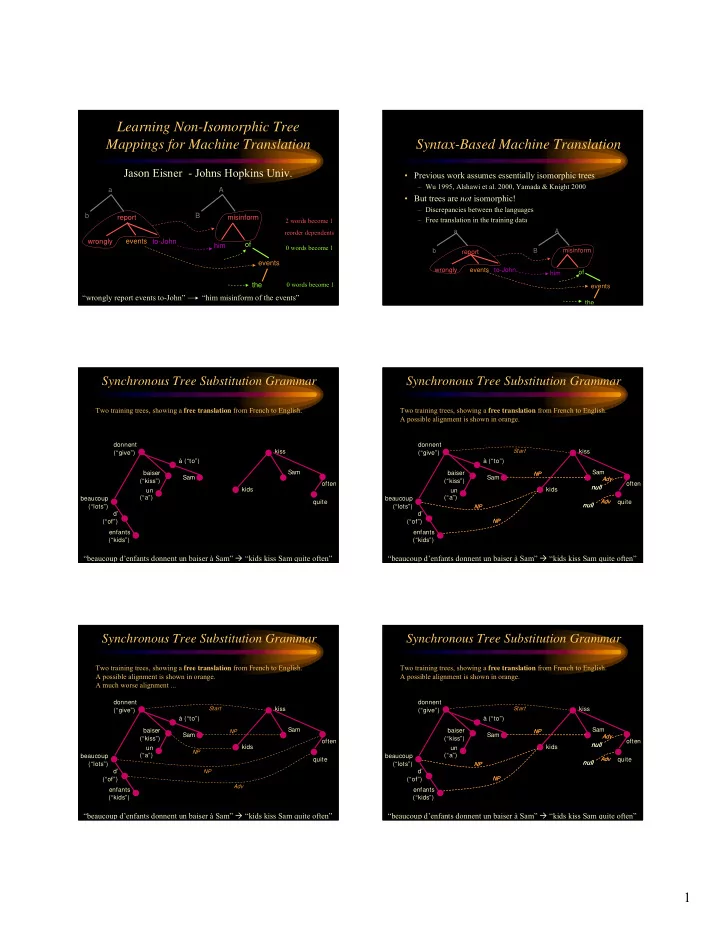
Learning Non-Isomorphic Tree Mappings for Machine Translation Syntax-Based Machine Translation Jason Eisner - Johns Hopkins Univ. Previous work assumes essentially isomorphic trees Wu 1995, Alshawi et al. 2000, Yamada & Knight 2000


slide-1
SLIDE 1

1

the

Learning Non-Isomorphic Tree Mappings for Machine Translation

Jason Eisner - Johns Hopkins Univ.

a b A B events

  • f

misinform wrongly report to-John events him

“wrongly report events to-John” “him misinform of the events”

2 words become 1 reorder dependents 0 words become 1 0 words become 1

Syntax-Based Machine Translation

  • Previous work assumes essentially isomorphic trees

– Wu 1995, Alshawi et al. 2000, Yamada & Knight 2000

  • But trees are not isomorphic!

– Discrepancies between the languages – Free translation in the training data

the a b A B events

  • f

misinform wrongly report to-John events him

Two training trees, showing a free translation from French to English.

Synchronous Tree Substitution Grammar

enfants (“kids”) d’ (“of”) beaucoup (“lots”) Sam donnent (“give”) baiser (“kiss”) un (“a”) à (“to”) kids Sam kiss quite

  • ften

“beaucoup d’enfants donnent un baiser à Sam” “kids kiss Sam quite often”

enfants (“kids”) kids

NP

d’ (“of”) beaucoup (“lots”)

NP NP

Sam Sam

NP

Synchronous Tree Substitution Grammar

kiss donnent (“give”) baiser (“kiss”) un (“a”) à (“to”)

Start NP NP

null

Adv

quite null

Adv

  • ften

null

Adv

null

Adv

“beaucoup d’enfants donnent un baiser à Sam” “kids kiss Sam quite often”

Two training trees, showing a free translation from French to English. A possible alignment is shown in orange.

enfants (“kids”) kids

Adv

d’ (“of”) beaucoup (“lots”)

NP

Sam Sam

NP

Synchronous Tree Substitution Grammar

kiss donnent (“give”) baiser (“kiss”) un (“a”) à (“to”)

Start NP

quite

  • ften

“beaucoup d’enfants donnent un baiser à Sam” “kids kiss Sam quite often”

Two training trees, showing a free translation from French to English. A possible alignment is shown in orange. A much worse alignment ...

enfants (“kids”) kids

NP

d’ (“of”) beaucoup (“lots”)

NP NP

Sam Sam

NP

Synchronous Tree Substitution Grammar

kiss donnent (“give”) baiser (“kiss”) un (“a”) à (“to”)

Start NP NP

null

Adv

quite null

Adv

  • ften

null

Adv

null

Adv

“beaucoup d’enfants donnent un baiser à Sam” “kids kiss Sam quite often”

Two training trees, showing a free translation from French to English. A possible alignment is shown in orange.

slide-2
SLIDE 2

2

enfants (“kids”) kids

NP

d’ (“of”) beaucoup (“lots”)

NP NP

quite null

Adv

  • ften

null

Adv

null

Adv

Sam Sam

NP

kiss donnent (“give”) baiser (“kiss”) un (“a”) à (“to”)

Start NP NP

null

Adv

Synchronous Tree Substitution Grammar

“beaucoup d’enfants donnent un baiser à Sam” “kids kiss Sam quite often”

Start

Two training trees, showing a free translation from French to English. A possible alignment is shown in orange. Alignment shows how trees are generated synchronously from “little trees” ...

Sam Sam

NP

Grammar = Set of Elementary Trees

kiss donnent (“give”) baiser (“kiss”) un (“a”) à (“to”)

Start NP NP

null

Adv

idiomatic translation enfants (“kids”) kids

NP

enfants (“kids”) kids

NP

Sam Sam

NP

Grammar = Set of Elementary Trees

kiss donnent (“give”) baiser (“kiss”) un (“a”) à (“to”)

Start NP NP

null

Adv

idiomatic translation Sam Sam

NP

enfants (“kids”) kids

NP

Grammar = Set of Elementary Trees

kiss donnent (“give”) baiser (“kiss”) un (“a”) à (“to”)

Start NP NP

null

Adv

Sam Sam

NP

enfants (“kids”) kids

NP

d’ (“of”) beaucoup (“lots”)

NP NP

“beaucoup d’” deletes inside the tree d’ (“of”) beaucoup (“lots”)

NP NP

“beaucoup d’” deletes inside the tree

Grammar = Set of Elementary Trees

kiss donnent (“give”) baiser (“kiss”) un (“a”) à (“to”)

Start NP NP

null

Adv

Sam Sam

NP

enfants (“kids”) kids

NP

enfants (“kids”) kids

NP

d’ (“of”) beaucoup (“lots”)

NP NP

“beaucoup d’” matches nothing in English

Grammar = Set of Elementary Trees

kiss donnent (“give”) baiser (“kiss”) un (“a”) à (“to”)

Start NP NP

null

Adv

Sam Sam

NP

enfants (“kids”) kids

NP

slide-3
SLIDE 3

3

Sam Sam

NP

enfants (“kids”) kids

NP

quite null

Adv

Grammar = Set of Elementary Trees

  • ften

null

Adv

null

Adv

d’ (“of”) beaucoup (“lots”)

NP NP

kiss donnent (“give”) baiser (“kiss”) un (“a”) à (“to”)

Start NP NP

null

Adv

adverbial subtree matches nothing in French

Probability model similar to PCFG

Probability of generating training trees T1, T2 with alignment A

P(T1, T2, A) = ∏ p(t1,t2,a | n)

probabilities of the “little” trees that are used

p(

is given by a maximum entropy model

wrongly misinform

NP NP

report

VP

| )

VP

could be trained on zillions

  • f target-language trees

train on paired trees (hard to get)

Form of model of big tree pairs

Wise to use noisy-channel form: Pθ(T1 | T2) * Pθ(T2) But any joint model will do. Joint model Pθ(T1,T2). In synchronous TSG, aligned big tree pair is generated by choosing a sequence of little tree pairs:

P(T1, T2, A) = ∏ p(t1,t2,a | n)

FEATURES

  • report+wrongly ↔ misinform?

(use dictionary)

  • report ↔ misinform? (at root)
  • wrongly ↔ misinform?

Maxent model of little tree pairs

  • verb incorporates adverb child?
  • verb incorporates child 1 of 3?
  • children 2, 3 switch positions?
  • common tree sizes & shapes?
  • ... etc. ....

p(

wrongly misinform

NP NP

report

VP

| )

VP

Inside Probabilities

the a b A B events

  • f

misinform wrongly report to-John events him

VP

β( ) = ...

misinform report

VP

* β( ) * β( ) + ... p( | )

VP

Inside Probabilities

the a b A B events

  • f

misinform wrongly report to-John events him

VP NP NP

β( ) = ...

misinform report

VP

events

  • f

NP

to-John him

NP

* β( ) * β( ) + ... p( | )

VP

NP

misinform wrongly report

VP NP

  • n

l y O ( n2 )

slide-4
SLIDE 4

4

  • Alignment: find A to max Pθ(T1,T2,A)
  • Decoding: find T2, A to max Pθ(T1,T2,A)
  • Training: find θ to max ∑A Pθ(T1,T2,A)
  • Do everything on little trees instead!
  • Only need to train & decode a model of pθ(t1,t2,a)
  • But not sure how to break up big tree correctly

– So try all possible little trees & all ways of combining them, by dynamic prog.

P(T1, T2, A) = ∏ p(t1,t2,a | n) Alignment Pseudocode

for each node c1 of T1 (bottom-up) for each possible little tree t1 rooted at c1 for each node c2 of T2 (bottom-up) for each possible little tree t2 rooted at c2 for each matching a between frontier nodes of t1 and t2 p = p(t1,t2,a) for each pair (d1,d2) of frontier nodes matched by a p = p * β β β β(d1,d2) // inside probability of kids β β β β(c1,c2) = β β β β(c1,c2) + p // our inside probability

Nonterminal states are used in practice but not shown here For EM training, also find outside probabilities

An MT Architecture

Viterbi alignment yields output T2

dynamic programming engine Probability Model pθ(t1,t2,a) of Little Trees

score little tree pair propose translations t2

  • f little tree t1

each possible (t1,t2,a) inside-outside estimated counts

update parameters θ

for each possible t1, various (t1,t2,a) each proposed (t1,t2,a)

Decoder Trainer

scores all alignments

  • f two big trees T1,T2

scores all alignments between a big tree T1 & a forest of big trees T2

Related Work

  • Synchronous grammars (Shieber & Schabes 1990)

– Statistical work has allowed only 1:1 (isomorphic trees)

  • Stochastic inversion transduction grammars (Wu 1995)
  • Head transducer grammars (Alshawi et al. 2000)
  • Statistical tree translation

– Noisy channel model (Yamada & Knight 2000)

  • Infers tree: trains on (string, tree) pair, not (tree, tree) pair
  • But again, allows only 1:1, plus 1:0 at leaves
  • Data-oriented translation (Poutsma 2000)

– Synchronous DOP model trained on already aligned trees

  • Statistical tree generation

– Similar to our decoding: construct forest of appropriate trees, pick by highest prob

– Dynamic prog. search in packed forest (Langkilde 2000) – Stack decoder (Ratnaparkhi 2000)

What Is New Here?

  • Learning full elementary tree pairs, not rule pairs or subcat pairs

– Previous statistical formalisms have basically assumed isomorphic trees

  • Maximum-entropy modeling of elementary tree pairs
  • New, flexible formalization of synchronous Tree Subst. Grammar

– Allows either dependency trees or phrase-structure trees – “Empty” trees permit insertion and deletion during translation – Concrete enough for implementation (cf. informal previous descriptions) – TSG is more powerful than CFG for modeling trees, but faster than TAG

  • Observation that dynamic programming is surprisingly fast

– Find all possible decompositions into aligned elementary tree pairs – O(n2) if both input trees are fully known and elem. tree size is bounded

Status & Thanks

  • Developed and implemented during JHU CLSP

summer workshop 2002 (funded by NSF)

  • Other team members: Jan Hajič, Bonnie Dorr, Dan Gildea,

Gerald Penn, Drago Radev, Owen Rambow, and students: Martin Cmejrek, Yuan Ding, Terry Koo, Kristen Parton

  • Also being used for other kinds of tree mappings:

– between deep structure and surface structure, or semantics and syntax – between original text and summarized/paraphrased/plagiarized version

  • Results forthcoming (that’s why I didn’t submit a full paper ☺)
slide-5
SLIDE 5

5 Summary

  • Most MT systems work on strings
  • We want to translate trees – want to respect syntactic structure
  • But don’t assume that translated trees are structurally isomorphic!
  • TSG formalism: Translation locally replaces tree structure and content.
  • Parameters: Probabilities of local substitutions (use maxent model)
  • Algorithms: Dynamic programming (local substitutions can’t overlap)
  • EM training on <English tree, Czech tree> pairs can be fast:

– Align O(n) tree nodes with O(n) tree nodes, respecting subconstituency – Dynamic programming – find all alignments and retrain using EM – Faster than aligning O(n) words with O(n) words – If correct training tree is unknown, a well-pruned parse forest still has O(n) nodes