Leading Schools for Social Justice Implications for Policymakers - - PDF document

leading schools for
SMART_READER_LITE
LIVE PREVIEW

Leading Schools for Social Justice Implications for Policymakers - - PDF document

5/9/2018 Leading Schools for Social Justice Implications for Policymakers & Administrators Sonya Douglass Horsford Associate Professor of Education Leadership Teachers College, Columbia University @sonyahorsford We have fought long


slide-1
SLIDE 1

5/9/2018 1 Leading Schools for Social Justice

Implications for Policymakers & Administrators

Sonya Douglass Horsford Associate Professor of Education Leadership Teachers College, Columbia University @sonyahorsford

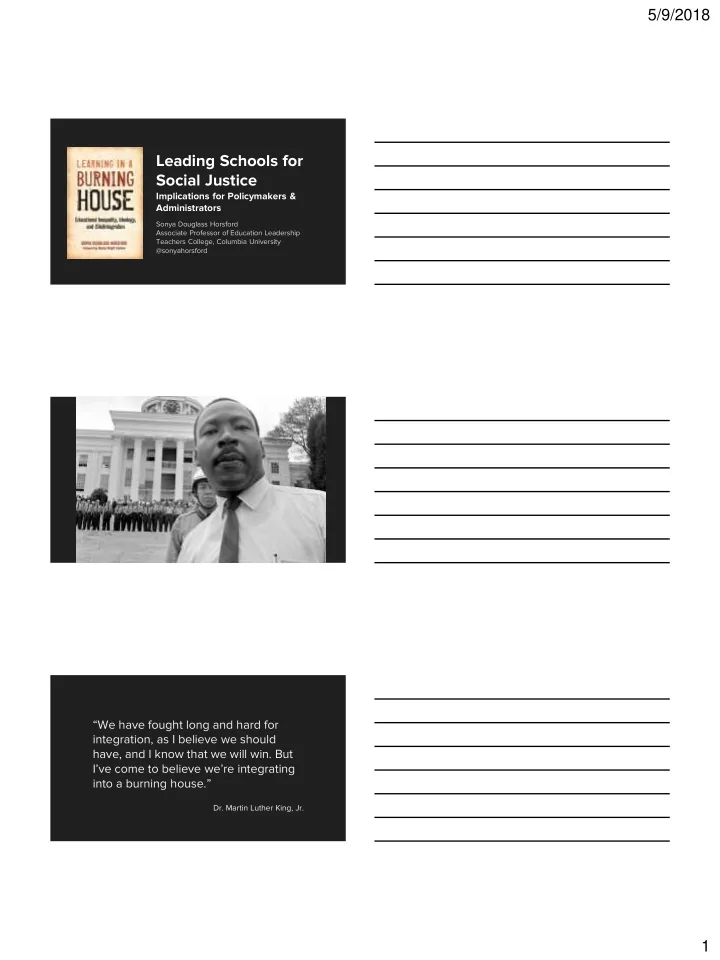
“We have fought long and hard for integration, as I believe we should have, and I know that we will win. But I’ve come to believe we’re integrating into a burning house.”

  • Dr. Martin Luther King, Jr.
slide-2
SLIDE 2

5/9/2018 2

“It is difficult to understand that these attempts - busing, affirmative action, or devices,

  • r words, or approaches -

are used to disguise the continuation of American racism.”

  • Dr. Kenneth B. Clark

Horsford, S. D. (2010). Mixed feelings about mixed schools: Superintendents on the complex legacy of school desegregation. Educational Administration Quarterly, 46(3), 287-321. Research Questions

Q1: How do the lived experiences of Black school superintendents as students under segregation influence their perspectives on desegregation policy, programs, and practices? Q2: How do the lived experiences of Black school superintendents as educational administrators under desegregation influence their perspectives on desegregation policy, programs, and practices? Q3: How do Black school superintendents perceive desegregation as education policy in the post-Brown era?

slide-3
SLIDE 3

5/9/2018 3

CRT Tenet Definition Counterstorytelling Storytelling method that aims to cast doubt on validity of accepted premises or myths held by the majority. (Matsuda, 1995) Critique of liberalism Critique of basic notions embraced by liberal legal ideology; including colorblindness, meritocracy, and neutrality of the law. (Crenshaw, 1988) Whiteness as property The role US racism and jurisprudence has played in reifying conceptions of race, the notion of Whiteness as a property interest. (Harris, 1995) Interest convergence Black progress is achieved only when the goals of blacks are consistent with the needs of whites. (Bell, 1980, 2004) Permanence of racism Racism, both conscious and unconscious, is a permanent component of American life. (Bell, 1992)

Name Born Gndr Hometown Undergraduate Graduate Superintendency Baker 1934 F South Mid- Atlantic Mid-Atlantic, segregated Mid-Atlantic, HBCU Mid-Atlantic Clark 1934 F Rural South South, HBCU West, PWI West Cooper 1932 F Mid-Atlantic, Northeast South, segregated Northeast, PWI Northeast Lewis 1939 M Midwest Midwest, segregated Midwest, PWI Midwest Marshall 1942 M South South, HBCU Northeast, PWI West, Midwest Steele 1932 M South Northeast, HBCU Midwest, PWI Midwest Wells 1947 F Mid-Atlantic South, HBCU Midwest, PWI South Young 1942 M Midwest Midwest, PWI Midwest, PWI Northwest, Midwest

Study Participants: The Black School Superintendent THE INFERIOR ALL BLACK SCHOOL

“There Is Nothing Wrong With Something Being All Black”

EQUAL ACCESS, EDUCATION, AND OPPORTUNITY

“Sometimes I Feel Like the Problems Started With Desegregation”

INTEGRATION, DIVERSITY, AND INCLUSION

“We’ve Never Truly Integrated"
slide-4
SLIDE 4

5/9/2018 4

“We’re just going to have to become firemen.”

  • Dr. Martin Luther King, Jr.

Horsford, S. D. (2014). When race enters the room: Improving leadership and learning through racial literacy. Theory into Practice, 53(1), 123-130.

A Critical Race Approach to Equal Education Step 1: Racial literacy Step 2: Racial realism Step 3: Racial reconstruction Step 4: Racial reconciliation

slide-5
SLIDE 5

5/9/2018 5

Racial Literacy

The ability to understand what race is, why it is, and how it is used to reproduce inequality and oppression.

“Race is a concept that was invented to categorize the perceived biological, social, and cultural differences between human groups.”

(Hammonds, 2003)

Racial Realism

Acknowledging that race and racism are not artifacts

  • f the past, but present

realities that continue to determine who gets what.

slide-6
SLIDE 6

5/9/2018 6

Race has “been used to discriminate and to distribute resources unequally and set up different standards for protection under law.” (Freund, 2003)

Racial Reconstruction

Process of ascribing new meaning to race in order to transform the ways we think about and subsequently, act

  • n, our racial assumptions,

attitudes, and biases.

“Race is a human invention. We created it.. . . And we can think

  • urselves out of it.

We made it, we can unmake it.” (Hammonds, 2003)

slide-7
SLIDE 7

5/9/2018 7

Racial Reconciliation

Healing the wounds inflicted and damage done in schools as a result of racial inequality and racism.

Historical Trauma Theory

“Populations historically subjected to long-term mass trauma exhibit a higher prevalence of disease even several generations after the original trauma occurred” (Sotero, 2006)

Historical Trauma Theory

Originates with subjugation of a population by a dominant group in four ways:

  • 1. Overwhelming physical and psychological

violence

  • 2. Segregation and/or displacement
  • 3. Economic deprivation
  • 4. Cultural dispossession
slide-8
SLIDE 8

5/9/2018 8

Horsford, S. D. (2012). This bridge called my leadership: An essay on Black women as bridge leaders in education. International Journal of Qualitative Studies in Education, 21(5), 11-22.

“My theory is strong people don’t need strong leaders.”

Ella Baker

“We have inherited a large house, a great ‘world house’ in which we have to live together . . . a family unduly separated in ideas, culture, and interests, who, because we can never again live apart, must learn somehow to live with each other in peace.”

  • Dr. Martin Luther King, Jr.
slide-9
SLIDE 9

5/9/2018 9

For more information:

Sonya Douglass Horsford, Ed.D.

Associate Professor of Education Leadership Teachers College, Columbia University horsford@tc.columbia.edu