Le Leveraging Technol chnology gy, Automa Automati tion, on, and - - PDF document

le leveraging technol chnology gy automa automati tion on
SMART_READER_LITE
LIVE PREVIEW

Le Leveraging Technol chnology gy, Automa Automati tion, on, and - - PDF document

7/22/2019 Le Leveraging Technol chnology gy, Automa Automati tion, on, and and Rede defi fini ning ng Recrui cruiti ting ng Bes Best Pra Practices Jeff Henderson Department of Justice Office of Human Resources Itin Itinerary The


slide-1
SLIDE 1

7/22/2019 1

Jeff Henderson Department of Justice Office of Human Resources

Le Leveraging Technol chnology gy, Automa Automati tion,

  • n, and

and Rede defi fini ning ng Recrui cruiti ting ng Bes Best‐Pra Practices

  • The “Old Days” of Recruiting
  • What is Recruiting Automation (including some definitions)
  • How is Recruiting Evolving
  • Real‐world examples of recruiting automation
  • Concerns about Automating Recruiting (including biases)
  • Wrap‐up

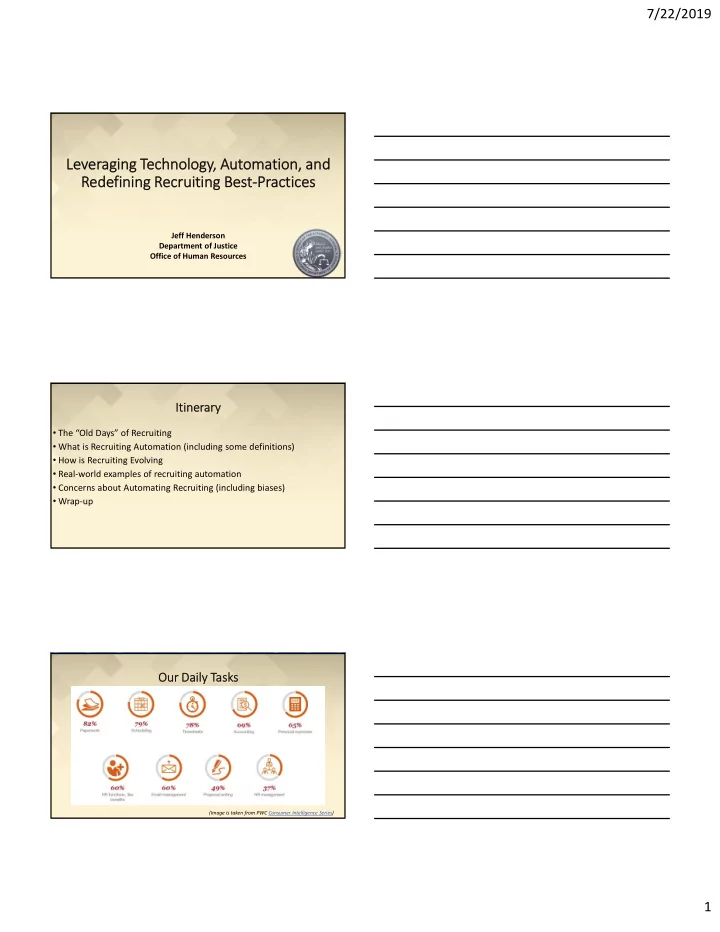
Itin Itinerary Our Our Daily Daily Ta Tasks

(Image is taken from PWC Consumer Intelligence Series)

slide-2
SLIDE 2

7/22/2019 2

  • The early 2000s brought about the first big tech disruption in

the hiring process with the advent of online job boards

  • Position opens up Job is posted on the career

website/job board (Post and Pray) HR hopes a suitable candidate discovers the opening and applies

  • More successful with finding active job seekers
  • These outdated methods are not as effective today

Recrui uiting ting In In The The Ea Early 2000s 2000s

  • The widespread adoption of LinkedIn in the late 2000s meant that

candidates’ profiles were easily searchable online.

  • It was now easier to seek out passive candidates due to this influx of

information.

  • This resulted in recruiters in becoming more specialized and more tech savvy.

The The Ri Rise se of

  • f Social

Social Med Media

slide-3
SLIDE 3

7/22/2019 3

  • Recruiting passive candidates has become the norm at many
  • rganizations. The problem, though, is that many companies have

made the same shift.

  • Every recruiter has access to the same information on the same

candidate so it’s no longer an advantage.

  • The frustrating reality is that the greatest challenge in recruiting is no

longer finding candidates, it’s engaging with the right candidates – before your competition does.

  • There needs to be a better way to get the best candidates as fast as
  • possible. That better way is Recruiting Automation.

Recrui uiting ting To Today (Th (The Ro Robots Ar Are Com Coming!! !!!) !)

  • A category of technology that allows companies to automate recruiting

tasks and workflows so they can increase recruiter productivity, accelerate time‐to‐fill, reduce cost‐per‐hire and improve the overall talent profile of their organization.

  • By using this automation, recruiters can refine their process, eliminate

inefficiencies, mitigate biases, and engage with top talent at the

  • ptimal time.

Wh What is is Recrui uiting ting Aut Automatio tion? Gaps Gaps in in To Today’s Hi Hiri ring ng Processes

  • cesses
  • 1. Inefficient procedures
  • 2. Difficult‐to‐find skill sets
  • 3. Unconscious bias – it’s imperative to prevent bias from sneaking into the hiring
  • process. Still, no system is perfect, and many organizations lament that they don’t

know how to track or stop unconscious bias in hiring.

  • 4. Lack of diversity and inclusion – modern organizations sell to an increasingly

diverse customer base and needs a workforce that reflects that diversity. Yet many

  • rganizations struggle with where to find, how to attract, and importantly, how to

engage diverse candidates.

  • 5. Volume of hiring
  • 6. Difficulty getting candidates to engage – many candidates are so overwhelmed

with recruiting solicitations that they simply tune them out.

2018, John Wiley & Sons, Inc.

slide-4
SLIDE 4

7/22/2019 4

The image below depicts some of the sections within the Recruiting Automation category and some vendors. The software solutions will vary depending upon your needs and budget required to roll these solutions out.

Va Various Aut Automatio tion Softw Software Solutio Solutions

Examples of recruiting automation technologies can be found throughout the recruiting funnel.

  • Candidate sourcing and engagement
  • Diversity & Inclusion
  • Candidate Screening and Experience
  • Recruiter chatbots
  • Interview Scheduling
  • Assessments and Interviewing
  • Applicant Tracking Systems (ATS)
  • Candidate Rediscovery

The Definitive Guide to Recruiting Automation, Entelo Interview Scheduling

15.8%

Hiring Manager Feedback

2%

Engaging Candidates

11.9%

Candidate Qualification

Candidate Nurturing

6.9%

Sourcing 39.6%

Where Recruiting Automation Is Most Useful

Entelo Research

slide-5
SLIDE 5

7/22/2019 5

Ta Talent Acquisiti Acquisition Is Is Ev Evolving

  • 1. Simple Automation – AI and machine learning are helping recruiters cut the

tedious workload of sorting through huge piles of resumes. These technologies are also bringing about a more level playing field where bias is reduced and diversity is encouraged.

  • 2. Transparency – With the advent of professional social networking sites, job

boards, and company review sites, more public user‐generated data about candidates and companies is available than ever before.

  • 3. Better candidate experience – New, automated systems are helping busy

recruiters keep applicants better informed about their status.

2018, John Wiley & Sons, Inc.

Wh What Fa Factors Ar Are Drivin Driving The The Move Move To Towards Aut Automatio tion?

  • Competition for talent with a finite number of qualified candidates. The reality

is your company is competing for talent with huge companies throwing virtually unlimited resources at the problem.

  • A Bureau of Labor Statistics report shows the that number of unemployed people per

job opening is 0.9, down from a high of 6.6 unemployed people per job at the height of the economic downturn.

  • Shift to passive recruiting – recruiters are actively seeking out passive

candidates for their open roles

  • Historically low unemployment rate in the US. The U.S. unemployment rate in

Q4 2018 stood at the historically low level of 3.7 percent.

2018, John Wiley & Sons, Inc.

slide-6
SLIDE 6

7/22/2019 6

Wh What Fa Factors Ar Are Drivin Driving The The Move Move To Towards Aut Automatio tion? (Con (Contin tinued)

  • Information overload
  • Too many resumes/applications are often received. Most recruiters simply don’t have

enough time to adequately source, assess, and screen candidates.

  • Lack of diversity in candidate pools
  • You may find that you can’t meet diversity goals without making special efforts to

expand the pool

  • Unconscious bias by recruiting teams and hiring managers
  • Automation can remove the biases by giving more weight to relevant qualifications

Wh What Fa Factors Ar Are Drivin Driving The The Move Move To Towards Aut Automatio tion? (Con (Contin tinued)

  • Increasingly specialized skills – positions may require advanced knowledge
  • Opportunistic Candidates – Candidates are becoming increasingly accustomed to

employers finding them. LinkedIn estimates that 70 percent of the workforce is comprised

  • f such passive candidates who aren’t actively job searching for a new job but may be

receptive if approached (by the right recruiter).

Po Positives Of Of Aut Automatio tion

Recruiting automation is commonly known for the time savings and efficiency gains it brings to modern recruiting departments, but it can bring other benefits.

  • Productivity Savings ‐ Recruiting automation technologies excel at eliminating

inefficiencies from talent operations.

  • Higher Quality Candidates – The recruiting automation process helps ensure that all

the best‐fit candidates were identified and engaged in the recruiting process, resulting in better quality hires and a higher performing organization.

  • Most recruiting automation tools also gather rich data that can be used to improve

and optimize the way a company hires. From diagnosing problems in your interview process to doing more targeted and strategic outreach.
slide-7
SLIDE 7

7/22/2019 7

Sho Should ld We We Fe Fear Aut Automatio tion?

  • “Will Recruiting Automation put me out of a job!?”
  • The forces leading the Recruiting Automation revolution -- from historically

low unemployment to technology innovations like artificial intelligence and machine learning -- are real. But so are the questions and confusion circling this emergent category.

Comm Common Mi Misconc

  • nceptions

ns About About Recruiti uiting ng Aut Automatio tion

  • Recruiting automation means we won’t need recruiters anymore.
  • This is perhaps the most common misconception about recruiting automation.
  • Recruiting automation systems will re‐enforce bias in the hiring process.
  • Unfortunately, traditional manual recruiting processes can be fraught with bias. Recruiting

automation can help companies to reduce and/or eliminate bias in their hiring processes by alerting them to situations where unconscious bias may be involved.

  • Recruiting automation will be poorly received by recruiters
  • While the fear of the “robots are coming for our jobs” is understandable, the reality is that

most of the things that will be automated in recruiting are the low‐value, tedious and manual tasks that most recruiters don’t enjoy doing.

Possibilitie ssibilities of

  • f Ma

Machine Bias Bias

  • Machine Learning – In order to have a basis for proper analysis of the data, AI

systems are typically fed information about past results. For example, you might provide AI with the resumes of previous hires along with data showing how well those people function in the organization.

  • Predictive Analytics – Armed with an extensive database showing past

performance based on analysis of applications and resumes, AI can make predictions about the potential for applicants to fit into the organization’s culture and be successful. It includes techniques such as data mining, regression analysis, and predictive modeling of historical data to make probabilistic estimates of what

  • utcomes are most likely in unknown events
slide-8
SLIDE 8

7/22/2019 8

How How A Com Compan any Lik Like Hea HearFi Fish sh Coul uld Addr Address Yo Your Aut Automatio tion Needs Needs (Spe (Specific Ex Exam amples) ples)

  • New applicants
  • Candidate status updates
  • Rejection communication
  • Interview reminders
  • New hires

Un Under derstanding nding The The Ben Benefits fits

  • Increased productivity as automation reduces low‐level, unproductive tasks
  • Improving the talent pipeline and candidate experience because you can respond

more quickly and keep applicants informed of their status

  • Accelerating candidate evaluations by applying artificial intelligence to assess

candidate fit

  • Elimination of human bias and driving diversity so you can achieve a more

inclusive workforce.

  • Improving candidate engagement with targeted and personalized email nurture

campaigns

slide-9
SLIDE 9

7/22/2019 9

Wr Wrapup

  • The reality is if you haven’t embraced recruiting automation then you are already

behind the curve. Though recruiting automation is still in its infancy, it is guaranteed to be a major player for years to come.

  • With the current state of the labor market, recruiters must dedicate an increasing

amount of their day to sourcing in order to stay competitive. This is a clear area in which automation can be leveraged to increase efficiency and offload tedious tasks.

  • While the technology is very advantageous, recruiters must be cognizant of not

diminishing the candidate experience. That start‐to‐finish candidate experience will be gone with automation and so you need to make sure you’re not leaning too heavily on automation.

  • For best results…. Your recruiting must blend high‐tech with high‐touch.

Questions?

The data presented in this report was obtained from a November/December 2018 annual survey conducted by Entelo. Results are based on responses from 625 global talent acquisition professionals. Participants were selected based on their human resources or talent acquisition job function. Respondents opted in to participate in this research study and completed a survey containing 33 questions related to their talent acquisition activities and behaviors. Sources: Direct References include: Entelo Research Society for Human Resource Management’s 2017 Human Capital Benchmarking Report Calculating the Cost of Vacant tech Positions, DICE, 2017 Talent Acquisition: Recruitment and Selection, Society for Human Resource Management, 2016 U.S. Bureau of Labor Statistics FRED – Federal reserve Economic Data NFIB Small Business Economic Trends