
SLIDE 1
Fran Berman
Laying the Groundwork for Success in the Information Age
- Dr. Fran Berman
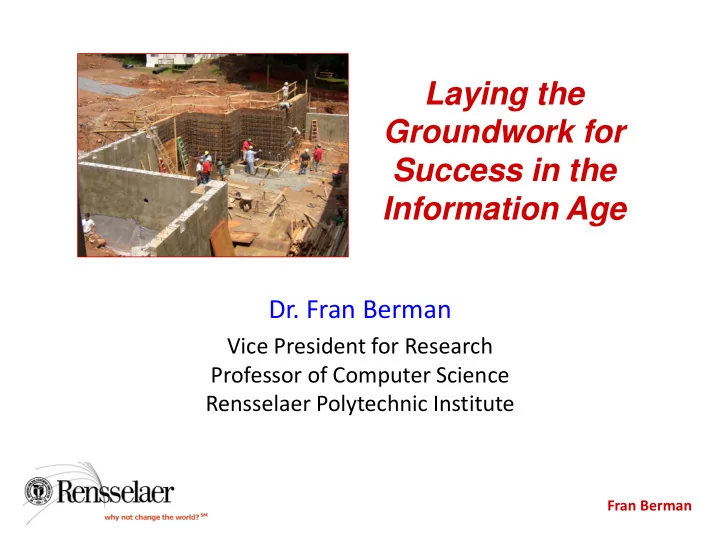
Laying the Groundwork for Success in the Information Age Dr. Fran - - PowerPoint PPT Presentation
Laying the Groundwork for Success in the Information Age Dr. Fran Berman Vice President for Research Professor of Computer Science Rensselaer Polytechnic Institute Fran Berman Ken Kennedy Pioneer, Colleague, Inspiration, Friend Ken
Fran Berman
Fran Berman
Fran Berman
What is the potential impact of Global Warming? How will natural disasters effect urban centers? What therapies can be used to cure or control cancer? Can we accurately predict market
What plants work best for biofuels?
“Science is more essential for our prosperity, our security, our health,
before.” President Barack Obama
Fran Berman
What is the potential impact of Global Warming? How will natural disasters effect urban centers? What therapies can be used to cure or control cancer? What plants work best for biofuels? Can we accurately predict market
“Science is more essential for our prosperity, our security, our health,
before.” President Barack Obama
The “Atkins Report”: Revolutionizing Science and Engineering Through Cyberinfrastructure, 2003
Computation Visualization Data Sensors Models
Images and movies courtesy of Al Wallace/RPI, Amit Chourasia/SDSC, and JCSG
Fran Berman The U.S. “cyber- election” of 2008 How does the political and cultural life of a society evolve? How does disease spread? PDB: World wide reference collection
information
Images and movies courtesy of Library of Congress, PDB, ICPSR
Which has the greatest impact – nature or nurture? Panel Study of Income Dynamics: longitudinal data
Life at the time of the Russian Revolution
Fran Berman
Kilo 103 Meg a 106 Giga 109 Tera 1012 Peta 1015 Exa 1018 Zetta 1021 U.S. Library of Congress manages 295+ terabytes of digital data, 230+
1 novel = 1 megabyte SDSC Tape Archives = 36+ petabytes capacity Stored data from ENZO cosmological simulations = 500 terabytes 50,000 Protein Data Bank Structures = 35 terabytes Google Earth =71+ terabytes
Graph Source: “The Diverse and Exploding Digital Universe” IDC Whitepaper, March 2008
By 2023, the amount of digital data will exceed Avogadro’s number. (6.02 X 10^23 = number of atoms in 12 grams of carbon)
Fran Berman
Create Edit Use / Reuse Publish Preserve / Destroy
Data creation / capture / gathering from
experiments
additional data
instruments / computers / devices ….
/ data collections / databases
literature ….
preserve
replicate / preserve
ignore
Information adapted from Chris Rusbridge and Liz Lyon
Fran Berman
Source: “The Diverse and Exploding Digital Universe” IDC Whitepaper, March 2008
Fran Berman
Access to information tomorrow requires preservation of information today
Fran Berman
(Census information, presidential emails, Shoah Collection, etc.)
Observatory, etc.
data, digital photos of my kids’ graduations, etc.
The Data Pyramid
increasing reliability required, increasing infrastructure expense
Fran Berman
Regulations Retention Requirement Penalty Sarbanes-Oxley Auditors must retain relevant data for at least 7 years Fines to $5M and 20 years in prison HIPAA Retain patient data for 6 years $250K fine and up to 10 years in prison Gramm-Leach- Baily Ensure confidentiality of customer financial information Up to $500K and 10 years in prison SEC 17a Broker data retention for 3-6 years. Some require longer retention Variable based on violation OMB Circular A- 110 / CFR Part 215 (applies to federally funded research data) “a three year period is the minimum amount of time that research data should be kept by the grantee” Penalty structure unclear, likely fines?
Table information partly based on “Data Retention – More Value, Less Filling”,John Murphy, http://www.tdan.com/view-articles/5222
Reform and Investor Protection Act of 2002)
Applies to all U.S. public company boards, management, and public accounting firms Includes electronic records (correspondence, work papers, memoranda, etc.) that are created, sent, or received in connection with an audit
1. “Don’t forget that email and instant messaging are business records … 4. Don't assume that the retention requirement …is …7 years. … most lawyers that understand information retention agree that business records need to be kept indefinitely.
Kevin Beaver, “Thirteen Data Retention Mistakes to Avoid” http://searchdatamanagement.techtarget.com/ news/article/0,289142,sid91_gci1186910,00.ht ml
Fran Berman
Regulations Retention Requirement Penalty Sarbanes-Oxley Auditors must retain relevant data for at least 7 years Fines to $5M and 20 years in prison HIPAA Retain patient data for 6 years $250K fine and up to 10 years in prison Gramm-Leach- Baily Ensure confidentiality of customer financial information Up to $500K and 10 years in prison SEC 17a Broker data retention for 3-6 years. Some require longer retention Variable based on violation OMB Circular A- 110 / CFR Part 215 (applies to federally funded research data) “a three year period is the minimum amount of time that research data should be kept by the grantee” Penalty structure unclear, likely fines?
Accountability Act)
maintained by health care providers “who engage in certain electronic transactions, health plans, and health care clearinghouses” [www.hipaa.org]
standards for the use and dissemination of health care information
records for a period of not less than 6 years.
Fran Berman
Regulations Retention Requirement Penalty Sarbanes-Oxley Auditors must retain relevant data for at least 7 years Fines to $5M and 20 years in prison HIPAA Retain patient data for 6 years $250K fine and up to 10 years in prison Gramm-Leach- Baily Ensure confidentiality of customer financial information Up to $500K and 10 years in prison SEC 17a Broker data retention for 3-6 years. Some require longer retention Variable based on violation OMB Circular A- 110 / CFR Part 215 (applies to federally funded research data) “a three year period is the minimum amount of time that research data should be kept by the grantee” Penalty structure unclear, likely fines?
Budget requires that federally funded research data, supporting documentation, scientific notebooks, financial records, etc. be maintained by the grantee for 3+ years
agencies, institutional repositories not currently prepared to address the economic, technological, legal and social issues associated with widespread compliance of data retention policies
Fran Berman
media
Why are 3 copies used as best practice?
Lamport, Shostak, and Pease’s solution to the Byzantine General’s Problem
– Method for agreement on a battle plan for a group of Byzantine generals communicating only by messenger – Analogous to reliable computer systems with malfunctioning components
can send unforgeable signed messages to one another, the minimum number required for agreement is 3.
Fran Berman
Fran Berman
tape, geographically)
Enti tity ty a at t ri risk Wha hat c can go n go wrong
Freque quenc ncy File ile Corrupted media, disk failure 1 year Sy System + Systemic errors in vendor SW,
error that deletes multiple copies 15 years Ar Archive + Natural disaster, obsolescence
50 - 100 years Information courtesy of Richard Moore, Reagan Moore
10.0 100.0 1000.0 10000.0 100000.0
June-97 June-98 June-99 June-00 June-01 June-02 June-03 June-04 June-05 June-06 June-07 June-08 June-09
Date Archival Storage (TB) Model A (8-yr,15.2-mo 2X) TB Stored Planned Capacity
Fran Berman
Supercomputers Archival Storage Systems Metrics of Success High Performance; good ranking on the Top500 list; application impact High reliability; Minimal data loss and damage Next Generation Systems Growth in capability/capacity key: Compatibility of systems not required although there should be application transition paths Smooth migration for data key: Preservation collections must migrate to new media without loss of data or disruption to users Funding Model Serial “one time” funding for each new HPC resource possible No gaps. Funding must be available for continuous support of data collections
Fran Berman
Creative partnerships needed to provide reliable preservation solutions for digital data in the public interest,
management structure, etc.
Fran Berman
Requirements courtesy of Blue Ribbon Task Force on Sustainable Digital Preservation and Access (brtf.sdsc.edu)
Pay as you go Institutional subsidy Advertisement Subscription
Fran Berman
cultural content
alternative ways of addressing sustainable digital preservation
(First year) BRTF Interim Report available at Task Force website: brtf.sdsc.edu
preservation context is X, you should consider using model Y for sustainable digital access and
Fran Berman
Fran Berman
College
kindergarten
Jhumpa Lahiri Barack Obama Mark Zuckerman Roxana Saberi Wendy Kopp
Fran Berman
Educational institutions must prepare students for the “outside” world they will encounter when they graduate
Fran Berman
– “How many women and under-represented minorities PIs and co-PIs are associated with your Department/School/Institution?”
development.”
students and colleagues for awards, prizes, recognitions, prestigious memberships, etc.
help drive a more successful future
Fran Berman