SLIDE 1
Last time: the chain rule in multi-variable calculus
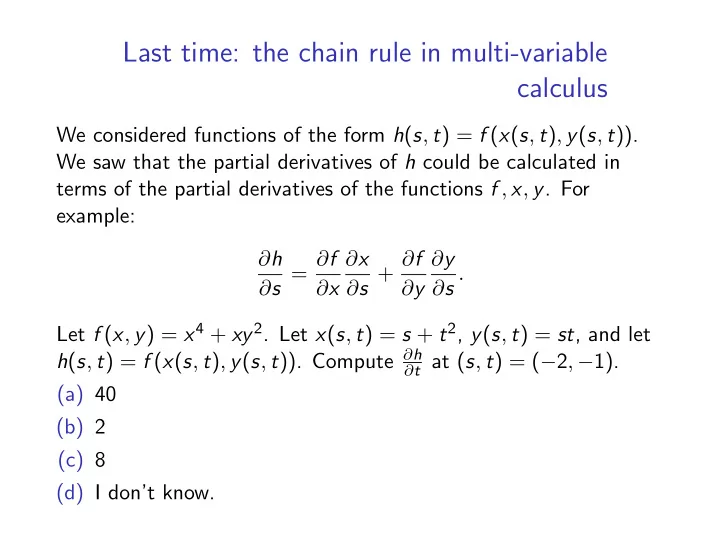
We considered functions of the form h(s, t) = f (x(s, t), y(s, t)). We saw that the partial derivatives of h could be calculated in terms of the partial derivatives of the functions f , x, y. For example: ∂h ∂s = ∂f ∂x ∂x ∂s + ∂f ∂y ∂y ∂s . Let f (x, y) = x4 + xy2. Let x(s, t) = s + t2, y(s, t) = st, and let h(s, t) = f (x(s, t), y(s, t)). Compute ∂h
∂t at (s, t) = (−2, −1).
(a) 40 (b) 2 (c) 8 (d) I don’t know.
SLIDE 2
Computing directional derivatives
Let T(x, y, z) = xyz be the temperature at location (x, y, z). Suppose there is a butterfly flying around the room. Right now it is at point P = (1, 2, 3) and has velocity v = ⟨ 1
√ 2, 0, −1 √ 2⟩. What
can you say about the temperature the butterfly is experiencing? (a) It’s getting hotter. (b) It’s getting colder. (c) It’s staying the same. (d) I don’t know. Hint: we already computed the gradient of T in an earlier example.
SLIDE 3
More about the butterfly
Remember that butterfly. It is in a room with temperature given by T(x, y, z) = xyz and it is at point P = (1, 2, 3). It wants to move in the direction of greatest warmth. Which way should it go, and what is the greatest rate of temperature increase it can achieve? (Make sure to express the direction as a unit vector.) (a) Max. rate 49, in direction 1
7⟨6, 3, 2⟩.
(b) Max. rate 7, in direction −1
7 ⟨6, 3, 2⟩.
(c) Max. rate 7, in direction 1
7⟨6, 3, 2⟩.
(d) I don’t know.
SLIDE 4 Still more about the butterfly
Also make sure you know about Midterm 1 locations.
Find out more
SLIDE 5
Gradients and contour maps
Consider the function f (x, y) = 1 − x2 − 4y2. We just sketched some level sets of f . Find the gradient vector at the point ( 1
√ 2, 1 2 √ 2). Draw it on the
contour map, as a vector with its tail at the point ( 1
√ 2, 1 2 √ 2).
Does this vector point towards the maximum point (0, 0) of f ? Is it at right angles to the contour line through ( 1
√ 2, 1 2 √ 2)?
(a) Yes and yes. (b) Yes and no. (c) No and yes. (d) No and no. (e) I don’t know.
SLIDE 6