SLIDE 1
ANLP Lecture 15 Dependency Syntax and Parsing
Shay Cohen (based on slides by Sharon Goldwater and Nathan Schneider) 18 October, 2019
Last class
◮ Probabilistic context-free grammars ◮ Probabilistic CYK ◮ Best-first parsing ◮ Problems with PCFGs (model makes too strong independence assumptions)
A warm-up question
We described the generative story for PCFGs - pick a rule at random and terminate when choosing a terminal symbol. Does this process have to terminate?
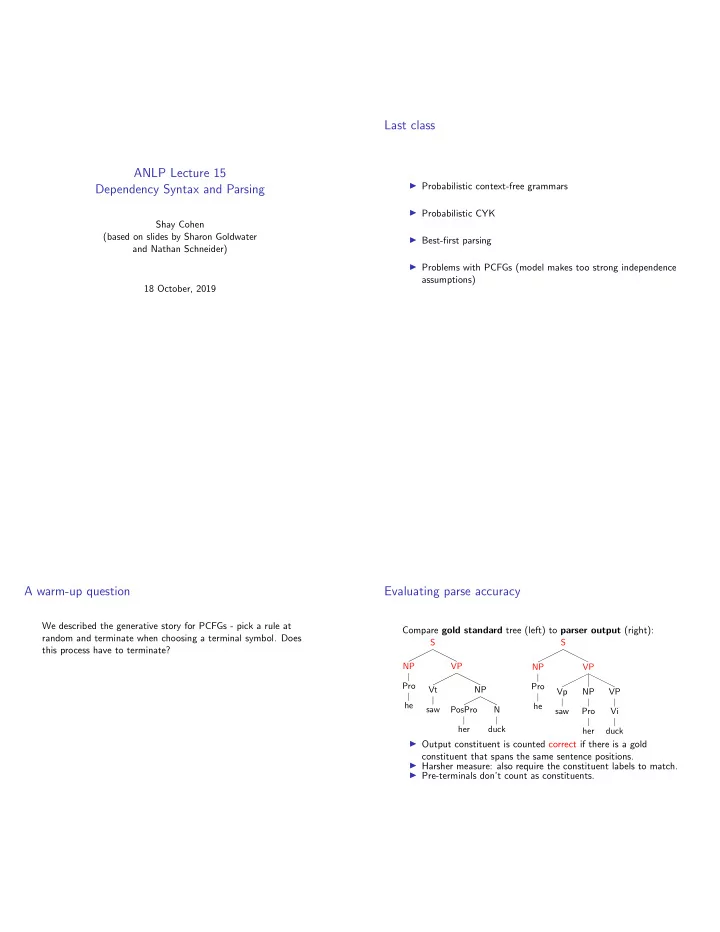
Evaluating parse accuracy
Compare gold standard tree (left) to parser output (right):
S NP Pro he VP Vt saw NP PosPro her N duck S NP Pro he VP Vp saw NP Pro her VP Vi duck
◮ Output constituent is counted correct if there is a gold constituent that spans the same sentence positions. ◮ Harsher measure: also require the constituent labels to match. ◮ Pre-terminals don’t count as constituents.
SLIDE 2 Evaluating parse accuracy
Compare gold standard tree (left) to parser output (right):
S NP Pro he VP Vt saw NP PosPro her N duck S NP Pro he VP Vp saw NP Pro her VP Vi duck
◮ Precision: (# correct constituents)/(# in parser output) = 3/5 ◮ Recall: (# correct constituents)/(# in gold standard) = 3/4 ◮ F-score: balances precision/recall: 2pr/(p+r)
Parsing: where are we now?
◮ We discussed the basics of probabilistic parsing and you should now have a good idea of the issues involved. ◮ State-of-the-art parsers address these issues in other ways. For comparison, parsing F-scores on WSJ corpus are:
◮ vanilla PCFG: < 80%1 ◮ lexicalizing + cat-splitting: 89.5% (Charniak, 2000) ◮ Best current parsers get about 94%
◮ We’ll say a little bit about recent methods later, but most details in sem 2.
1Charniak (1996) reports 81% but using gold POS tags as input.
Parsing: where are we now?
Parsing is not just WSJ. Lots of situations are much harder! ◮ Other languages, esp with free word order (up next) or little annotated data. ◮ Other domains, esp with jargon (e.g., biomedical) or non-standard language (e.g., social media text). In fact, due to increasing focus on multilingual NLP, constituency syntax/parsing (English-centric) is losing ground to dependency parsing...
Lexicalization, again
We saw that adding lexical head of the phrase can help choose the right parse: S-saw NP-kids kids VP-saw VP-saw V-saw saw NP-birds birds PP-fish P-with with NP-fish fish Dependency syntax focuses on the head-dependent relationships.
SLIDE 3 Dependency syntax
An alternative approach to sentence structure. ◮ A fully lexicalized formalism: no phrasal categories. ◮ Assumes binary, asymmetric grammatical relations between words: head-dependent relations, shown as directed edges: kids saw birds with fish ◮ Here, edges point from heads to their dependents.
Dependency trees
A valid dependency tree for a sentence requires: ◮ A single distinguished root word. ◮ All other words have exactly one incoming edge. ◮ A unique path from the root to each other word.
kids saw birds with fish kids saw birds with binoculars
It really is a tree!
◮ The usual way to show dependency trees is with edges over
◮ But the edge structure (without word order) can also be shown as a more obvious tree:
kids saw birds with fish saw kids birds fish with
Labelled dependencies
It is often useful to distinguish different kinds of head → modifier relations, by labelling edges: kids saw birds with fish
ROOT NSUBJ DOBJ NMOD CASE
◮ Historically, different treebanks/languages used different labels. ◮ Now, the Universal Dependencies project aims to standardize labels and annotation conventions, bringing together annotated corpora from over 50 languages. ◮ Labels in this example (and in textbook) are from UD.
SLIDE 4
Why dependencies??
Consider these sentences. Two ways to say the same thing:
S NP Sasha VP V gave NP the girl NP a book S NP Sasha VP V gave NP a book PP to the girl
Why dependencies??
Consider these sentences. Two ways to say the same thing:
S NP Sasha VP V gave NP the girl NP a book S NP Sasha VP V gave NP a book PP to the girl
◮ We only need a few phrase structure rules: S → NP VP VP → V NP NP VP → V NP PP plus rules for NP and PP.
Equivalent sentences in Russian
◮ Russian uses morphology to mark relations between words:
◮ knigu means book (kniga) as a direct object. ◮ devochke means girl (devochka) as indirect object (to the girl).
◮ So we can have the same word orders as English:
◮ Sasha dal devochke knigu ◮ Sasha dal knigu devochke
Equivalent sentences in Russian
◮ Russian uses morphology to mark relations between words:
◮ knigu means book (kniga) as a direct object. ◮ devochke means girl (devochka) as indirect object (to the girl).
◮ So we can have the same word orders as English:
◮ Sasha dal devochke knigu ◮ Sasha dal knigu devochke
◮ But also many others!
◮ Sasha devochke dal knigu ◮ Devochke dal Sasha knigu ◮ Knigu dal Sasha devochke
SLIDE 5 Phrase structure vs dependencies
◮ In languages with free word order, phrase structure (constituency) grammars don’t make as much sense.
◮ E.g., we would need both S → NP VP and S → VP NP, etc. Not very informative about what’s really going on.
Phrase structure vs dependencies
◮ In languages with free word order, phrase structure (constituency) grammars don’t make as much sense.
◮ E.g., we would need both S → NP VP and S → VP NP, etc. Not very informative about what’s really going on.
◮ In contrast, the dependency relations stay constant:
Sasha dal devochke knigu
ROOT NSUBJ IOBJ DOBJ
Sasha dal knigu devochke
ROOT NSUBJ IOBJ DOBJ
Phrase structure vs dependencies
◮ Even more obvious if we just look at the trees without word
Sasha dal devochke knigu
ROOT NSUBJ IOBJ DOBJ
Sasha dal knigu devochke
ROOT NSUBJ IOBJ DOBJ
dal Sasha devochke knigu dal Sasha devochke knigu
Pros and cons
◮ Sensible framework for free word order languages. ◮ Identifies syntactic relations directly. (using CFG, how would you identify the subject of a sentence?) ◮ Dependency pairs/chains can make good features in classifiers, for information extraction, etc. ◮ Parsers can be very fast (coming up...) But ◮ The assumption of asymmetric binary relations isn’t always right... e.g., how to parse dogs and cats?
SLIDE 6 How do we annotate dependencies?
Two options:
- 1. Annotate dependencies directly.
- 2. Convert phrase structure annotations to dependencies.
(Convenient if we already have a phrase structure treebank.) Next slides show how to convert, assuming we have head-finding rules for our phrase structure trees.
Lexicalized Constituency Parse
S-saw NP-kids kids VP-saw V-saw saw NP-birds NP-birds birds PP-fish P-with with NP-fish fish
. . . remove the phrasal categories. . .
saw kids kids saw saw saw birds birds birds fish with with fish fish
. . . remove the (duplicated) terminals. . .
saw kids saw saw birds birds fish with fish
SLIDE 7
. . . and collapse chains of duplicates. . .
saw kids saw saw birds birds fish with fish
. . . and collapse chains of duplicates. . .
saw kids saw saw birds birds fish with
. . . and collapse chains of duplicates. . .
saw kids saw saw birds birds fish with
. . . and collapse chains of duplicates. . .
saw kids saw saw birds fish with
SLIDE 8
. . . and collapse chains of duplicates. . .
saw kids saw saw birds fish with
. . . done!
saw kids birds fish with
Constituency Tree → Dependency Tree
We saw how the lexical head of the phrase can be used to collapse down to a dependency tree: S-saw NP-kids kids VP-saw VP-saw V-saw saw NP-birds birds PP-binoculars P-with with NP-binoculars binoculars ◮ But how can we find each phrase’s head in the first place?
Head Rules
The standard solution is to use head rules: for every non-unary (P)CFG production, designate one RHS nonterminal as containing the head. S → NP VP, VP → VP PP, PP → P NP (content head), etc. S NP kids VP VP V saw NP birds PP P with NP binoculars ◮ Heuristics to scale this to large grammars: e.g., within an NP, last immediate N child is the head.
SLIDE 9
Head Rules
Then, propagate heads up the tree: S NP-kids kids VP VP V-saw saw NP-birds birds PP P-with with NP-binoculars binoculars
Head Rules
Then, propagate heads up the tree: S NP-kids kids VP VP-saw V-saw saw NP-birds birds PP P-with with NP-binoculars binoculars
Head Rules
Then, propagate heads up the tree: S NP-kids kids VP VP-saw V-saw saw NP-birds birds PP-binoculars P-with with NP-binoculars binoculars
Head Rules
Then, propagate heads up the tree: S NP-kids kids VP-saw VP-saw V-saw saw NP-birds birds PP-binoculars P-with with NP-binoculars binoculars
SLIDE 10 Head Rules
Then, propagate heads up the tree: S-saw NP-kids kids VP-saw VP-saw V-saw saw NP-birds birds PP-binoculars P-with with NP-binoculars binoculars
Projectivity
If we convert constituency parses to dependencies, all the resulting trees will be projective. ◮ Every subtree (node and all its descendants) occupies a contiguous span of the sentence. ◮ = the parse can be drawn over the sentence w/ no crossing edges. A hearing
the issue is scheduled today
ROOT ATT ATT SBJ VC TMP PC ATT
Nonprojectivity
But some sentences are nonprojective. A hearing is scheduled
the issue today
ROOT ATT ATT SBJ VC TMP PC ATT
◮ We’ll only get these annotations right if we directly annotate the sentences (or correct the converted parses). ◮ Nonprojectivity is rare in English, but common in many languages. ◮ Nonprojectivity presents problems for parsing algorithms.
Dependency Parsing
Some of the algorithms you have seen for PCFGs can be adapted to dependency parsing. ◮ CKY can be adapted, though efficiency is a concern: obvious approach is O(Gn5); Eisner algorithm brings it down to O(Gn3)
◮ N. Smith’s slides explaining the Eisner algorithm: http://courses.cs.washington.edu/courses/cse517/ 16wi/slides/an-dep-slides.pdf
◮ Shift-reduce: more efficient, doesn’t even require a grammar!
SLIDE 11 Recall: shift-reduce parser with CFG
◮ Same example grammar and sentence. ◮ Operations:
◮ Reduce (R) ◮ Shift (S) ◮ Backtrack to step n (Bn)
◮ Note that at 9 and
11 we skipped over backtracking to 7 and 5 respectively as there were actually no choices to be made at those points.
Step Op. Stack Input the dog bit 1 S the dog bit 2 R DT dog bit 3 S DT dog bit 4 R DT V bit 5 R DT VP bit 6 S DT VP bit 7 R DT VP V 8 R DT VP VP 9 B6 DT VP bit 10 R DT VP NN 11 B4 DT V bit 12 S DT V bit 13 R DT V V 14 R DT V VP 15 B3 DT dog bit 16 R DT NN bit 17 R NP bit . . .
Transition-based Dependency Parsing
The arc-standard approach parses input sentence w1 . . . wN using two types of reduce actions (three actions altogether): ◮ Shift: Read next word wi from input and push onto the stack. ◮ LeftArc: Assign head-dependent relation s2 ← s1; pop s2 ◮ RightArc: Assign head-dependent relation s2 → s1; pop s1 where s1 and s2 are the top and second item on the stack,
- respectively. (So, s2 preceded s1 in the input sentence.)
Example
Parsing Kim saw Sandy: Step
←bot. Stacktop→
Word List Action Relations [root] [Kim,saw,Sandy] Shift 1 [root,Kim] [saw,Sandy] Shift 2 [root,Kim,saw] [Sandy] LeftArc Kim←saw 3 [root,saw] [Sandy] Shift 4 [root,saw,Sandy] [] RightArc saw→Sandy 5 [root,saw] [] RightArc root→saw 6 [root] [] (done) ◮ Here, top two words on stack are also always adjacent in
- sentence. Not true in general! (See longer example in JM3.)
Labelled dependency parsing
◮ These parsing actions produce unlabelled dependencies (left). ◮ For labelled dependencies (right), just use more actions: LeftArc(NSUBJ), RightArc(NSUBJ), LeftArc(DOBJ), . . . Kim saw Sandy Kim saw Sandy
ROOT NSUBJ DOBJ
SLIDE 12
Differences to constituency parsing
◮ Shift-reduce parser for CFG: not all sequences of actions lead to valid parses. Choose incorrect action → may need to backtrack. ◮ Here, all valid action sequences lead to valid parses.
◮ Invalid actions: can’t apply LeftArc with root as dependent; can’t apply RightArc with root as head unless input is empty. ◮ Other actions may lead to incorrect parses, but still valid.
◮ So, parser doesn’t backtrack. Instead, tries to greedily predict the correct action at each step.
◮ Therefore, dependency parsers can be very fast (linear time). ◮ But need a good way to predict correct actions (next lecture).
Notions of validity
◮ In constituency parsing, valid parse = grammatical parse.
◮ That is, we first define a grammar, then use it for parsing.
◮ In dependency parsing, we don’t normally define a grammar.
◮ Valid parses are those with the properties on slide 4.
Summary: Transition-based Parsing
◮ arc-standard approach is based on simple shift-reduce idea. ◮ Can do labelled or unlabelled parsing, but need to train a classifier to predict next action, as we’ll see next time. ◮ Greedy algorithm means time complexity is linear in sentence length. ◮ Only finds projective trees (without special extensions) ◮ Pioneering system: Nivre’s MaltParser.
Alternative: Graph-based Parsing
◮ Global algorithm: From the fully connected directed graph of all possible edges, choose the best ones that form a tree. ◮ Edge-factored models: Classifier assigns a nonnegative score to each possible edge; maximum spanning tree algorithm finds the spanning tree with highest total score in O(n2) time. ◮ Pioneering work: McDonald’s MSTParser ◮ Can be formulated as constraint-satisfaction with integer linear programming (Martins’s TurboParser) ◮ Details in JM3, Ch 16.5 (optional).
SLIDE 13 Graph-based vs. Transition-based vs. Conversion-based
◮ TB: Features in scoring function can look at any part of the stack; no optimality guarantees for search; linear-time; (classically) projective only ◮ GB: Features in scoring function limited by factorization;
- ptimal search within that model; quadratic-time; no
projectivity constraint ◮ CB: In terms of accuracy, sometimes best to first constituency-parse, then convert to dependencies (e.g., Stanford Parser). Slower than direct methods.
Choosing a Parser: Criteria
◮ Target representation: constituency or dependency? ◮ Efficiency? In practice, both runtime and memory use. ◮ Incrementality: parse the whole sentence at once, or obtain partial left-to-right analyses/expectations? ◮ Retrainable system? ◮ Accuracy?
Summary
◮ Constituency syntax: hierarchically nested phrases with categories like NP. ◮ Dependency syntax: trees whose edges connect words in the
- sentence. Edges often labeled with relations like nsubj.
◮ Can convert constituency to dependency parse using head rules. ◮ For projective trees, transition-based parsing is very fast and can be very accurate. ◮ Google “online dependency parser”. Try out the Stanford parser and SEMAFOR!