Largescale Anisotropy in the Arrival Directions of UltraHigh Energy - - PowerPoint PPT Presentation

large scale anisotropy in the arrival directions of ultra
SMART_READER_LITE
LIVE PREVIEW

Largescale Anisotropy in the Arrival Directions of UltraHigh Energy - - PowerPoint PPT Presentation

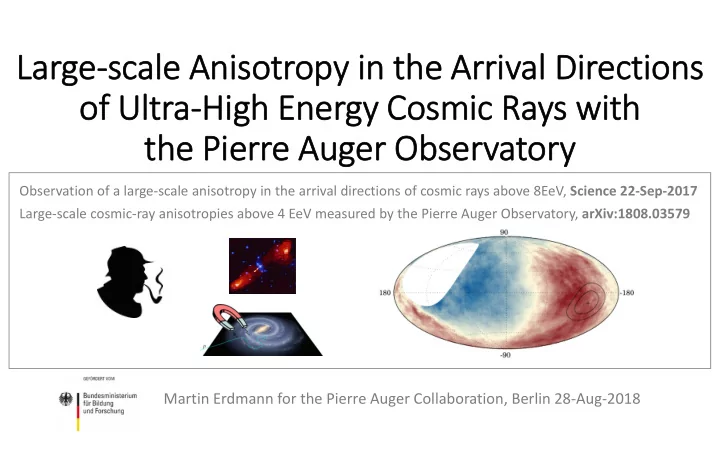
Largescale Anisotropy in the Arrival Directions of UltraHigh Energy Cosmic Rays with the Pierre Auger Observatory Observation of a largescale anisotropy in the arrival directions of cosmic rays above 8EeV, Science 22Sep2017


slide-1
SLIDE 1

Large‐scale Anisotropy in the Arrival Directions

  • f Ultra‐High Energy Cosmic Rays with

the Pierre Auger Observatory

Martin Erdmann for the Pierre Auger Collaboration, Berlin 28‐Aug‐2018

Large‐scale cosmic‐ray anisotropies above 4 EeV measured by the Pierre Auger Observatory, arXiv:1808.03579 Observation of a large‐scale anisotropy in the arrival directions of cosmic rays above 8EeV, Science 22‐Sep‐2017

slide-2
SLIDE 2

World‘s largest Calorimeter

50 km 60 km 10 km Pierre Auger Observatory

Martin Erdmann RWTH Aachen University 2

Water Cherenkov detectors

NASA

slide-3
SLIDE 3

Dipolar anisotropy in arrival directions

Martin Erdmann RWTH Aachen University 3

RA = right ascension dec = declination Cosmic ray arrival direction

Observation of a large‐scale anisotropy in the arrival directions of cosmic rays above 8EeV, Science 22‐Sep‐2017, Vol. 357, Iss. 6357, p. 1266

www.astro.ufl.edu

slide-4
SLIDE 4

Departure from isotropic arrival [E>8EeV]

First‐harmonic Fourier components 5 First clear anisotropy signal

Martin Erdmann RWTH Aachen University 4

Science 22‐Sep‐2017 measurement time

slide-5
SLIDE 5

Reconstructing the 3dim. Dipole

Galactic coordinates Equatorial coordinates Combine 2 first‐harmonic Fourier analyses Right ascension Azimuth

  • f shower

direction

Martin Erdmann RWTH Aachen University 5

perpendicular parallel Dipole components Amplitude 6.5 (+1.3/‐0.9) % Science 22‐Sep‐2017

slide-6
SLIDE 6

Galactic origin?

Martin Erdmann RWTH Aachen University 6

Messages

  • Dipole directions close to Galactic center
  • Dipole amplitudes too large for Galactic

cosmic‐ray origins (>0.8) Unlikely to arise from Galactic component Large‐scale cosmic‐ray anisotropies above 4 EeV measured by the Pierre Auger Observatory, arXiv:1808.03579 Model

  • Sources continuous in Galaxy, density as luminous

matter (gray)

  • Cosmic rays: various rigidities R=E/Z propagated

through Galactic magnetic field (JF12, PT11)

  • Flux weight by integrating matter density along

path through Galaxy

slide-7
SLIDE 7

Extragalactic origin: Galactic Magnetic Field

Model effect of Galactic Magnetic Field

  • Directional change of extragalactic dipole
  • Line color: suppression of dipole amplitude
  • Arrows start at extragalactic directions →

reconstruct on Earth for different CR rigidities

Martin Erdmann RWTH Aachen University 7

Messages

  • mild changes: dipole direction & amplitude
  • extragalactic dipoles at positive Galactic

longitudes align closer to inner spiral arm,

  • pposite half to outer spiral arm

Dipole most likely of extragalactic origin R=E/Z = 4,8,16,32 EV arXiv:1808.03579

slide-8
SLIDE 8

Examples extragalactic origins

Martin Erdmann RWTH Aachen University 8

example: 2MRS (<100 Mpc) flux weighted dipole plus galactic magnetic field deflections Also possible: diffusive propagation from powerful sources in a few nearby galaxies arXiv:1808.03579

slide-9
SLIDE 9

Energy dependence of dipole direction

Martin Erdmann RWTH Aachen University 9

Measurements

  • Direction of dipole for different energy bins
  • Gray symbols: 2MRS galaxy catalog (<100 Mpc)
  • Cross symbol: direction of flux‐weighted 2MRS dipole

Interpretation

  • no clear trend in change of dipole direction

as function of energy arXiv:1808.03579

slide-10
SLIDE 10

Energy dependence of dipole amplitude

Martin Erdmann RWTH Aachen University 10

Measurement

  • Growing amplitude of dipole with increasing energy

Interpretation

  • Smaller deflections of cosmic rays at higher rigidities
  • Increased attenuation for cosmic rays from distant

sources, increased relative flux from nearby sources → more anisotropic

8

arXiv:1808.03579

slide-11
SLIDE 11

Combine Dipolar & Quadrupol contributions?

Martin Erdmann RWTH Aachen University 11

Observations

  • Quadrupolar components not

statistically significant

  • Dipolar components consistent

with dipole‐only results arXiv:1808.03579

slide-12
SLIDE 12

5

Conclusion

Martin Erdmann RWTH Aachen University 12

Observation

  • Dipolar anisotropy with > 5  significance !
  • Dipole amplitude increases with cosmic‐ray energy

Interpretation

  • Unlikely of Galactic origin
  • Easily explained by extragalactic origin
  • Not yet clear: dipolar anisotropy may
  • arise from diffusive propagation from powerful sources in few nearby galaxies
  • reflect known anisotropy in distribution of galaxies within few hundred Mpc
slide-13
SLIDE 13

Amplitude & Phase

Martin Erdmann RWTH Aachen University 13