
SLIDE 1
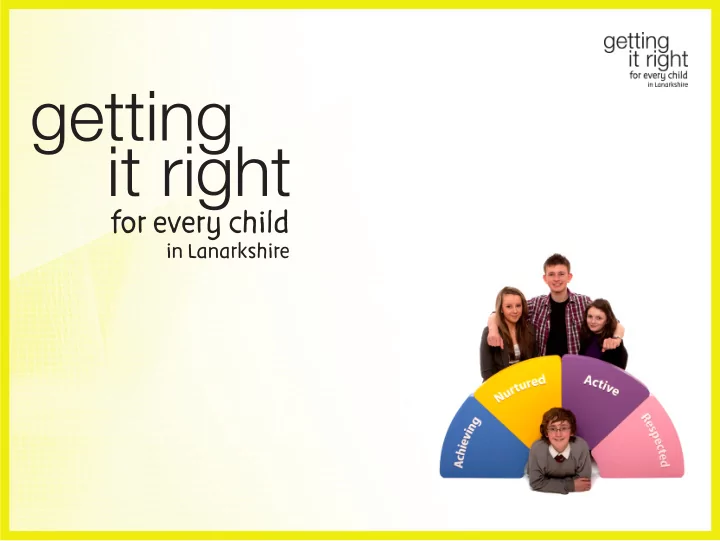
LANARKSHIRE Well-being Indicator Dr David Best GIRFEC Wheel - - PowerPoint PPT Presentation
LANARKSHIRE Well-being Indicator Dr David Best GIRFEC Wheel Background Getting it right for every child (GIRFEC), a national approach in supporting and working with all children and young people in Scotland GIRFEC was developed in
Getting it right for every child ∙ (GIRFEC), a national approach in supporting and working with all children and young people in Scotland GIRFEC was developed in order to refmect initiatives, studies and ∙ reports that had been carried out in services for children GIRFEC aims to improve the life chances of vulnerable children, ∙ although the words “every child” are of paramount importance
The current project builds on the success of GIRFEC by using the ∙ domains of the well-being indicator as the basic structure for the instrument Well-being indicators: ∙ Safe Healthy Achieving Nurtured Active Respected Responsible Included Children’s well-becoming: ∙ Confjdent individuals Effective contributors Successful learners Responsible citizens
The instrument also uses ‘strength’ and ‘risk’ factors ∙ which have been used in an adult well-being measure – the Assessment of Recovery Capital (ARC, Best et al. in preparation) Measuring well-being generically is more useful than an ∙ explicit measure of substance problems
Testing acceptability – using a steering group and with a ∙ focus group of young people This led to substantial changes to the questionnaire and the ∙ information provided to young people School-based testing: three aspects of the psychometrics of ∙ the instrument were assessed 1.) Factor structure 2.) Test-retest reliability analysis 3.) Concurrent validity
A total of 803 young people took part in the school phase of the analysis ∙ and Table 1 below shows the range of schools that they were attending
Table 1: Breakdown of schools involved in the pilot work Valid Frequency Percent Abronhill High 96 12.0 Braidhurst High 76 9.5 Cathkin High 57 7.1 Kilsyth High 77 9.6 Larkhall Academy 76 9.5 St Aidan's High 131 16.3 St Ambrose High 96 12.0 Strathaven Academy 130 16.2 Kilsyth – retest 64 8.0 Total 803 100.0
Table 2 below gives the breakdown of the school year for each of the pupils ∙ participating
Table 2: School year of participants Valid Missing Frequency Percent S1 103 12.8 S2 165 20.5 S3 197 24.5 S4 122 15.2 S5 132 16.4 S6 79 9.8 Total 798 99.4 9 5 .6 Total 803 100.0
The overall pattern of threats and strengths are shown in Table 3 and Figure 1 below
Strengths Threats Safety 4.2 0.4 Health 3.8 1.2 Achieving 4 1.6 Nurture 4.6 0.3 Activity 3.4 1.2 Respect 2.9 0.9 Responsibility 3.3 0.9 Inclusion 3.9 1.3 Figure 1: Overall profjle of strengths and threats Table 3: Overall average scores for strengths and threats
The overall pattern of threats by year are shown in table 4 ∙
Table 4: Mean threat scores by year Safety Health Achieving Nurture Activity Respect Respons Inclusion S1 0.4 0.9 1.3 0.3 0.8 1 1.2 1.6 S2 0.6 1.1 1.4 0.4 1.1 0.9 0.9 1.3 S3 0.4 1.2 1.7 0.3 1.3 0.9 1 1.4 S4 0.6 1.4 2 0.4 1.3 0.9 0.8 1.2 S5 0.3 1.2 1.3 0.2 1 0.8 0.7 1 S6 0.4 1.5 1.7 0.3 1.5 1 0.6 1.2
Figure 2: Threat scores by year
The next stage is to have a go at fjlling in the questionnaire ∙ for yourself Please complete it as a role-play – being an imaginary or ∙ real young person accessing the service
Baseline ∙ At appropriate subsequent follow-up points ∙ The key measure is change ∙ Recording and coding the results ∙ Use as a clinical marker ∙
Each section has two scores – one for ∙ strengths and one for risks or threats Both of these will be between 0-5 ∙ You can also work out a total score for ∙ strengths (0-40) And for threats (0-40) ∙ And you can compare to an ‘average’ ∙ school population
Complete with all new clients ∙ Take a copy for your case fjles ∙ Collate a central copy and UWS research ∙ team will collect The pilot will run for three months ∙ We are trying to establish service norms and ∙ change measures
The aim is to use as the basis for evaluation ∙ So what we are hoping to see is change in key indicators ∙ However, it may also direct your attention to key areas for therapeutic ∙ focus and intervention Intractable risk areas may require a more intensive intervention ∙ High correlations with the SDQ mean that there are grounds for ∙ clinical utility
We will feed back early in the new year ∙ But implementation is as important as the statistics ∙ Please give us feedback about how easy it is to use and what the ∙ response is like for the young people If this works, the next stage will be about using it as a therapeutic tool ∙