
SLIDE 1
Logical agents
Chapter 7
Chapter 7 1
Outline
♦ Knowledge-based agents ♦ Wumpus world ♦ Logic in general—models and entailment ♦ Propositional (Boolean) logic ♦ Equivalence, validity, satisfiability ♦ Inference rules and theorem proving – forward chaining – backward chaining – resolution
Chapter 7 2
Knowledge bases
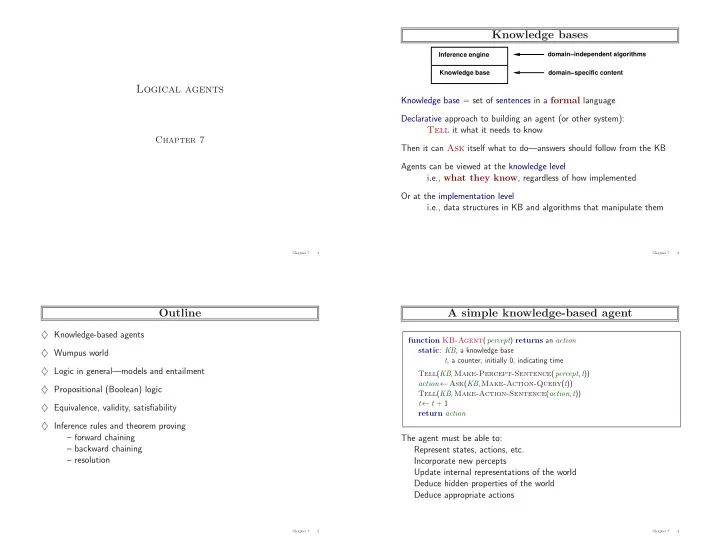
Inference engine Knowledge base domain−specific content domain−independent algorithms
Knowledge base = set of sentences in a formal language Declarative approach to building an agent (or other system): Tell it what it needs to know Then it can Ask itself what to do—answers should follow from the KB Agents can be viewed at the knowledge level i.e., what they know, regardless of how implemented Or at the implementation level i.e., data structures in KB and algorithms that manipulate them
Chapter 7 3
A simple knowledge-based agent
function KB-Agent( percept) returns an action static: KB, a knowledge base t, a counter, initially 0, indicating time Tell(KB,Make-Percept-Sentence( percept,t)) action ← Ask(KB,Make-Action-Query(t)) Tell(KB,Make-Action-Sentence(action,t)) t ← t + 1 return action
The agent must be able to: Represent states, actions, etc. Incorporate new percepts Update internal representations of the world Deduce hidden properties of the world Deduce appropriate actions
Chapter 7 4