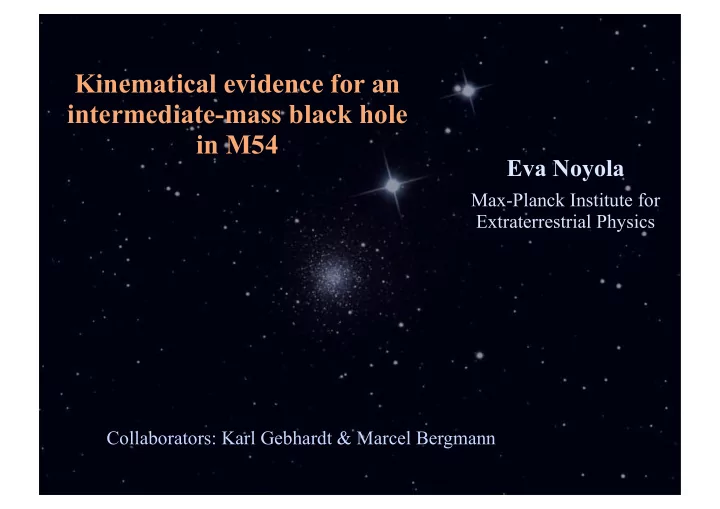
Kinematical evidence for an intermediate-mass black hole in M54 - - PowerPoint PPT Presentation

kinematical evidence for an intermediate mass black hole
SMART_READER_LITE
LIVE PREVIEW

Kinematical evidence for an intermediate-mass black hole in M54 - - PowerPoint PPT Presentation

Kinematical evidence for an intermediate-mass black hole in M54 Eva Noyola Max-Planck Institute for Extraterrestrial Physics Collaborators: Karl Gebhardt & Marcel Bergmann History and motivation for finding IMBHs in GCs X-ray sources


slide-1
SLIDE 1

Kinematical evidence for an intermediate-mass black hole in M54

Eva Noyola

Max-Planck Institute for Extraterrestrial Physics Collaborators: Karl Gebhardt & Marcel Bergmann

slide-2
SLIDE 2

History and motivation for finding IMBHs in GCs

  • X-ray sources (Silk & Arons, 1975)
  • Analytical models from Bahcall & Wolf (1976)
  • Small sphere of influence, only resolved until recently
  • Seeds necessary to form SMBHs
  • Possible extension of MBH-sigma relation
  • Possible sources for gravitational wave detectors
slide-3
SLIDE 3

Basic facts of star cluster dynamics

Two-body relaxation Heating mechanism

Core Collapse

  • Binaries
  • Stellar mass black holes
  • Stellar mass loss
  • White Dwarf kicks
  • Intermediate mass black hole
slide-4
SLIDE 4

SB slopes distributions

  • 0.5
  • 1

2 4 6 8 10 12 SB slope

  • 0.5
  • 1

SB slope

  • 0.5
  • 1
  • 1.5
  • 2

5 10 15 20 LD slope

  • 0.5
  • 1
  • 1.5
  • 2

LD slope

~20% of HST-based SB profiles have central slopes matching N-body models with central BHs

Baumgardt et al (2005)

N-body simulations of star clusters containing central black holes predict a central shallow cusp of slope ~-0.2 in surface density.

Noyola & Gebhardt, 2006, 2007

slide-5
SLIDE 5

Kinematic evidences for black holes in GCs

M15 G1

  • Evidence for central

black hole is inconclusive

  • 3400 M⦿ inside 0.05 pc
  • Possible central rotation
  • SB fits models for post

core-collapse bounce

  • 20,000 M⦿ central black

hole from orbit-based models

  • Alternative model fits
  • kinematics. Requires two

merging clusters

  • Central rotation detected
  • Flat central core in SB
  • Central X-ray and radio

emission detected

van den Bosch et al., 2006; McNamara et al., 2003; Gerssen et al., 2002 Gebhardt et al., 2005; Baumgardt et al., 2003 Pooley & Rappaport, 2006; Ulvestad et al., 2007

NGC 6752

  • Unusual millisecond

pulsar population

  • Measured central M/L

implies 1000-2000 M⦿ inside 0.08 pc

  • Configuration could

come from single or double black hole of 200-500 M⦿

Colpi et al., 2003; D’Amico et al., 2002

slide-6
SLIDE 6
  • Kinematics from Gemini-

GMOS IFU

  • Use Calcium triplet region
  • Velocity dispersion measured

from integrated spectra in two 5”×5” fields

  • Velocity dispersion rise

detected between the fields at 14” (18.6 km/s) and the central field (23.0 km/s)

Omega Centauri

ACS convolved ACS GMOS acquisition GMOS

Noyola, Gebhardt & Bergmann 2008

slide-7
SLIDE 7

Dynamical models

  • Central kinematics from

GMOS, outer points from individual radial velocities

  • Spherical dynamical

models assuming a constant M/L ratio and various black hole masses

  • Spherical models

consistent with a black hole

  • f 4±1×10⁴ M⦿
slide-8
SLIDE 8

Ibata et al, 1997

M54 and the Sag dwarf

Monaco et al, 2005

M54 could be the nucleus of the Sag dwarf galaxy

slide-9
SLIDE 9

GMOS H-alpha filter; ~700 velocities

GMOS data for M54

Noyola, Gebhardt & Bergmann., 2009, in prep

slide-10
SLIDE 10

GNIRS data for M54

WFPC2 V-band C

  • n

v V

  • b

a n d IFU K-band Acq H-band

WFPC2 V-band WFPC2 convolved Gemini aqc GNIRS reconst.

slide-11
SLIDE 11

Velocity map

  • Use CO bandhead to measure kinematics
  • Detect rotation pattern with 13 km/s amplitude, σ = 15 km/s
slide-12
SLIDE 12

Models

  • Density and velocity inputs completed

with other data

Bellazzini et al., 2008; Monaco et al., 2005

  • Best fit model has BH mass of 104 M⦿
  • No BH model requires some radial

anisotropy

slide-13
SLIDE 13

Conclusions

  • M54 shows a shallow central density cusp
  • GMOS data provides ~500 individual radial velocities
  • utside the core
  • GNIRS data shows clear rotation at the center
  • Best fit model for M54 requires a 104 M⦿ central BH
  • Stability tests are crucial to evaluate alternative

scenarios