Justin Derner, Agricultural Research 11/28/2017 Service Drought - - PDF document

justin derner agricultural research 11 28 2017 service
SMART_READER_LITE
LIVE PREVIEW

Justin Derner, Agricultural Research 11/28/2017 Service Drought - - PDF document

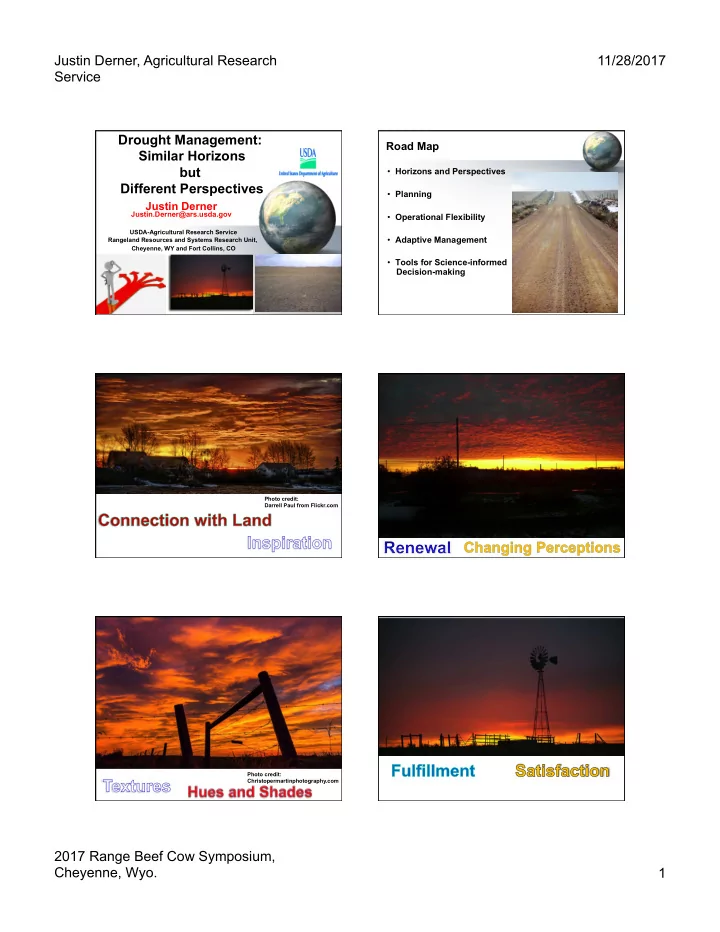
Justin Derner, Agricultural Research 11/28/2017 Service Drought Management: Road Map Similar Horizons but Horizons and Perspectives Different Perspectives Planning Justin Derner Justin.Derner@ars.usda.gov Operational Flexibility


slide-1
SLIDE 1

Justin Derner, Agricultural Research Service 11/28/2017 2017 Range Beef Cow Symposium, Cheyenne, Wyo. 1 Drought Management: Similar Horizons but Different Perspectives

Justin Derner

Justin.Derner@ars.usda.gov

USDA-Agricultural Research Service Rangeland Resources and Systems Research Unit, Cheyenne, WY and Fort Collins, CO

Road Map

  • Horizons and Perspectives
  • Planning
  • Operational Flexibility
  • Adaptive Management
  • Tools for Science-informed

Decision-making

Photo credit: Darrell Paul from Flickr.com Photo credit: Christopermartinphotography.com

slide-2
SLIDE 2

Justin Derner, Agricultural Research Service 11/28/2017 2017 Range Beef Cow Symposium, Cheyenne, Wyo. 2

20th Century Droughts

Woodhouse and Overpeck, 1998

Recent Droughts

2012 2017

Planning

Central Plains Experimental Range, CO

1940 1945 1950 1955 1960 1965 1970 1975 1980 1985 1990 1995 2000 2005 2010 2015

Annual Precipitation (inches)

0.0 2.5 5.0 7.5 10.0 12.5 15.0 17.5 20.0 22.5 25.0 Mean: 13.40 Max: 22.88 (1967) Min: 4.31 (1964)

Interannual Variability What Drought Management Strategies do Ranchers Use?

How many producers had a drought management plan? 60% How many producers thought drought would be more influential in their management plans in the future than past? 40%

Drought Planning

Kachergis et al. Ecosphere 5(6):77. http://dx.doi.org/10.1890/ES13-00402.1

4 in 10 producers do not have a drought plan

slide-3
SLIDE 3

Justin Derner, Agricultural Research Service 11/28/2017 2017 Range Beef Cow Symposium, Cheyenne, Wyo. 3

“…we do have a drought plan, it’s kind of pessimistic plan in that you just figure the drought is going to be here periodically and you keep things at a conservative level, so when it does come it doesn’t hit so

  • hard. Not that we aren’t

affected, but we aren’t affected as much.” “That’s why we run a smaller cow herd. That’s why we’re kind of under stocked.”

Drought: Preparing?

Kachergis et al. Ecosphere 5(6):77.

Proactive and reactive drought management strategies

Limited use currently, but potential is high for flexibility “So the last drought was just an expensive education to do something different. I think anybody that went through the last drought and didn’t do something before this drought is crazy. And I think most people are doing something.” “..instead of seeing it (drought) as an obstacle, you see it as a catalyst to make changes you might not ordinarily do.”

Drought: Opportunity?

Drought as a Change Agent

“...if you have more of a diverse type of livestock (enterprise), your options of being able to de-stock are so much easier so when you have this abrupt drought…when you have a diverse group of cattle… you’re not looking at trying to get rid of pairs, which is hard to do right now. Yearlings are a lot easier to unload, so that’s just another reason I have gone the way I’m going is it makes you more flexible in those decisions.”

Operational Flexibility Forage Production Variability

Difficulty for ranchers is matching this forage production variability with animal management flexibility across years.

1982 1984 1986 1988 1990 1992 1994 1996 1998 2000 2002 2004 2006 2008 2010 2012 2014

Forage Production (kg/ha)

250 500 750 1000 1250 1500 1750 2000 2250 2500 2750 3000 “really bad years” “really good years”

Data from USDA-ARS, Cheyenne, WY, Derner et al.

  • Transition from 100% cow-calf to cow-

calf-yearling operations

– Several operations using 2/3 of long-term forage carrying capacity for cow herd, flex with yearlings on the rest – Can markedly reduce selling of cow genetics in dry/drought years

  • Retain more heifer calves in fall

– If extra forage, can either breed or send to feedlot after grass – If dry, heifers can be sold or sent to feedlot

  • Dry cow grazing in late spring/summer

– If extra forage, can keep or purchase dry cows in spring and add weight

Possible Flexible Strategies

Photo credit – David Augustine

slide-4
SLIDE 4

Justin Derner, Agricultural Research Service 11/28/2017 2017 Range Beef Cow Symposium, Cheyenne, Wyo. 4

Adaptive Management

Four general strategies for dealing with drought: 1) predict it with forecasting tools 2) respond by adjusting animal numbers or length of grazing season 3) employ conservative stocking 4) use inherent spatial variability

Derner and Augustine 2016 Rangelands 38:211-215

Tools for Science-Informed Decision-making

  • Current conditions
  • Outlooks
  • Seasonal forecasts
  • Longer-term climatological

influences

Current Conditions Outlooks Seasonal Forecasts

http://www.cpc.ncep.noaa.gov/

slide-5
SLIDE 5

Justin Derner, Agricultural Research Service 11/28/2017 2017 Range Beef Cow Symposium, Cheyenne, Wyo. 5

Warm Phase Pacific Decadal Oscillation (PDO) Warm Phase Atlantic Multidecadal Oscillation (AMO)

Longer-term Climatological Influences

Dust Bowl Years High Variability And Drought 2013 to cold phase 2014 to warm phase A= PDO warm, AMO cold (current conditions)

B= PDO cold, AMO cold (mid-1960s to mid-1970s)

C= PDO warm, AMO warm 1930s Dust Bowl D= PDO cold, AMO warm (2000 to 2013) 1950s drought period

GrassCast

An Experimental Projection For Grassland Productivity In the Great Plains

Justin Derner and Dannele Peck USDA Northern Plains Climate Hub William (Bill) Parton Colorado State University Brian Fuchs National Drought Mitigation Center

June 12

Take Home Messages

  • Horizons and Perspectives
  • Planning
  • Operational Flexibility
  • Adaptive Management
  • Tools for Science-informed

Decision-making

slide-6
SLIDE 6

Justin Derner, Agricultural Research Service 11/28/2017 2017 Range Beef Cow Symposium, Cheyenne, Wyo. 6

Questions?

Justin.Derner@ars.usda.gov