June 11, 2013 STAP-GEF W/S, Washington DC Hashali Hamukuaya and - - PowerPoint PPT Presentation

june 11 2013
SMART_READER_LITE
LIVE PREVIEW

June 11, 2013 STAP-GEF W/S, Washington DC Hashali Hamukuaya and - - PowerPoint PPT Presentation

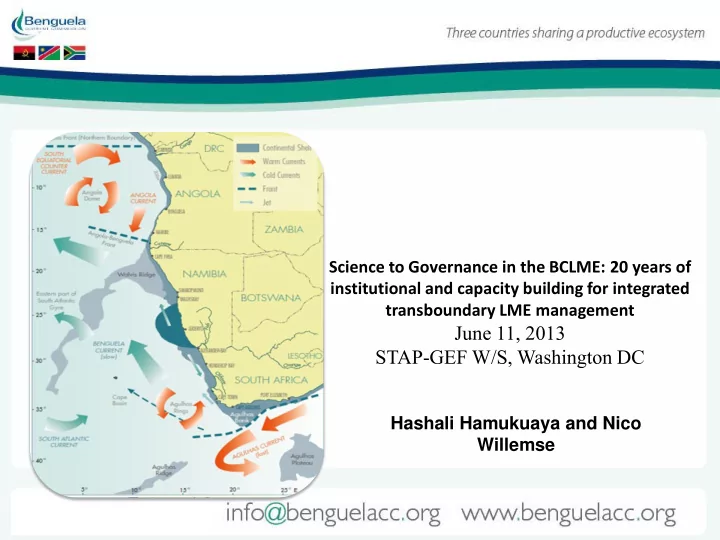
Science to Governance in the BCLME: 20 years of institutional and capacity building for integrated transboundary LME management June 11, 2013 STAP-GEF W/S, Washington DC Hashali Hamukuaya and Nico Willemse TDA: Major Transboundary Issues

slide-1
SLIDE 1

Science to Governance in the BCLME: 20 years of institutional and capacity building for integrated transboundary LME management

June 11, 2013 STAP-GEF W/S, Washington DC

Hashali Hamukuaya and Nico Willemse

slide-2
SLIDE 2

TDA: Major Transboundary Issues

  • Decline in commercial fish stocks
  • Uncertain ecosystem status and yields
  • Inadequate capacity to assess ecosystem
  • Deterioration in water quality
  • Habitat destruction and alteration
  • Loss of biotic integrity and biodiversity
  • Harmful algal blooms
slide-3
SLIDE 3

SAP: Policy Actions

  • Sustainable Management and Utilisation of Living

Marine Resources

  • Management of Mining and Drilling Impacts
  • Oil and gas exploration and production
  • Environmental Variability, Ecosystem Impacts and

Improvement of Predictability

  • Coastal Zone Management
  • Maintenance of Ecosystem Health and Protection of

Biodiversity

  • Capacity strengthening
  • Socio-economic and Governance
  • *
slide-4
SLIDE 4
  • Annual monitoring and assessments of

commercial fish stocks through transboundary surveys

  • Assessment of interactions between shared

demersal fish stocks in southern Angola and northern Namibia

  • Assessment of early history and stock

identity for shared hake (Namibia and SA) and horse mackerel (Angola and Nam)

  • Annual overall stock assessment report –

State of the Stocks Report published for 2012

  • Joint Management Plans for horse mackerel
  • Regional Stock Assessment Working Group
  • EAF review of institutional capacities and

ecological risk assessment of major species

Sustainable management and use of LMRs

slide-5
SLIDE 5
  • Minerals and Oil sector very

instrumental during Convention text development

  • Scoping study for Strategic

Environmental Assessment (SEA) of the BCLME completed, taking into account all marine sectors

  • Working Group on Minerals and

Extractive Resources established

  • Private sector indicate strong interest

for partnership – BCC Business Leadership Forum planned Management of Mining and Drilling Activities

slide-6
SLIDE 6
  • Environmental links to pelagic fish life

cycles, abundance and distribution: determining governing factors

  • Impacts of H2S and low oxygen on inshore

marine species – mass mortalities and walk-outs recorded in the past

  • Understanding of the impacts of climate

variability on the environment and on the resources and on communities

  • Collaboration with GOOS-Africa and ODIN

Africa improves access to high resolution

  • ceanographic data

Environmental variability, ecosystem impacts and improvements

  • f predictability

SHBML Bottom Oxygen March 2000 - October 2006

20 40 60 80 100 120 140 160 180 DISTANCE OFFSHORE (km)

Mar Sep

2000 2001 2002 2003 2004 2005 2006

Mar Sep Mar Mar Mar Mar Mar Sep Sep Sep Sep Sep

Concentration of dissolved oxygen

slide-7
SLIDE 7
  • Angola and Namibia at advanced

stages to accede to the Abidjan Convention

  • Closer

collaboration established with IMO especially on regional oil spills contingency planning and regional Oil Spill Risk Assessment (OSRA) and sensitivity mapping Management of pollution

slide-8
SLIDE 8
  • Spatial biodiversity assessment and spatial

management, including mapping of areas proposed for marine protected areas (MPAs)

  • Development of acoustic methodology for

zooplankton biomass assessment

  • Implementation of Continuous Plankton

Recorder (CPR) survey in the BCLME – first cruise in August 2011

  • Management planning for the Orange

River Mouth estuary underway – collaboration with GEF IW Project on ORM

Maintenance of ecosystem health and protection of biodiversity

slide-9
SLIDE 9
  • BCC’s Training and Capacity Building (TCB) Strategy

implemented since 2009

  • Training Policy adopted in 2012
  • BCC TCB Advisory Group in established
  • Significant training and capacity building in each of

the projects

  • Training offered in specialised fields e.g., Fish Stock

Assessment, hydro-acoustic surveys, responsible fisheries and fisheries management

  • BCC supports various workshops and events where

skills are exchanged about LME approach, ocean governance

Training and capacity building

slide-10
SLIDE 10
  • BCC Instruments
  • BCC Convention signed in

March 2013. First multi- sectorial LME framework

  • Finance Policy, Personnel

Policy and Procurement Policy, Data Policy adopted

  • Reviewing and updating
  • f the TDA, SAP and

Science Programme to be completed by August

slide-11
SLIDE 11
  • Structures and functions

in place:

  • Ministerial Conference,
  • Management Board,
  • Ecosystem Advisory

Committee (EAC),

  • Regional thematic

working groups

  • The Secretariat

Institutional Building

slide-12
SLIDE 12
  • Norway – BCC Science Programme
  • Iceland – BCC Training and Capacity

Building Strategy

  • FAO EAF-Nansen Project– Implementation
  • f EAF projects and on climate change

vulnerability

  • Danish Technical University (DTU) and EU –

improving stock assessment

  • ODIN Africa (improved data management)
  • ASCLME, GCLME and CCLME (African LME

Caucus) – which is a network that collaborates on issues of common interest.

Wider Cooperation

slide-13
SLIDE 13

Concluding remarks:

Where we are:

  • BCC is an established Commission with requisite

structures and functions, due to:

  • Unwavering political will and support by the BCC

Ministers

  • Support from GEF, other developing partners

Where we are heading:

  • Finalising the updating of the TDA/ Strategic

Action Programme

  • Sustainability of BCC – ensuring support to

implement the Convention and thus scaling up “Science-to-Governance”

  • Establish partnerships with the private sector,

academia and relevant organisations