John H. Williams New York Water Science Center Troy, New York - - PowerPoint PPT Presentation

john h williams new york water science center troy new
SMART_READER_LITE
LIVE PREVIEW

John H. Williams New York Water Science Center Troy, New York - - PowerPoint PPT Presentation

THE MARCELLUS SHALE GAS PLAY Water-Resource Issues John H. Williams New York Water Science Center Troy, New York https://profile.usgs.gov/jhwillia/ Water Resource Issues Drill cuttings Frac flowback Faults and fractures Methane


slide-1
SLIDE 1

THE MARCELLUS SHALE GAS PLAY Water-Resource Issues

John H. Williams

https://profile.usgs.gov/jhwillia/
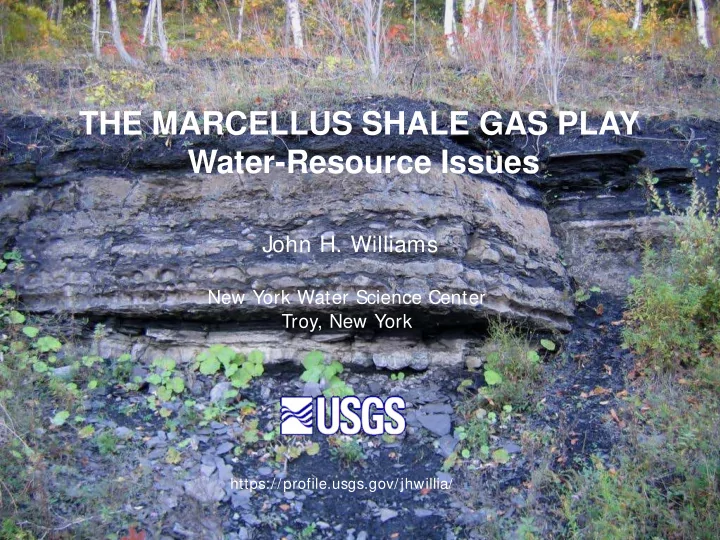
New York Water Science Center Troy, New York

slide-2
SLIDE 2

/

Water Resource Issues

  • Drill cuttings
  • Frac flowback
  • Faults and fractures
  • Methane migration
slide-3
SLIDE 3

Teff (2011)

Horizontal wells target basal Marcellus Shale

slide-4
SLIDE 4

Tompkins County, NY

Levanthal and others (1981)

High TOC and elevated radioactivity in basal Marcellus Shale

slide-5
SLIDE 5

Uranium & Thorium to Radium & Radon Radioactive Decay Series

Radioisotope and half life

slide-6
SLIDE 6

Drill Core Sample Analysis

Lash and Engelder (2009)

Gamma Log

High TOC and abundant pyrite in basal Marcellus Shale

slide-7
SLIDE 7
  • Elevated uranium and abundant pyrite in high-TOC black shale
  • Multi-horizontal well site will generate more than 500 times the volume
  • f shale cuttings than single-vertical well site

Drill Cuttings

Core of target interval Drill cuttings

slide-8
SLIDE 8

Lined pit Mixed with sawdust Closed-loop system Offsite disposal in landfill

Drilling Fluids and Cuttings

slide-9
SLIDE 9

Papso and others (2010) Blauch (2010)

Contains elevated TDS, chlorides, barium, and radioisotopes whose concentrations increase during the flowback period approaching formation brine

Flowback

slide-10
SLIDE 10

Kirby (2011)

TDS and Radioactivity of Flowback Water Ra-226 increases relative to Ra-228 in the later higher TDS flowback consistent with a

U-rich source for the water such as the Marcellus shale (Engle and others, 2011)

slide-11
SLIDE 11

Reuse flowback, onsite treatment for solids / blend with 70 % freshwater Municipal wastewater treatment plants not designed to handle flowback chemistry Limited number of disposal wells in Ohio

slide-12
SLIDE 12

Fisher (2010)

Microseismic Mapped Frac Tops and Bottoms

Marcellus Shale

slide-13
SLIDE 13

Onondaga Limestone Tully Limestone Marcellus Shale Burkett Shale Deep-seated fracture zone Upper Devonian bedrock containing freshwater aquifers above sandstone gas reservoirs.

Seismic Line from North-Central Pennsylvania

Seismic data courtesy

  • f Shell Appalachia

Salt Salt pillow

Faults and Fractures

Shallow faults

slide-14
SLIDE 14

Teff (2011)

Avoid Hydraulic Fracturing across Structures

slide-15
SLIDE 15

Methane in Water Wells

Marcellus/Utica Gas-Play Area Osborn and others (2011) Sampling sites

slide-16
SLIDE 16

2,500 – 4,000 feet

Marcellus Gas-Well Construction

slide-17
SLIDE 17

Directional rig for drilling horizontal leg Top-set rig for drilling vertical surface- and intermediate- cased interval

slide-18
SLIDE 18

Wellheads of first two of six horizontal wells ~15 ft

slide-19
SLIDE 19

FRESH WATER AQUIFER ZONE SHALLOW PRODUCING ZONE INTERMEDIATE PRODUCING ZONE CONDUCTOR PIPE SURFACE CASING PRODUCTION CASING

Good Zonal Isolation

TARGET PRODUCING ZONE

slide-20
SLIDE 20

Poor Zonal Isolation

PRESSURE BUILDS UP

CONDUCTOR PIPE SURFACE CASING PRODUCTION CASING FRESH WATER AQUIFER ZONE SHALLOW PRODUCING ZONE INTERMEDIATE PRODUCING ZONE TARGET PRODUCING ZONE CASING CEMENT FORMATION

slide-21
SLIDE 21

Freshwater Transition Saltwater

Geophysical Logs and Base of Freshwater Aquifer

Log data courtesy

  • f Shell Appalachia
slide-22
SLIDE 22

Shale Gas Development

Best practices based on state-of-the-art technology and science

  • Geophysical logging to delineate base
  • f freshwater aquifers
  • Surface casing/cement deep

enough to protect freshwater aquifers

  • Intermediate and production

casing/cement/packers to prevent upward migration of gas

  • Cement-bond logging and pressure

testing to ensure good seals

  • Drilling and frac fluid storage in tanks

and offsite burial of drill cuttings

  • Avoid hydraulic fracturing near structures
  • Microseismic monitoring of hydraulic fracs
  • Reuse of frac fluid reduces freshwater

resource impacts and disposal issue

  • Water-well sampling before and

after drilling/hydraulic fracturing operation

slide-23
SLIDE 23