
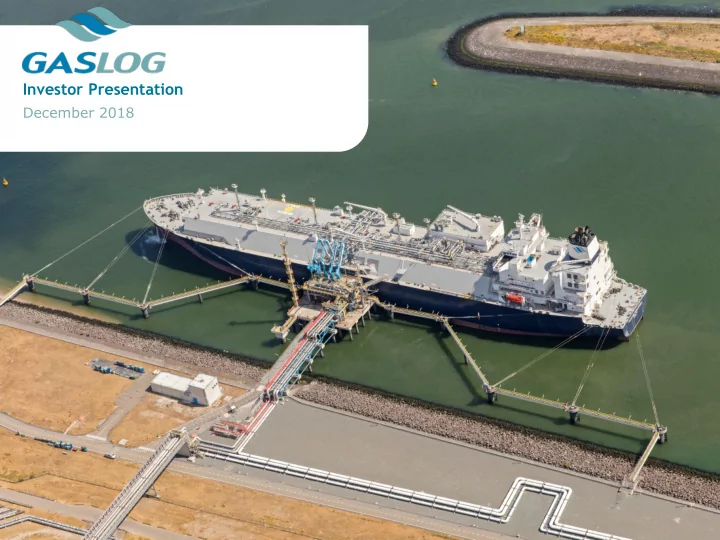
SLIDE 1
Investor Presentation
December 2018
Investor Presentation December 2018 2 Forward Looking Statements - - PowerPoint PPT Presentation
Investor Presentation December 2018 2 Forward Looking Statements All statements in this presentation that are not statements of historical fact are forward -looking statements within the meaning of the U.S. Private Securities Litigation
Investor Presentation
December 2018
All statements in this presentation that are not statements of historical fact are “forward-looking statements” within the meaning of the U.S. Private Securities Litigation Reform Act of 1995. Forward- looking statements include statements that address activities, events or developments that the Company expects, projects, believes or anticipates will or may occur in the future, particularly in relation to
which we operate. We caution that these forward-looking statements represent our estimates and assumptions only as of the date of this presentation, about factors that are beyond our ability to control
accuracy of the forward-looking statements. Accordingly, you should not unduly rely on any forward-looking statements. Factors that might cause future results and outcomes to differ include, but are not limited to the following: ▪ general LNG shipping market conditions and trends, including spot and long-term charter rates, ship values, factors affecting supply and demand of LNG and LNG shipping, technological advancements and opportunities for the profitable operations of LNG carriers; ▪ fluctuations in spot and long-term charter hire rates and vessel values; ▪ changes in our operating expenses, including crew wages, maintenance, dry-docking and insurance costs and bunker prices; ▪ number of off-hire days and dry-docking requirements including our ability to complete scheduled dry-dockings on time and within budget; ▪ planned capital expenditures and availability of capital resources to fund capital expenditures; ▪
may no longer have the latest technology which may impact the rate at which we can charter such vessels; ▪
▪ increased exposure to the spot market and fluctuations in spot charter rates; ▪ fluctuations in prices for crude oil, petroleum products and natural gas, including LNG; ▪ changes in the ownership of our charterers; ▪
▪
▪
and other obligations under our credit facilities; ▪ future, pending or recent acquisitions of or orders for ships or other assets, business strategy, areas of possible expansion and expected capital spending; ▪ the time that it may take to construct and deliver newbuildings and the useful lives of our ships; ▪ fluctuations in currencies and interest rates; ▪ the expected cost of and our ability to comply with environmental and regulatory conditions, including changes in laws and regulations or actions taken by regulatory authorities, governmental
▪ risks inherent in ship operation, including the risk of accidents, collisions and the discharge of pollutants; ▪
▪ potential disruption of shipping routes due to accidents, political events, piracy or acts by terrorists; ▪ potential liability from future litigation; ▪ any malfunction or disruption of information technology systems and networks that our operations rely on or any impact of a possible cybersecurity breach; and ▪
We undertake no obligation to update or revise any forward-looking statements contained in this presentation, whether as a result of new information, future events, a change in our views or expectations
The declaration and payment of dividends are at all times subject to the discretion of our board of directors and will depend on, amongst other things, risks and uncertainties described above, restrictions in
.
2
3
International Owner And Operator Of LNG Carriers Since 2001
Employees Onshore And Offshore
Q3 18 Consolidated Revenue Backlog Monaco Athens London Busan (South Korea) New York
Consolidated Fleet(1) Singapore
1. As of November 26, 2018
Q3 18 Total Assets
NYSE:GLOP Market Cap: $1.0 billion(1) Yield: 9.4%(1)
14 LNG Carriers
NYSE:GLOG Market Cap: $1.6 billion(1) Yield: 3.2%(1)
19 LNG Carriers(2)
28%(3) 100% of IDRs and GP 72% 51%
Public Unitholders Public Shareholders
1099, no K-1
4 Notable Investors
Peter Livanos 40% Onassis Foundation 9% Total 49%
5
See the end of this presentation for the footnotes pertaining to the GasLog Ltd. and GasLog Partners Fleets
6
Global Fleet Equity Ownership – Independents(1)
Source: Company data as of November 27, 2018 1. Not a subsidiary of, or controlled by, an integrated oil company or national oil company 2. Excludes small-scale LNG carriers below 100,000 cubic meters 3. Excludes floating storage and regassification units (FSRUs) 4. Excludes floating liquefaction vessels (FLNGs)
7
1. Unit freight cost estimates based on an assumed round-trip US Gulf to Far East route Source: Wood Mackenzie, Company information
GasLog Fleet – Unit Freight Cost Comparison To Global Fleet
STEAM S-CLASS 170 TFDE G-CLASS H-CLASS S-CLASS (1)
More Than 30% Of The Global Fleet Is Less Efficient Than GasLog’s Modern Steam Vessels
8
… Driving Growth In Cash Flow, Earnings and NAV
Best-In-Class MLP GasLog Partners 49% EBITDA CAGR Since IPO 14% Fleet Growth CAGR 2012-2021 Cost Efficiencies Scale Operational Excellence $3.4B Backlog(1) Access To Capital Commercial Relationships FSRU Modern Fleet
Strong Value Platform… … And Multiple Value Drivers
Leverage To Strong Spot Market
Creating Value For GasLog And Our Shareholders
1. At September 30, 2018
(1,2) For notes and cautionary statements please see the Appendix to this presentation
9
Near-term Consolidated EBITDA(2) Medium-term Consolidated EBITDA(2)
2017 EBITDA(2) Revenue Driven EBITDA(2) Growth Targeted Cost-Saving Driven EBITDA(2) Growth Q3 2018 Results updates
Recovery to $70-80,000/day mid- cycle spot rates(3) $1,500/day target for fleet opex & G&A savings per vessel(4) Contracted EBITDA(2) on fixed vessels and $70,000/day assumed on uncommitted(5) EBITDA(2) from future fleet growth(6)
$356m
100% of revenue driven EBITDA(2) growth is generated by the C-Corp and potentially increases the MLP dropdown pipeline
(2) (2)
Three chartered newbuild vessels announced in May and August 2018 TCEs currently in excess of mid-cycle rates
✓ ✓
10
LNG Commodity Demand 2012-25E
Global LNG Fleet Growth 2012-21(1) GasLog Fleet Growth 2012-21(1)
Source: Wood Mackenzie, Poten, Clarksons
Each Incremental MTpa Of Supply Has Historically Required 1.4 Ships
11
GasLog Newbuild Capex Commitments(1) Q3 2018 – Q4 2020
Free Cash Flow Generation From Spot Ships Newbuild Capex Payments Sourced From: Dropdowns To GasLog Partners – Average Annual Equity Raised Of $140m Balance Sheet Capacity – Scheduled 2019 Debt Amortisation Of c.$200m
1. Figures as of September 30, 2018, does not include net proceeds from public offering of GasLog Partners’ Series C Preference Units which closed on November 15, 2018
12
Illustrative Q3 2018 GasLog EBITDA Sensitivity To Higher Spot Rates
Each $20k/day Increase In Spot TCEs Would Have Increased Q3 GasLog EBITDA By c.$11 Million
13
$207.4 million Sale price $113.5 million in cash $93.9 million in assumed debt Financing
1. Gross proceeds exclude payment to GasLog Partners to maintain GasLog Ltd’s 2% GP stake
Methane Becki Anne Dropdown
Financing Of Dropdowns to GasLog Partners(1)
October 25, 2018 Announcement date November 14, 2018 Closing Date
On Average GasLog Partners Has Recycled Over $140M Per Annum Of Equity To GasLog Since IPO
14
Over $1.2 Billion Of Equity Capital Raised By GasLog Partners Since IPO
Net Debt / Capitalization Net Debt / EBITDA(1) (Trailing 12 Month)
15
16
LNG Import Growth (MT) By Country On Trailing 12-Month Basis
Source: Poten
LNG Imports Q4 2016 – Q3 2017: 285 million tonnes Q4 2017 – Q3 2018: 308 million tonnes YoY increase: 8% Imports from the top 10 countries increased by 32mtpa year-over-year, representing 25% growth
17
LNG Demand Growth 2017-2025 (MT)
Source: Wood Mackenzie
Approximately 80% Of Demand Growth Is Outside Of China
18
1. Long-term supply agreement defined as greater than 5 years. Source: Wood Mackenzie, public disclosures, company estimates
Long-Term LNG Supply Agreements(1) January 2017-October 2018
Significant Offtake Agreements Signed In Q3 2018
19
▪ At least 112 mtpa of new liquefaction capacity is scheduled to come online during 2018-23 ▪ Approximately 50% of new capacity is located in the US ▪ Recent FIDs of Corpus Christi T3 and LNG Canada represent nearly 19 mtpa of incremental capacity
Source: Wood Mackenzie
Expected LNG Capacity Additions 2018-2023
20
▪ The US exported 77 cargoes in Q3 18, in line with H1 2018
– Sabine Pass shipped 60 cargoes, Cove Point 17 cargoes – South Korea, Japan and China (shipping multiplier(2) > 2) received 30 cargoes from the US in Q3 2018
▪ Q2 and Q3 2018 have exhibited similar ‘seasonality’ to the corresponding periods in 2016 and 2017 ▪ Since Sabine Pass start-up, 1.83 ships(2) have been needed for each 1 mtpa of US supply, compared to a historical global average shipping multiplier of 1.32x
Source: Poten
US Exports And Shipping Multiplier Q1 2016 – Q3 2018(2) Q3 2018 Sabine Pass and Cove Point Trade Routes(1)
1. Numbers represent the number of cargoes imported to each country 2. Normalised to a vessel capacity of 160,000 m3
21
Source: Goldman Sachs
Net LNG Trade From Atlantic and Middle East To Pacific Basin Tonne Mile LNG Demand – driven higher by expansion in US LNG exports and growing Asia Pacific demand
Source: DNB Markets
22
Source: Clarksons
TFDE And Steam Headline Spot Rates (2011-18)
Clarksons Quoting Average TFDE Headline Rates Of $190,000/Day And ST Of $98,000/Day
Number Of Spot Fixtures 2015 2016 2017 2018 Q1 33 57 62 69 Q2 40 66 78 110 Q3 52 74 97 76 Q4 47 76 97
23
Spot TCE (Q1 2017 – Q3 2018) And Relationship To Headline Spot Rates(1)
‘Capture’ Rate Can Move Above c.70%, But Needs A Sustainably Tighter Market
Spot vessel TCE (as a % of headline spot rates) increases in a tighter market reflecting 1) lack of available tonnage and 2) positioning fees/ballast bonuses
1. Clarksons Headline TFDE Spot Rate Assessment lagged by 45 days to take into account spot vessels being fixed forward on multi-month and/or multi-voyage charters Source: Clarksons, Company Analysis
24
Newbuild Delivery Schedule Q4 2018 – Q2 2021(1)
1. Includes 8 committed and 4 uncommitted FSRUs Source: Poten, company estimates
Only Five Out Of 43 LNG Carriers Scheduled For Delivery By End-2019 Are Without Charter
25
Projected LNGC Vessel Supply & Demand Balance (160k CBM Vessel Equivalent)
1. Projected LNG Vessel Demand high and low cases are based on Wood Mackenzie LNG Demand(3) (4) forecast and the respective vessel-to-volume multipliers, as annotated in the chart legend 2. Projected LNG Vessel Demand are based on Wood Mackenzie LNG Supply(3) (4) forecast and the respective vessel-to-volume multipliers, as annotated in the chart legend 3. Demand breakdown between US and Rest of World (RoW) is based on Wood Mackenzie supply estimates 4. Annual Wood Mackenzie demand & supply forecasts assumed to increase quarterly on a linear basis Source: Wood Mackenzie, Poten
Vessel Supply (no scrappages) Vessel Supply (excluding unfixed pre-2000 built vessels) Vessel Demand (LNG Demand(1) @ 1.5x US & 1.3x RoW) Vessel Demand (LNG Demand(1) @ 1.7x US & 1.4x RoW)
35 - 63 Vessels
26
… Driving Growth In Cash Flow, Earnings and NAV
Best-In-Class MLP GasLog Partners 49% EBITDA CAGR Since IPO 14% Fleet Growth CAGR 2012-2021 Cost Efficiencies Scale Operational Excellence $3.4B Backlog(1) Access To Capital Commercial Relationships FSRU Modern Fleet
Strong Value Platform… … And Multiple Value Drivers
Leverage To Strong Spot Market
Creating Value For GasLog And Our Shareholders
1. At September 30, 2018
28
LNG Fleet And Orderbook Overview(1)
1. All fleet statistics exclude vessels <65,000 m3, FLNG assets are also excluded. Source: Poten,
Existing Fleet # of Vessels % Average
Age (Yrs) 185 -266,000 m3 46 13% 9 167- 185,000 m3 116 24% 2 150- 167,500 m3 129 25% 5 130-150,000 m3 185 32% 14 100-130,000 m3 36 6% 33 <100,000 m3 9 1% 23 Total 521 9 (Of which laid up) 22 3% 34 (Of which FSRU/FSUs) 35 7% 10
29
Spot LNGC Fixtures By Month and Charter Rate(1,2) - July 2018 onwards
Spot Rates Need To Be Sustained And Stable To Allow For Further Fixing At Current Levels
1. Comprises spot fixtures of up to 180 days concluded between 1 January and 22 October 2018. Only fixtures with a known charter rate have been included 2. No known fixtures in the $151-175k range Source: Poten, Company estimates
The majority of Q3 fixtures were in the $40-100k range Only a small number of vessels have been fixed at or close to headline rate assessments in Q4 to date
30
(US$,000 unless otherwise stated)
Q3 2017 Q3 2018 % change 9M 2017 9M 2018 % change Revenues 131,242 158,398 21% 389,457 429,700 10% Total net pool performance 7,707 27,763 260% 21,343 56,123 163% Opex 29,569 31,948 8% 86,891 98,964 14% Unit opex (US$ per vessel per day) 14,564 13,859 (5%) 14,424 14,845 3% G&A 9,988 9,917 (1)% 30,213 32,282 7% Unit G&A (US$ per vessel per day) 4,720 4,146 (12%) 4,812 4,661 (3%)
)EBITDA(1) 89,603 114,085 27% 266,247 302,529 14% Gain/(loss) on derivatives 3,137 7,368 (6,585) 26,306 Consolidated profit 24,228 39,261 54,524 96,014 Profit/(loss) to owners of the Group 5,335 18,214 6,572 33,898 Dividend on GasLog preference shares (2,516) (2,516) (7,548) (7,548) Profit/(loss) to owners of Group used in EPS 2,819 15,698 (976) 26,350 Basic EPS (US$/share) 0.03 0.19 (0.01) 0.33 Adjusted EPS (US$/share)(1) (0.00) 0.11 0.02 0.03 Dividend (US$/share) 0.14 0.15 7% 0.42 0.45 7%
31
1. EBITDA and Adjusted EPS are non-GAAP financial measures, and should not be used in isolation or as substitutes for GasLog’s financial results presented in accordance with International Financial Reporting Standards (“IFRS”). For reconciliations of these measures to the most directly comparable financial measures calculated and presented in accordance with IFRS, please refer to the Appendix to these slides.
32
provides us with advance notice of declaration. The charterer of the GasLog Sydney may extend the term of this time charter for a period ranging from six to twelve months, provided that the charterer provides us with advance notice of declaration. The charterers of the GasLog Seattle and the Solaris have unilateral options to extend the term of the time charters for periods ranging from five to ten years, provided that the charterers provide us with advance notices of declaration of any option in accordance with the terms of the applicable charter. The charterers of the Methane Heather Sally, the Methane Becki Anne and the Methane Julia Louise have unilateral options to extend the term of the related time charters for a period of either three or five years at their election, provided that the charterers provide us with advance notice of declaration of any option in accordance with the terms of the applicable charter. The charterer of the GasLog Greece and the GasLog Glasgow has the right to extend the charters for a period of five years at the charterer’s
GasLog Houston and the GasLog Genoa has the right to extend the charter by two additional periods of three years, provided that the charterer provides us with advance notice of declaration. The charterer of the GasLog Hong Kong has the right to extend the charter for a period of three years, provided that the charterer provides us with advance notice of declaration.The vessel is chartered to Total Gas & Power Chartering Limited, a wholly owned subsidiary of Total S.A.
until November or December 2020, with the charterer having the option to extend the charter from one to four years.
consideration approximately equivalent to its current book value. GasLog has leased back the vessel under a bareboat charter from Lepta Shipping for a period of up to 20 years. GasLog has the option to re-purchase the vessel on pre-agreed terms no earlier than the end
33
1. Each growth estimation on this slide is based on numerous assumptions and estimates that are inherently uncertain. Please review the cautionary statements and risk factors referenced in "Forward-Looking Statements" on slide 2 in this presentation. Any of those factors could cause the results of our operations to vary materially from the examples above. The growth estimations on this slide are not fact and should not be relied upon as being necessarily indicative of future results. 2. Consolidated EBITDA is a non-GAAP measure. Please refer to the Appendix of this presentation for a definition of EBITDA. 3. Consolidated EBITDA growth from the Existing Fleet assumes that each vessel currently operating in the spot market achieves mid-cycle TCE rates at an average TCE per day rate of $70,000 – $80,000, less the revenue contribution from those vessels included in the 2017 EBITDA. Vessels coming off charter within the next five years are assumed to be re-chartered at rates in-line with their existing charters. These illustrative potential growth estimates also reflect no adjustment for increases in operating or
4. Assumes the full, timely and successful implementation of our cost optimisation programme, which represents a target to reduce per vessel opex and G&A by $1,500/day per vessel within 3 years. LNG carriers are complex and their operations are technically challenging, and we may not be able to successfully implement this programme. 5. Consolidated EBITDA growth from scheduled 2018-2020 Newbuild deliveries assumes that our newbuildings will be delivered on schedule. The illustrative potential growth reflects contracted charter revenues for the newbuildings for which we have secured time charters and an assumed charter rate of $70,000/day on currently unfixed vessels. 6. Consolidated EBITDA growth resulting from hypothetical incremental market share capture by GasLog is derived from the share of projected aggregate LNG carrier demand as at the of end 2022, estimated by us to be captured by GasLog based on the assumption that we maintain our historical market share capture since IPO, as the aggregate LNG carrier fleet increases. This example assumes we will acquire up to 8 vessels between now and the end of 2022. The assumed EBITDA per ship is based on 99.5% utilization, at an average day rate of $70,000/day per vessel and vessel operating expenses of $15,000/day. Future acquisitions of vessels are subject to various risks and uncertainties which include, but are not limited to, general LNG and LNG shipping market conditions and trends; our ability to enter into shipbuilding contracts for newbuildings and our expectations about the availability of existing LNG carriers to purchase, as well as our ability to consummate any such acquisitions; our future financial condition and liquidity; our ability to obtain financing to fund acquisitions, funding by banks of their financial commitments, and our ability to meet our obligations under our credit facilities. The vessels required to be ordered or acquired to meet the hypothetical incremental market share capture as illustrated have not been ordered
Source: Company Information and estimates