Investor presentation 27 October 2010 Cameron Clyne, Group Chief - - PDF document

investor presentation
SMART_READER_LITE
LIVE PREVIEW

Investor presentation 27 October 2010 Cameron Clyne, Group Chief - - PDF document

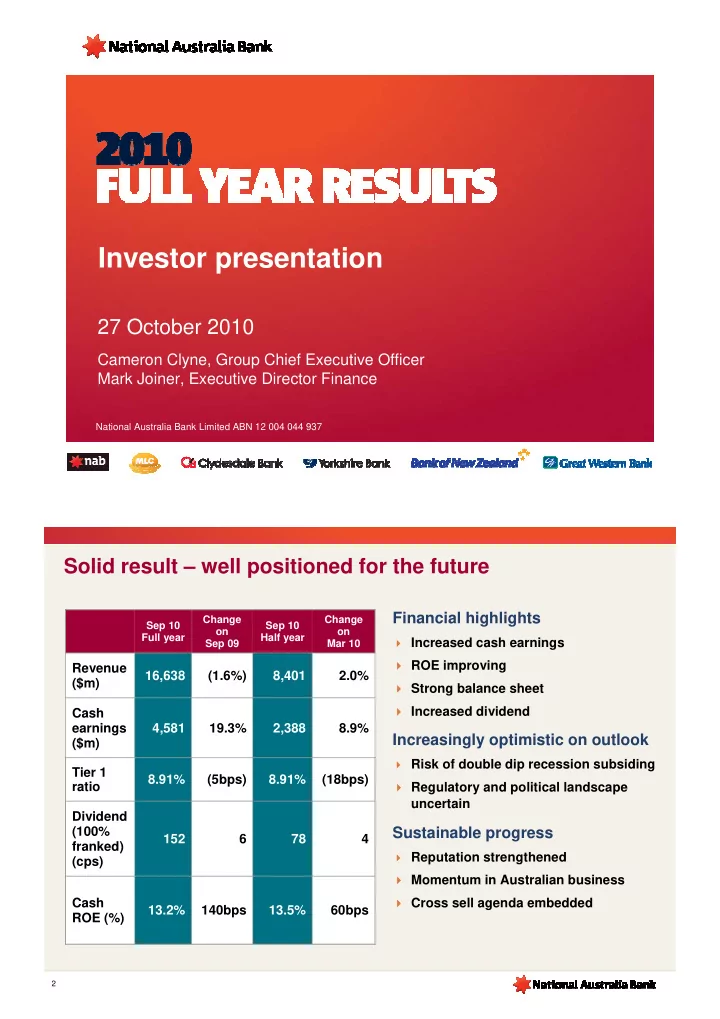
Investor presentation 27 October 2010 Cameron Clyne, Group Chief Executive Officer Mark Joiner, Executive Director Finance National Australia Bank Limited ABN 12 004 044 937 Solid result well positioned for the future Financial highlights


slide-1
SLIDE 1

27 October 2010

National Australia Bank Limited ABN 12 004 044 937

Cameron Clyne, Group Chief Executive Officer Mark Joiner, Executive Director Finance

Investor presentation

2

Solid result – well positioned for the future

2.0% 8,401 (1.6%) 16,638 Revenue ($m) 60bps 13.5% 140bps 13.2% Cash ROE (%) (18bps) 8.91% (5bps) 8.91% Tier 1 ratio 4 78 6 152 Dividend (100% franked) (cps)

Sep 10 Half year

8.9% 2,388

Sep 10 Full year Change

  • n

Sep 09 Change

  • n

Mar 10

Cash earnings ($m) 4,581 19.3%

Financial highlights

Increased cash earnings

ROE improving Strong balance sheet Increased dividend

Increasingly optimistic on outlook

Risk of double dip recession subsiding

Regulatory and political landscape

uncertain

Sustainable progress

Reputation strengthened

Momentum in Australian business Cross sell agenda embedded

slide-2
SLIDE 2

3

Macro outlook still uncertain

Economic outlook Banking regulation Political environment

Global recovery underway US stimulus efforts continue UK budget measures as expected Multi-speed Australian economy Australian business confidence and conditions improving Capital impact becoming clearer Liquidity – solution yet to be determined Australian Government and regulators need to

consider a wider range of alternatives

Focus on financial services sector Potential for competition and consumer regulation NAB relatively well positioned

4

Strong progress against priorities

Strong mortgage growth in Personal Bank proprietary and broker channels Business Bank momentum in slow market Wealth position enhanced by Aviva, JBWere and nabInvest Managing UK and GWB optionality Tight management of SGA – some rundown

Rebalancing portfolio

Disciplined underlying cost management creating capacity for increased investment Mortgage transformation – early progress Completed 1st phase

  • f NextGen

– 2nd underway Innovations being leveraged across the Group

Investing for the future

Maintained AA rating Strong Tier 1 capital position Strong funding position (CFI > 60%, SFI > 80%) Well positioned for regulatory change Leading Business Bank reputation – active support of customers during GFC Won 8 AB&F* awards and Business Bank of the Year – CFO Magazine Personal Bank closing the gap on customer satisfaction MLC attracting advisers Broader community advocacy Carbon neutrality

Balance sheet strength Reputation / customers Leadership, culture and talent

Improved employee engagement Strong cross business unit collaboration Investment in enterprise leadership

* Australian Banking & Finance Corporate and Business Banking Awards

slide-3
SLIDE 3

5

Transformation program

2010 Achievements 2011 Priorities

Mortgage processing – productivity, policy simplification, improved conversion rate Technology incidents down >30% Network upgrade Enterprise convergence WealthHub Continued development of NextGen release 2 capability – UBank, Broker and Redstar Customer-led innovation Customer satisfaction gap narrowed Strong wealth adviser growth Securitisation engine implemented Single Australian/NZ SAP upgrade Upgrade to nab.com.au website Delivery of key NextGen information capability > Single Australian/NZ General Ledger > Campaign management Implementation of a ‘requisition to pay’ system Infrastructure and network transformation Docklands 2 commenced Payments transformation - SWIFT Gateway Product rationalisation Mortgage Transformation Program

Customer experience Simplicity, efficiency & risk mitigation Employee experience Enterprise systems & information

Significant improvement in employee engagement Carbon neutral 2010 Employer of Choice for Women (EOWA) Capability development – Academy,

  • perations and service

Diversity

6

2011 outlook

Continued focus on progressing strategic priorities Navigate economic, regulatory and political uncertainty NAB well positioned

slide-4
SLIDE 4

FY10 Financials

8

Group financial result

(18bps) 8.91% (5bps) 8.91% Tier 1 ratio 4.9% 2,227 (10.0%) 4,350 Other operating income (incl MLC) 1.0% 6,174 1.8% 12,288 Net interest income

$m Sep 10 Full year Change on Sep 09 Sep 10 Half year Change on Mar 10

Net operating income 16,638 (1.6%) 8,401 2.0% Operating expenses (7,862) (3.7%) (4,001) (3.6%) Underlying profit 8,776 (5.9%) 4,400 0.5% B&DDs (2,263) 40.7% (1,033) 16.0% Cash earnings 4,581 19.3% 2,388 8.9% Cash ROE (%) 13.2% 140bps 13.5% 60bps NIM (%) 2.25% 9bps 2.24% (2bps)

slide-5
SLIDE 5

9

Business unit contributions

^ Other comprises Group Funding, Group Business Services, other supporting units, Asia Banking, GWB, IoRE and minority interest within MLC & NAB Wealth

Home currency 79.3% (45) 54.6% (262) Specialised Group Assets (m) Sep 10 Full Year Change on Sep 09 Sep 10 Half Year Change on Mar 10 Cash earnings Business Banking 2,193 37.1% 1,098 0.3% Personal Banking 743 (15.1%) 426 34.4% Wholesale Banking 705 (38.6%) 302 (25.1%) UK Banking £118 53.2% £57 (6.6%) NZ Banking NZ$524 1.4% NZ$269 5.5% MLC & NAB Wealth 549 32.9% 285 8.0% Other^ 33 large 11 (50.0%) Group cash earnings 4,581 19.3% 2,388 8.9% Underlying profit – attribution analysis by business ($m, constant currency)

* Includes Group Treasury and Other

4,376 4,400

(7) (16) (30) (28) (152) 41 130 24 35 27

Mar 10 Business Banking Personal Banking Wholesale Banking UK Banking NZ Banking MLC & NAB Wealth GWB SGA Other * FX Sep 10 10

Key elements of the result (1)

Average GLAs (FX & acquisitions reported separately) Change in market share Increased cost of funding an Australian variable rate mortgage

20 40 60 80 100 120 140 Funding cost

  • ver the RBA

cash rate (bps) Bank Bill / Overnight Index Swap Spread Customer Deposits Liquidity Portfolio Costs Term Funding 33bps increase since Apr 09 Mar 08 Sep 08 Mar 09 Sep 09 Mar 10 Sep 10 Pre-Crisis April 2009 last increase above RBA rate Total increase since Jun 07 118bps Total recovered 92bps Gap 26bps 2.26% 2.24% (0.05% ) (0.02% ) 0.05% Mar 10 Lending Margin Deposit Margin Funding & Liq Costs Sep 10

Group net interest margin – attribution analysis

Based on management estimates. Applies to NAB Ltd only

433.3 443.2 (2.1) (0.6) (0.2) (0.5) (1.2) 0.7 3.1 0.8 6.4 3.5 M a r 1 B u s i n e s s B a n k i n g P e r s

  • n

a l B a n k i n g W h

  • l

e s a l e B a n k i n g U K B a n k i n g N Z B a n k i n g M L C & N A B W e a l t h S G A A c q u i s i t i

  • n

s F X O t h e r S e p 1

($bn) 10 120 40 94

Basis Points *

APRA monthly banking statistics. Represents APRA data adjusted historically to include Business Markets Flexible Rate Loans

**

RBA Financial System / NAB including wholesale banking data as at Aug 2010

^

Plan for Life Australian retail & wholesale investments market share & dynamics report - 2010

^^ RBNZ – Aug 2010 Australian Business Lending* Sep 09 – Aug 10 Australian Housing** Sep 09 – Aug 10 Retail Super^ Jun 09 – Jun 10 NZ Housing^^ Sep 09 – Aug 10

slide-6
SLIDE 6

11

Key elements of the result (2)

Jaws and banking CTI momentum Operating expenses

2H10 v 1H10 1H10 v 2H09 2H09 v 1H09

1.1%

CTI 2H09

44.5%

CTI 2H10

46.2%

CTI 1H10

45.5%

  • 1.4%

1.3%

  • 1.8%

Revenue growth Expense growth

3.6% 2.0%

  • 3.1%
  • 1.6%
  • 2.5%

Other operating income

1,410 1,417 1,263 1,255 760 468 302 213 539 529 748 764 (5) (79) (210) (190)

Mar 09 Sep 09 Mar 10 Sep 10

Fees & Commissions Markets & Treasury MLC Other*

($m) 2,630 2,204 2,123 2,227

SGA portfolio income

($m)

138 127 100 80 (67) (162) (30) (139) (160) (14) (65) (80) (84) 125 (1) (6) (101) Mar 09 Sep 09 Mar 10 Sep 10

SCDO Risk Mitigation MTM Mngmt Overlay for Conduit & derivative trans Markets Counterparty Credit Val Adj Non Franchise Asset Income CDS Hedging MTM volatility

Total income (165) Total income (84) Total income (108) Total income 18

* Includes SGA, Group Treasury and Other

7,580 7,868 7,862 (399) (180) 393 59 254 155

Sep 09 EQS Benefits Investment in Business BAU (net) UK Pension Sep 10 ex FX & Acqn Acquisitions FX Impacts Sep 10 incl FX & Acqn

($m)

CTI – Banking Cost to Income Ratio

12

B&DD charge and asset quality

B&DD charge – half yearly 90+DPD & impaired assets as a % of gross loans and acceptances by product

  • 100

300 700 1,100 1,500 1,900 2,300

Mar 07 Sep 07 Mar 08 Sep 08 Mar 09 Sep 09 Mar 10 Sep 10

0.00% 0.20% 0.40% 0.60% 0.80% 1.00%

Specific Provision Collective Provision Economic Cycle Adjustment ABS CDOs & Investments held to maturity B&DD Charges as % of GLAs (annualised)

390 400 726 1,763 1,811 2,004 1,230

($m)

1,033 0.0% 0.5% 1.0% 1.5% 2.0% Mar 07 Sep 07 Mar 08 Sep 08 Mar 09 Sep 09 Mar 10 Sep 10

Impaired 90+DPD

Mortgages Impaired Business Impaired Mortgages 90+ DPD Business 90+ DPD Retail Unsecured 90+ DPD

B&DD charge – quarterly

($m)

300 600 900 1,200 Dec 08 Mar 09 Jun 09 Sep 09 Dec 09 Mar 10 Jun 10 Sep 10

824 987 1,064 940 739 491 0.00% 0.25% 0.50% 0.75% 1.00% 1.25% 1.50% 1.75% 2.00% Mar 07 Sep 07 Mar 08 Sep 08 Mar 09 Sep 09 Mar 10 Sep 10

Coverage ratios

Basel II RWAs

510 523

GRCL top up (pre-tax) as % of Credit Risk Weighted Assets (ex Housing) Collective Provisions as % of Credit Risk Weighted Assets (ex Housing) Total Provisions as % Gross Loans and Acceptances
slide-7
SLIDE 7

13

Tier 1 capital position

(%)

6.91 2.18 2.11 11.30 6.80 0.04 0.72 (0.06) (0.12) (0.09) (0.07) (0.27) (0.33)

^ Net RWA growth excludes GWB acquisitions ($2.0bn) * Non-cash earnings effect on Tier 1 after adjusting for Distributions and Treasury Shares † Other consists primarily Wealth Management adjustments (1bp) and other immaterial movements # FSA calculation is approximate

9.09

Tier 1 Hybrid Core Tier 1

8.91

Mar 10 ($30.3bn) Cash Earnings ($2.4bn) Dividend (net of DRP) ($1.1bn) Net RWA Growth^ ($9.9bn) FCTR ($0.2bn) GWB Acquisitions Non-Cash Earnings ($0.4bn)* Expected Loss > Eligible Provisions ($0.2bn) Other ($0.1bn)† Sep 10 ($30.7bn) Sep 10 FSA# 14

Funding and liquidity

Group Stable Funding Index (SFI)

57% 59% 63% 64% 19% 19% 20% 20% 78% 83% 76% 84% Mar 09 Sep 09 Mar 10 Sep 10

Customer Funding Index Term Funding Index

Liquid asset holdings Term funding

($bn)

14 14

68 71 68 72 19 19 18 17 90 86 87 89 Mar 09 Sep 09 Mar 10 Sep 10

Internal Securitisation (contingent liquidity) Liquid Assets

100% 26% 74% $22bn $32.3bn $28.3bn $25bn to $30bn Sep 09 Sep 10 Sep 11

FY11 Balance Sheet Growth and Structure FY11 Refinancing Requirement ($22bn) Guaranteed Term Funding Raised Unguaranteed Term Funding Raised

Term funding tenor

3.7 4.6 5.5

4.7

Mar 09 Sep 09 Mar 10 Sep 10 Average 4.2 Average 5.1

Weighted average maturity (years) of term funding issuance

slide-8
SLIDE 8

15

Regulatory reform

Note: Supervisory confirmation required

Net Stable Funding Ratio

Impact manageable Extent of Australian Basel III

harmonisation uncertain

Potential for early adoption by

APRA, 1 Jan 2013

Leverage ratio a backstop

(not a constraint) Liquidity Coverage Ratio Core Tier 1

Funding and liquidity impacts more

significant

Liquidity is mainly a composition issue for

the industry

“Australia solution” uncertain Expected implementation 1 Jan 2015 after

  • bservation period

Direction consistent with our disciplined

approach to balance sheet management > Reduce reliance on short term funding > Extend duration of term funding > Deposit gathering culture

Impact delayed to 2018, subject to

transition / recalibration

Our focus on balance sheet strength and

extended timeframes will assist transition

7.0% Basel III minimum 6.80% 8.19% 6.65% Sep 10 Actual Basel III est. (BIS Alignment) Basel III est. (Ignoring Upside)

16

1.1 0.8 0.5 2.5 Mar 09 Sep 09 Mar 10 Sep 10

Personal Banking

MFI customer satisfaction1 Home loan share of system growth2 Net transaction account growth Sweeney research brand tracker3

Personal Banking multiple of system

  • !

"#$%% &## ' ()!*+,#!$# !'- !),- . )%(/0.)',,

69.0 70.8 72.8 74.7 77.2 75.4 74.1 74.1 Mar 09 Sep 09 Mar 10 Sep 10

NAB Weighted average of three major bank peers

123,173 13,066 15,755 79,911 Mar 09 Sep 09 Mar 10 Sep 10

(#)

* Not tracked in Sep 09

Open and upfront Transparent with fees and charges Customers are at an advantage A bank for people like me A leader in making banking fairer* Sep 10 Sep 09

Peer Average

30% 33% 35% 32% 40% 40%

  • 44%

43%

  • 43%

46%

X

42% 42%

  • 42%

41%

  • NAB vs

Peers

(%)

5.1 2.5

slide-9
SLIDE 9

17

Other Australian franchises

2.50 2.51 2.45 2.24 Mar 09 Sep 09 Mar 10 Sep 10

Business Banking net interest margin

(%)

Wholesale Banking

Risk Management Solutions - Partnering with bank wide franchises

10 12 14 16 18 20 22 24

J a n 3 J a n 4 J a n 5 J a n 6 J a n 7 J a n 8 J a n 9 J a n 1

Foreign Exchange Options Forward FX Contracts Interest Rate Swaps Spot FX

Primary % Supplier Share

Business lending Mar 09 - Aug 10

NAB Business Lending inc Bill Acceptances Volume Growth ($bn)

MLC & NAB Wealth

Market share up reflecting return to positive net flows Unprecedented interest from advisers in joining MLC

(adviser numbers up 69 over the half)

Aviva integration ahead of expectations

> Adviser and client retention over initial forecasts

JBWere integration complete

> Private client platform to be launched next year

Continued flat costs

  • 45.0
  • 35.0
  • 25.0
  • 15.0
  • 5.0

5.0 Mar 09 Jun 09 Sep 09 Dec 09 Mar 10 Jun 10

Australian Banking Market ex NAB1 NAB data

(1) APRA Monthly Banking Statistics Mar 2009 - Aug 2010. Lending represents loans & advances to non-financial corporations plus bill acceptances of customers

Aug 10

+$1.9bn

  • $40.0bn

Source: East & Partners’ Australian Corporate Banking Markets – July 2010

18

International businesses

NZ Banking

Solid financial performance Strong risk management and stable asset quality Culture of continuous improvement and innovation

UK Banking

UK economy in recovery but economic activity below pre-crisis peak Recovery in profitability - Cash Earnings £118m (up 53%) Reshaping and strengthening of the balance sheet to support future growth Asset quality lags economic recovery but signs of stabilisation

Great Western Bank

Continued organic growth momentum despite depressed economic environment Two strategic acquisitions on attractive terms added to footprint Over 100% deposit funded

SGA

Well managed portfolio with run-off progress made Significantly less of an earnings drag

slide-10
SLIDE 10

19

Summary and outlook

Reasonable momentum and upside potential – mainly through the

Australian franchises

Disciplined with costs; will manage to jaws Balance sheet settings remain strong and provide capacity

for growth

Risks are being closely managed Regulatory, political and economic factors will continue to present

challenges

Questions

slide-11
SLIDE 11

Additional Information

Business Banking

Personal Banking Wholesale Banking MLC & NAB Wealth NZ Banking UK Banking Specialised Group Assets Asset Quality Capital and Funding Economic Outlook

22

Business Banking

Business lending volumes1

($bn)

128.3 127.9 128.8 (0.3) (0.8) (1.3) 0.4 0.8 0.6 0.8 0.3

Sep 09 Corporate & Specialised Banking nabbusiness Institutional Banking Working Capital Services Mar 10 Corporate & Specialised Banking nabbusiness Institutional Banking Working Capital Services Sep 10

(1) Updated to reflect transfers of customers between business units (2) Total enterprise revenue/lending assets

Increased Total Customer Return New Customer Acquisition

INPUTS OUTPUTS

Improved Employee Engagement Sustainable Customer Satisfaction Customer Service Effectiveness Capability and Coaching Change, Comms & Engagement Reward & Recognition Analytics, Metrics & Diagnostic Sales Framework Product and RM Interface Customer Experience/ Value Proposition Infrastructure Delivery

10% 12% 14% 16% 18% 20% 22% 24% Sep 08 Mar 09 Sep 09 Mar 10 Aug 10 NAB* Bank 1 Bank 2 Bank 3

Enterprise cross-sell focus – Total Customer Returns2

2.31% 2.29% 0.86% 0.86% 3.17% 3.60% 3.15%

Mar 10 TCR Sep 10 TCR Target State TCR Lending - TCR Non-Lending - TCR

CIS work streams: a multidimensional approach

Source: APRA Monthly Banking Statistics Sep 2008 - Aug 2010. Lending represents loans & advances to non-financial corporations plus bill acceptances of customers. * Represents APRA data adjusted historically to include Business Markets Flexible Rate Loans

Business lending market share Sep 08 - Aug 10

Business Lending inc Bill Acceptances Volume Growth

slide-12
SLIDE 12

23

129 128 128 129

M ar 09 Sep 09 M ar 10 Sep 10

69 73 78 77

M ar 09 Sep 09 M ar 10 Sep 10

Business Banking

Business lending Customer deposits Housing lending

12

Cost to Income Ratio

0.0% ($bn) ($bn) ($bn) (0.8%) 5.8% 5.5% 0.8% 1.3%

51 52 53 55

M ar 09 Sep 09 M ar 10 Sep 10 2.0% 1.9% 3.8%

809 836 843 871 Mar 09 Sep 09 Mar 10 Sep 10 .!32 .!2 .,!.2

Costs

($m)

.,!42

Cash earnings on average assets

0.90% 0.86% 1.20% 1.18% Mar 09 Sep 09 Mar 10 Sep 10

24

September 10 v September 09 September 10 v March 10

Business Banking: Net interest margin

2.45% 2.51% 2.50% (0.06%) 0.00% (0.08%) (0.02%) (0.07%) (0.15%) 0.07% 0.02% 0.32% 0.02% Sep 09 Lending Margin Deposit Margin Funding & Liquidity Cost Capital Benefit Other Mar 10 Lending Margin Deposit Margin Funding & Liquidity Cost Capital Benefit Other Sep 10

2.35% 2.51% (0.06%) (0.13%) (0.10%) 0.41% 0.04%

Sep 09 Lending Margin Deposit Margin Funding & Liquidity Cost Capital Benefit Other Sep 10

slide-13
SLIDE 13

25

Business Banking

Cash earnings B&DD charge

776 1,095 1,098 823 Mar 09 Sep 09 Mar 10 Sep 10

(5.7%) 41.1%

($m)

0.3%

757 381 410 559 Mar 09 Sep 09 Mar 10 Sep 10

(35.4%) 49.7% (7.6%)

2,063 2,242 2,312 2,352 475 442 470 485 2,837 2,782 2,538 2,684 Mar 09 Sep 09 Mar 10 Sep 10

Revenue

5.8% 3.7%

($m)

2.0% OOI NII

1,848 1,939 1,966 1,729 Mar 09 Sep 09 Mar 10 Sep 10

Underlying profit

6.9% 4.9%

($m)

1.4%

($m)

26

Housing 30% Business 70%

Retail Trade 6% Accommodation, Cafes, Pubs & Restaurants 5% Manufacturing 7% Other 18% Construction 4% Agriculture Forestry and Fishing 13% Wholesale Trade 5% Property & Business Services 42%

Business Banking

Well secured – business products Portfolio quality* Diverse assets^

200 400 600 800 Mar 09 Sep 09 Mar 10 Sep 10 0.00% 0.15% 0.30% 0.45% 0.60% 0.75% 0.90%

B&DD charge B&DDs / GLAs (annualised) (RHS)

B&DD charges stabilised

($m)

27% 28% 31% 32% 73% 72% 69% 68%

M ar 09 Sep 09 M ar 10 Sep 10 Investment grade equivalent Sub-Investment grade

54% 57% 58% 60% 28% 28% 28% 27% 13% 14% 15% 18%

M ar 09 Sep 09 M ar 10 Sep 10 F ully Secured** P artially Secured Unsecured

^ Based on product split * Based upon expected loss which is the product of probability of default x exposure at default x loss given default ** Based upon security categories in internal ratings systems 1 Non Retail LGD Model Change in Nov 09

slide-14
SLIDE 14

27

Construction 8% Retail Trade 8% Accommodation, Cafes, Pubs & Restaurants 7% Manufacturing 6% Wholesale Trade 6% Finance & Insurance 4% Other 13% Property & Business Services 48%

Business Banking: SME Business*

Well secured – business products Portfolio quality** Diverse assets^

50 100 150 200 250 300 Mar 09 Sep 09 Mar 10 Sep 10 0.00% 0.15% 0.30% 0.45% 0.60%

B&DD Charge B&DD / GLAs (annualised) (RHS)

B&DD charges stabilised

($m)

34% 33% 38% 38% 66% 67% 62% 62%

M ar 09 Sep 09 M ar 10 Sep 10 Investment grade equivalent Sub-Investment grade

65% 66% 68% 69% 28% 27% 26% 25% 6% 6% 7% 7%

M ar 09 Sep 09 M ar 10 Sep 10 F ully Secured*** P artially Secured Unsecured

5 ( 6 )7$#$$#((0%$ %8'9-)( 66 (-%#$$##--#- # 666 ( 1 Non Retail LGD Model Change in Nov 09 Personal 36% Business 64%

Additional Information

Business Banking

Personal Banking

Wholesale Banking MLC & NAB Wealth NZ Banking UK Banking Specialised Group Assets Asset Quality Capital and Funding Economic Outlook

slide-15
SLIDE 15

29

Personal Banking

1,589 1,516 1,667 1,608 66 82 Mar 09 Sep 09 Mar 10 Sep 10

Revenue

($m)

Costs

866 834 791 783 28 39 Mar 09 Sep 09 Mar 10 Sep 10

($m)

48.7% 47.5% 55.0%

Cost to Income Ratio

12

Net interest margin

(%)

Cash earnings

408 467 317 426 26 29 Mar 09 Sep 09 Mar 10 Sep 10

($m)

2.28 2.49 2.64 2.34 Mar 09 Sep 09 Mar 10 Sep 10

Advantedge Acquisition Advantedge Acquisition Advantedge Acquisition 54.5% 291 397

1,507 1,450

14.5% (32.1%) 34.4% 3.7% (9.1%) 4.8%

30

Household deposits market share2 Housing loan market share1

Personal Banking

54 59 61 49 Mar 09 Sep 09 Mar 10 Sep 10 87 88 95 104 Mar 09 Sep 09 Mar 10 Sep 10

Customer deposits

1.1%

($bn)

8.0%

Housing loans

9.3% 10.2%

($bn)

13.2% 13.0% 12.8% 12.8% Mar 09 Sep 09 Mar 10 Aug 10

(1) RBA Financial System, NAB including Wholesale Banking as at Aug 2010, Mar 2010 restated to exclude Advantedge (2) APRA Banking System, NAB including Wholesale Banking as at Aug 2010

9.5% 3.4% 13.6% 13.0% 13.1% 13.4% Mar 09 Sep 09 Mar 10 Aug 10

slide-16
SLIDE 16

31

Personal Banking: Asset quality

Mortgage 90+ DPD and impaired B&DD charge

116 231 220 262 Mar 09 Sep 09 Mar 10 Sep 10 ($m)

Cards & personal loans 90+ DPD

1.09% 1.19% 1.17% 1.26% Mar 09 Sep 09 Mar 10 Sep 10 0.67% 1.11% 0.95% 0.85% Mar 09 Sep 09 Mar 10 Sep 10

Total 90+ DPD and impaired

836 1,093 998 967 Mar 09 Sep 09 Mar 10 Sep 10 ($m) 16.0% (5.0%) 49.8%

32

September 10 v September 09 September 10 v March 10

Personal Banking: Net interest margin

2.34% 2.28% 2.64%

(0.02%) (0.04%) (0.01%) 0.01% (0.01%) (0.12%) (0.17%) Sep 09 Lending Margin Deposit Margin Funding & Liquidity Cost Mar 10 Lending Margin Deposit Margin Funding & Liquidity Cost Asset Liability Mix Sep 10

2.57% 2.31%

(0.13%) (0.11%) (0.01%) (0.01%)

Sep 09 Lending Margin Deposit Margin Funding & Liquidity Cost Asset Liability Mix Sep 10

slide-17
SLIDE 17

33

Home loans under management (spot)

Advantedge operating performance

Business made $55m cash earnings for

the 11 months of ownership in FY10

Maintained key staff and brokers Lending volumes continuing to increase

in response to new competitively priced products

Home loans under administration - aggregator businesses Monthly settlement volumes

4.6 4.9 6.3 Oct 09 Mar 10 Sep 10 100 197 335 Oct 09 Mar 10 Sep 10 113 119 124 Oct 09 Mar 10 Sep 10

($bn) ($bn) ($m)

97% increase in activity 1.6x system growth 70% increase in activity 6.5% 28.6% 1.1x system growth

34

Change in profile of mortgage approvals

LVR distributions: broker channel LVR distributions: all channels Risk grade distribution of 90+ LVR Residential mortgage portfolio (Australian Region)

LVR Breakdown of Final Approvals for the Australian Region 20 40 60 80 100 Dec 08 Mar 09 Jun 09 Sep 09 Dec 09 Mar 10 Jun 10 Sep 10

LVR 60% or less LVR 60.01% to 70% LVR 70.01% to 80% LVR 80.01% to 90% LVR >90%

(%) LVR Breakdown of Homeside Final Approvals (%) 20 40 60 80 100 Dec 08 Mar 09 Jun 09 Sep 09 Dec 09 Mar 10 Jun 10 Sep 10

LVR 60% or less LVR 60.01% to 70% LVR 70.01% to 80% LVR 80.01% to 90% LVR >90%

Breakdown of Open Accounts >90% LVR by Application Risk Grade (%) 20 40 60 80 100

Very High High Medium Low Very Low

Dec 08 Mar 09 Jun 09 Sep 09 Dec 09 Mar 10 Jun 10 Cumulative 30+ DPD at 3 months on Book

  • 70
  • 60
  • 50
  • 40
  • 30
  • 20
  • 10

Dec 08 Mar 09 Jun 09 Sep 09 Dec 09 Mar 10 Jun 10 Origination Period Variance from Long Run Average

(%)

Excludes Advantedge

slide-18
SLIDE 18

35

Australian house prices have reflected lower rates, inflation and greater borrowing ability

Key dynamics of housing prices over the past 30 years have

reflected

> Fundamental lowering of inflation which has increased borrowers ability to service mortgages > A belief that housing is a good investment in the long-run and favourable tax treatment for investment housing > The increased servicing ability has seen debt levels as a percentage

  • f income move from low levels to relatively high levels by

global standards > However servicing ratio (debt repayments as a percent of income) still reasonable provided incomes are maintained > And the stock of debt as a percentage of the value of the assets is moderate

36

Housing prices and debt

RBA recent research has shown a flattening

in some key measures of house price to incomes and servicing ability

House price growth was most marked from

mid 1990s to 2005

House price to income below recent peaks

and at globally reasonable levels

Debt servicing burden flattening

Note: Income is disposable income after tax and before interest payments. Household sector excludes unincorporated enterprises Sources: ABS, APM, RBA, REIA

200 150 100 Index Capital Cities 1980 1985 1990 1995 2000 2005 2010

Real dwelling prices 1993 = 100, log scale Dwelling price-to-income ratio Household debt-to-income ratio

5 4 3 Ratio 1980 1985 1990 1995 2000 2005 2010 Capital Cities Nationwide 1980 1985 1990 1995 2000 2005 2010 150 100 50 % Total Housing

slide-19
SLIDE 19

37

Prospects for house prices

Australian house prices – 12 months

(% yoy) (%)

House price expectations – Next 12 months Key drivers

> Unemployment > Real rates > Supply/demand dynamics

Survey suggests expectations have

decreased significantly in mid 2010

Despite survey findings, 2011 NAB house

price growth expectation is 5 - 7%

Large increases in prices and housing

credit less likely

Source: NAB Quarterly Residential Survey Q3 2010 1 2 3 4 5 6 7 CAN ADEL SYD PER AUS MEL BRIS

Mar 10 Jun 10 Sep 10

  • 15

15 30 45 60 Sep 87 Mar 90 Sep 92 Mar 95 Sep 97 Mar 00 Sep 02 Mar 05 Sep 07 Mar 10 Sep 12 Actual NAB forecast forecast

Additional Information

Business Banking Personal Banking

Wholesale Banking

MLC & NAB Wealth NZ Banking UK Banking Specialised Group Assets Asset Quality Capital and Funding Economic Outlook

slide-20
SLIDE 20

39

Wholesale Banking

Securities custody business Leading debt capital solutions Offering products and solutions to NAB’s business, personal and wealth customers

Delivering synergies with the Group’s Wealth and Financial Institutions Group franchises to maximise

  • pportunities from global

wealth pools Well placed to benefit from proposed changes to superannuation contribution (Cooper report) BNY Mellon discussions

  • ngoing to enhance the

range of products and services available to clients

Asset under custody & administration

Source: 1 Insto: 1 January - 31 December 2009; 2 Thomson Reuters 30 June 2010; 3 Dealogic Global Project Finance Review – First Nine Months 2010

Top-ranked book runner of Australian securitisation deals, managing A$2.3bn over 10 deals1 NAB is the only Australian bank to place in the top 10 cross border US Private Placements league table over a period of 4 years2 #2 on Dealogic’s3 mandated lead arranger league table for Australasian project finance deals, leading US$1.0bn over 13 transactions (10.3% of the market) Funding solutions Investment solutions Client Risk Management solutions Asset Servicing Research

Debt capital markets, specialised finance, loan syndicates, property equity and advisory, securitisation Short and long term investment products including capital protected products, property investments and debt- equity hybrids Client risk management solutions for exposure to fluctuations in interest rates, currencies and commodity prices Custodian for superfunds, investment managers, government entities and global banks Providing quality research and insights into Banking / Finance markets Royal Australian Navy (RAN) A$200m Sole Arranger Structured Asset Finance facilities to fund naval fleet maintenance vessels September 2010 Peninsula Link A$765m Project Finance Facilities Mandated Lead Arranger January 2010 Mandate 1st multi- currency Australian issue since GFC A$1.2bn US$ & A$ prime residential mortgage- backed securities July 2010 A$150m 10 year MTN private placement NAB Arranger June 2010 A$2.3bn & US$200m Syndicated Loan Facility Mandated Lead Arranger, Bookrunner & Agent April 2010 Mandate 1st retail bond in Australian DCM to utilise ASIC prospect relief A$150m A$ retail bond

  • Primary Bond

Series A September 2010 599 600 660 506 487 531 561 Sep 04 Sep 05 Sep 06 Sep 07 Sep 08 Sep 09 Sep 10 ($bn)

40

Wholesale Banking

338 251 613 535 403 302 418 430 853 586 428 1,093 Mar 08 Sep 08 Mar 09 Sep 09 Mar 10 Sep 10

Cash Earnings Underlying Profit

Cash earnings and underlying profit

($m)

Revenue by line of business B&DD charge

($m) 108 234 111 16 (45) 29

Mar 08 Sep 08 Mar 09 Sep 09 Mar 10 Sep 10

Other comprises of Asset Servicing, Specialised Finance and Financial Institutions

490 538 883 656 611 463 104 92 429 420 148 169 225 196 224 232 274 263 Mar 08 Sep 08 Mar 09 Sep 09 Mar 10 Sep 10

Markets Treasury Other

($m) CAGR 10% 819 826 1,536 1,308 1,033 895

Cash earnings 10% CAGR on

September 2008 levels

Revenue normalised following

standout 2009 year

Improved credit quality with lower

B&DD charge

slide-21
SLIDE 21

41

Wholesale Banking: Global Markets

Trading income

($m) 208 270 476 318 256 206 100 200 300 400 500 Mar 08 Sep 08 Mar 09 Sep 09 Mar 10 Sep 10 5 10 15 20 Trading (LHS) Average VaR Usage (RHS) ($m)

Global Markets result was against the

backdrop of a more challenging market environment

Revenue was lower in 2010 following the

stand out 2009 year

The markets were characterised by reduced

volatility, narrowing margins, increased competition and steeper yield curves

Some locations encountered subdued

demand for interest rate risk management products

The result includes growth and favourable

  • utcomes for the Credit Trading and Debt

Markets businesses following a rebound in demand for debt products

Sales income

282 268 407 338 355 257 Mar 08 Sep 08 Mar 09 Sep 09 Mar 10 Sep 10 ($m)

42

100 200 300 400 Mar 08 Sep 08 Mar 09 Sep 09 Mar 10 Sep 10 0.0% 0.5% 1.0% 1.5% 2.0% 2.5% 3.0%

Gross Impaired Assets Gross Impaired Assets as % of GLAs

Wholesale Banking: Asset quality

($m)

Impaired assets ratio impacted by one large default at March 2010 – two at March 2009 Portfolio asset quality

50 100 150 200 Mar 08 Sep 08 Mar 09 Sep 09 Mar 10 Sep 10 0% 10% 20% 30% 40% 50% 60%

Specific Provisions Specific Provisions to Gross Impaired Assets

129 219 313 233 233 209 Mar 08 Sep 08 Mar 09 Sep 09 Mar 10 Sep 10

Collective provisions Specific provisions to gross impaired assets

($m) ($m) (%) 91 90 91 91 95 94 Mar 08 Sep 08 Mar 09 Sep 09 Mar 10 Sep 10

Investment Grade Equivalent Non Investment Grade

slide-22
SLIDE 22

Additional Information

Business Banking Personal Banking Wholesale Banking

MLC & NAB Wealth

NZ Banking UK Banking Specialised Group Assets Asset Quality Capital and Funding Economic Outlook

44

MLC & NAB Wealth

Return on Regulatory Capital* (RORC) Premiums in force

500 600 700 800 900 1,000 1,100 1,200 1,300 1,400 1,500 Sep 07 Mar 08 Sep 08 Mar 09 Sep 09 Mar 10 Sep 10

Underlying (excluding Aviva) CAGR 10% vs System CAGR 15% ($m) Aviva

0% 10% 20% 30% 40% 50% Mar 07 Sep 07 Mar 08 Sep 08 Mar 09 Sep 09 Mar 10 Sep 10 Insurance (LHS) Investments incl Private Wealth (LHS) MLC & NAB Wealth (RHS)

Expenses Movement in FUM

($bn) Annual Growth 11%

* Including IoRE

150 200 250 300 350 400 450 500 550 600 Sep 07 Mar 08 Sep 08 Mar 09 Sep 09 Mar 10 Sep 10 ($m) Private Bank and Other JBWere and Aviva Underlying CAGR -3.0% Declining trend in underlying expenses the result of strong cost control and synergies derived from the integration of Aviva

85.1 106.5 114.2 116.1

0.5

4.6 3.1 18.3 4.1 2.6 (1.0) (1.2)

)

  • ,

3

  • $
  • )
  • ,

3

  • :
  • $
  • *
  • #
  • %
  • ;
  • ,

*

  • #
  • %
  • ;
  • )
  • ,

Retail 75% Retail 74% Retail 72%

slide-23
SLIDE 23

45

Channel and adviser growth

Investment sales by channel Insurance sales by channel

683 1,115 1,040 1,125 921 1,438 1,068 1,232 548 829 674 790 181 172 119 Mar 09 Sep 09 Mar 10 Sep 10 Bank Aligned IFA Other 27 34 31 32 15 9 11 12 17 17 13 14 Mar 09 Sep 09 Mar 10 Sep 10 NAB FP / Bank Aligned IFA

Wealth adviser movement analysis

1,383 1,346 1,486 1,555 132 101 165 211 (169) (126) (142) M a r 9 R e c r u i t s E x i t s S e p 9 R e c r u i t s E x i t s J B W e r e M a r 1 R e c r u i t s E x i t s S e p 1

($m) ($m) (#)

Proportion of sales from the bank

channel is growing year on year

Significant interest from advisers in

joining MLC

Adviser numbers up 69 in the half

46

Investments cash earnings

($m)

128 167 185 7 6 2 9 8 23 17 29 (6) (14) (4) (16) (4)

Sep 09 Increase in Underlying Avg FUM Aviva/JBWere Business Reduction in Underlying Expenses Tax Provisions Private Bank Margins Mark to Market nabInvest Other Mar 10 Increase in Underlying FUM Margin Movements in Investments Increase in Private Bank Volumes Increase in Expenses Tax Impacts Other Sep 10

MLC & NAB Wealth

Insurance cash earnings

($m)

84 97 100 2 10 12 11 17 (2) (5) (12) (14) (3)

Sep 09 Aviva Business Growth in PIF Change in Group Reserving Growth in Expenses Tax Provisions Mar 10 Growth in PIF Changes in Business Mix Favourable Tax Movements Increase in Claims Distribution Expenses Sep 10

slide-24
SLIDE 24

Additional Information

Business Banking Personal Banking Wholesale Banking MLC & NAB Wealth

NZ Banking

UK Banking Specialised Group Assets Asset Quality Capital and Funding Economic Outlook

48 48

New Zealand Banking

Cash earnings up 5.5% v Mar 10 result Cash earnings up 1.4% over prior year driven by growth in variable

rate mortgage products and repricing, offset by the impact of a weak business credit environment, pressure on deposit margins and removal of fees as part of the Fair Value initiative

Adapting to a continued slow NZ economic recovery and an evolving

regulatory environment > Focus on diversifying funding and lengthening of the funding profile > Successful portfolio approach to margin management as asset repricing initiatives are helping to offset pressure from higher funding/deposit costs > Successfully growing retail deposits to improve customer funding ratios > Flat costs maintained while reinvesting in the business > B&DDs in line with prior year

Strategic agenda

> Long term strategic agenda focused on maintaining a strong balance sheet, driving cost efficiencies, leveraging investment in

  • ur Partners and Retail stores and enhancing the customer

experience > Further enhancement of the BNZ Partners business model with the integration of Corporate Banking and the opening of new Partners centres across the country > The transformation of the Retail store network continues,

  • ffering customers an experience more akin to retail shopping,

with the store network upgrade progressing well > Continued focus on building people capability, the culture of continuous improvement and further enhancing the customer experience

NZ Banking: Revenue v Expense growth

807 849 792 814 861 364 355 368 365 367 100 200 300 400 500 600 700 800 900 1,000 Sep 08 Mar 09 Sep 09 Mar 10 Sep 10 Revenue Expenses (NZ$m)

slide-25
SLIDE 25

49 49

New Zealand Banking

!<2 !92 !<2 26.7 27.7 27.6 26.9

M ar 09 Sep 09 M ar 10 Sep 10

Cost to Income Ratio

(0.4%) 3.7% (2.5%)

'!2 2.16 1.96 2.08 2.24

Mar 09 Sep 09 Mar 10 Sep 10 (%) (NZ$bn) (NZ$m)

Business lending Retail deposits Retail lending Costs Net interest margin

12.8 13.2 14.1 12.6 13.1 13.6 14.6 14.2

M ar 09 Sep 09 M ar 10 Sep 10 B N Z P artners B N Z R etail

26.0 24.5 25.2 25.6 1.4 1.4 1.4 1.5

M ar 09 Sep 09 M ar 10 Sep 10 H o using Unsecured P erso nal

4.0% 3.5% 1.9% 2.7% 25.4 26.3 27.7 28.8 5.3% 1.5% (NZ$bn) (NZ$bn)

12

25.9 26.6 27.0 27.5

50

2.08% 1.96% 2.24% (0.04%) (0.12%) (0.04%) (0.03%) (0.06%) 0.0% 0.08% 0.05% 0.19% 0.19% 0.03% 0.03%

Sep 09 Lending Margin Deposit Margin Funding & Liquidity Cost Capital Benefit rate change Early Repayment Costs Other Mar 10 Lending Margin Deposit Margin Funding & Liquidity Cost Capital Benefit rate change Early Repayment Costs Other Sep 10

50

New Zealand Banking: Net interest margin

2.06% 2.16%

(0.03%) (0.23%) (0.11%) 0.41% 0.03% 0.03%

Sep 09 Lending Margin Deposit Margin Funding & Liquidity Cost Capital Benefit rate change Early Repayment Costs Other Sep 10

September 10 v September 09 September 10 v March 10

slide-26
SLIDE 26

51 51

New Zealand Banking: Asset quality

90+ DPD have reduced in line with the credit cycle The rate of growth in impaired assets levels, while still

increasing, has tapered further from the two prior halves

Exposures in the commercial property, business lending

and agriculture sectors are the main industry hotspots

Net write-offs remain similar to prior half but still remain

relatively low due to the strength of the Bank’s frontline business credit analysis and credit risk management function

BNZ’s strong risk management framework and responsible

approach to lending has ensured that it has remained well placed in the fragile economic environment

Total 90+ days past due as % GLAs

100 200 300 Sep 06 Mar 07 Sep 07 Mar 08 Sep 08 Mar 09 Sep 09 Mar 10 Sep 10 0.0% 0.2% 0.3% 0.5% 0.6% 90+ Days Past Due Total 90+ days past due as % GLAs

(NZ$m)

Gross impaired assets as % GLAs

200 400 600 800 Sep 08 Mar 09 Sep 09 Mar 10 Sep 10 0.0% 0.3% 0.6% 0.9% 1.2% 1.5%

FV impaired Gross impaired assets GIA (including FV) as % of GLAs

Net write-offs

0.07% 0.07% 0.09% 0.12% 0.13% 0.24% 0.27% Sep 07 Mar 08 Sep 08 Mar 09 Sep 09 Mar 10 Sep 10

Net Write-offs to GLAs

(NZ$m)

Additional Information

Business Banking Personal Banking Wholesale Banking MLC & NAB Wealth NZ Banking

UK Banking

Specialised Group Assets Asset Quality Capital and Funding Economic Outlook

slide-27
SLIDE 27

53

344 353 359 325 Mar 09 Sep 09 Mar 10 Sep 10

UK Banking

12

Cost to Income Ratio

(£bn) (£m)

Business lending Personal lending Retail deposits Costs Net interest margin

10.9 11.0 11.2 11.3 8.1 7.9 7.3 6.8

5 10 15 20 Mar 09 Sep 09 Mar 10 Sep 10 Other business Commercial property

(£bn) (£bn)

94!<2 9!'2 94!'2 93!'2 2.28% 2.40% 2.36% 2.14% 0.14% 0.11% 0.19% 0.58% Mar 09 Sep 09 Mar 10 Sep 10

Margins Basis risk, funding and liquidity

11.9 12.0 12.4 12.6 2.4 2.3 2.1 2.0

5 10 15 20 Mar 09 Sep 09 Mar 10 Sep 10 Housing Unsecured

20.1 21.5 22.5 23.7

5 10 15 20 25 Mar 09 Sep 09 Mar 10 Sep 10

19.0 18.9 18.5 18.1 14.3 14.3 14.5 14.6 (0.5%) (2.1%) (2.2%) 0.0% 1.4% 0.7% 7.0% 4.6% 5.3%

54

UK Banking: Net interest margin

2.36% 2.40% 2.28% (0.06%) (0.07%) (0.06%) (0.07%) (0.07%) (0.07%) (0.04%) (0.02%) 0.16% 0.14% 0.08%

Sep 09 Lending Margin Deposit Margin Funding & Liquidity Cost Capital Benefit UK Basis Risk Other Mar 10 Lending Margin Deposit Margin Capital Benefit Increase in Liquid Assets Other Sep 10

September 10 v September 09

2.25% 2.34% 0.05% (0.14%) (0.08%) (0.25%) 0.39% 0.12%

Sep 09 Lending Margin Deposit Margin Capital Benefit Increase in Liquid Assets Funding and Liquidity Costs Other Sep 10

September 10 v March 10

slide-28
SLIDE 28

55

0.00 0.50 1.00 1.50 2.00 2.50 3.00 3.50 4.00 4.50 5.00 Mar 07 Sep 07 Mar 08 Sep 08 Mar 09 Sep 09 Mar 10 Sep 10 % 3m OIS to 3m LIBOR Spread Typical 3 year Credit Spread

Basis risk, liquidity and funding costs impacts

The cost of Basis Risk has reduced to pre-crisis levels The crisis period has resulted in credit spreads being significantly higher which is driving

increased funding costs. These costs now form the highest proportion of the Funding and Liquidity cost

Spreads Funding and liquidity cost trend

Northern Rock HBOS, A&L, B&B Barclays, RBS Britannia Dunfermline 20 40 60 80 100 120 140 Sep 07 Mar 08 Sep 08 Mar 09 Sep 09 Mar 10 Sep 10 Basis Risk Liquidity Other Funding Costs (£m)

56

UK Banking: Asset quality

115 168 253 183 164

Sep 08 Mar 09 Sep 09 Mar 10 Sep 10

Other business 35% Mortgages 39% Commercial Property - Development 4% Unsecured 6% Commercial Property - Investment 16%

GLAs by product B&DD charge Commercial property

(£32.8bn) (£m) (£6.6bn)

Gross impaired assets and 90+ DPD to GLAs

0.53% 1.12% 1.76% 2.09% 2.34% 0.47% 0.72% 0.85% 0.89% 0.81% Sep 08 Mar 09 Sep 09 Mar 10 Sep 10

GIA as % of GLAs 90+ DPD as % of GLAs

1.00% 1.84% 2.61% 2.98% 3.15%

Office 15% Tourism & Leisure 6% Land 9% Residential 41% Industrial 8% Other 3% Retail 18%

slide-29
SLIDE 29

57

GLAs as at September 09 GLAs as at September 10

Gross loans and acceptances

Mortgage lending 37% Business lending 57% Unsecured personal lending 6%

Business lending as at September 09 Business lending as at September 10

Mortgage lending 39% Business lending 55% Unsecured personal lending 6% Other business 59% Investment property 31% Development property 10% Other business 64% Investment property 29% Development property 7%

58

Funding mix

Note: Stable funding index and funding mix charts based on spot balances

Funding mix Stable funding index

76.3% 78.9% 83.7% 85.2% 20.9% 21.7% 21.8% 20.1% 63% 71% 66% 73% Mar 09 Sep 09 Mar 10 Sep 10

CFI TFI Retail cover ratio

97.2% 100.6% 105.5% 105.3%

3% 3% 6% 6% 8% 3% 2% 5% 6% 6% 59% 15% 64% 14% Retail deposits Market short term Subordinated debt Structured finance Securitisation Parent company Medium term notes Sep 09 Sep 10

slide-30
SLIDE 30

59

September 10 v September 09

UK Banking: Other operating income

September 10 v March 10

316 261 (7) (3) (9) (10) (10) (16) Sep 09 Up Front Payment from AXA Investment Mgmt Fees Revenues Refunds Property Sales Other Sep 10

AXA PPI

(£m) 127 134 (1) (6) 7 4 3 Mar 10 Property Sales IFA Commission PPI Fees Other Sep 10 (£m)

60

669 712 5 28 45 (35)

Sep 09 Pension Costs Efficiency savings initiatives One Off BAU Sep 10

September 10 v September 09

UK Banking: Operating expenses

Operating expenses September 10 v March 10

353 359 3 6 5 (8)

Mar 10 Efficiency savings initiatives Investment projects One Off BAU Sep 10

379 360 358 361 358 359 325 344 353 359

Mar 06 Sep 06 Mar 07 Sep 07 Mar 08 Sep 08 Mar 09 Sep 09 Mar 10 Sep 10 (£m) (£m) (£m)

slide-31
SLIDE 31

61

Gross Loans & Acceptances £32.8bn 100%

Business Lending £18.0bn 55% Mortgages £12.8bn 39% Unsecured £2.0bn 6%

"

  • =!$

.2 *

  • =!$

2

  • =,!$

432 >? ='!4$ '2 ? =,!3$ 2 " =,!9$ '42 =9!.$ <,2

@ =!.$ ',2

UK portfolio composition

Unsecured 6% Business 55% Mortgages 39%

2010 Total portfolio composition 2004 Total portfolio composition £32.8 bn

Unsecured 14% Business 51% Mortgages 35%

£14.3 bn

;

  • ; #

=,!$ '42 62

50 100 150 200 250 300 350

Sep 04 M ar 05 Sep 05 M ar 06 Sep 06 M ar 07 Sep 07 M ar 08 Sep 08 M ar 09 Sep 09 M ar 10 Sep 10

0.0% 0.2% 0.4% 0.6% 0.8% 1.0% 1.2%

90+ days past due (£m) 90+ days past due as % of GLAs

UK Banking: Asset quality

Total 90+ days past due as % GLAs 90+ days past due as a % of GLAs by product Gross impaired assets

0.0% 0.2% 0.4% 0.6% 0.8% 1.0% 1.2% 1.4% 1.6%

Sep 06 Mar 07 Sep 07 Mar 08 Sep 08 Mar 09 Sep 09 Mar 10 Sep 10

Coverage ratio (Total Provision to GLAs)

Coverage ratio

  • 50

50 150 250 350 450 550 650 750 850 Mar 05 Sep 05 Mar 06 Sep 06 Mar 07 Sep 07 Mar 08 Sep 08 Mar 09 Sep 09 Mar 10 Sep 10

0.00% 0.50% 1.00% 1.50% 2.00% 2.50% 3.00% Gross impaired assets Gross impaired assets as % of GL&As

0.0% 0.2% 0.4% 0.6% Mortgages Business Loans Personal

M ar 07 Sep 07 M ar 08 Sep 08 M ar 09 Sep 09 M ar 10 Sep 10

(£m) (£m)

slide-32
SLIDE 32

Additional Information

Business Banking Personal Banking Wholesale Banking MLC & NAB Wealth NZ Banking UK Banking

Specialised Group Assets

Asset Quality Capital and Funding Economic Outlook

64

Specialised Group Assets

19 (45) (217) (319) (258) (697) (6) (135) (127) (217) Sep 08 Mar 09 Sep 09 Mar 10 Sep 10

Cash Earnings Underlying Profit

Cash earnings and underlying profit

($m)

RWAs B&DD charge

($m)

189 299 173 95 965

Sep 08 Mar 09 Sep 09 Mar 10 Sep 10

26.5 25.3 24.3 20.5 19.0

Sep 08 Mar 09 Sep 09 Mar 10 Sep 10 ($bn)

Gross loans & acceptances

11.0 11.8 9.9 8.4 7.5

Sep 08 Mar 09 Sep 09 Mar 10 Sep 10 ($bn)

slide-33
SLIDE 33

65

Specialised Group Assets: Rate of portfolio degradation stabilising

Gross impaired assets as % of GLAs

200 400 600 800 Sep 08 Mar 09 Sep 09 Mar 10 Sep 10 0% 1% 2% 3% 4% 5% 6% 7% 8% 9%

Gross Impaired Assets Gross Impaired Assets as % of GLAs

50 100 150 200 Sep 08 Mar 09 Sep 09 Mar 10 Sep 10 0% 10% 20% 30% 40%

Specific provisions Specific provisions to gross impaired assets

Specific provisions to gross impaired assets*

* Net amount written off during FY10 is $193m, not included in the above

($m) ($m)

Collective provisions^ as a % of credit RWAs*

($m)

Internal and external rating trends of SCDOs

NAB internal ratings have been relatively stable and

have begun to improve in recent months

External ratings dropped sharply during the GFC

and due to methodology changes, but have subsequently stabilised and slowly started to improve

Credit Events have not been the primary driver of

ratings changes since 2008, as low rated SCDO portfolio credits are assumed highly likely to default in both internal and external ratings models

100 200 300 400 500 600 Sep 08 Mar 09 Sep 09 Mar 10 Sep 10 0.00% 1.00% 2.00% 3.00%

Collective provisions Collective provisions as a % of credit RWAs ^ Includes HTM Collective Provisions and $160m overlay * Net amount written off during FY10 is $193m, not included in the above 66

Total Commitments (A$bn) Total Provisions (specific & collective)* (A$m) Average Contractual Tenor (years) Leveraged Finance UK 1.3 108 4.3 Property Lending UK 1.1 148 1.8 Structured Asset Finance UK 1.8 28 14.6 Corporate & NBFI Lending UK 2.2 92 2.1 Infrastructure USA 0.5 6 8.0 PE & REIF USA 1.2 3 1.0 Corporate Lending USA 0.5 1 1.7

Total Loans & Advances 8.6 386 n/a

Structured Asset Management 5.2 192 13.5 Credit Wrapped Bonds 1.0 1 5.8

Total Hold to Maturity assets 6.2 193 n/a Total Commitments 14.8 n/a n/a Total Provisions n/a 579 n/a

66

Portfolio Composition as at 30 September 2010

* Provisions for Structured Asset Management include specific and collective provisions booked against Hold to Maturity assets. Not included in the above is a A$160m reserve held against conduits and MTM derivative exposures

PE & REIF USA 8% Infrastructure USA 3% Credit Wrapped Bonds 7% Structured Asset Management 35% Leveraged Finance UK 9% Corporate Lending USA 3% Property Lending UK 8% Structured Asset Finance UK 12% Corporate & NBFI Lending UK 15%

slide-34
SLIDE 34

67

Portfolio Composition - Credit profile

(A$bn) Leveraged Finance UK 0.0 0.3 0.6 0.3 0.1 Property Lending UK 0.3 0.1 0.2 0.3 0.2 Structured Asset Finance UK 1.3 0.2 0.2 0.0 0.1 Corporate & NBFI Lending UK 0.9 0.8 0.1 0.2 0.2 Infrastructure USA 0.3 0.1 0.1 0.0 0.0 PE & REIF USA 1.0 0.1 0.0 0.0 0.1 Corporate Lending USA 0.4 0.0 0.1 0.0 0.0

Total Loans & Advances 4.2 1.6 1.3 0.8 0.7

Structured Asset Management 4.3 0.4 0.0 0.3 0.2 Credit Wrapped Bonds 1.0 0.0 0.0 0.0 0.0

Total Hold to Maturity assets 5.3 0.4 0.0 0.3 0.2 Total Commitments 9.5 2.0 1.3 1.1 0.9 Total RWAs 9.1 2.9 2.7 4.3 1.5 Total Provisions* 0.005 0.021 0.034 0.195 0.325 Number of Accounts 101 36 45 27 23 Number of Close Review Accounts 1 7 20 23

64% of commitments relate to Investment Grade equivalent clients or transactions

Investment grades equivalent of external ratings * Provisions for Structured Asset Management include specific and collective provisions booked against Hold to Maturity assets. Not included in the above is a A$160m reserve held against conduits and MTM derivative exposures

Investment Grade AAA/BBB- Non- Investment Grade BB+/BB Non- Investment Grade BB-/B+ Non- Investment Grade B+/CCC- Default or restructure D

All data as at 30 September 2010

68

6% (23 accounts) 14% (36 accounts) 64% (101 accounts) 7% (27 accounts) 9% (45 accounts) 11% (51 accounts) 11% (40 accounts) 75% (121 accounts) Sep 08 Sep 09 Dec 09

Portfolio Composition - Credit quality

90 80 70 60 50 40 30 20 10

AAA/ BBB- rating BB+/BB- rating B+/CCC- rating BB-/B+ rating D rating

Dec 08 Mar 09 Jun 09

Investment grades equivalent of external ratings

Jun 10 1% (3 accounts) 100 2% (11 accounts) Mar 10 Sep 10 16% (53 accounts) 13% (51 accounts) 5% (24 accounts) 61% (101 accounts) 5% (24 accounts) % of commitments

slide-35
SLIDE 35

69

Portfolio Composition

Contractual Maturity Profile - Commitments

Actual commitments have decreased from September 2009 largely due to the weakening of both

USD and GBP against the AUD as well as through repayments and decreased commitments

The contractual maturity profile differs to the estimated maturity profile due to potential refinancing

risks for a number of clients. The weighted average contracted maturity of portfolio is 8.1 years Total commitments would be A$8.8bn by Sep 2013 on a contractual basis, assuming constant FX rates

22 20 18 16 14 12 10 8 6 Sep 09 Nov 09 Jan 10 Mar 10 May 10 Jul 10 Sep 10 Nov 10 Jan 11 Mar 11 May 11 Jul 11 Sep 11 Nov 11 Jan 12 Mar 12 May 12 Jul 12 Sep 12 Nov 12 Jan 13 Mar 13 May 13 Jul 13 Sep 13 Nov 13 Jan 14 Mar 14 May 14 Jul 14 Sep 14

Specialised Group Assets committed lending 5 year maturity profile

70

SGA Structured Asset Management Portfolio

Overall performance – FY10 SCDOs - A$1.5bn Credit Wrapped ABS - A$0.6bn

One portfolio policy provider (AMBAC) defaulted in March 2010. The other (MBIA) is still performing Reserves remain adequate and assume insurer defaults with limited recovery Portfolio A$5.2bn at 30 September 10 (A$6.1bn September 09) Portfolio performance in FY10 as expected Ongoing close management attention During the financial year there were five credit events, with just one of these occurring during the

2010 calendar year

As expected, one of the original CLNs was completely exhausted by losses upon settlement of the

Ambac Assurance Credit Event; two other notes are now partially written down. Related hedges paid as expected

Internal and external SCDO ratings and the credit quality of underlying portfolios have stabilised

(internal and external ratings are now in the A to BB range) and have continued to show modest improvement in recent months

The sovereign debt crisis in late April 10 caused a period of significant widening in corporate credit

spreads that persisted through the end of June. The market value of NAB’s Leg 2 SCDO positions decreased in a corresponding manner. By the end of September, credit markets and SCDO tranche valuations had recovered substantially relative to June month end lows

slide-36
SLIDE 36

71

Sep 2010 A$7.5bn A$6.7bn Mar 2010

SGA Conduit Portfolio Summary

* Includes Group’s exposures (drawn and available to be drawn) initially funded by NAB sponsored and third party sponsored asset backed commercial paper conduits and SPE purchased assets

Movements between March 2010 and September 2010

Decrease in exposure due to foreign currency exchange rate movements Subscription loans A$1.0bn Mortgages A$0.3bn Leveraged Loans A$1.5bn Credit Wrapped Bonds A$0.7bn Infrastructure Bonds A$0.4bn NAB CLO A$0.5bn CMBS A$0.6bn Credit Wrapped ABS A$0.7bn Corporates (SCDOs) A$1.5bn Asset Backed CDO A$0.3bn Mortgages A$0.3bn Subscription loans A$0.6bn Leveraged Loans A$1.5bn Credit Wrapped Bonds A$0.7bn Infrastructure Bonds A$0.3bn NAB CLO A$0.4bn CMBS A$0.6bn Credit Wrapped ABS A$0.6bn Corporates (SCDOs) A$1.5bn Asset Backed CDO A$0.2bn Changes due to repayments and maturities

  • r restructured facilities

(A$0.5bn) (A$0.3bn)

72

Corporates (SCDOs) – A$1.5bn (as at 30 September 2010)

Structured Asset Management Portfolio Summary

Internal and external ratings have held steady or improved since the external rating agency downgraded

most transactions under its new rating methodology in December 2009

Fundamental performance in the second half was generally positive Calculation of “Number of Credit Events to loss” shown above has been modified from prior periods to more

accurately reflect risk of loss on the SCDOs

Portfolio notional amount (A$bn) Attachment point Detachment point Tranche thickness Recovery rate Maturity (years) Remaining pre-risk mitigation (i.e. "Leg 1") number of Credit Events to loss at average concentration/in descending

  • rder of concentration (@ 20% recovery for deals 4/5/6)

Number of Reference Entities Portfolio weighted average rating (30 September 09/30 September 10) Number of Credit Events to loss at average concentration (@ 20% recovery for deals 4/5/6) Number of Credit Events to loss in descending order of concentration (@ 20% recovery for deals 4/5/6) Rating 30 September 09 (external/internal) Rating 31 March 10 (external/internal) Rating 30 September 10 (external/internal) Tranche size Individual Exposure Weighting Deal 1 Deal 2 Deal 3 Deal 4 Deal 5 Deal 6 A$258.8m A$207.0m A$207.0m A$228.3m (US$250m) (US$200m) (US$200m) (NZ$300m) $46 $19 $16 $29 $21 $27 3.84% 4.63% 5.96% 8.67% 5.82% 8.58% 4.40% 5.73% 7.22% 9.71% 6.89% 9.71% 0.56% 1.10% 1.26% 1.04% 1.07% 1.13% 70% 50% 40% Floating Floating Floating 3.47 2.98 3.22 6.77 6.52 6.79 4/3

  • 2/1

5/3

  • 115

125 135 108 117 101 Max: 1.39% Max: 1.37% Max: 1.37% Max: 1.56% Max: 1.39% Max: 1.41% Avg: 0.87% Avg: 0.80% Avg: 0.74% Avg: 0.93% Avg: 0.85% Avg: 0.99% Min: 0.22% Min: 0.27% Min: 0.17% Min: 0.26% Min: 0.16% Min: 0.28% BB/BB+ BB+/BBB- BBB-/BBB- BBB-/BBB- BBB-/BBB BB+/BBB- 15 12 14 12 9 11 13 7 9 7 6 10 BBB-*-/BBB- A*-/BBB- AA+*-/BBB AA-*-/BBB- A*-/BBB- BBB*-/BBB- BBB-/BB BBB+/BBB- A-/BBB BB+/A BB/BBB- BB/BBB- BBB-/BBB- BBB+/BBB- A-/BBB BBB-/A BB/BBB- BB+/BBB- A$300m A$300m

slide-37
SLIDE 37

73

Credit Wrapped ABS – A$0.6bn

Structured Asset Management Portfolio Summary

* Note that this includes Subprime, Prime, Alternative A, 2nd Lien and HELOC RMBS

  • NAB owns a pro-rata share of two RMBS/ABS portfolios with concentrations to US residential mortgage-

backed securities

  • At issue, all bonds in the portfolios were rated AAA/Aaa by S&P and Moody’s either directly or as the result of

an insurance policy

  • In addition to the bond-level policies covering a portion of each portfolio, there are portfolio-wide policies from

AMBAC and MBIA that serve as insurance against loss

  • In March 2010, AMBAC defaulted on certain policies in Portfolio 2 that had been making payments to NAB:

> No material change in existing provisioning, as default was expected > RWA increased by A$1bn

  • The A$83m provision relating to expected monoline defaults remains adequate

Portfolio 1 Portfolio 2 Current NAB Exposure A$372m A$267m (US$359m) (US$258m) Average Portfolio Rating (excludes Portfolio Policy, includes Bond Level Policies) B2 / BB- B3 /B- Portfolio Guarantor MBIA (B3/BB+) AMBAC (Caa2/D) % of Underlying Asset with Wrap 49.7% 31.7% Asset Breakdown Residential Mortgage Backed Security* 35.3% 49.5% Commercial Mortgage Backed Security 0.0% 5.4% Insurance 13.9% 3.0% Student Loan 6.3% 28.8% Collateralized Debt Obligation 25.0% 0.0% Transportation & Other ABS 19.5% 13.3%

74

The below timeline plots portfolio Credit Events from the beginning of 2008 to date SCDO portfolio Credit Events to date fall into one of two general categories: financial

and non-financial

14 of the 16 portfolio Credit Events that have occurred in SCDO positions to date

involved financial companies. 13 of the 14 Credit Events involving financial companies took place in 2008 or 2009

Only one portfolio Credit Event has occurred in calendar year 2010 to date

SCDO Credit Events: 2008-Present

Fannie Mae Freddie Mac Lehman Brothers Washington Mutual Landsbanki Glitner Bank Kaupthing Bank FINANCIALS NON- FINANCIALS Thomson Cemex

2008 2009 2010

BTA Bank Syncora Aiful Ambac CIT FGIC PERFORMING UNTIL IMMEDIATELY PRECEDING CREDIT EVENT; DIRECTLY RELATED TO GLOBAL FINANCIAL CRISIS DISTRESSED WELL IN ADVANCE OF CREDIT EVENT Capmark

slide-38
SLIDE 38

75

SGA Portfolio Composition

Commitments by Geography of Risk

Commitments (A$bn) RWAs (A$bn) Collective Provisions (A$m) Specific Provisions* (A$m) Financial Services 0.3 0.1 1.3 0.0 NBFI 1.0 0.8 3.0 54.1 Insurance 0.4 0.8 13.6 0.0 Commercial Real Estate Funds 0.4 0.7 0.1 0.0 Mixed Funds 0.8 0.9 0.5 0.0 Industrial 0.6 0.9 25.2 0.0 Infrastructure 0.7 0.4 2.6 1.2 Retail 0.4 0.8 22.8 2.2 Utilities 0.9 0.8 1.4 0.0 Resources 0.8 0.7 8.9 0.0 Transport 1.2 2.0 53.6 4.9 Property 1.3 1.9 83.0 82.1 TMT 0.5 0.9 9.0 5.5 ABS & CDOs 5.2 8.2 83.0 109.0 Other 0.3 0.6 12.0 0.0

Total 14.8 20.5 320 259 Commitments by Sector of Risk

Commitments (A$bn) RWAs (A$bn) UK & Europe 8.5 10.8 North America 4.1 6.9 Australia & New Zealand 1.0 1.0 US/ Europe 0.7 0.8 Asia 0.4 0.5 US/ Europe/ Asia 0.1 0.5

Total 14.8 20.5 Commitments

* Provisions for ABS & CDOs is on Hold to Maturity assets. All other specific provisions are on loans and advances

Asia 3% USA / Europe / Asia 1% USA / Europe 5% UK & Europe 56% Australia & New Zealand 7% North America 28% ABS & CDOs 35% Other 2% Financial Services 2% NBFI 7% Insurance 3% Commercial Real Estate Funds 3% Mixed Funds 5% Industrial 4% Infrastructure 5% Retail 3% Utilities 6% Resources 5% Transport 8% Property 9% TMT 3%

76

Leveraged Finance UK Portfolio

Description: the UK leveraged finance book was mostly originated between 2005-7 to finance syndicated Leveraged Buy-Outs (LBOs)

  • No. of Clients
  • No. of Close Review

Clients 39 14 Commitments Drawn Balance Close Review Commitments A$1.3bn A$1.2bn A$377m Credit RWA Avg* contractual maturity A$2.9bn 4.3 yrs

*weighted average by commitment

Sector Analysis

Commitments (A$bn) Collective Provisioning (A$m) Specific Provisioning (A$m) Retail 0.1 10.0 2.2 Industrial 0.3 17.5

  • Property

0.1 17.1

  • Resources

0.1 8.0

  • TMT

0.2 6.3 5.2 Financial Services 0.02 1.2

  • Transport

0.2 23.7 4.9 Other 0.3 12.1 0.2

Total 1.3 95.9 12.5

Other 23% Transport 15% Financial Services 1% Industrial 22% Retail 8% Property 8% Resources 8% TMT 15%

slide-39
SLIDE 39

77

Property UK Portfolio

  • No. of Clients
  • No. of Close Review

Clients 21 14 Commitments Drawn Balance Close Review Commitments A$1.1bn A$1.0bn A$743m Credit RWA Avg* contractual maturity A$1.6bn 1.8yrs

Description: syndicate and bilateral loans made to national and regional house builders, institutional clients and developers on a secured or unsecured basis. All assets are located within the UK Sector Analysis

Commitments (A$bn) Collective Provisioning (A$m) Specific Provisioning (A$m) House builder 0.4 42.1 32.2 Hotel Investment 0.05 7.7

  • Commercial Property Investment

0.2 1.2 10.4 Mixed Development 0.07 14.1 4.9 Medical Property Investment 0.2 0.1

  • Residential Property Investment

0.1 0.2

  • Student Accommodation

Developer/Investor 0.05 0.4

  • Commercial Property Development

0.02 0.0 12.0 Hotel Developer 0.05 0.0 22.6

Total 1.1 65.8 82.1

*weighted average by commitment Hotel Developer 4% Hotel Investment 4% Commercial Property Investment 18% Commercial Property Development 2% Medical Property Investment 18% Residential Property Investment 9% House builder 35% Mixed Development 6% Student Accommodation Developer / Investor 4% 78

Structured Asset Finance Portfolio

Description: Structured finance and operating leases involving mobile infrastructure assets (i.e. ships, trains, helicopters, etc.) or loans to such structures

  • No. of Clients
  • No. of Close Review

Clients 21 1 Commitments Drawn Balance Close Review Commitments A$1.8bn A$1.8bn A$54m Credit RWA Avg* contractual maturity A$1.8bn 14.6 yrs

Sector Analysis

Commitments (A$bn) Collective Provisioning (A$m) Specific Provisioning (A$m) Property 0.03 0.0

  • Resources

0.8 0.9

  • Financial Services

0.3 0.1

  • Transport

0.6 27.1

  • Infrastructure

0.1 0.2

  • Total

1.8 28.3

  • *weighted average by commitment

Resources 44% Property 2% Financial Services 16% Transport 33% Infrastructure 5%

slide-40
SLIDE 40

79

UK Corporate and NBFI Lending Portfolio

Description: Corporate loans and funding facilities for non-bank financial institutions. Largely based in the UK, across a broad mix of industries

  • No. of Clients
  • No. of Close Review

Clients 39 11 Commitments Drawn Balance Close Review Commitments A$2.2bn A$1.7bn A$728m Credit RWA Avg* contractual maturity A$2.8bn 2.1 yrs

Sector Analysis

Commitments (A$bn) Collective Provisioning (A$m) Specific Provisioning (A$m) Retail 0.2 11.6

  • Industrial

0.2 7.6

  • TMT

0.2 2.7

  • Insurance

0.4 13.6

  • NBFI

1.0 0.6 54.1 Transport 0.2 1.5

  • Total

2.2 37.6 54.1

*weighted average by commitment NBFI 46% Transport 9% Retail 9% Insurance 18% Industrial 9% TMT 9% 80

Infrastructure USA Portfolio

Description: portfolio consists of essential infrastructure assets across both the USA and Canada, in both operating and construction phases

  • No. of Clients:
  • No. of Close Review

Clients: 12 2 Commitments Drawn Balance Close Review Commitments A$0.5bn A$0.4bn A$18.7m Credit RWA Avg* contractual maturity A$0.5bn 8.0 yrs

Sector Analysis

Commitments (A$bn) Collective Provisioning (A$m) Specific Provisioning (A$m) Retail 0.02 0.7

  • Infrastructure

0.4 2.4 1.2 Transport 0.1 1.2

  • Total

0.5 4.3 1.2

*weighted average by commitment Infrastructure 77% Retail 4% Transport 19%

slide-41
SLIDE 41

81

Private Equity and Real Estate Investment Funds Portfolio

Description: Bridging loans and markets facilities to pooled investment funds used for making debt and equity investments primarily in global real estate assets

  • No. of Clients
  • No. of Close Review

Clients 30 1 Commitments Drawn Balance Close Review Commitments A$1.2bn A$0.9bn A$54.8m Credit RWA Avg* contractual maturity A$1.6bn 1.0 yrs

Sector Analysis

Commitments (A$bn) Collective Provisioning (A$m) Specific Provisioning (A$m) Commercial Real Estate Funds 0.4 0.1

  • Mixed Funds

0.8 0.5

  • NBFI

0.04 2.4

  • Total

1.2 3.0

  • *weighted average by commitment

Mixed Funds 65% Commercial Real Estate Funds 32% NBFI 3% 82

Corporate Lending USA Portfolio

  • No. of Clients
  • No. of Close Review

Clients 15

  • Commitments

Drawn Balance Close Review Commitments A$0.5bn A$0.03bn

  • Credit RWA

Avg* contractual maturity A$0.2bn 1.7 yrs

Sector Analysis Description: Senior secured and unsecured credit facilities across various sectors within the US including Retail, Industrial, Infrastructure and Property

Commitments (A$bn) Collective Provisioning (A$m) Specific Provisioning (A$m) Retail 0.02 0.4

  • TMT

0.1 0.0

  • Industrial

0.1 0.2

  • Infrastructure

0.2 0.0

  • Financial Services

0.001 0.0

  • Property & Other

0.03 0.3

  • Total

0.5 0.9

  • *weighted average by commitment

Financial Services 0% Property & Other 7% Retail 5% Infrastructure 44% TMT 22% Industrial 22%

slide-42
SLIDE 42

83

Credit Wrapped Bonds Portfolio

Description: transactions where corporate bond issuers add a monoline insurance company guarantee in order to credit enhance bonds to achieve a higher external rating and better market pricing. The monoline insurance is not factored into the credit rating

  • No. of Clients
  • No. of Close Review

Clients 4

  • Commitments

Drawn Balance Close Review Commitments A$1.0bn A$1.0bn

  • Credit RWA

Avg* contractual maturity A$0.9bn 5.8 yrs

Commitments (A$bn) Collective Provisioning (A$m) Specific Provisioning (A$m) Transport 0.1 0.2

  • Utilities

0.9 1.2

  • Total

1.0 1.4

  • Sector Analysis

*weighted average by commitment Utilities 90% Transport 10% 84

Structured Asset Management Portfolio

Description: CDOs, residential mortgage backed securities (“RMBS”), commercial mortgage backed securities (“CMBS”) and other asset backed securities. ABS CDOs were mostly written off in 2008

  • No. of Transactions
  • No. of Close Review

Clients 31 3 Commitments Drawn Balance Close Review Commitments A$5.2bn A$5.2bn A$502m Credit RWA Avg* contractual maturity A$8.2bn 13.5 yrs

Commitments (A$bn) Collective Provisioning* (A$m) Specific Provisioning # (A$m) SCDO 1.5

  • ABS CDO

0.2

  • 109.0

CLO 1.9

  • Other

0.2

  • CMBS

0.7

  • RMBS

0.5

  • CRE/CMBS CDO

0.1

  • Student Loan ABS

0.1

  • Total

5.2 83.0* 109.0 #

* Collective provision is applied to the entire portfolio and is not assigned to individual sectors In addition to the provision is a further $160m management overlay for conduits and MTM derivative exposures

Sector Analysis

*weighted average by commitment

# Provisions on this portfolio are booked against hold to maturity assets

SCDO 29% ABS CDO 4% CLO 36% Other 4% CMBS 13% RMBS 10% CRE/CMBS CDO 2% Student Loan ABS 2%

slide-43
SLIDE 43

Additional Information

Business Banking Personal Banking Wholesale Banking MLC & NAB Wealth NZ Banking UK Banking Specialised Group Assets

Asset Quality

Capital and Funding Economic Outlook

86

SGA 1% MLC & NAB Wealth, Other 5% Wholesale Banking 3% NZ Banking 9% Business Banking 42% Personal Banking 27% UK Banking 12% GWB 1%

Group portfolio

Term Lending 28% Credit Cards 2% Other 2% Acceptances 11% Housing Loans 50% Overdrafts 3% Leasing 4%

Risk rated non-retail exposures* Gross loans and acceptances by product and by business unit as at September 2010

* Expected loss is the product of Probability of Default x Exposure at Default x Loss Given Default. The calculation excludes defaulted assets.

Group categorised assets by balance

4,000 8,000 12,000 16,000 20,000 24,000 28,000 Mar 08 Jun 08 Sep 08 Dec 08 Mar 09 Jun 09 Sep 09 Dec 09 Mar 10 Jun 10 Sep 10 0.0% 1.0% 2.0% 3.0% 4.0% 5.0% 6.0% 7.0%

Watch Loans 90+ Days Past Due Impaired Assets Categorised Assets as % of GLAs

($bn)

Note: Categorised Assets includes Watch, 90+ DPD & Impaired Assets but excludes default no loss < 90DPD loans. 18% 18% 21% 20% 19% 19% 35% 36% 37% 36% 26% 26% 27% 18% 18% 26%

Mar 09 Sep 09 Mar 10 Sep-10

74%

Investment Grade Equivalent

74%

Investment Grade Equivalent

AAA to AA- A+ to A- BBB+ to BBB- Other 73%

Investment Grade Equivalent

Non Retail LGD Model Change

74%

Investment Grade Equivalent

4 8 12 16 20 24 28

slide-44
SLIDE 44

87

B&DD charge and provision coverage

($m)

2,649 3,545 3,553 3,570 3,610 Sep 08 Mar 09 Sep 09 Mar 10 Sep 10

Collective provision balances Specific provision balances

892 963 954 126 165 142 494 476 428 668 378 88 151 522 179 Sep 08 Mar 09 Sep 09 Mar 10 Sep 10 Business Retail Single Names >$25m 645 1,316 1,551 1,590 1,524

($m)

88

Group gross loans and acceptances

Non Retail Retail - secured Retail - unsecured

  • 15
  • 10
  • 5

5 10 15

Mar 09 Sep 09 Mar 10 Sep 10 Australia 74.7% New Zealand 9.4% Asia 0.5% United States 1.6% Europe 13.8%

Group asset composition – growth by product segment Industry balances* Gross loans and acceptances – geography

($bn) ($bn)

* Defined by ANZSIC codes Note: These charts use spot exchange rates. Weakening of the Pound Sterling relative to the Australian dollar since Sep 2008 has partly affected growth rates

30 60 90 120 150 180 210 240 Real estate - mortgage Commercial property services Other commercial and industrial Agriculture, forestry, fishing & mining Financial, investment and insurance Asset and lease financing Personal lending Manufacturing Real estate - construction Government and public authorities Sep 09 Sep 10

50,000 100,000 150,000 200,000 250,000 Mar 07 Jun 07 Sep 07 Dec 07 Mar 08 Jun 08 Sep 08 Dec 08 Mar 09 Jun 09 Sep 09 Dec 09 Mar 10 Jun 10 Sep 10

  • 2%

0% 2% 4% 6% 8% 10% 12%

  • Retail Portfolio – outstandings volume

($m)

slide-45
SLIDE 45

89

90+ days past due as a % of GLAs

Group* Business Banking* UK Banking NZ Banking Personal Banking

0.00% 0.20% 0.40% 0.60% 0.80% Mortgages Business Loans Personal

Sep 08 Mar 09 Sep 09 Mar 10 Sep 10

0.00% 0.20% 0.40% 0.60% 0.80% Mortgages Business Loans Personal

Sep 08 Mar 09 Sep 09 Mar 10 Sep 10 0.00% 0.20% 0.40% 0.60% 0.80% Mortgages Business Loans Personal Sep 08 Mar 09 Sep 09 Mar 10 Sep 10 0.00% 0.20% 0.40% 0.60% 0.80% Mortgages Business Loans Personal Sep 08 Mar 09 Sep 09 Mar 10 Sep 10

0.00% 0.20% 0.40% 0.60% 0.80% Mortgages Business Loans Personal

Sep 08 Mar 09 Sep 09 Mar 10 Sep 10

MLC & NAB Wealth

0.00% 0.20% 0.40% 0.60% 0.80% Mortgages Business Loans Personal

Sep 08 Mar 09 Sep 09 Mar 10 Sep 10 * September 2009 Business Banking mortgages adjusted to include National Portfolio product. No change to

  • verall 90+ DPD

Note 2: Wholesale Banking and SGA have no 90+ DPD loans Note 1: GWB acquired US$228m of 90+ DPD loans from TierOne in June 2010. Consequently, the GWB 90+ DPD to gross loans and acceptances was 4.07% at September 2010. There is an agreement with the Federal Deposit Insurance Corporation (FDIC) where the FDIC absorbs 80% of credit losses arising on the loan portfolio and related assets acquired from TierOne Bank, excluding approximately US$127 million in agricultural loans and US$44 million in consumer loans.

90

Impaired assets as a % of GLAs

Group* Business Banking* UK Banking NZ Banking Personal Banking

0.00% 1.00% 2.00% 3.00% Mortgages Business

Sep 08 Mar 09 Sep 09 Mar 10 Sep 10

0.00% 1.00% 2.00% 3.00% Mortgages Business

Sep 08 Mar 09 Sep 09 Mar 10 Sep 10

0.00% 1.00% 2.00% 3.00% Mortgages Business

Sep 08 Mar 09 Sep 09 Mar 10 Sep 10

0.00% 1.00% 2.00% 3.00% Mortgages Business Sep 08 Mar 09 Sep 09 Mar 10 Sep 10 0.00% 1.00% 2.00% 3.00% Mortgages Business

Sep 08 Mar 09 Sep 09 Mar 10 Sep 10 * September 2009 Business Banking mortgages adjusted to include National Portfolio product. No change to

  • verall impaired assets.

MLC & NAB Wealth

0.00% 1.00% 2.00% 3.00% Mortgages Business

Sep 08 Mar 09 Sep 09 Mar 10 Sep 10

slide-46
SLIDE 46

91

Impaired assets as a % of GLAs

SGA GWB

0.00% 2.00% 4.00% 6.00% 8.00% 10.00% Mortgages Business

Sep 08 Mar 09 Sep 09 Mar 10 Sep 10

0.00% 1.00% 2.00% 3.00% Mortgages Business

Sep 08 Mar 09 Sep 09 Mar 10 Sep 10

0.00% 1.00% 2.00% 3.00% Mortgages Business

Sep 08 Mar 09 Sep 09 Mar 10 Sep 10

Wholesale Banking

92

Attribution analysis

Collective Provision attribution – Group Specific Provision attribution – Group

($m) ($m)

3,610 3,570 110 (12) (79) (59)

Mar 10 FX Impact Retail Non-Retail Fair Value Sep 10

1,524 1,590 377 (35) (2) (9) (397)

Mar 10 Non-Retail Large (>$10m) Non-Retail Other* Mortgages* Retail Other* Net W/Offs Large (>$10m) Sep 10

27.2% #

# Specific provision as % to impaired assets * Net of write-offs

25.2% #

slide-47
SLIDE 47

Business Banking, Personal Banking and NAB Wealth

Australian Portfolio break up – total $325bn

53.9% 54.3% 54.6% Dynamic LVR (Balance to Valuation) % * 14.9% 18.0% 18.6% Specific provision coverage $223.5 $222.0 $238.9 Average loan size $ (‘000) 0.06% 0.27% 0.53% 46.6% 68.7% 15.1% 27.2% 72.8% 2.3% 32.6% 67.4% Sep 10 46.4% 46.7% Customers ahead 3 repayments or more % * 33.7% 33.1% Investment 69.3% 67.7% Loan to Value (at origination)* 0.09% 0.08% Loss rate 0.43% 0.36% Impaired loans 0.57% 0.56% 90 + days past due 2.0% 2.5% Low Document 13.8% 15.7% LMI Insured % of Total HL Portfolio 22.8% 25.2% Third Party Introducer 77.2% 74.8% Proprietary 66.3% 66.9% Owner Occupied Sep 09 Mar 10 Australian Mortgages

Term Loans - Business 22% Credit Cards 2% Other 2% Personal Loans 1% Mortgages 56% Bills 15% Overdraft 2%

* Ratio exclude Advantedge mortgages portfolio

93 94

Australia* Mortgages – $181bn

Geography

NSW 34% Qld 22% SA 5% WA 11% Vic 28%

Customer segment

Owner

  • ccupied

59% First home buyer 8% Investor 33%

Origination source – flows (Australia) Mar 09 Sep 09 Mar 10 Sep 10 Proprietary 81% 81% 75% 61% Broker 12% 11% 17% 31% Introducer 7% 8% 8% 8%

$4.1bn outstanding (2.3% of

housing book)

LVR capped at 60% (without LMI)

Low doc loans

$5.8bn outstanding Approx 3.2% of housing book

Inner-city apartments#

* Excludes Wholesale Banking # Excludes Advantedge mortgage portfolio

slide-48
SLIDE 48

95

64.0% 64.0% 62.2% Loan to Value (at Origination) UK Mortgages Sep 10 Mar 10 Sep 09 Owner Occupied 78.7% 77.9% 76.8% Investment 21.3% 22.1% 23.2% Low Document 0.0% 0.0% 0.0% Proprietary 78.4% 77.1% 76.9% Third Party Introducer 21.6% 22.9% 23.1% LMI Insured % of Total HL Portfolio 1.6% 1.5% 1.4% Loan to Value Indexed 51.9% 52.2% 53.7% Average loan size £ (‘000) 88 86 86 90 + days past due 0.76% 0.81% 0.80% Impaired loans 0.35% 0.24% 0.22% Specific provision coverage 17.1% 20.0% 30.0% Loss rate 0.05% 0.06% 0.02%

Portfolio breakdown – total £32.8bn

Retail 6% Mortgages 39% Other Business 35% Commercial Property 20%

UK Banking

96

NZ Banking Mortgages

New Zealand Mortgages Sep 10 Mar 10 Sep 09 Low Document Loans 0.19% 0.18% 0.14% Proprietary (Distributed by Bank) 100% 100% 100% Third Party Introducer Nil Nil Nil LMI Insured % of Total HL Portfolio 3.2% 3.6% 4.0% Loan to Value (at origination) 59.5% 58.8% 60.7% Average loan size NZ$ (‘000) 240 236 233 90 + days past due 0.30% 0.38% 0.30% Impaired loans 0.62% 0.46% 0.43% Specific provision coverage 32.6% 35.4% 36.4% Loss rate 0.08% 0.07% 0.04%

Mortgages 47% Commercial Property 12% Other Commercial 12% Personal Lending 3% Manufacturing 4% Retail and Wholesale Trade 4% Agriculture, Forestry and Fishing 18%

Total NZ$26.3bn

47.4% of Gross Loans & Acceptances

slide-49
SLIDE 49

97 97

Total SGA Asia USA NZ UK Aus 13.9% 17.3% 17.8% 25.9% 12.5% 20.1% 12.8% % of GLAs TOTAL CRE (A$bn) 42.8 10.8 5.3 1.8 0.4 1.1 62.2

Total $62.2bn

13.9% of Gross Loans & Acceptances

Commercial Real Estate – Group Summary1

(1) Measured as balance outstanding at September 2010 per APRA Commercial Property ARF definitions

Group Commercial Property by type Group Commercial Property by geography

Office 25% Tourism & Leisure 6% Residential 15% Industrial 14% Other 7% Land 10% Retail 23% Australia 69% United Kingdom 17% New Zealand 8% USA 3% Asia 1% SGA 2%

98 98

Total $42.8bn

12.8% of Australian geography Gross Loans & Acceptances

Commercial Real Estate – Business Banking

State NSW VIC QLD Other Total Location % 33% 27% 22% 18% 100% Loan Balance < $5m 10% 10% 8% 5% 33% Loan Balance > $5m < $10m 4% 3% 3% 2% 12% Loan Balance > $10m 19% 14% 11% 11% 55% Loan tenor < 3 yrs 29% 23% 19% 15% 86% Loan tenor > 3 < 5 yrs 2% 3% 2% 2% 9% Loan tenor > 5 yrs 2% 1% 1% 1% 5% Average loan size ($m) 3.0 2.5 2.5 2.9 2.7 Security Level1 – Fully Secured 25% 22% 17% 14% 78% Partially Secured 7% 5% 4% 3% 19% Unsecured 1% 0% 1% 1% 3% 90+ days past due 0.14% 0.01% 0.17% 0.12% 0.44% Impaired loans2 0.85% 0.95% 0.57% 0.16% 2.53% Specific provision coverage2 16.5% 19.7% 20.6% 34.0% 23.5% Trend Sep 10 Mar 10 Sep 09 Mar 09 90+ days past due 0.44% 0.32% 0.21% 0.29% Impaired Loans2 2.53% 1.79% 1.40% 0.41% Specific Provision Coverage2 23.5% 15.6% 10.9% 33.5%

(1) Fully Secured represents loans of up to 70% of the Market Value of Security. Partially Secured are over 70%, but not Unsecured. Unsecured is primarily Negative Pledge lending. (2) Includes a large Victorian restructured loan in September 2009 and March 2010

NSW 33% Vic 27% Qld 22% Other 18% Office 27% Tourism & Leisure 5% Residential 10% Industrial 16% Other 6% Land 9% Retail 27%

slide-50
SLIDE 50

99 99

Commercial Real Estate - UK Banking

Region North East South West Total Location % 28% 28% 17% 27% 100% Loan Balance < £2m 20% 19% 12% 19% 70% Loan Balance > £2m < £5m 3% 4% 2% 4% 13% Loan Balance > £5m 5% 5% 3% 4% 17% Average loan tenor < 3 yrs 19% 16% 12% 17% 64% Average loan tenor > 3 < 5 yrs 3% 3% 2% 3% 11% Average loan tenor > 5 yrs 6% 9% 3% 7% 25% Average loan size (£m) 0.74 0.82 0.86 0.75 0.78 Security Level1 Fully Secured 13% 16% 10% 15% 54% Partially Secured 13% 12% 6% 12% 43% Unsecured 2% 0% 1% 0% 3%

Total £6.6bn

20.1% of Gross Loans & Acceptances

North 28% East 28% South 17% West 27%

Trend Sep 10 Mar 10 Sep 09 Mar 09 90+ days past due 1.47% 1.52% 1.35% 0.68% Impaired Loans 7.69% 7.15% 5.60% 3.08% Specific Provision Coverage 4.8% 8.2% 11.8% 12.9%

(1) Fully Secured represents loans of up to 70% of the Market Value of Security. Partially Secured are

  • ver 70%, but not Unsecured. Unsecured is primarily Negative Pledge lending

Office 15% Tourism & Leisure 6% Land 9% Residential 41% Industrial 8% Other 3% Retail 18% 100 100 100

Commercial Real Estate – NZ Banking

Total NZ$6.9bn

12.5% of Gross Loans & Acceptances

(1) Fully Secured represents loans of up to 70% of the Market Value of Security. Partially Secured are

  • ver 70%, but not Unsecured. Unsecured is primarily Negative Pledge lending

Region Auckland Other Regions Total Location % 42% 58% 100% Loan Balance < NZ$5m 11% 26% 37% Loan Balance > NZ$5m < NZ$10m 4% 9% 13% Loan Balance > NZ$10m 27% 23% 50% Average loan tenor < 3 yrs 38% 48% 86% Average loan tenor > 3 < 5 yrs 2% 5% 7% Average loan tenor > 5 yrs 2% 5% 7% Average loan size (NZ$m) 4.9 2.9 3.2 Security Level1 Fully Secured 23% 39% 62% Partially Secured 13% 16% 29% Unsecured 6% 3% 9% 90+ days past due 0.24% 0.19% 0.43% Impaired loans 0.30% 1.38% 1.68% Specific Provision coverage 30.4% 10.7% 14.1% Trend Sep 10 Mar 10 Sep 09 Mar 09 90+ days past due 0.43% 1.28% 1.11% 0.88% Impaired Loans 1.68% 1.77% 2.35% 1.20% Specific Provision Coverage 14.1% 22.6% 28.4% 24.9% Office 33% Tourism & Leisure 5% Residential 6% Industrial 18% Other 6% Land 10% Retail 22%

slide-51
SLIDE 51

101 101

Commercial Real Estate – SGA

Total £0.7bn

17.3% of Gross Loans & Acceptances

Office 14% Tourism & Leisure 16% Residential 10% Industrial 2% Other 24% Land 34% Region Scotland North South London USA Total Location % 5% 39% 38% 12% 6% 100% Loan Balance < £2m 1% 0% 0% 0% 0% 1% Loan Balance > £2m < £5m 0% 1% 1% 1% 0% 3% Loan Balance > £5m 4% 38% 37% 11% 6% 96% Average loan tenor < 3 yrs 2% 35% 26% 8% 6% 77% Average loan tenor > 3 < 5 yrs 3% 4% 12% 4% 0% 23% Average loan tenor > 5 yrs 0% 0% 0% 0% 0% 0% Average customer loan size (£m) 6.9 24.2 29.2 26.7 21.6 23.7 Security Level1 Fully Secured 0% 0% 0% 0% 0% 0% Partially Secured 5% 38% 31% 12% 1% 87% Unsecured 0% 1% 7% 0% 5% 13% Specific Provision Coverage 100.6% 38.0% 26.0% 0.0% 0.0% 30.0%

(1) Fully Secured represents loans of up to 70% of the Market Value of Security. Partially Secured are

  • ver 70%, but not Unsecured. Unsecured is primarily Negative Pledge lending

Trend Sep 10 Mar 10 Sep 09 Impaired Loans 24.3% 23.4% 13.1% Specific Provision Coverage 30.0% 38.4% 24.9% South 38% London 12% USA 6% Scotland 5% North 39%

Additional Information

Business Banking Personal Banking Wholesale Banking MLC & NAB Wealth NZ Banking UK Banking Specialised Group Assets Asset Quality

Capital and Funding

Economic Outlook

slide-52
SLIDE 52

103

Credit RWA movement

312.3 301.5 2.4 (2.4) (1.6) 10.3 2.0 0.1

Mar 10 Growth GWB A cquisitions Credit Quality Calculation A djustments FX RWA Optimisation Sep 10

NAB Group: Credit RWA movement March 2010 to September 2010

($bn)

104 104 104

Regulatory reform

Basel Committee on track to deliver fully calibrated reforms by Dec 2010 Expected APRA timeline as follows: > Draft prudential standards by 2H 2011 followed by broad industry consultation > Potential for APRA to implement capital components of Basel III from 1 Jan 2013 > Transition period may differ from announced Basel timeline APRA may continue to be more conservative than Basel on capital Expected capital impact of transition to Basel III is modest NAB Basel II Core Tier 1 ratio of 6.80% relative to Basel III 7% minimum A number of material items remain outstanding: > APRA’s approach to calculating Tier 1 > Structure of Basel III hybrid capital / subordinated debt and approach to transition > Implementation and operation of capital buffers > Framework for systemically important institutions Other APRA reforms (Conglomerate Supervision, Reform Proposals for General and

Life Insurance) progressing with 2012 implementation expected

slide-53
SLIDE 53

105

Estimated impacts of Basel III: Sep 10

  • Estimated deductions relate to change in treatment for EL>EP and lower rated tranches of securitisation plus expected

RWA increase from changes to market risk

  • Deduction of declared vs anticipated dividend
  • RWA upside adjustments, relate to IRRBB, higher LGD floor on mortgages and other minor overlays
  • Numbers do not include impacts of changes to counterparty credit risk and definition of re-securitisation. Impact

expected to be negative 6.80 6.65 8.19

0.31 0.46 0.77 (0.02) (0.09) (0.04)

Basel III Core Tier 1 (Act) EL > EP Securitisation Deductions Market Risk RWAs Basel III Core Tier 1 (Ignoring Upside) WM NTAs, DTA & Other Dividend net of DRP Accrual RWA Adjustments Basel III Core Tier 1 BIS Current home regulatory requirements above Basel III minimum Current regulatory requirements below Basel III minimum (%)

Note: Supervisory confirmation required

106 106 106

Group capital ratios

(%)

6.81 6.91 6.80 8.96 9.09 8.91 11.48 12.07 11.36 2 4 6 8 10 12 14 Sep 09 Mar 10 Sep10

Core Tier 1 Tier 1 Total Capital

slide-54
SLIDE 54

107 107 107

Liquidity portfolio

Based on management reporting

Liquid asset breakdown

Banks Internal RMBS (contingent liquidity) Cash & Central Bank Deposits Corporate, RMBS & Other Government Securities

37 35 37 17 13 12 7 12 17 10 6 19 18 17 8 Sep 09 Mar 10 Sep 10

($bn)

90 86 89 Total

108 108 108

Asset funding

Based on management reporting

108 108

Balance sheet (A$bn) Core Assets Customer Deposits Term Funding > 12 Months

Life Insurance Assets

CFI 64% TFI 20% SFI 84% 288

Liquid Assets Other Assets

Assets Liabilities & Equity 686 686 450

Short Term Funding of Core Assets Short Term Liabilities Life Insurance Liabilities Equity & Other Liabilities

88 74

slide-55
SLIDE 55

109 109

Funding profile remains robust

The weighted average remaining maturity of the Group’s term funding index qualifying (includes >

12 months remaining maturity, excludes <12 months) senior and subordinated debt is 3.6 years (Sep 09 3.2 years)

The weighted average remaining maturity of the Group’s senior and subordinated debt is 2.9 years

(Sep 09 2.7 years)

FY11 term refinancing requirement is partly driven by term debt that will roll into the < 12 month

remaining to maturity category during FY11

* Based on 30 Sep 10 exchange rates. Senior and subordinated term debt (to call date)

Term funding maturity profile*

($bn)

Government Guaranteed (Total $22bn) Non-Government Guaranteed (Total $80bn)

5 10 Mar 11 Sep 11 Mar 12 Sep 12 Mar 13 Sep 13 Mar 14 Sep 14 Mar 15 Sep 15 Mar 16 Sep 16 Mar 17 Sep 17 Beyond Sep 17

`

FY11 Refinancing Requirement, $22bn

15 20

110

Diversified funding issuance – FY10

Issuer ($28.3bn)

BNZ 10% NWMH 2% NAB 88% Private Placement 21% Public - Domestic 19% Senior Public - Offshore 54% Subordinated Public - Offshore 6%

EUR 28% AUD 24% Other 15% USD 27% JPY 6%

Currency ($28.3bn)

(Total Portfolio 32%) (Total Portfolio 15%) (Total Portfolio 21%) (Total Portfolio 25%) (Total Portfolio 7%) USA 20% UK 9% Europe 29% Australia & NZ 24% Asia 18%

Type ($28.3bn) Investor Location ($28.3bn)

slide-56
SLIDE 56

111

UK FSA Capital Comparison – Basel II

Summarised below are details of current key differences as pertinent to the Group and identified by

the ongoing Australian Bankers’ Association (ABA) study “Comparison of Regulatory Capital Frameworks – APRA and FSA”.1

Increase APRA requires Wealth Net Tangible Assets (NTA) to be deducted 50/50 from Tier 1 and Tier 2 capital. The FSA allows embedded value (including NTA) to be included in Tier 1 capital and deducted from Total capital under transitional rules to 31 December 2012 (when it will revert to a 50/50 deduction from Tier 1 and Tier 2). Investments in Non- Consolidated Controlled Entities Increase The scheme continues to be in deficit as at 30 September 2010. Under FSA rules, the bank’s deficit reduction amount may be substituted for a defined benefit liability. No deficit reduction amounts are presently being paid, therefore the liability can be reversed from reserves (net of tax) and no liability is required to be substituted at this time. UK Defined Benefit Pension Scheme Increase APRA requires Deferred Tax Assets (DTA) to be deducted from Tier 1 capital, except for any DTA associated with collective provisions which are eligible to be included in the General Reserve for Credit

  • Losses. Under FSA rules, DTA are risk weighted at 100%.

DTA (excluding DTA on the collective provision for doubtful debts) Increase This amount represents the value of business in force (VBIF) at acquisition of MLC, which is an intangible asset. VBIF is deducted from Tier 1 capital under APRA guidelines, whereas under FSA rules, it is deducted from Total capital. Wealth Value of Business in Force at acquisition Increase APRA requires Loss Given Default estimate for loans secured by mortgages to be a minimum of 20% compared to a 10% minimum under FSA rules. This results in lower RWA under FSA rules. RWA Treatment – Mortgages Increase APRA rules require the inclusion of IRRBB within Pillar 1 calculations. This is not required by the FSA and results in lower RWA under FSA rules. Interest Rate Risk in the Banking Book (IRRBB) Increase APRA requires a deduction from Tier 1 capital for up-front costs associated with a debt issuance. The FSA requires costs associated with debt issuance not used in the capital calculations to follow the accounting treatment. Capitalised Expenses Decrease APRA requires certain deferred fee income to be included in Tier 1 capital. The FSA does not allow this deferred fee income to be included in Tier 1 capital, which results in lower capital under FSA rules. Eligible Deferred Fee Income Increase The FSA requires dividends to be deducted from regulatory capital when declared and/or approved. APRA requires dividends to be deducted on an anticipated basis, which is partially offset by APRA making allowance for expected shares to be issued under a dividend re-investment plan. This difference results in higher capital under FSA rules. Estimated Final Dividend Impact on Bank’s Tier 1 capital ratio if FSA rules applied Details of differences Item

(1) The above comparison is based on public information on the FSA approach to calculating Tier 1. Some items cannot be quantified where the FSA may have entered into bi-lateral agreements on specific items, which are not generally in the public domain

112

0.11 0.11 UK Defined Benefit Pension 0.00 0.25 Investments in non-consolidated controlled entities (net of intangible component) 0.22 0.23 DTA (excluding DTA on the collective provision for doubtful debts) 0.00 0.46 Wealth Value of Business in Force (VBIF) at acquisition2 0.29 0.24 IRRBB (RWA) 1.04 0.83 RWA treatment – Mortgages1

11.36 8.91 30 September 2010 – APRA basis 13.29 1.93

0.03 (0.07) 0.31

Total Capital % 11.30 30 September 2010 – Normalised for UK FSA differences 2.39 Total Adjustments

0.03 Capitalised expenses3 (0.07) Eligible deferred fee income 0.31 Estimated final dividend (net of estimated reinvestment under DRP / BSP)

Tier 1 Capital %

UK FSA Capital Comparison – Basel II

Estimated Impact on NAB’s capital position

The following table illustrates the impact on the Group’s capital position considering these key

differences between APRA and UK FSA Basel II guidelines

This reflects only a partial list of the factors requiring adjustment

(1) RWA treatment for mortgages is based on APRA 20% loss given default (LGD) floor compared to FSA LGD floor of 10% aligned to the Basel II Framework (2) This ignores any potential accounting differences between IFRS and UK GAAP (3) Capitalised expenses associated with debt raisings only

slide-57
SLIDE 57

113

Basel II Risk Weighted Assets

5,653 7,000 IRRBB RWAs

45%

79% 68% 48% 22% 54%

RWA/EAD %

54% 172,917 174,723 Corporate & Business

45% 301,473 312,345 Total Credit RWAs 332,833 344,658 Total RWAs

22,402 22,234 Operational RWAs 3,305 3,079 Market RWAs 22% 45,932 48,909 Mortgages 76% 6,982 8,175 Other Assets 66% 59,680 63,624 Standardised* 50% 15,962 16,914 Retail

RWA/EAD % RWAs RWAs 31 March 2010 30 September 2010 Asset Class ($m)

* The majority of the Group’s standardised portfolio is the UK Clydesdale PLC banking operations

114

IRB Eligible Provisions vs Expected Losses

Expected losses (EL): a regulatory

measure under Basel II on a gross-

  • f-tax basis, representing losses

based on long-term estimates and through-the-cycle considerations

Eligible provisions (EP): based on

the AIFRS definition of incurred losses for IRB assets. Collective provisions are net of tax while specific provisions and partial write-offs are pre-tax

The capital deduction is impacted

by the different tax treatment in calculating EL and EP

5,939 6,167 Total IRB Eligible Provisions, pre tax

  • n IRB Collective Provision

586 551 IRB Portion of Collective Provision top-up 534 412 Regulatory specific provision 1,398 1,332 IFRS specific provision 1,150 1,566 Partial write-offs (608) (630) Tax on IRB collective provision

624

312 312 6,161

5,537

2,306

Sep 10 Mar 10 $m

2,271 IRB Collective Provision

5,331 Total IRB Eligible Provisions (EP)

5,523 Regulatory Expected Loss (EL) 96 Tier 1 deductions (50%)

192 Total deductions

96 Tier 2 deductions (50%)

slide-58
SLIDE 58

Additional Information

Business Banking Personal Banking Wholesale Banking MLC & NAB Wealth NZ Banking UK Banking Specialised Group Assets Asset Quality Capital and Funding

Economic Outlook

116 116

Economic outlook

Australia

75% 14% 2% 9%

United Kingdom New Zealand United States

Business confidence & conditions remain in positive territory Multi-speed economy: retail soft but mining strong as government stimulus passes Expect GDP growth of approx 3¼% for calendar 2010, 3¾% in 2011 Global recovery on track & East Asian growth continuing to support demand for Australian bulk commodity exports RBA expected to raise rates by 100 basis points by late 2011 & A$ likely to remain strong relative to US$ Moderate upturn in economic activity started in late 2009 and growth should continue at 1½ to 2% Weak housing market, household sector de-leveraging and fiscal tightening hold back pace of recovery Economy needs to shift toward exports and business investment (Sterling depreciation will help) Credit growth stopped and only a modest recovery expected Moderate patchy recovery under

  • way. 2011 growth influenced by

holding of Rugby World Cup in NZ Mixed picture across sectors – housing and retail weak, high commodity prices help exporters Interest rates expected to rise slowly Growth has resumed but jobless rate has stayed very high US$ weakness should help exports – needed as consumer spending still weak and government will have to eventually address its big deficit

% represent share of 30 September 2010 GLAs Australia includes Asia

slide-59
SLIDE 59

117 117 117

Economic conditions

Annual % growth in global trade and GDP

  • 1970 - 2012

Real GDP % change year on year Annual % growth in major economies System credit growth % change year on year

IMF, OECD, Datastream, NAB Forecasts RBA, RBNZ, Bank of England, NAB Forecasts ONS, ABS, SNZ, Datastream, NAB Forecasts Datastream (F) - Forecast

  • 12
  • 9
  • 6
  • 3

3 6 9 12 15 18 21 24 1970 1975 1980 1985 1990 1995 2000 2005 2010

  • 4
  • 3
  • 2
  • 1

1 2 3 4 5 6 7 8

World economic growth (RHS) World trade (LHS)

(F)

  • 8
  • 6
  • 4
  • 2

2 4 6 8 10 12 Mar 79 Mar 84 Mar 89 Mar 94 Mar 99 Mar 04 Mar 09 (F)

Australia United Kingdom New Zealand

  • 10
  • 5

5 10 15 20 2006 2007 2008 2009 2010 (f) 2011 (f) 2012 (f)

China India Global growth United States Eurozone Australia United Kingdom New Zealand

  • 4
  • 2

2 4 6 8 10 12 14 16 18 Jan 90 Jan 93 Jan 96 Jan 99 Jan 02 Jan 05 Jan 08 Jan 11 (F)

118 118 118

Australia regional outlook

Economic Indicators (%) (a) CY08 CY09 CY10 (f) CY11 (f) CY12 (f) GDP growth 2.2 1.2 3.3 3.8 4.5 Unemployment rate 4.6 5.5 5.0 4.8 4.5 Core Inflation 4.3 3.3 2.8 2.8 3.0 Cash rate 4.25 3.75 4.75 5.5 5.5 System Growth (%) FY08 FY09 FY10(f) FY11(f) FY12(f) Housing 9.2 7.4 8.1 10.0 13.0 Other personal (incl cards) 2.2

  • 5.8

2.9 6.0 6.5 Business 14.8

  • 2.6
  • 3.5

6.5 10.0 Total system credit 10.7 2.5 3.4 8.4 11.0 Total A$ ADI deposits (b) 14.3 8.1 5.0 9.5 9.5

Percentage change in year ended December, except for cash and unemployment rates, which are as at end December Total ADI deposits also includes wholesale deposits (such as CDs), community & non-profit deposits but excludes deposits by government & ADI’s CY = calendar year (ending December); FY = bank fiscal year (ending September)

  • The Australian economy avoided the worst of the global

recession in 2009 because of a large and timely fiscal and monetary stimulus, resilient banking sector, flexible labour market response, an under-built housing sector and significant export exposure to Chinese growth

  • The Australian economy rebounded strongly from the

GFC in late 2009 before growth moderated in 2010 in response to financial market turbulence in Europe and concerns about the sustainability of the recovery in the US and China. The withdrawal of the fiscal stimulus has meant that the economy is becoming increasingly reliant

  • n growth in private sector activity
  • Despite these concerns, growth is likely to be driven by

the mining sector and the overall strength of our international trading environment. Increases in the contract prices of metal ores and mineral fuels have driven up the terms of trade by almost 20% in the first half of 2010, adding more than $50 billion to annual export income. Official survey data indicate that capital spending in the mining sector may rise by as much as 74%

  • The wealth and income effects of the renewed minerals

boom are expected to contribute to an acceleration in Australian growth from 3.3% in 2010 to 3.7% in 2011

  • The RBA is likely to begin raising cash rates before the

end of 2010, or early next year, in anticipation of the potentially inflationary consequences of stronger growth. We expect cash rates to rise to 5½% by the second half

  • f 2011. The A$ is likely to be supported by the strength
  • f the Australian economy and a vulnerable US$
  • Business credit has continued to decline, albeit at a

diminishing rate. Growth is expected to resume in 2011

  • n the back of rising business investment, reflecting

strengthening investment intentions. Modest growth in personal credit is continuing. Housing credit is expected to grow at solid rates in the face of continuing dwelling under-supply and falling unemployment

(a) (b)

slide-60
SLIDE 60

119 119 119

UK regional outlook

The UK started recovering in the latter half of 2009 – after experiencing a fall of 6½% in GDP through the recession, one of the worst downturns of the postwar period. Thus far the recovery has not been particularly strong – and GDP in mid-2010 was still around 2½% below its pre-recession level There is a good chance that this moderately paced economic upturn will continue – although the serious fiscal position requires deep cuts in spending and/or tax rises to maintain the sovereign credit rating. This fiscal retrenchment should slow economic growth The UK economy requires a structural re- balancing in its growth through the next few years – with more reliance on exports and private investment spending and less on consumption, government spending and housing prices. The approx 25% drop in Sterling should contribute significantly toward that rebalancing in activity toward traded goods output and investment System credit growth has stopped with a declining stock of business credit and minimal growth in lending to households. The weakness

  • f the housing market is likely to hold back the

recovery in lending growth Although system asset quality has worsened with recession and rising unemployment, it has not fared as badly as might have been expected

Economic Indicators (%) CY08 CY09 CY10(f) CY11(f) CY12(f) GDP growth 0.9

  • 5.0

1.5 2.1 2.2 Unemployment 5.8 7.7 7.8 7.5 7.3 Inflation 2.4 3.0 3.3 3.0 1.9 Cash rate 5.0 0.5 0.5 1.5 2.5 System Growth (%) FY08 FY09 FY10(f) FY11(f) FY12(f) Housing 8.5 2.2 0.9 1.4 3.0 Consumer 6.6 3.0 1.6 2.5 Business 12.7 0.7

  • 2.9
  • 1.7

2 Total lending 9.8 1.7

  • 0.5

0.3 2.6 Household deposits 8.6 3.2 2.9 3.2 4.3

120 120 120

NZ regional outlook

New Zealand has experienced a moderate and patchy economic upturn which, after 5 successive quarters of recovery from recession, has still left the level of real GDP in mid-2010 some 1½% below its end 2007 level The sluggish nature of the upturn is largely the consequence of a necessary and protracted phase of structural change in the economy – involving de-leveraging, higher saving, and a shift in the model of growth toward exports with less reliance on consumer spending and asset inflation as growth drivers The upturn is expected to continue with 2011 growth boosted by the holding of the Rugby World Cup in New Zealand. Slower economic expansion than in Australia means that the RBNZ is under less pressure than is the RBA to get its target interest rate back toward neutral Business conditions are mixed across the economy – with comparatively weak outcomes for consumer spending and the housing market whereas very high global commodity prices for key New Zealand export products are boosting farm incomes System credit growth has stopped and the

  • utlook is for a milder upturn than in Australia

(where the mining boom stimulates business credit). The continued weakness of the New Zealand housing market and still high household debt/income ratios keep household credit growth subdued and the dairy industry is already quite heavily geared as a result of previous strong borrowing

Economic Indicators (%) CY08 CY09 CY10(f) CY11(f) CY12(f) GDP growth

  • 0.2
  • 1.7

2.0 3.6 2.3 Unemployment 4.6 7.1 6.5 5.4 5.4 Inflation 3.4 2.0 4.6 2.7 2.6 Cash rate (end period) 5.0 2.5 3.0 4.75 5.0 System Growth (%) FY08 FY09 FY10(f) FY11(f) FY12(f) Housing 10.6 3.6 3.0 2.1 4.0 Personal 6.1

  • 0.9
  • 4.1
  • 0.2

3.6 Business 14.1 10.9

  • 2.5
  • 1.9

2.6 Total lending 11.8 6.3 0.5 0.4 3.5 Household retail deposits 13.2 12.5 2.9 2.8 4.9

slide-61
SLIDE 61

121

For further information visit www.nabgroup.com or contact: Nehemiah Richardson George Wright General Manager, Investor Relations Head of Group Communications Mobile | 0427 513 233 Mobile | 0419 556 616

Disclaimer: This document is a presentation of general background information about the Group’s activities current at the date of the presentation, 27 October 2010. It is information in a summary form and does not purport to be complete. It is to be read in conjunction with the National Australia Bank Limited Full Year Results filed with the Australian Securities Exchange on 27 October 2010. It is not intended to be relied upon as advice to investors or potential investors and does not take into account the investment objectives, financial situation or needs of any particular investor. These should be considered, with or without professional advice, when deciding if an investment is appropriate. This announcement contains certain "forward-looking statements". The words "anticipate", "believe", "expect", "project", "forecast", "estimate", “outlook”, “upside”, "likely", "intend", "should", "could", "may", "target", "plan" and other similar expressions are intended to identify forward- looking statements. Indications of, and guidance on, future earnings and financial position and performance are also forward-looking

  • statements. Such forward-looking statements are not guarantees of future performance and involve known and unknown risks, uncertainties

and other factors, many of which are beyond the control of the Group, that may cause actual results to differ materially from those expressed or implied in such statements. There can be no assurance that actual outcomes will not differ materially from these statements. Note: Information in this document is presented on a cash earnings basis.