Investigating Human-Technology Relations through Research through - - PowerPoint PPT Presentation

investigating human technology relations through research
SMART_READER_LITE
LIVE PREVIEW

Investigating Human-Technology Relations through Research through - - PowerPoint PPT Presentation

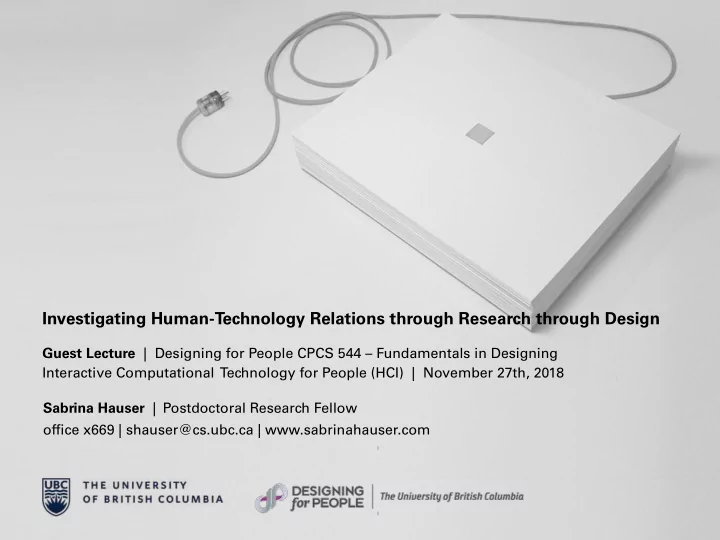
Investigating Human-Technology Relations through Research through Design Guest Lecture | Designing for People CPCS 544 Fundamentals in Designing Interactive Computational Technology for People (HCI) | November 27th, 2018 Sabrina Hauser


slide-1
SLIDE 1

Investigating Human-Technology Relations through Research through Design

Guest Lecture | Designing for People CPCS 544 – Fundamentals in Designing 
 Interactive Computational Technology for People (HCI) | November 27th, 2018 Sabrina Hauser | Postdoctoral Research Fellow

  • ffice x669 | shauser@cs.ubc.ca | www.sabrinahauser.com
slide-2
SLIDE 2

Sabrina Hauser | DFP Guest Lecture @UBC | November 27th, 2018 | 64 2

INTRODUCTION

  • My Background

MY HCI WORK

  • The kind of HCI research I do
  • Methods I use
  • HCI research space: design-oriented HCI

RESEARCH INSIGHTS

  • Human-T

echnology Relations; Technological Mediation

  • Research through Design (RtD)
  • Look at Several RtD projects

This Lecture | Overview Investigating Human-Technology Relations through Research through Design

  • My lecture will offer insights into the kind of work I do in

HCI that uses a Research through Design approach with contemporary philosophical perspectives.

  • A main thread in my research is to explore a deeper and

more holistic understanding of humans, technology and the different kinds of relations that can emerge between them.

  • This work is situated in an emerging strand of HCI research

exploring alternatives to goal-driven, feature-laden, and productivity-oriented ways of designing digital technologies through expanded foci beyond interaction, functionality, and human-centeredness. READINGS

  • Verbeek (2015). COVER STORY: Beyond interaction: a short

introduction to mediation theory. ACM interactions

  • Hauser, Oogjes, Wakkary, & Verbeek (2018). An Annotated

Portfolio on Doing Postphenomenology Through Research

  • Products. ACM DIS'18.
slide-3
SLIDE 3

Sabrina Hauser | DFP Guest Lecture @UBC | November 27th, 2018 | 64 3

  • Diplom (BSc + MSc/BSc Hon) in Information Science,

University of Applied Sciences, Darmstadt [2007] Introduction | My Background

slide-4
SLIDE 4

Sabrina Hauser | DFP Guest Lecture @UBC | November 27th, 2018 | 64 4

  • Diplom (BSc + MSc/BSc Hon) in Information Science,

University of Applied Sciences, Darmstadt [2007]

  • Master of Arts in Strategic Design, Design University, HfG

Schwäbisch Gmünd [2009]

Introduction | My Background

DATA/CONTENT/EMPATHY → DESIGN SPACE → DESIGN FOCUS → DESIGN DECISIONS = DESIGN RATIONALE throughout: DOCUMENTATION

slide-5
SLIDE 5

Sabrina Hauser | DFP Guest Lecture @UBC | November 27th, 2018 | 64 5

  • Diplom (BSc + MSc/BSc Hon) in Information Science,

University of Applied Sciences, Darmstadt [2007]

  • Master of Arts in Strategic Design, Design University, HfG

Schwäbisch Gmünd [2009]

Introduction | My Background

slide-6
SLIDE 6

Sabrina Hauser | DFP Guest Lecture @UBC | November 27th, 2018 | 64 6

HfG Ulm – Ulm School of Design (1953 - 1968)

slide-7
SLIDE 7

Sabrina Hauser | DFP Guest Lecture @UBC | November 27th, 2018 | 64 7

slide-8
SLIDE 8

Sabrina Hauser | DFP Guest Lecture @UBC | November 27th, 2018 | 64 8

  • Diplom (BSc + MSc/BSc Hon) in Information Science,

University of Applied Sciences, Darmstadt [2007]

  • Master of Arts in Strategic Design, Design University,

HfG Schwäbisch Gmünd [2009]

  • Academic Manager, Interaction Design B.A. program,

Design University, HfG Schwäbisch Gmünd [2010/11] Introduction | My Background

slide-9
SLIDE 9

Sabrina Hauser | DFP Guest Lecture @UBC | November 27th, 2018 | 64 9

  • Diplom (BSc + MSc/BSc Hon) in Information Science,

University of Applied Sciences, Darmstadt [2007]

  • Master of Arts in Strategic Design, Design University,

HfG Schwäbisch Gmünd [2009]

  • Academic Manager, Interaction Design B.A. program,

Design University, HfG Schwäbisch Gmünd [2010/11] Introduction | My Background

slide-10
SLIDE 10

Sabrina Hauser | DFP Guest Lecture @UBC | November 27th, 2018 | 64 10

  • Diplom (BSc + MSc/BSc Hon) in Information Science,

University of Applied Sciences, Darmstadt [2007]

  • Master of Arts in Strategic Design, Design University,

HfG Schwäbisch Gmünd [2009]

  • Academic Manager, Interaction Design B.A. program,

Design University, HfG Schwäbisch Gmünd [2010/11] Introduction | My Background

http://www.nuilab.com/
slide-11
SLIDE 11

Sabrina Hauser | DFP Guest Lecture @UBC | November 27th, 2018 | 64 11

  • Diplom (BSc + MSc/BSc Hon) in Information Science,

University of Applied Sciences, Darmstadt [2007]

  • Master of Arts in Strategic Design, Design University,

HfG Schwäbisch Gmünd [2009]

  • Academic Manager, Interaction Design B.A. program,

Design University, HfG Schwäbisch Gmünd [2010/11] Introduction | My Background

slide-12
SLIDE 12

Sabrina Hauser | DFP Guest Lecture @UBC | November 27th, 2018 | 64 12

  • Diplom (BSc + MSc/BSc Hon) in Information Science,

University of Applied Sciences, Darmstadt [2007]

  • Master of Arts in Strategic Design, Design University,

HfG Schwäbisch Gmünd [2009]

  • Academic Manager, Interaction Design B.A. program,

Design University, HfG Schwäbisch Gmünd [2010/11] Introduction | My Background

slide-13
SLIDE 13

Sabrina Hauser | DFP Guest Lecture @UBC | November 27th, 2018 | 64 13

  • Diplom (BSc + MSc/BSc Hon) in Information Science,

University of Applied Sciences, Darmstadt [2007]

  • Master of Arts in Strategic Design, Design University,

HfG Schwäbisch Gmünd [2009]

  • Academic Manager, Interaction Design B.A. program,

Design University, HfG Schwäbisch Gmünd [2010/11]

  • PhD, Simon Fraser University, School of Interactive

Arts and Technology, Everyday Design Studio [2018] Introduction | My Background

slide-14
SLIDE 14

Sabrina Hauser | DFP Guest Lecture @UBC | November 27th, 2018 | 64 14

  • Diplom (BSc + MSc/BSc Hon) in Information Science,

University of Applied Sciences, Darmstadt [2007]

  • Master of Arts in Strategic Design, Design University,

HfG Schwäbisch Gmünd [2009]

  • Academic Manager, Interaction Design B.A. program,

Design University, HfG Schwäbisch Gmünd [2010/11]

  • PhD, Simon Fraser University, School of Interactive

Arts and Technology, Everyday Design Studio [2018]

  • Instructor at Emily Carr University of Art and Design,

Interaction Design B.A. [2015-17] Introduction | My Background

slide-15
SLIDE 15

My Work in HCI

slide-16
SLIDE 16

Sabrina Hauser | DFP Guest Lecture @UBC | November 27th, 2018 | 64 16

My work in HCI | The kind of HCI research I do Interaction Design Researcher in Design-oriented HCI

  • What I do/ Methods I use:
  • qualitative studies;
  • design ethnography: ethnography-informed

studying of people/ future users)

  • Research through Design: constructive design

research; deployment studies

  • try to actively integrate critical (contemporary)

philosophical perspectives and approaches in my design research work and practice

Hauser, S., Wakkary, R., & Neustaedter, C. (2014). Understanding Guide Dog Team Interactions: Design Opportunities to Support Work and Play. In Proc. of ACM DIS ’14, pp. 295–304.

slide-17
SLIDE 17

Sabrina Hauser | DFP Guest Lecture @UBC | November 27th, 2018 | 64 17

My work in HCI | The kind of HCI research I do Interaction Design Researcher in Design-oriented HCI

  • What I do/ Methods I use:
  • qualitative studies;
  • design ethnography: ethnography-informed

studying of people/ future users)

  • Research through Design: constructive design

research; deployment studies

  • try to actively integrate critical (contemporary)

philosophical perspectives and approaches in my design research work and practice

slide-18
SLIDE 18

Sabrina Hauser | DFP Guest Lecture @UBC | November 27th, 2018 | 64 18

slide-19
SLIDE 19

Sabrina Hauser | DFP Guest Lecture @UBC | November 27th, 2018 | 64 19

My work in HCI | Design-oriented HCI

  • ACM CHI 2019 Subcommittees
  • User Experience and Usability
  • Specific Application Areas
  • Learning, Education and Families
  • Interaction Beyond the Individual
  • Games and Play
  • Privacy, Security, and Visualization
  • Health
  • Accessibility and Aging
  • Design (since 2011)
  • Interaction techniques, Devices and Modalities
  • Understanding People:

Theory, Concepts, Methods

  • Engineering Interactive Systems and

Technologies

  • ACM Designing Interactive Systems (DIS)
  • since 1995
slide-20
SLIDE 20

Sabrina Hauser | DFP Guest Lecture @UBC | November 27th, 2018 | 64 20

SUBCOMMITTEES

slide-21
SLIDE 21

Research Insights

slide-22
SLIDE 22

Sabrina Hauser | DFP Guest Lecture @UBC | November 27th, 2018 | 64 22

Research Insights | Human-Technology Relations; Technological Mediation (Postphenomenology)

slide-23
SLIDE 23

Sabrina Hauser | DFP Guest Lecture @UBC | November 27th, 2018 | 64 https://archinect.com/eightinc/project/acure-digital-vending-machine

slide-24
SLIDE 24

Sabrina Hauser | DFP Guest Lecture @UBC | November 27th, 2018 | 64 24 https://buy.garmin.com/en-NZ/NZ/sports-fitness/activity-tracking/cIntoSports-c571-p1.html

slide-25
SLIDE 25

Sabrina Hauser | DFP Guest Lecture @UBC | November 27th, 2018 | 64 25

http://www.auger-loizeau.com/projects/toothimplant https://groups.csail.mit.edu/netmit/IMDShield/

slide-26
SLIDE 26

Sabrina Hauser | DFP Guest Lecture @UBC | November 27th, 2018 | 64 26 https://www.cnet.com/news/google-said-to-be-working-on-mini-google-home-smart-speaker

slide-27
SLIDE 27

Sabrina Hauser | DFP Guest Lecture @UBC | November 27th, 2018 | 64 27

Research Insights | Human-Technology Relations; Technological Mediation (Postphenomenology)

slide-28
SLIDE 28

Sabrina Hauser | DFP Guest Lecture @UBC | November 27th, 2018 | 64 https://www.smithsonianmag.com/innovation/hot-food-fast-home-microwave-oven-turns-50-180962545/

“Technologies and human beings help to shape each

  • ther.

Technologies are an element of human nature: They are part of us. […] “Technologies help shape perceptions and actions, experiences, and practices” (Verbeek 2015, p.29).

slide-29
SLIDE 29

Sabrina Hauser | DFP Guest Lecture @UBC | November 27th, 2018 | 64 29

slide-30
SLIDE 30

Sabrina Hauser | DFP Guest Lecture @UBC | November 27th, 2018 | 64 30

Research Insights | Human-Technology Relations; Technological Mediation (Postphenomenology)

  • How do we even understand what a preferable future

with technology could be??

  • It’s complicated; no single answer
  • Yet we need to move forward and understand and

know better how to design technologies and systems

  • In my research I have largely migrated towards using

postphenomenology as a framing

slide-31
SLIDE 31

Sabrina Hauser | DFP Guest Lecture @UBC | November 27th, 2018 | 64 31

Research Insights | Human-Technology Relations; Technological Mediation (Postphenomenology)

  • A strand of philosophy of technology to understand

the role of technologies in human existence and experience (e.g. Verbeek 2005, Rosenberger& Verbeek 2015).

  • Views technology as transformative mediators of

human-world relations.

  • Humans and technology mutually shape each other in

the relations that come about between them.

  • The human is no longer understood as an

autonomous agent. Agency is distributed across the human and technology; intentionality is mediated.

  • Technologies are investigated in terms of the relations

humans have with them; several sets of bodily-perceptual human-technology relations are considered.

  • Technology could be encountered as an embodiment, as

an alterity, through a hermeneutic, or a background relation (Ihde 2009).

  • Offers a holistic understanding of Human-Technology

Relations

  • Emerging interest into postphenomenology in HCI
slide-32
SLIDE 32

Sabrina Hauser | DFP Guest Lecture @UBC | November 27th, 2018 | 64 32

slide-33
SLIDE 33

Sabrina Hauser | DFP Guest Lecture @UBC | November 27th, 2018 | 64 33

Research Insights | Human-Computer Interaction vs. Human-Technology Relations

  • Understanding the relations between technologies and

humans as interactions and technologies as tools has been foundational to HCI’s establishment & development.

  • Yet Interactions (in use contexts) may just be one of

many possible relations that can come about between humans and technologies (Verbeek, 2015).

  • Technologies not only are instrumental tools but also

actively shape us. Technologies help shape perceptions and actions, experiences, and practices (Verbeek, 2015). There is an opportunity for HCI to engage with a deeper understanding of the relations between humans and technology to complement its existing approaches. The broad goal of my research is to explore moving beyond a focus solely on interaction, use, utility, and human-centeredness in the context of HCI.

https://foundationsofhci.wordpress.com/

slide-34
SLIDE 34

Sabrina Hauser | DFP Guest Lecture @UBC | November 27th, 2018 | 64 34

Research Insights | Research through Design What design is

  • To design is to devise courses of action aimed at changing

existing situations into preferred ones – Herbert Simon 1969).

  • Design is the ability to imagine that-which-does-not-yet-exist,

to make appear in concrete form as a new, purposeful addition to the real world (Nelson & Stolterman 2002)

  • The power of design is not only problem solving but also

problem framing (Rittel & Webber 1973; Schön 1983). What Research through design is

  • Research through Design (RtD) is a growing methodological

approach to conducting scholarly research in HCI that investigates and asks questions potential futures with technology (Zimmerman, Forlizzi & Evenson 2007)

slide-35
SLIDE 35

Design Research Case: 
 An Annotated Portfolio on Doing Postphenomenology through Research Products

Sabrina Hauser1, Doenja Oogjes1, Ron Wakkary1,2, and Peter-Paul Verbeek3


1 Simon Fraser University, Surrey, BC, Canada 2 Eindhoven University of

Technology, Netherlands

3 University of

Twente, Netherlands

slide-36
SLIDE 36

Sabrina Hauser | DFP Guest Lecture @UBC | November 27th, 2018 | 64 36

Design Research Case | An Annotated Portfolio on Doing Postphenomenology through Research Products table-non-table as a postphenomenological inquiry

  • Inquiry into the human-technology relations with

and through the table-non-table

  • Insights into relations beyond use and into the

background relation organized by the table-non- table

Wakkary, Oogjes, Lin, and Hauser. Philosophers Living with the Tilting Bowl. CHI ’18 Hauser, Wakkary, Odom, Verbeek, Desjardins, Lin, Dalton, Schilling, and de Boer. Deployments of the table-non-table: A Reflection on the Relation Between Theory and Things in the Practice of Design Research. CHI 2018.

slide-37
SLIDE 37

Sabrina Hauser | DFP Guest Lecture @UBC | November 27th, 2018 | 64 37

My PhD Dissertation | Methodological approach

Hauser, S., Wakkary, R., Odom, W., Verbeek, P .P .,et

  • al. (2018). Deployments of the table-non-table: A

Reflection on the Relation Between Theory and Things in the Practice of Design Research. In Proc.

  • f ACM CHI ’18. 13 pages.

Hauser, S., Wakkary, R., & Neustaedter, C. (2014). Understanding Guide Dog Team Interactions: Design Opportunities to Support Work and Play. In Proc. of ACM DIS ’14, pp. 295–304.

Three Design Research Cases Overarching Question: Could postphenomenology contribute a holistic perspective on human relations with technology that can help complement and expand human-centered approaches to design research and practice? Overarching Commitment

  • A reflexive account of a design researcher exploring 


what a postphenomenology-informed approach holds to complement human-centeredness

  • Unique researcher-designed framework (Creswell, 2009)
  • Two cases that challenge aspects of human-centeredness

+ use of postphenomenology

  • III. Annotated Portfolio of

Research Products as Postphenomenological 
 Inquiries

Hauser, S., Oogjes, D., Wakkary, R., & Verbeek, P .P . (2018). An Annotated Portfolio on Doing Postphenomenology Through Research Products. In Proc. of ACM DIS ’18, pp. 459-471.

  • I. Retrospective Analysis of an

empirical design ethnography study of guide dog teams

  • II. Analysis of a Research

through Design (RtD) study of the table-non-table
slide-38
SLIDE 38

Sabrina Hauser | DFP Guest Lecture @UBC | November 27th, 2018 | 64 38

My PhD Dissertation | Methodological approach

Hauser, S., Wakkary, R., Odom, W., Verbeek, P .P .,et

  • al. (2018). Deployments of the table-non-table: A

Reflection on the Relation Between Theory and Things in the Practice of Design Research. In Proc.

  • f ACM CHI ’18. 13 pages.

Hauser, S., Wakkary, R., & Neustaedter, C. (2014). Understanding Guide Dog Team Interactions: Design Opportunities to Support Work and Play. In Proc. of ACM DIS ’14, pp. 295–304.

Three Design Research Cases Overarching Question: Could postphenomenology contribute a holistic perspective on human relations with technology that can help complement and expand human-centered approaches to design research and practice? Overarching Commitment

  • A reflexive account of a design researcher exploring 


what a postphenomenology-informed approach holds to complement human-centeredness

  • Unique researcher-designed framework (Creswell, 2009)
  • Two cases that challenge aspects of human-centeredness

+ use of postphenomenology

  • III. Annotated Portfolio of

Research Products as Postphenomenological 
 Inquiries

Hauser, S., Oogjes, D., Wakkary, R., & Verbeek, P .P . (2018). An Annotated Portfolio on Doing Postphenomenology Through Research Products. In Proc. of ACM DIS ’18, pp. 459-471.

  • I. Retrospective Analysis of an

empirical design ethnography study of guide dog teams

  • II. Analysis of a Research

through Design (RtD) study of the table-non-table

slide-39
SLIDE 39

Design Research Case: 
 Field Deployments of the table-non-table

slide-40
SLIDE 40

Sabrina Hauser | DFP Guest Lecture @UBC | November 27th, 2018 | 64 40

Design Research Case | table-non-table

slide-41
SLIDE 41

Sabrina Hauser | DFP Guest Lecture @UBC | November 27th, 2018 | 64 41

The approach informing the table-non-table project

  • Research through Design (RtD) project that inquiries into

non-utilitarian aspects of human-technology relations.

  • The table-non-table diverts from assumptions around 


use-centric ideas of technologies and design

  • Combines familiarity with unfamiliarity
  • Specific functionality but not in the service of human use
  • Avoids specific use goals yet is still crafted in an

intentional and purposeful way (Wakkary, Desjardins &

Hauser 2016)

  • Material Speculation (Wakkary, Odom, Hauser, Hertz & Lin 2015)
  • Research Product (Odom, et al. 2016)
  • Studied through three different field studies with six

deployments over the course of 4 years Design Research Case | table-non-table

slide-42
SLIDE 42

Sabrina Hauser | DFP Guest Lecture @UBC | November 27th, 2018 | 64 42

slide-43
SLIDE 43

Sabrina Hauser | DFP Guest Lecture @UBC | November 27th, 2018 | 64 43

Three series of field deployments between 2013 - 2017 with six different case instances

First Series 
 thing-oriented explorations informed by everyday design and theories of social practice THING How the table-non-table can find a place in the home

Informed by: Everyday Design (Wakkary & Maestri 2007), Theories of Social Practice (e.g. Shove Watson & Pantzar 2012) Will the TNT find a place in a home? 
 How could the TNT be taken up in people’s domestic settings and practices? 
 Letting the thing do the talking. #1 Two Researchers’ Homes: Few Days 
 #2 One Participant Household: 6 Weeks

Design Research Case | Field Deployments of the table-non-table

slide-44
SLIDE 44

Sabrina Hauser | DFP Guest Lecture @UBC | November 27th, 2018 | 64 44

Three series of field deployments between 2013 - 2017 with six different case instances

First Series 
 thing-oriented explorations informed by everyday design and theories of social practice Second Series 
 ethnographic accounts of lived-with experiences informed by goodness

  • f fit and unselfconscious culture

THING How the table-non-table can find a place in the home HUMAN How the table-non-table relates to other things

Informed by: Everyday Design (Wakkary & Maestri 2007), Theories of Social Practice (e.g. Shove Watson & Pantzar 2012) Will the TNT find a place in a home? 
 How could the TNT be taken up in people’s domestic settings and practices? 
 Letting the thing do the talking. #1 Two Researchers’ Homes: Few Days 
 #2 One Participant Household: 6 Weeks Informed by: Alexander (1964)’s notions of goodness of fit & unselfconscious cultures How does the TNT fit in our participants’ homes? Looking into participants’ lived- with experiences, using established HCI

  • riented methods

#3 One Participant Households: 6 Weeks
 #4 Home of Two Researchers: 3½ Months 
 #5 One Participant Household: 3½ Months

Design Research Case | Field Deployments of the table-non-table

slide-45
SLIDE 45

Sabrina Hauser | DFP Guest Lecture @UBC | November 27th, 2018 | 64 45

Three series of field deployments between 2013 - 2017 with six different case instances

First Series 
 thing-oriented explorations informed by everyday design and theories of social practice Second Series 
 ethnographic accounts of lived-with experiences informed by goodness

  • f fit and unselfconscious culture

Third Series
 exploration of relational and mediating effects informed by postphenomenology THING How the table-non-table can find a place in the home HUMAN How the table-non-table relates to other things MEDIATION How the table-non-table 
 co-constructs human-world relations

Informed by: Everyday Design (Wakkary & Maestri 2007), Theories of Social Practice (e.g. Shove Watson & Pantzar 2012) Will the TNT find a place in a home? 
 How could the TNT be taken up in people’s domestic settings and practices? 
 Letting the thing do the talking. #1 Two Researchers’ Homes: Few Days 
 #2 One Participant Household: 6 Weeks Informed by: Alexander (1964)’s notions of goodness of fit & unselfconscious cultures How does the TNT fit in our participants’ homes? Looking into participants’ lived- with experiences, using established HCI

  • riented methods

#3 One Participant Households: 6 Weeks
 #4 Home of Two Researchers: 3½ Months 
 #5 One Participant Household: 3½ Months Informed by: Postphenomenology (e.g. Ihde 1990, Rosenberger & Verbeek 2015) How is the table-non-table encountered (relationship-wise)? 
 How does the table-non-table mediate

  • ur participants lives?

#6 Professional Designer Couple Household: 11 Weeks

Design Research Case | Field Deployments of the table-non-table

slide-46
SLIDE 46

Sabrina Hauser | DFP Guest Lecture @UBC | November 27th, 2018 | 64 46

  • The relations we have with things and technologies

are not solely be based on or begin with ‘use’

  • As soon as an artifact becomes part of a home, it

shapes a new reality and mediates people’s existence and experience regardless of its usefulness

  • A postphenomenological account of the

TNT

  • Human-Technology Relations: Background

relation (cf. Ihde 1990) with added particulars

  • Mediating effects: can be subtle, diffuse, and go

well beyond use

  • TNT as a postphenomenological inquiry

Design Research Case | Postphenomenology-informed Study of the table-non-table

slide-47
SLIDE 47

Sabrina Hauser | DFP Guest Lecture @UBC | November 27th, 2018 | 64 47

Research Insights | An Annotated Portfolio on Doing Postphenomenology through Research Products table-non-table as a postphenomenological inquiry

  • Inquiry into the human-technology relations with

and through the table-non-table

  • Insights into relations beyond use and into the

background relation organized by the table-non- table 
 Could this framing be extended to other key Research through Design works in HCI?

Wakkary, Oogjes, Lin, and Hauser. Philosophers Living with the Tilting Bowl. CHI ’18 Hauser, Wakkary, Odom, Verbeek, Desjardins, Lin, Dalton, Schilling, and de Boer. Deployments of the table-non-table: A Reflection on the Relation Between Theory and Things in the Practice of Design Research. CHI 2018.

slide-48
SLIDE 48

Sabrina Hauser | DFP Guest Lecture @UBC | November 27th, 2018 | 64 48

  • Greenscreen Dress 


(Mackey et al. 2017)

  • Obscura 1C Digital Camera 


(Pierce & Paulos, 2015)

  • Indoor Weather Stations 


(Gaver et al. 2013)

  • Morse

Things 
 (Wakkary et al. 2017)

  • Photobox


(Odom et al. 2012,2014)

  • Datacatcher


(Gaver et al. 2016) Hauser, S., Oogjes, D., Wakkary, R., & Verbeek, P .P . (2018). An Annotated Portfolio on Doing Postphenomenology Through Research Products. 
 In Proceedings of the 2018 Designing Interactive Systems Conference (DIS '18). ACM Press, 459-471.

slide-49
SLIDE 49

Sabrina Hauser | DFP Guest Lecture @UBC | November 27th, 2018 | 64 49

Research Insights | Research Products

  • The term and concept of research products

“emphasizes the actuality of the design artifact helping to overcome the limitations of prototypes when investigating complex matters of human- technology relations over time, which is of growing interest in the HCI community” [Odom et al. 2016].

  • designed to drive a research inquiry;
  • they have a high quality of finish such that people

engage with them as they are, rather than what they might become and such that

  • they can fit among other things and into everyday

environments;

  • they operate independently in everyday settings
  • ver time.
slide-50
SLIDE 50

Sabrina Hauser | DFP Guest Lecture @UBC | November 27th, 2018 | 64 50

GreenScreen Dress (Mackay et al)

slide-51
SLIDE 51

Sabrina Hauser | DFP Guest Lecture @UBC | November 27th, 2018 | 64 51

Obscura 1 C Camera (Pierce & Paulos)

slide-52
SLIDE 52

Sabrina Hauser | DFP Guest Lecture @UBC | November 27th, 2018 | 64 52

Indoor Weather stations (Gaver et al / Interactions Research Studio @Goldsmiths)

slide-53
SLIDE 53

Sabrina Hauser | DFP Guest Lecture @UBC | November 27th, 2018 | 64 53

Datacatcher (Gaver et al / Interaction Research Studio @Goldsmiths)

slide-54
SLIDE 54

Sabrina Hauser | DFP Guest Lecture @UBC | November 27th, 2018 | 64 54

Photobox (Odom et al)

slide-55
SLIDE 55

Sabrina Hauser | DFP Guest Lecture @UBC | November 27th, 2018 | 64 55

Morse Things (Wakkary et al)

slide-56
SLIDE 56

Sabrina Hauser | DFP Guest Lecture @UBC | November 27th, 2018 | 64 56

Research Insights | Postphenomenological Commitments across Research Products

1 Empirical work as the basis of the inquiry 2 Structures of human-technology-world relations as a starting point 3 Technology co-constitutes objectivity and subjectivity of any given situation (mediations) (c.f. Rosenberger and Verbeek, 2015)

slide-57
SLIDE 57

Sabrina Hauser | DFP Guest Lecture @UBC | November 27th, 2018 | 64 57

1 Empirical work as the basis of the inquiry

  • First Person Experiences
  • Self-conducted studies
  • Empirical Work by others


 What kind of empirical work is done with and through the selected research products?

  • 20 cameras as stand-alone products
  • distributed through bulletin boards, local stores,

& craigslist

  • empirical account builds on the specific actuality
  • 1st person experience by Pierce

Obscura 1C Digital Camera (Pierce & Paulos, 2015)

Research Insights | Postphenomenological Commitments across Research Products

slide-58
SLIDE 58

Sabrina Hauser | DFP Guest Lecture @UBC | November 27th, 2018 | 64 58

1 Empirical work as the basis of the inquiry 2 Structures of human-technology-world relations as a starting point

  • We can encounter technologies through different

bodily-perceptual relationships 
 (Ihde 1990):

  • as an embodiment
  • as an alterity,
  • through a hermeneutic, or
  • a background relation.
  • We can also encounter technologies through

cyborg relationships (Verbeek 2008):

  • through fusion, immersion, & augmentation

What structures of relationships are at play in 
 the selected research products?

  • Designed to be encountered hermeneutically

revealing aspects of the home’s microclimate

  • They eventually become part of the home’s

background and in a desirable way

  • Novelty results in relationships and their

dynamics to evolve over time Research Insights | Postphenomenological Commitments across Research Products

slide-59
SLIDE 59

Sabrina Hauser | DFP Guest Lecture @UBC | November 27th, 2018 | 64 59

1 Empirical work as the basis of the inquiry 2 Structures of human-technology-world relations 
 as a starting point 3 Technology co-constitutes objectivity and subjectivity of any given situation (mediations) What kind of ‘human’ and what kind of ‘world’ is co- constituted by our research products?

  • Greenscreen Dress changed Mackey’s ways of

relating to clothing, her identity, & her environment.

  • Her perception of and experiences with the system

moved from being “gimmicky” to an exploration into regaining control and expressing identity.

  • She experienced her environment as wearable, as

most of the digital content she ‘wore’ came from captures from her surroundings. Research Insights | Postphenomenological Commitments across Research Products

slide-60
SLIDE 60

Sabrina Hauser | DFP Guest Lecture @UBC | November 27th, 2018 | 64 60

Implications | Research Products as Doing Postphenomenology (in a more experimental way)

  • Revealed how the research products inquires

align with key postphenomenological commitments.

  • Empirical approaches, human-technology

relationship structures, and mediation

  • Established a postphenomenological

vocabulary and concepts in the context of HCI and RtD Research products can be seen as doing postphenomenology in a more experimental way

The co-constructive roles of HCI researchers in their postphenomenological inquiries

slide-61
SLIDE 61

Sabrina Hauser | DFP Guest Lecture @UBC | November 27th, 2018 | 64 61

Research Insights | Implications

Annotated Portfolio of Research Products as Postphenomenological Inquiries

  • Revealed how the research products inquires align

with key postphenomenological commitments.

  • Empirical approaches, human-technology relationship

structures, and mediation

  • Established a postphenomenological vocabulary and

concepts in the context of HCI and RtD Research products can be seen as doing postphenomenology in a more experimental way

Co-constructive roles of HCI researchers in their postphenomenological inquiries

slide-62
SLIDE 62

Sabrina Hauser | DFP Guest Lecture @UBC | November 27th, 2018 | 64 62

The constructive roles of HCI researchers in their inquiries

Research Insights | Implications

slide-63
SLIDE 63

Sabrina Hauser | DFP Guest Lecture @UBC | November 27th, 2018 | 64 63

Design Research Case III | Implications How can this be useful for you?

  • Think about not only what your designing as what

it enable. What does it obscure?

  • What kind of human subjectivity are you co-

constituting through your technology?

  • Besides its functionality, in what way does your

technology shape or change people?

  • How can people relate to it?

Co-constructive roles of HCI researchers in their postphenomenological inquiries Technological Mediation; Human-Technology Relations

slide-64
SLIDE 64

Investigating Human-Technology Relations through Research through Design

Guest Lecture | Designing for People CPCS 544 – Fundamentals in Designing 
 Interactive Computational Technology for People (HCI) | November 27th, 2018 Sabrina Hauser | Postdoctoral Research Fellow

  • ffice x669 | shauser@cs.ubc.ca | www.sabrinahauser.com

Thank you!