Introduction to WSU Accounting Presented by Terry Ely Controller, - - PDF document

introduction to wsu accounting
SMART_READER_LITE
LIVE PREVIEW

Introduction to WSU Accounting Presented by Terry Ely Controller, - - PDF document

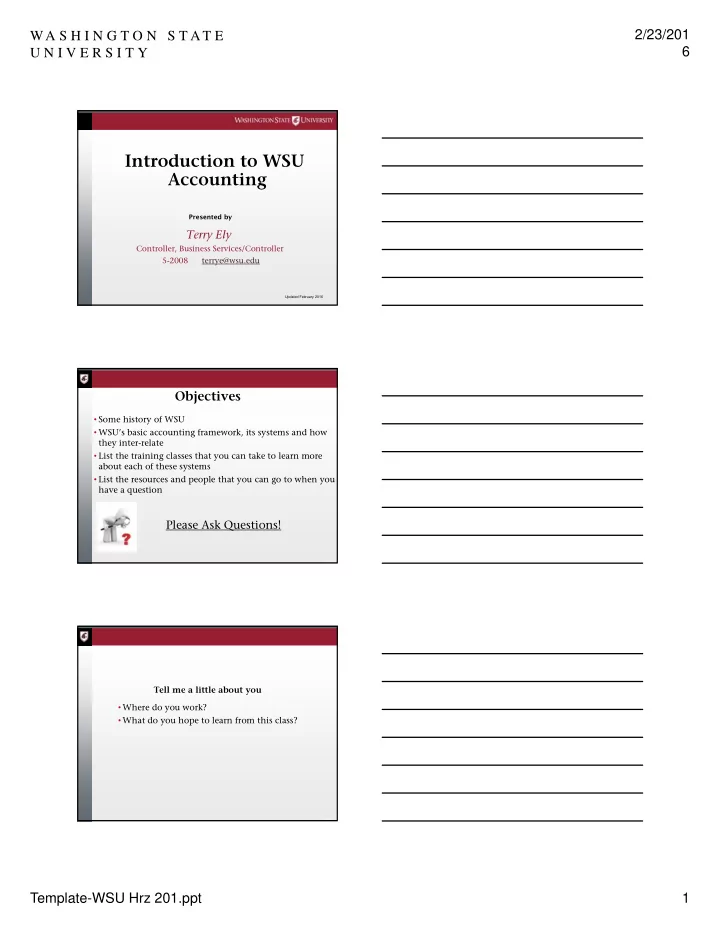
2/23/201 WA S H I N G T O N S T AT E 6 U N I V E R S I T Y Introduction to WSU Accounting Presented by Terry Ely Controller, Business Services/Controller 5-2008 terrye@wsu.edu Updated February 2016 Objectives Some history of WSU


slide-1
SLIDE 1

2/23/201 6 Template-WSU Hrz 201.ppt 1 WA S H I N G T O N S T AT E U N I V E R S I T Y

Introduction to WSU Accounting

Updated February 2016

Presented by

Terry Ely

Controller, Business Services/Controller 5-2008 terrye@wsu.edu

Objectives

  • Some history of WSU
  • WSU’s basic accounting framework, its systems and how

they inter-relate

  • List the training classes that you can take to learn more

about each of these systems

  • List the resources and people that you can go to when you

have a question

Please Ask Questions!

Slide 2

Tell me a little about you

  • Where do you work?
  • What do you hope to learn from this class?

Slide 3

slide-2
SLIDE 2

2/23/201 6 Template-WSU Hrz 201.ppt 2 WA S H I N G T O N S T AT E U N I V E R S I T Y

Washington State University is Washington State’s Land Grant University

  • Morrill Acts of 1862 and 1890
  • Hatch Act of 1887
  • Smith-Lever Act of 1914

Slide 4

WSU is a public research university committed to its land-grant heritage and tradition of service to society.

Slide# 5

https://strategicplan.wsu.edu/ WSU has a long tradition of excellence. It has great plans for the future. If you’d like to share that vision, see the university’s mission statement and Strategic plan at the website below. In addition, Finance and Administration has a vision and mission statement as well. We are in the process of updating it now. http://baf.wsu.edu/StrategicPlan.html

Slide# 6

WSU doesn’t collect taxes like the Department of Revenue WSU doesn’t build roads like the Department of Transportation WSU sells education to students

We operate more like a business enterprise.

WSU is also an agency of the State of Washington, but…. A different kind of agency

slide-3
SLIDE 3

2/23/201 6 Template-WSU Hrz 201.ppt 3 WA S H I N G T O N S T AT E U N I V E R S I T Y

A competitive state agency

  • Must compete to attract students
  • Must compete to attract research
  • Result – very different expenses

Slide 7

Sometimes our unique requirements make trying to fit into the state’s mold uncomfortable. But it can be done.

A picture is worth 1,000 words

Slide 8 Slide# 9

  • WSU Business Policies and Procedures

http://www.wsu.edu/~forms/manuals.htm l

  • Office of Financial Management (OFM)

State Administrative and Accounting Manual http://www.ofm.wa.gov/policy/default.as p

  • Washington State Constitution

http://www.leg.wa.gov/lawsandagencyrules/pages/constitution.aspx

  • Revised Code of Washington (RCWs)

http://apps.leg.wa.gov/rcw/

  • Washington Administrative Code (WACs)

http://apps.leg.wa.gov/wac/ WSU’s Business Policies and Procedures have their basis in the state’s laws and policies.

slide-4
SLIDE 4

2/23/201 6 Template-WSU Hrz 201.ppt 4 WA S H I N G T O N S T AT E U N I V E R S I T Y

Why do we have all these rules?

  • These laws and regulations provide the guidance framework for

how the State does business. When properly implemented and followed, they will safeguard our resources, protect our staff, and provide internal controls to ensure that we are careful stewards of our public funds.

  • These rules also guide us in how we track all of the business

we’ve done. They define what our accounting systems need to track, how to record transactions to properly account for the financial resources we’ve received or used.

Slide 10 Slide 11

FUND ACCOUNTING

Governments use fund accounting. Fund accounting was created to enable governments to be “accountable” to their citizens.

  • Tax levies for a specific project are placed in a specific fund for that

project.

  • Expenditures made to accomplish that project come out of that same

fund.

  • At the end of the project, citizens can see that their money was used as

they had intended.

But wait! There’s more!

  • Governmental Accounting Standards Board (GASB)

Establishes the requirements for financial statement presentation and footnote disclosures for governments and public universities Currently they have issued 64 pronouncements

  • National Association of College and University Business

Officers (NACUBO)

Provides detailed guidance to public and private colleges and universities on how to implement the guidance provided by GASB (and FASB) These rules apply to how we must account for transactions within

  • ur accounting systems.

Slide 12

slide-5
SLIDE 5

2/23/201 6 Template-WSU Hrz 201.ppt 5 WA S H I N G T O N S T AT E U N I V E R S I T Y

Brief History of College and University Accounting

  • NACUBO
  • FASB
  • GASB
  • Blank Slate Project

Slide 13 Slide 14

University Accounting

WSU uses fund accounting (“bucket accounting”) The source of the funds determines the bucket it goes into.

  • State appropriated funds
  • Self-sustaining funds
  • Grant funds
  • Donated funds

Slide 15

  • Unrestricted funds – can be expended for any lawful

purpose

  • Restricted funds – can only be used for a specific

purpose established by an outside person or entity

UNRESTRICTED or RESTRICTED

slide-6
SLIDE 6

2/23/201 6 Template-WSU Hrz 201.ppt 6 WA S H I N G T O N S T AT E U N I V E R S I T Y

The Color of Money

  • State appropriation funded budget

Slide 16

Operating account – 06F-5555-0001 Instruction & departmental research for The College of Business PBL funded

The Color of Money, continued

  • Federally sponsored grant money

Slide 17

Grant account – 11E-5555-0002 Federal grant from the Department of Commerce to design a better mousetrap

Your Dean wants to Support the Grant

  • Transfer money from our state account into

the grant account so they can buy more cheese.

  • You send an email to General Accounting

requesting them to transfer the funds.

  • They will tell you that you can’t do that.
  • Why?
slide-7
SLIDE 7

2/23/201 6 Template-WSU Hrz 201.ppt 7 WA S H I N G T O N S T AT E U N I V E R S I T Y

The Color of Money, continued

  • Green money is “unaccountable”

Slide 19

When you move “yellow” money and put it into “blue money”, it becomes muddied “green money”. You can no longer tell what the grant mo spent for and what the PBL money was used for. To account for both types of m correctly, you should by the cheese with the PBL money and then let the grant You can show the cheese purchase as cost share on the grant. Some mixing of funds is allowable. In general, if you want to move money from one account to another within the same fund, you can do that. If you want to move money from one fund to a different fund, call the Controller’s office first.

What Color is My Money? You can tell by the fund number

  • Unrestricted operating funds are: 001, 148, and 149
  • Unrestricted internal service & auxiliary funds are: 400’s & 500’s
  • Restricted grant funds are: 143 & 145
  • Restricted donated funds are: 846

Slide 20

Donated Funds

  • Not considered “state” money
  • Fewer restrictions on spending than state money
  • Can’t move state funds into donated funds
  • Please read our 17A policy BPPM 70.33

Slide 21

slide-8
SLIDE 8

2/23/201 6 Template-WSU Hrz 201.ppt 8 WA S H I N G T O N S T AT E U N I V E R S I T Y

How do I know what my money is to be used for? You can tell by the program and subprogram

  • Instruction & Departmental Research (Programs 06 & 10)
  • Sponsored Research (Programs 11, 12, 13, & 14)
  • Public Service (Program 09)
  • Student Services (Program 03)
  • Academic Support (Programs 07 & 08)
  • Institutional Support (Program 01)
  • Operation & Maintenance of Plant (Program 04)
  • Auxiliary Enterprises (Program 15)
  • Scholarships, Financial Aid, Donations (Program 17)

Slide 22

Who can I call if I have a question about how to account for the money in my buckets?

  • Terry Ely, 5-2008 terrye@wsu.edu
  • Joy Morton, 5-2072 joy.morton@wsu.edu
  • Robert Wright, 5-2024 wrightrd@wsu.edu
  • Tami Bidle, 5-1202 tbidle@wsu.edu

Slide 23

How do Funds and Programs fit into WSU’s Financial Reporting?

  • Revenues are summarized by source
  • Expenditures are summarized by object and by program
  • Required adjustments, accruals, and reclassifications are made
  • The result becomes the income statement on our financial

statements WSU financial statements are available online at: http://www.wsu.edu/genacct/finstat.htm

Slide 24

slide-9
SLIDE 9

2/23/201 6 Template-WSU Hrz 201.ppt 9 WA S H I N G T O N S T AT E U N I V E R S I T Y

Chart of Accounts

  • An organization’s chart of accounts forms the

structural framework for accounting for all the

  • rganization’s financial transactions.

–Funds –Programs –Revenues –Expenditures –Other

General Ledger and Budgetary Sub-ledger

  • FACTS
  • BALANCES

BALANCES

  • Cash basis
  • Revenues, Allocations, Encumbrances
  • Expenses
  • Cash
slide-10
SLIDE 10

2/23/201 6 Template-WSU Hrz 201.ppt 10 WA S H I N G T O N S T AT E U N I V E R S I T Y

FACTS

  • Balances transactions feed to it through two

control accounts, 7101 for revenue and 8101 for expenses

  • Offset is cash, 1103
  • Facts records all balance sheet transactions

and converts our accounting system to an accrual basis A Quick Walk through the Chart

  • Funds
  • Programs
  • Revenue Sources
  • Expenditure Objects

Funds

  • Follows the State’s accounting system

– All WSU transactions are summarized and transmitted to the State monthly

  • State Operating Appropriations – 001 (Unrestricted)
  • State Capital Appropriations – 057 and 062 (Restricted)

– 057 are monies provided by State budget for capital projects – 062 are monies earned on the land grant endowments and can only be spent for capital projects and debt service

  • Federal Operating Appropriations – 143 (Restricted)
  • Grants and Contracts – 145 (Restricted)
slide-11
SLIDE 11

2/23/201 6 Template-WSU Hrz 201.ppt 11 WA S H I N G T O N S T AT E U N I V E R S I T Y

Funds, continued

  • Self-sustaining Funds – 148 (Unrestricted)

–Some are allocated

  • 148-02 F&A Cost Recovery
  • 148-05 Admin Fees and Interest

–Others are managed by departments

  • These generate revenue
  • Their functions are education-related
  • They are set up as service centers
  • They are supposed to operate on a break-even basis

Funds, continued

  • Tuition and Fees - 149 (Unrestricted)

–All tuition revenue is deposited to these funds. The tuition revenue is then combined with the State operation appropriations and allocated to departments as part of their 001 allocation.

Funds, continued

  • Local Construction Funds – 252 (Sorta restricted)

–These funds are used to track construction projects that will be paid for with university funds or bond proceeds

  • Internal Service Funds – 4XX (Unrestricted)

–These funds are used by departments that perform services for all units of the university. Examples are: Central Stores, Motor Pool, Printing & Publications, and Facilities.

slide-12
SLIDE 12

2/23/201 6 Template-WSU Hrz 201.ppt 12 WA S H I N G T O N S T AT E U N I V E R S I T Y

Funds, continued

  • Auxiliary Funds – 5XX (Unrestricted)

–These are fully self-supporting business-type

  • perations that provide services to customers of

the university – students –Examples are: ASWSU, the CUB, the Student Recreation Center, and Housing and Dining.

  • Donated Funds – 846 (Restricted)

–These funds contain monies donated to the university through the WSU Foundation. The monies may be used only for the purpose established by the donor.

Funds, continued

  • Loan Funds – 849 & 860 (Restricted)

–These funds track the various types of loans the university is authorized to issue to students.

  • Endowment Funds – 859 (Permanently

Restricted)

–The WSU Foundation holds most of the university endowments, but WSU does hold a few on our books.

  • Agency Funds

–These are used for tracking money that WSU holds for others. Examples are: student clubs.

Revenue Source Codes

  • Source and sub-source codes are used to

identify the type of revenue received.

–Revenue cannot be recorded in all types of funds. In general, self-sustaining, internal service, auxiliary, grant, and agency funds can receive revenue. –Before generating revenue, the department needs to submit a request to create a service center.

slide-13
SLIDE 13

2/23/201 6 Template-WSU Hrz 201.ppt 13 WA S H I N G T O N S T AT E U N I V E R S I T Y

Classifications of Source Codes

  • 0300 – Federal Revenue

–These are generally only used by grant funds

  • 0400 – Miscellaneous

–These record revenue from property rentals, endowments, investment income, and sale of property and equipment

  • 0420 – Charges for Services

–The codes are meant to track revenues for charges to other departments of the university.

Classification of Source Codes, continued

  • 0424 Tuition and Fees

–These codes are used to classify the types of tuition and fees charged to students. –0424-9x and 0425-xx record tuition waivers

  • 0428 Revenue from Sales within an Area

–When a department sells something to another department within their area, these source codes are used. Using these codes tells accounting why there was no administrative service charge applied.

Classification of Source Codes, continued

  • 0430 Dedicated Student Fees

–These codes are used to classify course fees and

  • ther student fees.
  • 0440 F&A Cost Recovery

–These codes are used by Sponsored Programs to record the F&A revenue received from grants.

  • 0451 Revenue from Sales to Students and

Outside Customers

–These codes are used to classify sales made to customers of the university – students or other universities, or outside businesses.

slide-14
SLIDE 14

2/23/201 6 Template-WSU Hrz 201.ppt 14 WA S H I N G T O N S T AT E U N I V E R S I T Y

Classifications of Source Codes, continued

  • 0473 Investment Costs
  • 0541 Contributions

–These codes are used by the WSU Foundation to record contributions received

  • 0546 Federal Pass-Thru Revenue

–These codes are used by Sponsored Programs to track Federal revenues received through non- Federal entities

  • 06xx Transfers (Revenue transfers)

Objects of Expenditure

  • 00 Salaries
  • 01 Wages
  • 02 Service Contracts – Personal or Purchased
  • 03 Goods and Supplies
  • 04 Travel
  • 06 Capitalizable Equipment
  • 07 Employee Benefits
  • 08 Scholarships
  • 09 Principal and Interest on Debt
  • 10 Capitalizable Land or Buildings

Objects of Expenditure

  • 12 Depreciation, Amortization, Bad Debt Expense
  • 13 F&A Charged to Grants (Sponsored Programs only)
  • 14 Sub-Contract Expenses (Sponsored Programs only)
  • 15 Cost of Goods Sold (only used by H&D)
  • 16 Non-Capitalized Equipment
  • 2x Intra-agency Reimbursements
slide-15
SLIDE 15

2/23/201 6 Template-WSU Hrz 201.ppt 15 WA S H I N G T O N S T AT E U N I V E R S I T Y

WSU Accounting Systems

  • AIS PAPR – purchasing & accounts payable
  • AIS DEPPS – payroll & position control
  • SIS – student & general accounts receivable
  • AIS SCBAIMS – service center billing
  • AIS BPS – budget system/PBL data

Slide 43

Other Systems

  • Purchasing Card/Central Travel
  • Point of Sale cashiering
  • Property Inventory
  • Facilities, Land
  • Cost Share/Effort Reporting
  • WSU Org
  • Endowment Investment Tracking

Slide 44

AIS Balances

  • Allows you to view your accounts in summary and

detail

  • Flexibility
  • Multiple years
  • Essential tool
  • Refer to BPPM 85.33 to request access
  • Sign up for AIS: Account Balances training through

HRS

Slide 45

slide-16
SLIDE 16

2/23/201 6 Template-WSU Hrz 201.ppt 16 WA S H I N G T O N S T AT E U N I V E R S I T Y

Financial Data Warehouse

  • Almost all data that goes into AIS Balances is

exported to the financial data warehouse.

  • Using Business Objects as the query tool, you can

write and run reports to gather all information about your budgets

  • The license is now free to all who need access.

– https://infotech.wsu.edu/DataWarehouse/FinancialData/AccessProcedure.aspx

Slide 46

AIS HEPPS/DEPPS

  • Payroll processing system
  • This system contains information on employees, payroll

and position control

  • Training is available through Human Resources
  • http://www.hrs.wsu.edu/Fiscal%20Management%20Traini

ng%20Resource%20Materials

  • Payroll data is fed to the Financial data warehouse

Slide 47

DEPTPAY

  • All departments must have two people who have

been trained in inputting hours for hourly staff and reviewing gross pay for departmental employees.

  • You must attend training before you can use

DEPTPAY.

  • You must have access to DEPPS before you can get

training.

  • The training is offered through Human Resources.

Slide 48

slide-17
SLIDE 17

2/23/201 6 Template-WSU Hrz 201.ppt 17 WA S H I N G T O N S T AT E U N I V E R S I T Y

PERMS & TEMPS

Personnel Action Forms must be completed using the PERMS system

  • Frequently asked questions about PERMS
  • http://www.hrs.wsu.edu/utils/File.aspx?fileid=5158
  • You may access PERMS via the following websites:
  • https://webapps.wsu.edu/ais/perms/permsmaster/permswelcome.aspx
  • Temporary Employee Personnel Actions must be processed using the TEMPS system
  • TEMPS Training Manual
  • http://www.hrs.wsu.edu/utils/file.aspx?fileid=1007
  • BPPM 60.26

Both PERMS and TEMPS training is available through Human Resources http://www.hrs.ws.edu/ILT%20Schedule.htm

Slide 49

Fiscal Management Training

Slide 50

  • Human Resources offers a comprehensive selection of classes

that will give you the knowledge you need to do your job well.

  • Some of the classes are online, others are instructor-led like this
  • ne.
  • See what is offered and the class schedules at:

http://www.hrs.wsu.edu/Fiscal+Management+Training+Resource +Materials

Focus Area Finance

Concept Area 1 – Accounting Foundations

Accounting Foundations

Accounting Fundamentals The Basics of Budgeting

Funding at WSU Introduction to WSU Accounting Systems

Concept Area 2 – Financial Operations & Accounting Activity

WSU Procurement I & II

Purchasing & Purchasing Cards Central Stores, Receiving, & Delivery

WSU Purchasing

Purchasing Card Training, Levels 1 & 2 Purchasing Card Training for Approvers

Slide 51

slide-18
SLIDE 18

2/23/201 6 Template-WSU Hrz 201.ppt 18 WA S H I N G T O N S T AT E U N I V E R S I T Y

Focus Area Finance, continued

Revenue Management Cash Handling AIS Account Balances Business Objects: Financial Business Objects: InfoBurst AIS: DEPPS Department Pay Position Control Training, 1 & 2 Accruals, Allocation Adjustments and Reserve Accounts Travel Training Life Cycle of a Sponsored Program

Slide 52

Focus Area Finance, continued

Concept Area 3 – Fiscal Management

Managing & Reconciling your Budget Financial Analysis Fiscal Audits and Internal Controls

Slide 53

Receivables – Internal or External

  • Service centers & billing
  • Invoicing customers

If your department bills for goods or services, refer to the BPPM 30.56 and 30.57 for policies and procedures to follow If you have questions about customer billing, call Debbie Stellyes in Student Accounts, 5-1270, stellyes@wsu.edu If you have questions about Internal Requisitions & Invoices (IRIs) call Marilyn Dahmen, 5-2042, dahmenm@wsu.edu If you have a question about service centers, call Karen Breese, 5-2056, kbreese@wsu.edu

Slide 54

slide-19
SLIDE 19

2/23/201 6 Template-WSU Hrz 201.ppt 19 WA S H I N G T O N S T AT E U N I V E R S I T Y

New Receivables system

  • The university has converted to a new student system:

– Admissions – Registration – Financial Aid – Student Accounts – General Receivables

Students and staff access the new systems through the myWSU portal. The new software is PeopleSoft by Oracle.

Slide 55

Property Inventory

All university property meeting certain criteria must be

  • inventoried. It must be tagged and safeguarded and can
  • nly be disposed of through Surplus Stores.

Who is the equipment inventory coordinator for your department or area? What property must be inventoried?

– Weapons & Firearms – Laptop Computers – Licensed Vehicles and Trailers – Any item of equipment whose:

Purchase cost is $5,000 or more Useful life is more than one year

If you have questions about property, call Tami Bidle, 5-1202, tbidle@wsu.edu

Slide 56

Sponsored Programs

If you are responsible for grants, there are a lot more regulations you need to be aware of:

The grant will be subject to Facilities & Administrative costs The grant may require cost sharing & effort certification Human Resources offers training on both of these areas.

  • Effort Certification and Cost Sharing
  • Understanding Facilities & Administrative Costs
  • http://www.hrs.wsu.edu/ILT%20Schedule

If you have questions about a sponsored program, call Kim Small, 5- 2047, kksmall@wsu.edu

Slide 57

slide-20
SLIDE 20

2/23/201 6 Template-WSU Hrz 201.ppt 20 WA S H I N G T O N S T AT E U N I V E R S I T Y

Revenue Management

Does your department ever receive cash or checks? Does your department ever receive electronic payments – wires or ach transfers?

Take the cash handling course

If you have questions about your revenue, contact, Nicole Blessing 5-2025, n.blessing@wsu.edu If you think you should have received an electronic payment, but don’t see it in your account, call Robert Wright at 5-1202.

Slide 58

Recap

  • WSU – Land Grant Public University
  • WSU – State Agency
  • Fund (Bucket) Accounting
  • Funds, Programs, Revenue & Expense Codes
  • WSU Accounting Systems
  • WSU Training
  • WSU Helpful Contacts

Slide 59 Slide 60

That’s All for Now, Folks!

Email questions or let us know what

  • ther topics you would like to see

covered.

Terry’s email: terrye@wsu.edu

slide-21
SLIDE 21

2/23/201 6 Template-WSU Hrz 201.ppt 21 WA S H I N G T O N S T AT E U N I V E R S I T Y

If you attended this live training session and wish to have your attendance documented in your training history, please notify Human Resource Services within 24 hours of today's date:

hrstraining@wsu.edu

This has been a WSU Training Videoconference