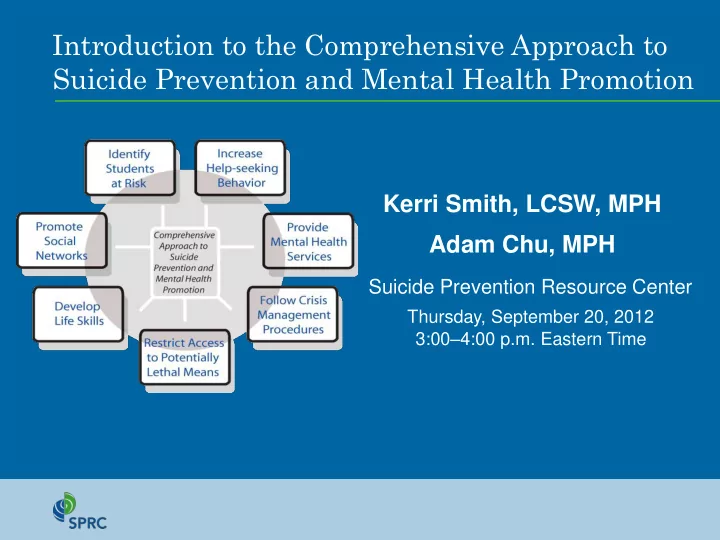
SLIDE 1 Introduction to the Comprehensive Approach to Suicide Prevention and Mental Health Promotion
Kerri Smith, LCSW, MPH Adam Chu, MPH
Suicide Prevention Resource Center
Thursday, September 20, 2012 3:00–4:00 p.m. Eastern Time
SLIDE 2 Who you’ll hear from today
Kerri Smith Senior Campus Prevention Specialist Adam Chu Prevention Specialist
SLIDE 3
Before we begin…
If you are having any technical problems joining the
webinar please call 617-618-2380 or Adobe Connect 1- 800-422-3623.
Type any questions or comments at anytime into the
text box on the lower left hand side of your screen and we will attempt to assist you.
SLIDE 4
Agenda
SPRC/Jed Foundation Comprehensive Approach to
Suicide Prevention and Mental Health Promotion
Examples of how other campuses have adopted a
comprehensive approach
Identify current strengths and gaps on your campus for
implementing a comprehensive suicide prevention program
SLIDE 5
What is one part of your program that you are excited to begin work on?
SLIDE 6 Public Health Approach
Problems occur at multiple levels Individual Interpersonal Institutional Community Society
Based on DeJong & Langford, 2002
SLIDE 7 TJF/SPRC Comprehensive Approach
Intervene at multiple levels with multiple, integrated strategies
The Jed Foundation; Suicide Prevention Resource Center
SLIDE 8 Identify Students at Risk
Goal:
students who may have mental health problems, be at risk for mental health problems,
suicide.
SLIDE 9
Identify Students at Risk
SLIDE 10 Increase Help-Seeking Behaviors
Goal:
likelihood that a student who needs supportive services or counseling will seek
assistance.
SLIDE 11
Example: University of Wisconsin- Oshkosh
SLIDE 12 What barriers to help-seeking exist
SLIDE 13 Increase Access to Mental Health Services
Goals:
who need services receive them.
appropriate and of high quality.
suicide risk.
SLIDE 14 Follow Crisis Management Procedures
Goals:
students who are acutely distressed or suicidal.
with grief and confusion, and to prevent suicide contagion when a suicide does occur.
SLIDE 15 TJF Framework for Developing Institutional Protocols
http://www.jedfoundation.org/professionals/programs-and-research/framework
SLIDE 16
Questions?
SLIDE 17 Restrict Access to Lethal Means
Goal:
potential sites, weapons, and
may facilitate dying by suicide
SLIDE 18
Restrict Access to Lethal Means
Cornell University Bridge Barriers NYU Bobst Library
SLIDE 19
Other ways campuses can restrict access to lethal means?
SLIDE 20 Develop Life Skills
Goal:
development of skills that will assist students as they face various challenges in school and in life
SLIDE 21
What do you think?
SLIDE 22
Other ways this campus could promote the development of stress management skills?
SLIDE 23 Goal:
relationship- building between students, staff, and faculty and a sense of community on campus
Promote Social Networks
SLIDE 24
Example: WPI’s Student Support Network
SLIDE 25
Questions?
SLIDE 26
Are you ready?
SLIDE 27
Activity
Current strengths Gaps to be addressed Steps to address gaps
SLIDE 28
Discussion
SLIDE 29 What Alumni Grantees are Saying…
“Collaboration with other campuses is extremely valuable: shared ideas, shared perspective, shared goals.” “Don’t do it alone!” “Find out what campus partners need and make your program work for them. Help them to see this as a resource.”
SLIDE 30 Your SPRC Prevention Specialists
Kerri Smith, LCSW, MPH Senior Campus Prevention Specialist ksmith@edc.org 617-618-2738 Cohort 6 Assignments:
University
Carolina
- Miami University
- Niagara County Community
College
- Oglala Lakota College
- Temple University
- Trustees of Amherst College
- University of Florida
- University of Iowa
Sheila Krishnan, MPH Campus Prevention Specialist skrishnan@edc.org 202-572-3761 Cohort 6 Assignments:
- Delta State University
- George Mason University
- Montgomery College
- Oakland University
- Pensacola State
- Saginaw Valley State
University
District
- Texas Christian University
- University of CA- Davis
- Wartburg College
- University of WI – Madison
- University of WI -
Milwaukee
SLIDE 31 Adam Chu, MPH Prevention Specialist achu@edc.org 617-618-2947 Cohort 6 Assignments:
Northridge
- CSU Sacramento
- Century College
- Purdue University – Ft.
Wayne
Huntsville
Your SPRC Prevention Specialists
Smita Varia, MA Prevention Specialist svaria@edc.org 202-572-3718 Cohort 6 Assignments:
Honolulu
University
College
- University of Hawaii at Hilo
Julie Ebin, M.Ed Senior Prevention Specialist jebin@edc.org 617-618-2257 Cohort 6 Assignments:
College
- Miami Dade College
- Monmouth University
SLIDE 32 Your SPRC Prevention Specialists
Gayle Jaffe, MSW, MPH Senior Prevention Specialist gjaffe@edc.org 202-572-3773 Cohort 6 Assignments:
Martin Elly Stout, MS Prevention Support Program Manager estout@edc.org 617-618-2206 Cohort 6 Assignments:
- College of William and Mary
- Plymouth State University
- Salisbury University
- University of MA - Lowell
SLIDE 33
What’s Next?
Exercise: Inventory of programs, policies and services on your campus Webinar: Strategic Planning Principles Thursday, October 4th, 3-4pm ET
SLIDE 34
Final Questions?
SLIDE 35
Thank ank you!
This webinar will be posted on SPRC’s website at: www.sprc.org/grantees/grantees-technical- assistance-meetings-and-webinars