Introduction to Functional Programming Course Summary and Future - - PowerPoint PPT Presentation

introduction to functional programming
SMART_READER_LITE
LIVE PREVIEW

Introduction to Functional Programming Course Summary and Future - - PowerPoint PPT Presentation

Introduction to Functional Programming Course Summary and Future Based on material by Koen Lindstrm Claessen The End of the Course Next week: Exam Example exams + answers on the web No computers In English: Bring an English


slide-1
SLIDE 1

Based on material by Koen Lindström Claessen
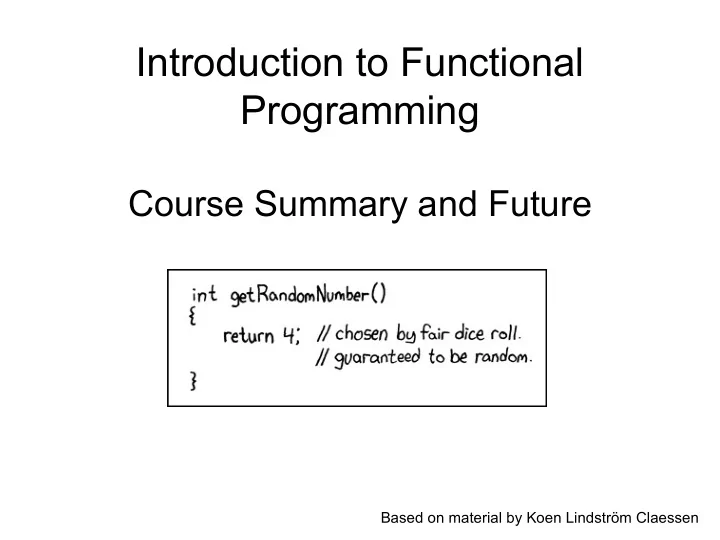
Introduction to Functional Programming

Course Summary and Future

slide-2
SLIDE 2

The End of the Course

  • Next week: Exam

– Example exams + answers on the web – No computers – In English: Bring an English dictionary

  • answers may be in swedish

– A list of standard Haskell functions

slide-3
SLIDE 3

What If ...

  • You are not done with the labs in time?

– Next year: this course runs again – Possibly changed labs

  • You do not pass the exam?

– January: re-exam – August: re-exam – Next year: this course runs again

slide-4
SLIDE 4

What Have We Learned?

  • Programming

– For some of you: first time – Make the computer do some useful tasks

  • Programming Language

– Haskell – Different from what most of you had seen before

  • Programming Principles

– ...

slide-5
SLIDE 5

Programming Principles (I)

  • Modelling

– Create a new type that models what you are dealing with – Design and define typed functions around your types – Sometimes your type has an extra invariant – Invariants should be documented (for example as a property)

slide-6
SLIDE 6

Programming Principles (II)

  • Properties

– When you define functions around your types... – Think about and define properties of these functions – Properties can be tested automatically to find mistakes – Mistakes can be in your functions (program)

  • r in your properties (understanding)
slide-7
SLIDE 7

Programming Principles (III)

  • Breaking up problems into simpler parts,

recursion

– When you need to solve a large, complicated problem... – Continue breaking up until the parts are simple,

  • r until you can use an existing solution

– The parts can be solved recursively – Solve the whole problem by combining the solutions of all parts

slide-8
SLIDE 8

Programming Principles (IV)

  • Abstraction and Generalization

– When you find yourself repeating a programming task – Take a step back and see if you can generalize – You can often define an abstraction (higher-

  • rder function) performing the old task and

the new one – Avoid copy-and-paste programming

slide-9
SLIDE 9

Programming Principles (V)

  • Pure functions

– Use pure functions as much as possible – These are easier to understand, specify and test – Concentrate IO instructions in a small part of your program

slide-10
SLIDE 10

Programming Principles (VI)

  • Separation

– Divide up your program into small units (functions) – These should be grouped together into larger units (modules) – Minimize dependencies between these parts – So that it is easy to make internal changes, without affecting your whole program

slide-11
SLIDE 11

Programming Principles

  • Important!
  • Independent of programming language
slide-12
SLIDE 12

Report from the front

“Läste kursen 2010 när jag började på D och lärde mig mycket, fast jag tyckte att jag kunde programmera innan. Fick 2012 jobb på Ericsson och programmerade då i Python, och använde då dagligen tekniker som jag lärde mig i kursen, framförallt då rekursion, operationer på listor och delar av det funktionella programmeringssättet som var nytt för mig 2010.”

slide-13
SLIDE 13

Report from the front

“En vanlig fråga/missuppfattning som jag minns från början av Chalmers är just 'varför Haskell? Ingen använder det på riktigt i industrin', och det kan vara värt att påminna en extra gång om att man lär sig metoder och tankesätt som är användbara oavsett vilket språk man sedan kodar i.”

slide-14
SLIDE 14

Why Haskell?

  • What is easy in Haskell:

– Defining types – Properties and testing – Recursion – Abstraction, higher-order functions – Pure functions – Separation (laziness)

slide-15
SLIDE 15

Why Haskell (II)?

  • What is harder in Haskell:

– Ignoring types

  • Static strong typing
  • Expressive type system

– Most advanced type system in a real-world language

– Impure functions

  • All functions are pure

– Unique among real-world languages

  • Instructions are created and composed explicitly

– Makes it clear where the ”impure stuff” happens

slide-16
SLIDE 16

Imperative programming:

  • Instructions are used to change the computer's

state: – x := x+1 – deleteFile(”slides.pdf”)

  • Run the program by following the instructions top-

down Functional programming:

  • Functions are used to declare dependencies

between data values: – y = f(x)

  • Dependencies drive evaluation

Two major paradigms

slide-17
SLIDE 17

Imperative programming:

  • Instructions are used to change the computer's

state: – x := x+1 – deleteFile(”slides.pdf”)

  • Run the program by following the instructions top-

down Functional programming:

  • Functions are used to declare dependencies

between data values: – y = f(x)

  • Dependencies drive evaluation

Two major paradigms

slide-18
SLIDE 18

Functional Programming

  • Functions are used to declare dependencies

between data values: – y = f(x)

  • Functions are the basic building blocks of

programs

  • Functions are used to compose functions into

larger functions

  • In a (pure) function, the result depends only on

the argument (no external communication)

slide-19
SLIDE 19

Functional Programming

  • “Drives” development of new programming

languages

– Type systems – Garbage collection – Higher-order functions / Lambdas – List comprehensions – ...

  • Haskell is the most advanced functional

programming language today

slide-20
SLIDE 20

Learning a Programming Language

  • Learn the new features, principles,

associated with the language

  • Reuse things you know from other

languages

  • Learn different languages

– what is popular now might not be popular in 5 years from now

  • Use the right language for the right job

– Systems consist of several languages

slide-21
SLIDE 21

Multi-core Revolution

  • Traditional ways of programming do not

work – a challenge for the programming language community

  • Right now, industry is looking for

alternatives

– Intel – Microsoft – IBM – ...

slide-22
SLIDE 22

Alternatives?

  • Expression-level parallelism

– Haskell – Other functional languages

  • Software Transactional Memory

– Haskell

  • Message passing between processes

– Erlang

restriction: control of side effects restriction: no shared memory restriction: no side effects

slide-23
SLIDE 23

This Course

  • Introduction to programming
  • Introduction to Haskell
  • There is lots, lots more...
slide-24
SLIDE 24

Coming Programming Courses

  • Grundläggande

datorteknik

– Assembler

  • Objektorienterad

programming

– Java

  • Inbyggda system

– C

  • Data structures

– Java – Haskell

D-line GU

  • Two programming

courses

– Both in Java

  • Datastructures

– Java – Haskell

slide-25
SLIDE 25

Future Programming Courses

  • Concurrent Programming
  • Compiler Construction
  • Advanced Functional Programming
  • Parallel Functional Programming
  • Software Engineering using Formal Methods
  • Language Technology
  • (Programming Paradigms)
  • ...

All use Functional Programming in some way

slide-26
SLIDE 26

Course evaluation

  • Please don't forget to fill in the course

evaluation!

  • This will help us improve the course in

coming years