international international c e n t e r c e n t e r for - - PowerPoint PPT Presentation

international international c e n t e r c e n t e r for
SMART_READER_LITE
LIVE PREVIEW

international international c e n t e r c e n t e r for - - PowerPoint PPT Presentation

international international c e n t e r c e n t e r for research for research on anarchism on anarchism CIRA, avenue de Beaumont 24, CH 1012 Lausanne, Switzerland (Bus 5 from train station, stop at Hpital CHUV)


slide-1
SLIDE 1

8 cira – beaumont 24 – ch-1012 lausanne – tel. + 4121 550 1804 – cira@plusloin.org – www.cira.ch

international c e n t e r for research

  • n anarchism

CIRA, avenue de Beaumont 24, CH – 1012 Lausanne, Switzerland (Bus 5 from train station, stop at Hôpital CHUV) cira@plusloin.org — www.cira.ch

  • tel. +4121 550 1804 during opening hours.

The CIRA library opens week days from 4 to 7 p.m., or by appoint-

  • ment. It is also a correspondence library: it lends books abroad,

sends xeroxes of documents or articles from newspapers and perio-

  • dicals. It gives information about holdings and current research. It

publishes an annual bulletin. The readers’ card entitles for the consulting and loaning of docu- ments (books, etc.) and for the bulletin. It costs 40 Swiss francs or the equivalent of 30 euros a year, payable through the postal account 12-17750-1, CIRA, Geneva, or by bank transfer (no cheques, please; banking details on request). Support subscription from 100 euros, or 150 Swiss francs Annual subscription for libraries and institutions: 10 francs. The library is usually closed in August.

March 2007

international c e n t e r for research

  • n anarchism
slide-2
SLIDE 2

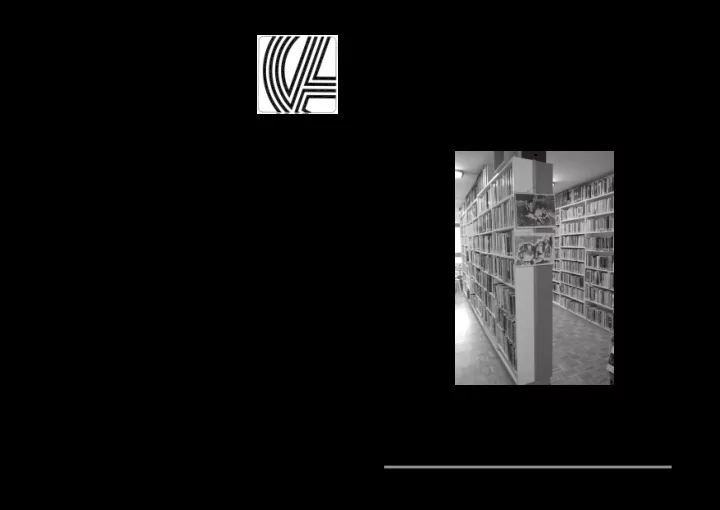
2 7 Welcome to the CIRA! The CIRA library (Centre international de rechereches sur l’anarchisme) collects, pre- serves and makes available a collection of books, periodicals and documents concern- ing the anarchist movement, its history, and its ideas. The CIRA is an association under articles 60 et seq. of the Swiss Civil Code. An international committee supervises its activ- ity and a local committee runs the center with a group of volunteers. The library is sit- uated in Lausanne, in a leafy setting near the hospital, with premises of 130 m2 spread

  • ver two floors.

The CIRA has non-profit status (there- fore it does not pay taxes nor inhereitance taxes) but does not receive any direct pub- lic funding nor support. Its running costs are covered by member’s fees (reader’s cards), by some donations, and by irregular financial help. There is no acquisitions budget: current periodicals are sent direct- ly from the editors; books and documents are given by the authors, the publishers,

  • rganizations and friends. It is one of the

few non-institutional centers which has such important holdings and which lends and sends books abroad. History The International Center for Research on Anarchism was founded in Geneva in 1957, with the idea of preserving and making available to readers a collection that was

  • ften kept in poor conditions in attics and

in private houses. The idea was born in 1956 at a meeting between an Italian conscientious objector, a French war resister, a Bulgarian refugee and an elderly Swiss anarchist, former activist at the Ligue d’Action du Bâtiment Geneva. At that time in Geneva there were three dormant collections of anarchist material. They constituted the basis of the CIRA

C. I. R. A.

Spain), that are available. The CIRA takes part in international conferences (such as Venice 1984, São Paulo 1992, Toulouse 1999, Paris 2000) and in local events (at the university, in an alternative cinema, etc.). Once or twice a year, the CIRA invites friends and supporters to a common meal and a book sale. For the last thirty years, the CIRA has done its best to network with other libraries and documentation centers, in particular with the FICEDL (International Federation

  • f Anarchist Research and Documentation

Centres), to support anarchist bookstores in Latin America or publishers in Russia, to encourage the constitution of archives and their use. It keeps good contacts with insti- tutes of social and labour history, like those in Amsterdam or in Paris. Next steps The library and the archives have been pro- fessionalised, whilst continuing to be run by (often qualified!) volunteers. Some ques- tions for the future:

  • how to keep and preserve old collections

and fragile mediums (newspaper, posters, audiovisual…), how to computerize them;

  • the referencing and stocking of digital

publications and contributions;

  • moving the catalogue to an open source

software, putting it on-line, standardizing of the databases;

  • collecting documents coming from differ-

ent social movements, from a less specific anarchism, archiving priorities;

  • the possibility of continuing to work as

volunteers, the committee renewal, etc. To move ahead, we need to cooperate with other centers and other projects, to find personal and financial solutions, to carefully examine the possibilities of a finan- cial or material bond with other institu-

  • tions. We welcome suggestions!
slide-3
SLIDE 3

6 3

C. I. R. A.

library: the whole collections of Le Réveil anarchiste (a magazine published in Geneva by Luigi Bertoni) from 1900 to 1947, mag- azines and publications that had been exchanged, as well as the Germinal Library coming from a former local anarchist group. The library grew with donations, bequests, exchanges and editorial donations. For six years, Pietro Ferrua ran the library in a rented room until he was deported from Switzerland, in connection with an anti-Francoist attack on the Spanish consulate in Geneva in February 1961. In 1964, the CIRA was transferred to Lausanne into a room of the family board- ing house in Beaumont kept by Marie- Christine Mikhaïlo. At this time Marie- Christine ran the library, along with her daughter Marianne Enckell. The CIRA returned to Geneva from 1975 to 1989 before coming back to its current address, into premises purpose-built with the help of friends and supporters. The catalogue, produced by activists without any library training until 1985, then becomes “professional”. It now uses a systematic index file (the diploma work of Anne Cassani) purpose built, listing the recurrent themes in books by anarchists or

  • n anarchism and specific time periods. The

catalogue is computerized in 1995 and the collection is now almost completely cata- logued. The origins of donations are not always known and archives often scattered. Some

  • f them, however, come from important

local acquisitions: about one hundred vol- umes of the former Maison du Peuple of Lausanne were purchased from the local library in 1963, which donated some others in 2006. Activists from the region or their families (Jacques Gross, Léon Berchtold, Henri Baud, Willy Widmann, Auguste Fornerod, Lucien Tronchet, Peter Fuchs, Gaston Gremaud) also donated books and

  • periodicals. A number of exchanges were

made with other anarchist documentation centers abroad or with other archives of the labour movement. However, many of the

  • lder books and documents are in such a

poor state that they only can be consulted in the library in Lausanne. Using CIRA The CIRA puts different tools at the users’ disposal:

  • a computerized catalogue : currently,

17,000 bibliographical entries of written, audio or video documents are available at the library; the list is on the website.

  • a periodicals catalogue (historic and cur-

rent), with detailed computerized descrip- tions (listed on the website)

  • partial inventories: iconography, posters,

printed archives, videos and DVDs, audio- cassettes and CDs, manuscripts.

  • files (individual, by theme and by country)

and partial card index of articles in maga- zines and periodicals.

  • specialized bibliographies (on people or

themes) upon request. The annual bulletin contains the list of new acquisitions and information on differ- ent resources. A photocopier is available. The audio and visual recordings, as well as the images, can be duplicated under certain conditions. Users buy a reading card (subscription), which currently costs 40 Swiss francs or 30Euros a year (there are about 150 users). The editors and authors of books or period- icals who send their publications to the CIRA receive information in exchange. For a long time, the CIRA received an average of 300 new titles, 300 visits, wrote 300 letters and lent 300 books yearly. With the arrival

  • f the internet, the on-line catalogue, email

and on-line publications, statistics are obvi-

  • usly harder to keep. The CIRA is well

indexed by internet search engines. Who comes to the CIRA University and high school students, researchers, journalists, activists, passers- by, etc. Daniel Guérin, Paul Avrich and many other historians have used the CIRA’s resources. Also friends who stop for a chat or a cup of tea, who organize a con- cert or a debate. And all those who work at the CIRA: trainees, people doing their “civilian service” (instead of going to the Army), passing students, punctual help cataloguing documents in Japanese or

  • Yiddish. And sometimes their friends or

their children. What does the CIRA do On top of the everyday services and the interminable cataloguing, the CIRA some- times publishes books or pamphlets (the first French translation

  • f

About Anarchism, by Nicolas Walter, Un siècle de chansons, Les anarchistes à l’écran/ Anarchists on Screen, the memoirs of André Bösiger and those of Swiss militiamen in the Spanish Revolution). It puts together exhibitions (antimilitarism, anarchist women, anti-authoritarian education,

slide-4
SLIDE 4

The CIRA collection consists of printed documents in over thirty languages. The best represented language is French (approx- imately 5000 titles), followed by Italian, Spanish, English and German; far behind come Swedish, Portuguese, Yiddish, Chinese, Russian, Esperanto, etc. – 16000 books and brochures Recent acquisitions come from publishers and authors. Many thanks to all of them! Amongst the older documents, a number of titles in English (Tom Keell Collection) were donated to the CIRA by his widow in

  • 1970. About the same time, a set of books

in Yiddish were given by the last editors of the magazine Freie Arbeiter Stimme (New York). Works in German or in Portuguese (Brazil), hidden during the periods of dicta- torship, were saved by activists and sent to the CIRA. In 1994, half of the collections of the library of the Asociación Isaac Puente (Vitoria, Spain) was donated to the CIRA, the other half to the Fundación Anselmo Lorenzo (Madrid). – 4000 periodicals, 200 of them still publishing Some of the collections are significant: the English newspaper Freedom, since its cre- ation in 1886; Le Réveil – Il Risveglio of Geneva (1900-1947); Le Libertaire (Paris) since its creation in 1895 and its metamor- phoses (Le Monde libertaire); L’Adunata dei Refrattari, published in Italian in the United States from 1922 to 1971 by “anti-

  • rganisationists”, as well as the main maga-

zines of the anarchist movement since

  • 1939. A series of newspapers published by

Pierre-Joseph Proudhon in 1848-1849 were found in France in the 1960s under the floor of a house that was being renovated; so saved, they were brought to the CIRA. Periodicals published during the Spanish revolution (1936-1939) are not many but they enclose several rarities. Some examples of the main magazines: La Revista blanca (Barcelona), Volontà (Milano), Défense de l’Homme (France), Anarchy (London), Die Internationale (Berlin-Amsterdam) as well as a few

  • reprints. There is also a beautiful collection

(put together by Solon Amoros) of the first newspapers and leaflets published by anar- 4 5

C. I. R. A.

chists in Spain in 1976-77, as well as countless mimeo- graphed bulletins and

  • ther fanzines in all

languages. – ephemera and archives The largest collection concerns Switzerland: documents related to Ernest Cœurderoy, Mikhail Bakunin, Luigi Bertoni, Carlo Frigerio, Lucien Tronchet, to the Groupe du Réveil and the Groupe Ravachol (Geneva), to youth movements since 1967, to squats and infoshops, among

  • thers.

Concerning France, we have an impor- tant collection about May 68, internal papers of organizations, numerous flyers and press cuttings about cities or events. Bulletins and documents concerning the Spanish movement in exile from 1939 to 1976, its constituents and splits fill a dozen boxes, as well as the archives of inter- national coordinations since 1945. The other collections are more disparate. Some important personal archives: E. Armand, Louis Mercier, Higinio Noja Ruiz, as well as photocopies of all the articles pub- lished by Peter Kropotkin, interviews by Claire Auzias in Lyon, documents of the Living Theatre from its origins to 1985, and last but not least, CIRA’s own archives (50 years of correspondence). Other collections:

  • VHS and DVD recordings, films, docu-

mentaries, interviews, etc. A database was put together and currently consists of 1500 films where anarchists or allusions to anar- chism are shown; it is accessible on-line, as well as partly printed (Les anarchistes à l’écran, Anarchists on Screen, 1901-2003, CIRA bulletin 60, 2004). The CIRA owns 450 of these recordings, of variable quality, mostly due to the collaboration with Eric Jarry and David Doillon and to donations from directors.

  • some 200 audio recordings (cassette

and CD), as well as lyrics and scores of songs (the most well known of them were published in a booklet: Un siècle de chansons / A Century of Songs, CIRA bulletin 52, 1996).

  • an iconographic collection (postcards,

pictures, various illustrations) and 2000 posters, described in a database and partial- ly computerized (about fifty original posters from the Spanish Revolution), as well as some original prints (Félix Vallotton, Enrico Baj, Flavio Constantini, David Orange).