Intelligent Agents Sven Koenig, USC Russell and Norvig, 3 rd - - PDF document

intelligent agents
SMART_READER_LITE
LIVE PREVIEW

Intelligent Agents Sven Koenig, USC Russell and Norvig, 3 rd - - PDF document

12/18/2019 Intelligent Agents Sven Koenig, USC Russell and Norvig, 3 rd Edition, Chapters 1 and 2 Note: Different AI researchers have different opinions what AI is all about. These slides are new and can contain mistakes and typos. Please


slide-1
SLIDE 1

12/18/2019 1

Intelligent Agents

Sven Koenig, USC

Russell and Norvig, 3rd Edition, Chapters 1 and 2 Note: Different AI researchers have different opinions what AI is all about. These slides are new and can contain mistakes and typos. Please report them to Sven (skoenig@usc.edu).

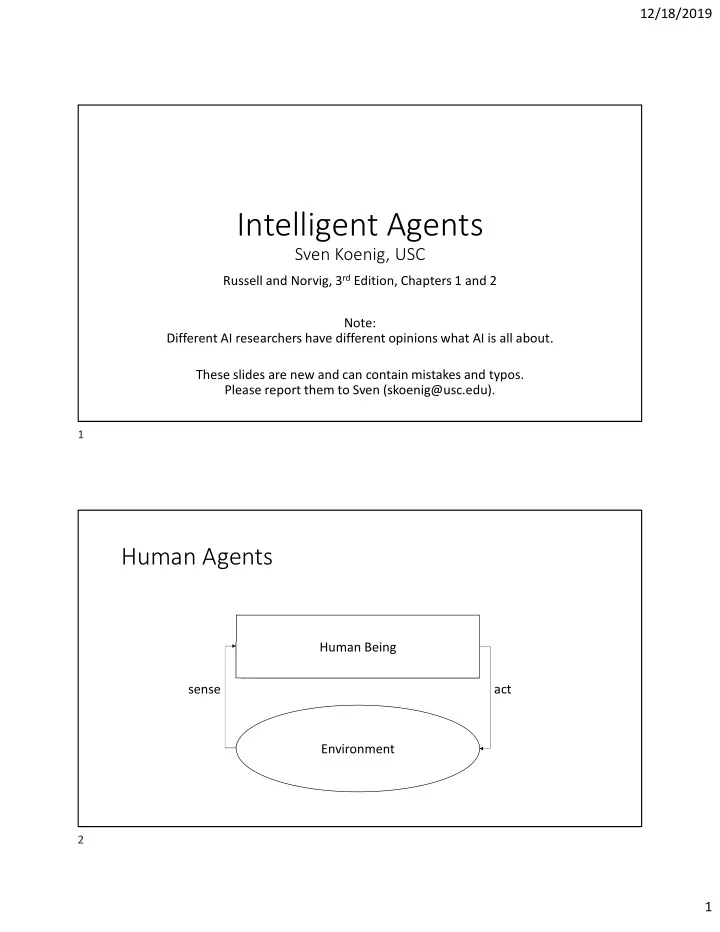
Human Agents

Human Being Environment act sense

1 2

slide-2
SLIDE 2

12/18/2019 2

“Cognitive Science” Approach

Human Being Environment act sense

  • understand
  • replicate

Lots of exciting research going on at USC – but not the topic of this class.

“Cognitive Science” Approach

I would like to fly!

3 4

slide-3
SLIDE 3

12/18/2019 3

“Cognitive Science” Approach

  • Ornithopters: to flap or not to flap?

neilisthekingoftheworld.tumblr.com Harvard University www.blokeish.com 20 seconds, 2010

“Engineering” Approach (Intelligent Systems)

Software System = Agent Environment act sense Lots of exciting research going on at USC – and the topic of this class.

5 6

slide-4
SLIDE 4

12/18/2019 4

“Engineering” Approach (Intelligent Systems)

Wikipedia Der Spiegel

 Deep Blue: 200,000,000 positions/second

Turing Test

 Alan Turing “Computing Machinery and Intelligence” (1950) 7 8

slide-5
SLIDE 5

12/18/2019 5

Chat(ter)bots

This was in 2014.

Loebner Competition (Turing Test)

  • 2017

9 10

slide-6
SLIDE 6

12/18/2019 6

Chat(ter)bots Turing Test

I would like to walk on the Moon!

Year 1 Year 2 Year 3

11 12

slide-7
SLIDE 7

12/18/2019 7

Turing Test

  • Problems
  • Tendency to make systems dumber to resemble humans.
  • Incremental progress might fool some judges but

might eventually not result in truly intelligent systems. I would like to walk on the Moon!

Year 1 Year 2 Year 3

Movies

13 14

slide-8
SLIDE 8

12/18/2019 8

Winograd Schema Challenge

  • The trophy would not fit in the brown suitcase because it was too big.

What was too big?

  • The trophy would not fit in the brown suitcase because it was

too small. What was too small?

“Making Rational Decisions”

Software System = Agent Environment Performance Measure act sense Could be as simple as a thermostat or as complex as a robot

15 16

slide-9
SLIDE 9

12/18/2019 9

A different view: What is AI?

Systems that think like humans Systems that think rationally Systems that act like humans Systems that act rationally

A different view: What is AI?

Cognitive Systems Turing Test Making Rational Decisions

17 18

slide-10
SLIDE 10

12/18/2019 10

Overview of Class

Sensors Sensor interpretation Effector control Effectors Percepts Actions

?

Speech recognition Handwriting recognition Gesture recognition Language interpretation Robotics Vision Emphasis of this class Emphasis of other classes

Overview of Class

  • We will learn about lots of individual AI techniques that are helpful

for constructing agents but will not integrate them into agents.

  • Thus, this class is mostly a theoretical class (a la “differential

equations” for building spaceships).

19 20

slide-11
SLIDE 11

12/18/2019 11

Overview of Class

  • The “core” toolbox of AI
  • Knowledge representation and reasoning
  • Machine learning
  • Search and planning

Beyond the Class

  • Other disciplines that have studied rational decision making
  • Operations research
  • Decision and utility theory
  • Economics
  • Control theory
  • Statistics
  • Theoretical computer science

21 22

slide-12
SLIDE 12

12/18/2019 12

Beyond the Class

  • Decision theory
  • 16.1. Combining Beliefs and Desires under Uncertainty ... 610
  • 16.2. The Basis of Utility Theory ... 611

16.2.1. Constraints on rational preferences ... 612 16.2.2. Preferences lead to utility ... 613

  • 16.3. Utility Functions ... 615

16.3.1. Utility assessment and utility scales ... 615 16.3.2. The utility of money ... 616 16.3.3. Expected utility and post-decision disappointment ... 618 16.3.4. Human judgment and irrationality ... 619

  • 16.4. Multiattribute Utility Functions ... 622

16.4.1. Dominance ... 622 16.4.2. Preference structure and multiattribute utility ... 624

  • 16.5. Decision Networks ... 626

16.5.1. Representing a decision problem with a decision network ... 626 16.5.2. Evaluating decision networks ... 628

Beyond the Class

  • Economics
  • 17.5. Decisions with Multiple Agents: Game Theory ... 666

17.5.1. Single-move games ... 667 17.5.2. Repeated games ... 673 17.5.3. Sequential games ... 674

  • 17.6. Mechanism Design ... 679

17.6.1. Auctions ... 679 17.6.2. Common goods ... 683

23 24
slide-13
SLIDE 13

12/18/2019 13

Beyond the Class

  • Operations Research
  • 17.1. Sequential Decision Problems ... 645

17.1.1. Utilities over time ... 648 17.1.2. Optimal policies and the utilities of states ... 650

  • 17.2. Value Iteration ... 652

17.2.1. The Bellman equation for utilities ... 652 17.2.2. The value iteration algorithm ... 652 17.2.3. Convergence of value iteration ... 654

  • 17.3. Policy Iteration ... 656
  • 17.4. Partially Observable MDPs ... 658

17.4.1. Definition of POMDPs ... 658 17.4.2. Value iteration for POMDPs ... 660 17.4.3. Online agents for POMDPs ... 664

25