INTELECT Incentives and actual cost calculations for electric - - PowerPoint PPT Presentation

intelect
SMART_READER_LITE
LIVE PREVIEW

INTELECT Incentives and actual cost calculations for electric - - PowerPoint PPT Presentation

INTELECT Incentives and actual cost calculations for electric transport in the Nordic countries Jn Bjrn Sklason General Manager Icelandic New Energy Coordinator INTELECT Electric Transport - NER Oslo, April 1 st INTELECT -partners


slide-1
SLIDE 1

INTELECT

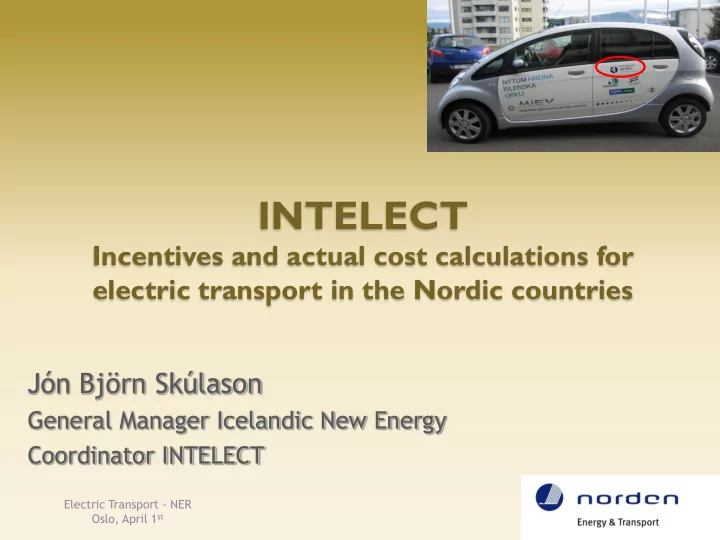
Incentives and actual cost calculations for electric transport in the Nordic countries Jón Björn Skúlason

General Manager Icelandic New Energy Coordinator INTELECT

Electric Transport - NER Oslo, April 1st
slide-2
SLIDE 2

INTELECT

  • partners

 Partners from all the Nordic region:  Icelandic New Energy (IS) – coordinator  VTT (FI)  Nukissiorfiit (GL)  Dansk Energi (DK)  AF-Industry AB (SE)  Elfelagid SEV (FO)  Grönn Bil (NO)  Orkusetur (Energy Agency Iceland) (IS)

Salomon fishing using an FCEV

slide-3
SLIDE 3

Problem description

  • All of the Nordic countries have taken steps towards increasing the

use of environmentally friendly transport

  • As part of their policy different incentives have been put in place
  • They are different on country and city level
  • They are fisical and non-fisical
  • Some have worked well others not as well
  • Different regulations also exist
  • Barriers
  • Certification
  • Homologation
  • Fuels
slide-4
SLIDE 4

INTELECT objective

  • Map available incentives in all of the Nordic countries, including
  • Governmental incentives
  • Financial, tax, etc
  • Municipal incentives
  • Each country will map available incentives in the 3 largest municipalities (Faroe Island

and Greenland are different as only the capital areas will be used)

  • A matrix will be made showing all the different incentives for

different fuels/technological solutions

  • Including a brief description of which have been successful and which not

Environmentally friendly?

slide-5
SLIDE 5

INTELECT objective

  • It can be difficult for the public and private players to understand

what the incentives mean – financially

  • The project will therefore create a calculator which an calculate

the different benefits – including TOC (total cost of ownership)

  • Example of such calculators exist for Norway and Iceland (see www.gronnbil.no

and www.orkusetur.is

  • Will be made for all the Nordic countries
  • Will be in all the nordic languages – currencies and fuel price
  • It will have two layers
  • Layer 1 – User friendly and will give the user a simple picture to compare the

cost of an envrionmentally friendly vehicles and conventional

  • Layer 2 – A more comprehensive with more parameters and exact conclusion.

Mainly aimed for the final decisions support.

slide-6
SLIDE 6

INTELECT objective

  • Regulatory barriers
  • The INTELECT project will map if there are any regulatory barriers

to the introduction of environmentally friendly fuels – focusing on ZEV and if any regulations prevent or delay the early introduction

  • f such vehicles
  • Including
  • Homologation – certification
  • Fuels
  • Other

iMIEV at fuel source

slide-7
SLIDE 7

INTELECT objective

  • Dissemination
  • The matrix will be made available electronically to all partners

and all other key players along with NER

  • The same applies to the calculator
  • Both can support decision makers
  • Provides a tool which can be used by many different actors –

specifically early adopters

  • Will identify if there are any regulatory barriers
  • Will support cross boarder discussions and policy fomulation
slide-8
SLIDE 8

Timeframe and budget

  • The INTELECT project is a 12 month project – kick off was

February 24th 2011

  • The total budget of the project is 1,3MNOK
  • Conclusions will all be made public and should be available from

early 2012

  • Work has already started

THINK arrives in Iceland

slide-9
SLIDE 9

Example Vehicle taxation in Iceland

 Fossil fuel vehicles

  • Total change in 2011,
  • Taxes were based on engine size and weight
  • Now only on CO2 . Vehicles carry 0-60% CO2 tax + VAT

.

  • Vehicle with less than 80g/CO2/km 0% and then roughly 5% per 20g/CO2/km increase.

 Alternative vehicles

  • Methane: Taxes same as for fossil fuels – NOK 50.000 as a subsidy
  • Battery: Carry only VAT

 It should though be mentioned that the parliament has recommended that VAT should be temporarily revoked

  • Hydrogen: No taxes (no VAT)

 Eco-Energy (Græna Orkan)

  • Platform for public private partnership
  • Established by the Minister of Industry – in partnerships with other Ministries
  • Should propose and recommend actions from the government and policy
slide-10
SLIDE 10

EcoEnergy has asked for increased incentives

  • Number of new incentives have been suggested and are currently being

evaluated

  • No

VAT on vehicles with zero emission vehicles (ZEV)

  • Annual tax on ZEV to be 0 (zero)
  • Public transport should get special incentives if alternative vehicles are used
  • Increased incentives if vehicles are converted to use environmentally friendly

fuels

  • Reduced taxation on companies if they use alternative vehicles
  • Environmentally friendly fuels should not carry taxation like gasoline/diesel
  • Use of bus lanes for ZEV
  • Special free parking spaces
  • No fee on toll roads
  • Etc.
slide-11
SLIDE 11

Examples: Vehicle taxes in Nordic countries

SWEDEN

  • Fossil fuel vehicles carry 25% VAT
  • Hydrogen and battery vehicles carry 25% VAT but get a € 5.000 subsidy if <50gCO2/10km
  • Annual road tax: fossil fuels €200-400; hydrogen; € 0 (first 5 years if<37kWh/100km
  • Additional €5.000 subsidy possible in early tender programs
  • NORWAY
  • Fossil fuel vehicles carry 25% VAT and 50-100% import duty
  • Hydrogen/battery vehicles carry 0% VAT and 0% import duty
  • Annual road tax: fossil fuels 350 €; hydrogen; 350€
  • ICELAND
  • Fossil fuel vehicles carry 25% VAT and 0-60% import duty (depending on emission)
  • Hydrogen vehicles carry 0% VAT and 0% import duty (BEV carry VAT)
  • Annual road tax: fossil fuels € ~133; H2/battery; € ~33
  • DENMARK
  • Fossil fuel vehicles carry 25% VAT and up to 180% import duty (depending on emission)
  • Hydrogen/battery vehicles carry 25% VAT and 0% import duty
  • Annual road tax: fossil fuels € ~70-2.000 (CO2 emission); hydrogen; € 0

ZEV vehicles also carry other advantages like free parking, special parking spaces, driving on bus lanes etc.

slide-12
SLIDE 12

Taxes are a unique opportunity

  • The Nordic region is known for very high taxes on vehicles and fuel
  • This gives the region a special opportunity to install relatively

powerful incentives for early adoption of low emission vehicles

  • If there are f.ex. no taxes on ZEV they are already commercial in

the Nordic countries though they would cost 2x the price of conventional vehicles

  • Such early adoption in Nordic countries would also be powerful as

large portion of electric production is already renewable in the region

slide-13
SLIDE 13

Nordic cooperation

  • Already a strong cooperation in this field exist in the Nordic region
  • Joint approach from the region strengthens all players
  • Simular Nordic incentives would make stakeholders approach to

OEM´s and other technical providers more direct and fruitful

  • The stakeholders in hydrogen

(electric vehicles) have already made important progress

FCEV – plug in Dream car of the Nordic countries?

slide-14
SLIDE 14

Example of Nordic cooperation

Key players in the Nordic countries signed an MoU, Jan 31st 2011, with Hyundai for deployment of FCEV in the Nordic countries in 2011-2015

slide-15
SLIDE 15

One thing needs future attention: public confusion

 Public is very confused regarding different alternative vehicles

 Public seems to be waiting for one solution, what will come instead of gasoline  The future will probably have many different alternatives

 Even in different locations – depending on local resources

 Terminology of different technologies (confusing)

  • Battery
  • Hybrid / Plug-in hybrid
  • Methane (possibly plug-in in the future)
  • Hydrogen (possibly plug-in in the future)
  • More.......

 Most people want electric mobility

  • Expectations are very high
  • Druing the battery hype, last few years, statements have been made about simplicity of fast

refuelling, 10-20 min, range similar to fossil fuel vehicles or at least 400 km

  • Will this affect the marketing of the first battery generation vehicles?
  • 8 hour refuelling / 150 km range

Icelandic New Energy 15

slide-16
SLIDE 16

Iceland today

& also for future generations