Inpatient Hospital Services Billing, Denials and Reimbursement: - - PowerPoint PPT Presentation

inpatient hospital services billing denials and
SMART_READER_LITE
LIVE PREVIEW

Inpatient Hospital Services Billing, Denials and Reimbursement: - - PowerPoint PPT Presentation

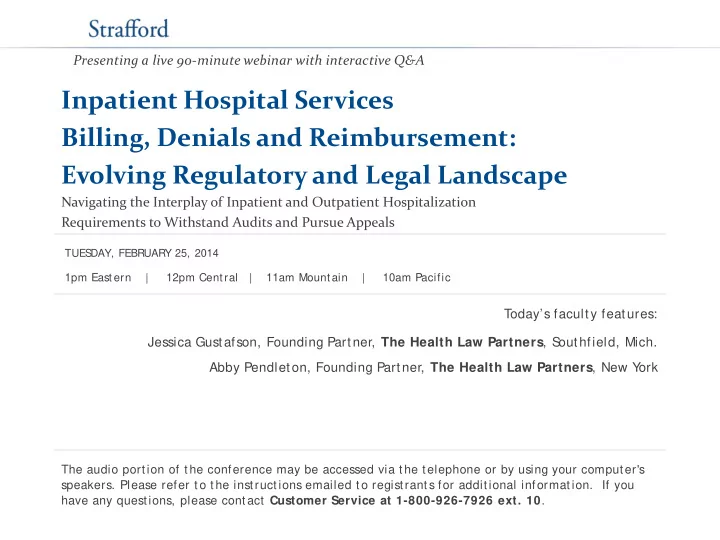
Presenting a live 90-minute webinar with interactive Q&A Inpatient Hospital Services Billing, Denials and Reimbursement: Evolving Regulatory and Legal Landscape Navigating the Interplay of Inpatient and Outpatient Hospitalization


slide-1
SLIDE 1

Inpatient Hospital Services Billing, Denials and Reimbursement: Evolving Regulatory and Legal Landscape

Navigating the Interplay of Inpatient and Outpatient Hospitalization Requirements to Withstand Audits and Pursue Appeals

Today’s faculty features:

1pm East ern | 12pm Cent ral | 11am Mount ain | 10am Pacific

The audio portion of the conference may be accessed via the telephone or by using your computer's

  • speakers. Please refer to the instructions emailed to registrants for additional information. If you

have any questions, please contact Customer Service at 1-800-926-7926 ext. 10.

TUES DAY, FEBRUARY 25, 2014

Presenting a live 90-minute webinar with interactive Q&A

Jessica Gustafson, Founding Partner, The Health Law Partners, S

  • uthfield, Mich.

Abby Pendleton, Founding Partner, The Health Law Partners, New Y

  • rk
slide-2
SLIDE 2

Tips for Optimal Quality

S

  • und Qualit y

If you are listening via your computer speakers, please note that the quality

  • f your sound will vary depending on the speed and quality of your internet

connection. If the sound quality is not satisfactory, you may listen via the phone: dial 1-888-601-3873 and enter your PIN when prompted. Otherwise, please send us a chat or e-mail sound@ straffordpub.com immediately so we can address the problem. If you dialed in and have any difficulties during the call, press *0 for assistance. Viewing Qualit y To maximize your screen, press the F11 key on your keyboard. To exit full screen, press the F11 key again.

FOR LIVE EVENT ONLY

slide-3
SLIDE 3

Continuing Education Credits

For CLE purposes, please let us know how many people are listening at your location by completing each of the following steps:

  • In the chat box, type (1) your company name and (2) the number of

attendees at your location

  • Click the word balloon button to send

FOR LIVE EVENT ONLY

slide-4
SLIDE 4

I npatient Hospital Services

Billing, Denials and Reim bursem ent

Abby Pendleton, Esq. Jessica L. Gustafson, Esq. The Health Law Partners, P.C.

www.thehlp.com Contact: (248) 996-8510 / (516) 492-3390 apendleton@thehlp.com jgustafson@thehlp.com

4

slide-5
SLIDE 5

2014 IPPS Final Rule

  • CMS published its 2014 Inpatient Prospective

Payment System (“IPPS”) Final Rule (the “Final Rule”) on August 2, 2013.

– Final Rule was codified in the Federal Register on August 19, 2013, available at 78 Fed. Reg. 50496. – Effective Date: October 1, 2013.

  • There has been no delay in the effective date of the

Final Rule.

5

slide-6
SLIDE 6

Probe and Educate

http://cms.gov/Research-Statistics-Data-and-Systems/Monitoring-Programs/Medical- Review/InpatientHospitalReviews.html

  • To evaluate hospitals’ compliance with the 2014 IPPS Final

Rule, the Probe and Educate medical review program has been extended through 9/30/2014.

  • For inpatient admissions between 10/1/2013 and 9/30/2014:

– CMS will direct the Medicare review contractors to apply the 2-midnight presumption – i.e., contractors should not select Medicare Part A IP claims for review if the IP stay spanned 2 midnights from the time of formal admission for the purposes of determining whether IP status was appropriate.

6

slide-7
SLIDE 7

Probe and Educate

  • MACs may still review Part A IP claims crossing 2 midnights following the formal admission

for purposes unrelated to patient status: – (1) To ensure the services provided were medically necessary; – (2) To ensure that the hospitalization was medically necessary; – (3) To validate provider coding and documentation; – (4) When a CERT Contractor is directed to review such claims; – (5) If directed by CMS or other entity to review such claims. Per the Final Rule at p. 50951: “We note that it was not our intent to suggest that a 2-midnight stay was presumptive evidence that the stay at the hospital was necessary; rather, only that if the stay was necessary, it was appropriately provided as an inpatient stay… [S]ome medical review is always necessary…”

  • Claims with evidence of systemic gaming, abuse or delays in the provision of care in an

attempt to surpass the 2 midnight presumption could warrant medical review at any time. See CR 8508, Transmittal 1315, 11/15/2013.

7

slide-8
SLIDE 8

Probe and Educate

  • For inpatient admissions between 10/1/2013

and 9/30/2013:

– “Generally,” CMS will not allow MACs, recovery auditors, and SMRCs to conduct post-payment reviews of IP admissions for the purposes of determining whether IP status was medically necessary.

  • However, MACs, recovery auditors and SMRCs may

continue other types of IP hospital review during this time period.

8

slide-9
SLIDE 9

Probe and Educate

  • For inpatient admissions between 10/1/2013

and 9/30/2014:

– CMS will conduct pre-payment reviews of a probe sample of hospital’s IP claims spanning less than 2 midnights, to determine hospitals’ compliance with the IP regulations and provide feedback to CMS for purposes of jointly developing further education and guidance.

9

slide-10
SLIDE 10

Probe and Educate

  • During the Probe and Educate medical review

program, for inpatient admissions between 10/1/2013 and 9/30/2014, MACs will assess the hospital’s compliance with 3 things:

– The admission order requirements, – The certification requirements, and – The 2 midnight benchmark.

10

slide-11
SLIDE 11

Probe and Educate

11

slide-12
SLIDE 12

Recent Updates: Recovery Audit Activity

  • On February 18, 2014, CMS announced a

pause in recovery audit activities.

  • Important dates:

– February 21 – last day a Recovery Auditor may send a post-payment ADR – February 28 – last day a MAC may send prepayment ADRs for the Recovery Auditor Prepayment Review Demonstration – June 1 – last day a Recovery Auditor may send denied claims to the MAC for adjustment

12

slide-13
SLIDE 13

Recent Updates: Recovery Audit Activity

  • CMS has announced 5 changes to the Recovery Audit

program effective with next contract awards:

– (1) Recovery Auditors will be required to wait 30 days following review results before sending claims to the MAC for adjustment (to allow time for discussion period); – (2) Recovery Auditors will be required to confirm receipt of a discussion request within 3 days; – (3) Recovery Auditors will not receive their contingency fee payment until the denial is upheld at the reconsideration level

  • f appeal;

– (4) CMS will establish revised ADR limits for different claim types (inpatient, outpatient); and – (5) CMS will require Recovery Auditors to adjust ADR limits in accordance with a hospital’s denial rate.

13

slide-14
SLIDE 14

2014 IPPS Final Rule

  • Increased documentation requirements:

– Physician orders and certifications – Establishing medical necessity: 2-midnight rule

  • Medical review policies

– 2-midnight presumption – 2-midnight benchmark

14

slide-15
SLIDE 15

Orders and Certifications

Orders

  • Condition of Payment
  • 42 C.F.R. § 412.3
  • Must be made at or before the time of

inpatient admission.

  • Must specify admission for inpatient services.

– Should include the word “inpatient”

  • See January 30, 2014 sub-regulatory guidance
  • May be made verbally or in writing.

15

slide-16
SLIDE 16

Orders and Certifications

Orders

  • Inpatient admission orders must be made by a

physician or other practitioner who is:

– (a) licensed by the State to admit inpatients to hospitals; – (b) granted privileges by the hospital to admit inpatients to that specific facility; – (c) knowledgeable about the patient’s hospital course, medical plan of care, and current condition at the time of admission.

16

slide-17
SLIDE 17

Orders and Certifications

Orders – Special Circumstances

  • Residents and non-physician practitioners (NP, PA)

authorized by State law and under hospital by-laws or policies to make initial admission decisions

– An ordering practitioner may allow a resident or non- physician practitioner to write inpatient admission orders

  • n his or her behalf, if the ordering practitioner approves

and accepts responsibility for the admission decision by counter-signing the order prior to discharge.

  • If the physician or other practitioner responsible for

countersigning an initial order or verbal order does not agree that IP admission was appropriate or valid, he or she should not countersign the order, and the beneficiary is not considered to be an inpatient.

17

slide-18
SLIDE 18

Orders and Certifications

Orders – Special Circumstances

  • Verbal orders

– Practitioners lacking the authority to admit patients under either State law or hospital bylaws (e.g., RNs) may document the inpatient admission order under certain conditions:

  • An admission order (including verbal order) may be documented by an

individual who does not possess qualifications to admit patients following a discussion with and at the direction of the ordering practitioner;

  • The documentation of the order (transcription) must be in accordance

with State law, including scope of practice laws, hospital policies, and medical staff bylaws, rules and regulations;

  • The staff receiving the verbal order must document the verbal order in

the record at the time it is received;

  • The order must identify the qualified “admitting practitioner”; and
  • The order must be authenticated (countersigned) by the ordering

practitioner promptly and prior to discharge.

18

slide-19
SLIDE 19

Orders and Certifications

Orders – Special Circumstances

  • Standing orders and protocols

–The inpatient admission order cannot be a standing order.

19

slide-20
SLIDE 20

Orders and Certifications

Orders

  • Who has the requisite “knowledge” to admit a patient to inpatient status?

– Must have direct involvement in the care of the patient:

  • The admitting physician of record, or a physician on call for him or her;
  • Primary or covering hospitalists caring for the patient in the hospital;
  • The beneficiary’s primary care practitioner or a physician on call for him or her;
  • A surgeon responsible for a major surgical procedure on the beneficiary, or a surgeon on

call for him or her;

  • Emergency or clinic practitioners caring for the beneficiary at the point of inpatient

admission; and

  • Other practitioners qualified to admit inpatients and actively treating the beneficiary at

the point of inpatient admission.

– UR committee physician may sign the required certification, but does not have direct responsibility for the care of the patient and therefore is not considered to be sufficiently knowledgeable to order the IP admission.

20

slide-21
SLIDE 21

Orders and Certifications

Orders

  • The ordering practitioner may be, but is not

required to be, the physician who signs the certification.

21

slide-22
SLIDE 22

Orders and Certifications

Certifications

  • Condition of payment
  • 42 C.F.R. § 424.13
  • The Final Rule creates a requirement that

physicians complete certifications of the medical necessity of IP admissions for all IP admissions.

– Requirement for certification is not limited to longer hospital stays and outlier cases.

22

slide-23
SLIDE 23

Orders and Certifications

Certifications

  • Required elements:

– Order to IP status (or authentication of order); – The reasons for either the hospitalization (i.e., the diagnosis) or special or unusual services for cost

  • utlier cases;

– The estimated time the patient will need to remain in the hospital; – Plans for post-hospital care; and – CAHs: For inpatient CAH services, the physician must certify the beneficiary may reasonably be expected to be discharged or transferred to a hospital within 96 hours after admission to the CAH.

23

slide-24
SLIDE 24

Orders and Certifications

Certifications

  • The certification must be completed, signed,

and documented in the medical record prior to a patient’s discharge.

24

slide-25
SLIDE 25

Orders and Certifications

Certifications

  • Certification statements may only be signed by:

– (1) A physician who is a MD or DO; or – (2) A dentist in circumstances specified in 42 C.F.R. 424.13(d); or – (3) A doctor of podiatric medicine if his or her certification is consistent with the functions he or she is authorized to perform under state law.

  • Certification statements may only be signed by:

– The physician responsible for the case, or – Another physician who has knowledge of the case and who is authorized to do so by the responsible physician or by the hospital’s medical staff.

  • UR Committee physician is permitted to complete the certification statements.
  • The physician completing the certification statements is not required to have

admitting privileges at the hospital (e.g., ED physician qualifies).

25

slide-26
SLIDE 26

Orders and Certifications

Certifications

  • No specific forms are required for certification

and recertification statements.

  • The provider may adopt any method that permits

verification.

– Certification statements may be made on forms, notes or records that the appropriate individual signs or on a special separate form. – Except as provided for delayed certifications, there must be a separate signed statement for each certification or recertification.

26

slide-27
SLIDE 27

Orders and Certifications

Orders and Certifications

  • Although admission orders and certification

statements are required conditions of payment, no presumptive weight will be given to physician orders and certifications.

– Orders and certifications must be supported by the admission notes and progress notes.

27

slide-28
SLIDE 28

Establishing Medical Necessity

2-Midnight Rule

  • 42 C.F.R. § 412.3 (e)

– When a patient enters a hospital for a surgical procedure not specified by Medicare as IP only, a diagnostic test, or any other treatment, and the physician expects to keep the patient in the hospital for only a limited period of time that does not cross 2 midnights, the services are generally inappropriate for inpatient admission and inpatient payment under Medicare Part A. – Surgical procedures, diagnostic tests, and other treatment are generally appropriate for IP admission and IP hospital payment under Medicare Part A when the physician expects to the patient to require a stay that crosses at least 2 midnights.

28

slide-29
SLIDE 29

Establishing Medical Necessity: Medical Review

2-Midnight Presumption

  • Under the 2-midnight presumption, IP claims

with lengths of stay greater than 2 midnights after the formal admission following the order will be presumed generally appropriate for Part A payment and will not be the focus of medical review efforts absence evidence of systemic gaming, abuse or delays in the provision of care in an attempt to qualify for the 2-midnight presumption.

29

slide-30
SLIDE 30

Establishing Medical Necessity: Medical Review

2-Midnight Presumption

  • Inpatient hospital claims satisfying the 2-midnight presumption will

still be assessed by medical review contractors in the following circumstances:

– (1) To ensure the services provided were medically necessary; – (2) To ensure that the hospitalization was medically necessary; – (3) To validate provider coding and documentation; – (4) When a CERT Contractor is directed to review such claims; – (5) If directed by CMS or other entity to review such claims.

  • Per the Final Rule at p. 50951: “We note that it was not our intent to

suggest that a 2-midnight stay was presumptive evidence that the stay at the hospital was necessary; rather, only that if the stay was necessary, it was appropriately provided as an inpatient stay… [S]ome medical review is always necessary…”

30

slide-31
SLIDE 31

Establishing Medical Necessity: Medical Review

2-Midnight Benchmark

  • If a hospital stay does not cross 2 midnights

after the order is written, CMS and its contractors will not presume that the inpatient status was reasonable and necessary for payment purposes, but may instead evaluate the claim pursuant to the 2-midnight benchmark.

31

slide-32
SLIDE 32

Establishing Medical Necessity: Medical Review

2-Midnight Benchmark

  • Applying the 2-midnight benchmark, medical review contractors will

evaluate the following: – (a) the physician order and certification; – (b) the medical documentation supporting the expectation that care would span at least 2 midnights; and – (c) the medical documentation supporting a decision that it was reasonable and necessary to keep the patient at the hospital to receive such care.

  • The ordering physician may consider the time a beneficiary spent

receiving outpatient services (including observation services, treatment in the ED and outpatient procedures) when determining whether the 2-midnight benchmark will be met.

32

slide-33
SLIDE 33

Establishing Medical Necessity: Medical Review

2-Midnight Benchmark

  • Pursuant to the Final Rule at p. 50952:

– Medical reviewers will still consider the fact that the beneficiary was in the hospital for greater than 2 midnights following the onset of care when making the determination of whether the inpatient stay was reasonable and necessary. For those admissions in which the basis for the physician expectation of care surpassing 2 midnights is reasonable and well- documented, reviewers may apply the 2-midnight benchmark to incorporate all time receiving care in the hospital.

33

slide-34
SLIDE 34

Implications for Auditor Behavior

  • Generally speaking, IP stays spanning 0-1

midnight following formal IP admission will be the focus of review for patient status.

– Order – Certification – Benchmark

  • When does the benchmark begin?
  • Delays in the provision of care?
  • Evidence of gaming?

34

slide-35
SLIDE 35

Implications for Auditor Behavior

  • Cases where IP stays lasting less than 2 midnights

are generally appropriate for Part A payment:

– If an unforeseen circumstance results in a shorter beneficiary stay than the physician’s reasonable expectation of at least 2 midnights. Examples:

  • Death
  • Transfer to another hospital
  • Departure AMA
  • Clinical improvement

– Importance of documentation

35

slide-36
SLIDE 36

Implications for Auditor Behavior

  • Cases where IP stays may be appropriate with

an expected stay of less than 2 midnights:

– IP only list; – Newly initiated mechanical ventilation (excluding anticipated intubations related to minor surgical procedures or other treatment); – “CMS will work with the hospital industry and with MACs to determine if there are any categories of patients that should be added.”

  • NOT Telemetry, NOT Admissions to ICU

36

slide-37
SLIDE 37

QUESTI ONS?

Abby Pendleton, Esq. Jessica L. Gustafson, Esq. The Health Law Partners, P.C. www.thehlp.com Contact: (248) 996-8510 / (516) 492-3390 apendleton@thehlp.com jgustafson@thehlp.com

37