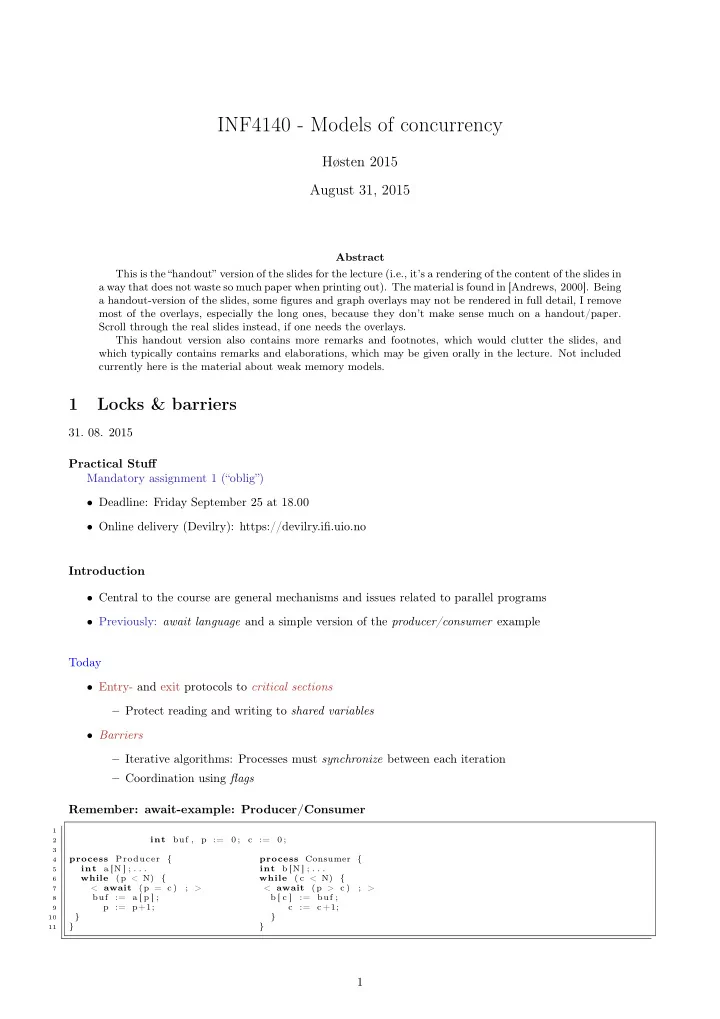
INF4140 - Models of concurrency Hsten 2015 August 31, 2015 - - PDF document

inf4140 models of concurrency
SMART_READER_LITE
LIVE PREVIEW

INF4140 - Models of concurrency Hsten 2015 August 31, 2015 - - PDF document

INF4140 - Models of concurrency Hsten 2015 August 31, 2015 Abstract This is the handout version of the slides for the lecture (i.e., its a rendering of the content of the slides in a way that does not waste so much paper when


slide-1
SLIDE 1

INF4140 - Models of concurrency

Høsten 2015 August 31, 2015

Abstract This is the “handout” version of the slides for the lecture (i.e., it’s a rendering of the content of the slides in a way that does not waste so much paper when printing out). The material is found in [Andrews, 2000]. Being a handout-version of the slides, some figures and graph overlays may not be rendered in full detail, I remove most of the overlays, especially the long ones, because they don’t make sense much on a handout/paper. Scroll through the real slides instead, if one needs the overlays. This handout version also contains more remarks and footnotes, which would clutter the slides, and which typically contains remarks and elaborations, which may be given orally in the lecture. Not included currently here is the material about weak memory models.

1 Locks & barriers

  • 31. 08. 2015

Practical Stuff Mandatory assignment 1 (“oblig”)

  • Deadline: Friday September 25 at 18.00
  • Online delivery (Devilry): https://devilry.ifi.uio.no

Introduction

  • Central to the course are general mechanisms and issues related to parallel programs
  • Previously: await language and a simple version of the producer/consumer example

Today

  • Entry- and exit protocols to critical sections

– Protect reading and writing to shared variables

  • Barriers

– Iterative algorithms: Processes must synchronize between each iteration – Coordination using flags Remember: await-example: Producer/Consumer

1 2

int buf , p := 0 ; c := 0 ;

3 4

process Producer { process Consumer {

5

int a [N ] ; . . . int b [N ] ; . . .

6

while (p < N) { while ( c < N) {

7

< await (p = c ) ; > < await (p > c ) ; >

8

buf := a [ p ] ; b [ c ] := buf ;

9

p := p+1; c := c +1;

10

} }

11

} }

1

slide-2
SLIDE 2

Invariants An invariant holds in all states in all histories of the program.

  • global invariant:

c ≤ p ≤ c + 1

  • local (in the producer): 0 ≤ p ≤ N

1.1 Critical sections

Critical section

  • Fundamental concept for concurrency
  • Immensely intensively researched, many solutions
  • Critical section: part of a program that is/needs to be “protected” against interference by other processes
  • Execution under mutual exclusion
  • Related to “atomicity”

Main question today: How can we implement critical sections / conditional critical sections?

  • Various solutions and properties/guarantees
  • Using locks and low-level operations
  • SW-only solutions? HW or OS support?
  • Active waiting (later semaphores and passive waiting)

Access to Critical Section (CS)

  • Several processes compete for access to a shared resource
  • Only one process can have access at a time: “mutual exclusion” (mutex)
  • Possible examples:

– Execution of bank transactions – Access to a printer or other resources – . . .

  • A solution to the CS problem can be used to implement await-statements

Critical section: First approach to a solution

  • Operations on shared variables inside the CS.
  • Access to the CS must then be protected to prevent interference.

1

process p [ i =1 to n ] {

2

while ( true ) {

3

CSentry # entry protocol to CS

4

CS

5

CSexit # e x i t protocol from CS

6

non−CS

7

}

8

}

General pattern for CS

  • Assumption: A process which enters the CS will eventually leave it.

⇒ Programming advice: be aware of exceptions inside CS! 2

slide-3
SLIDE 3

Naive solution

1

int in = 1 # p o s s i b l e values in {1, 2}

2 3 4

process p1 { process p2 {

5

while ( true ) { while ( true ) {

6

while ( in =2) { skip } ; while ( in =1) { skip } ;

7

CS ; CS ;

8

in := 2 ; in := 1

9

non−CS non−CS

10

}

  • entry protocol: active/busy waiting
  • exit protocol: atomic assignment

Good solution? A solution at all? What’s good, what’s less so?

  • More than 2 processes?
  • Different execution times?

Desired properties

  • 1. Mutual exclusion (Mutex): At any time, at most one process is inside CS.
  • 2. Absence of deadlock: If all processes are trying to enter CS, at least one will succeed.
  • 3. Absence of unnecessary delay: If some processes are trying to enter CS, while the other processes are

in their non-critical sections, at least one will succeed.

  • 4. Eventual entry: A process attempting to enter CS will eventually succeed.

note: The three first are safety properties,1 The last a liveness property. (SAFETY: no bad state, LIVENESS: something good will happen.) Safety: Invariants (review) A safety property expresses that a program does not reach a “bad” state. In order to prove this, we can show that the program will never leave a “good” state:

  • Show that the property holds in all initial states
  • Show that the program statements preserve the property

Such a (good) property is often called a global invariant. Atomic sections Used for synchronization of processes

  • General form:

await(B) S – B: Synchronization condition – Executed atomically when B is true

  • Unconditional critical section (B is true):

S (1) S executed atomically

  • Conditional synchronization:2

await(B) (2)

1The question for points 2 and 3, whether it’s safety or liveness, is slightly up-to discussion/standpoint! 2We also use then just await (B) or maybe await B. But also in this case we assume that B is evaluated atomically.

3

slide-4
SLIDE 4

Critical sections using locks

1

bool lock = f a l s e ;

2 3

process [ i =1 to n ] {

4

while ( true ) {

5

< await (¬ lock ) lock := true >;

6

CS ;

7

lock := f a l s e ;

8

non CS ;

9

}

10

}

Safety properties:

  • Mutex
  • Absence of deadlock
  • Absence of unnecessary waiting

What about taking away the angle brackets . . .? “Test & Set” Test & Set is a method/pattern for implementing conditional atomic action:

1

TS( lock ) {

2

< bool i n i t i a l := lock ;

3

lock := true >;

4

return i n i t i a l

5

}

Effect of TS(lock)

  • side effect: The variable lock will always have value true after TS(lock),
  • returned value: true or false, depending on the original state of lock
  • exists as an atomic HW instruction on many machines.

Critical section with TS and spin-lock Spin lock:

1

bool lock := f a l s e ;

2 3

process p [ i =1 to n ] {

4

while ( true ) {

5

while (TS( lock ) ) { skip } ; # entry protocol

6

CS

7

lock := f a l s e ; # e x i t protocol

8

non−CS

9

}

10

}

Note: Safety: Mutex, absence of deadlock and of unnecessary delay. Strong fairness needed to guarantee eventual entry for a process Variable lock becomes a hotspot! A puzzle: “paranoid” entry protocol Better safe than sorry? What about double-checking in the entry protocol whether it is really, really safe to enter?

1

bool lock := f a l s e ;

2 3

process p [ i = i to n ] {

4

while ( true ) {

5

while ( lock ) { skip } ; # a d d i t i o n a l spin−lock check

6

while (TS( lock ) ) { skip } ;

7 8

CS ;

9

lock := f a l s e ;

10

non−CS

11

}

12

}

4

slide-5
SLIDE 5

1

bool lock := f a l s e ;

2 3

process p [ i = i to n ] {

4

while ( true ) {

5

while ( lock ) { skip } ; # a d d i t i o n a l spin lock check

6

while (TS( lock ) ) {

7

while ( lock ) { skip }}; # + more i n s i d e the TAS loop

8

CS ;

9

lock := f a l s e ;

10

non−CS

11

}

12

}

Does that make sense? Multiprocessor performance under load (contention)

time number of threads TTASLock TASLock ideal lock

A glance at HW for shared memory

shared memory thread0 thread1 shared memory L2 L1 CPU0 L2 L1 CPU1 L2 L1 CPU2 L2 L1 CPU3 shared memory L2 L1 CPU0 L1 CPU1 L2 L1 CPU2 L1 CPU3

5

slide-6
SLIDE 6

Test and test & set

  • Test-and-set operation:

– (Powerful) HW instruction for synchronization – Accesses main memory (and involves “cache synchronization”) – Much slower than cache access

  • Spin-loops: faster than TAS loops
  • “Double-checked locking”: important design pattern/programming idiom for efficient CS (under certain

architectures)3 Implementing await-statements Let CSentry and CSexit implement entry- and exit-protocols to the critical section. Then the statement S can be implemented by CSentry; S; CSexit; Implementation of conditional critical section < await (B) S;> :

1

CSentry ;

2

while ( !B) {CSexit ; CSentry } ;

3

S ;

4

CSexit ;

The implementation can be optimized with Delay between the exit and entry in the body of the while statement.

1.2 Liveness and fairness

Liveness properties So far: no(!) solution for “Eventual Entry”-property, except the very first (which did not satisfy “Absence

  • f Unnecessary Delay”).
  • Liveness: Something good will happen
  • Typical example for sequential programs: (esp. in our context) Program termination4
  • Typical example for parallel programs:

A given process will eventually enter the critical section Note: For parallel processes, liveness is affected by the scheduling strategies. Scheduling and fairness

  • A command is enabled in a state if the statement can in principle be executed next
  • Concurrent programs: often more than 1 statement enabled!

1

bool x := true ;

2 3

co while ( x ){ skip } ; | | x := f a l s e co

Scheduling: resolving non-determinism A strategy such that for all points in an execution: if there is more than one statement enabled, pick one

  • f them.

Fairness Informally: enabled statements should not systematically be neglected by the scheduling strategy.

3depends on the HW architecture/memory model. In some architectures: does not guarantee mutex! in which case it’s an

anti-pattern . . .

4In the first version of the slides of lecture 1, termination was defined misleadingly.

6

slide-7
SLIDE 7

Fairness notions

  • Fairness: how to pick among enabled actions without being “passed over” indefinitely
  • Which actions in our language are potentially non-enabled? 5
  • Possible status changes:

– disabled → enabled (of course), – but also enabled → disabled

  • Differently “powerful” forms of fairness: guarantee of progress
  • 1. for actions that are always enabled
  • 2. for those that stay enabled
  • 3. for those whose enabledness show “on-off” behavior

Unconditional fairness A scheduling strategy is unconditionally fair if each unconditional atomic action which can be chosen, will eventually be chosen. Example:

1

bool x := true ;

2 3

co while ( x ){ skip } ; | | x := f a l s e co

  • x := false is unconditional

⇒ The action will eventually be chosen

  • This guarantees termination
  • Example: “Round robin” execution
  • Note: if-then-else, while (b) ; are not conditional atomic statements!

Weak fairness Weak fairness A scheduling strategy is weakly fair if

  • it is unconditionally fair
  • every conditional atomic action will eventually be chosen, assuming that the condition becomes true and

thereafter remains true until the action is executed. Example:

1

bool x = true , int y = 0 ;

2 3

co while ( x ) y = y + 1 ; | | < await y ≥ 10; > x = f a l s e ;

  • c
  • When y ≥ 10 becomes true, this condition remains true
  • This ensures termination of the program
  • Example: Round robin execution

5provided the control-flow/program pointer stands in front of them.

7

slide-8
SLIDE 8

Strong fairness Example

1

bool x := true ; y := f a l s e ;

2 3

co

4

while ( x ) {y:=true ; y:= f a l s e }

5

| |

6

< await ( y ) x:= f a l s e >

7

  • c

Definition 1 (Strongly fair scheduling strategy).

  • unconditionally fair and
  • each conditional atomic action will eventually be chosen, if the condition is true infinitely often.

For the example:

  • under strong fairness: y true ∞-often ⇒ termination
  • under weak fairness: non-termination possible

Fairness for critical sections using locks The CS solutions shown need to assume strong fairness to guarantee liveness, i.e., access for a given process (i ):

  • Steady inflow of processes which want the lock
  • value of lock alternates (infinitely often) between true and false
  • Weak fairness: Process i can read lock only when the value is false
  • Strong fairness: Guarantees that i eventually sees that lock is true

Difficult: to make a scheduling strategy that is both practical and strongly fair. We look at CS solutions where access is guaranteed for weakly fair strategies Fair solutions to the CS problem

  • Tie-Breaker Algorithm
  • Ticket Algorithm
  • The book also describes the bakery algorithm

Tie-Breaker algorithm

  • Requires no special machine instruction (like TS)
  • We will look at the solution for two processes
  • Each process has a private lock
  • Each process sets its lock in the entry protocol
  • The private lock is read, but is not changed by the other process

Tie-Breaker algorithm: Attempt 1

1

in1 := false , in2 := false ;

2 3

process p1 { process p2 {

4

while ( true ){ while ( true ) {

5

while ( in2 ) { skip } ; while ( in1 ) { skip } ;

6

in1 := true ; in2 := true ;

7

CS CS ;

8

in1 := false ; in2 := false ;

9

non−CS non−CS

10

} }

11

} }

What is the global invariant here? Problem: No mutex 8

slide-9
SLIDE 9

Tie-Breaker algorithm: Attempt 2

1

in1 := false , in2 := false ;

2 3

process p1 { process p2 {

4

while ( true ){ while ( true ) {

5

while ( in2 ) { skip } ; while ( in1 ) { skip } ;

6

in1 := true ; in2 := true ;

7

CS CS ;

8

in1 := false ; in2 := false ;

9

non−CS non−CS

10

} }

11

} }

1

in1 := false , in2 := false ;

2 3

process p1 { process p2 {

4

while ( true ){ while ( true ) {

5

in1 := true ; in2 := true ;

6

while ( in2 ) { skip } ; while ( in1 ) { skip } ;

7

CS CS ;

8

in1 := false ; in2 := false ;

9

non−CS non−CS

10

} }

11

} }

  • Problem seems to be the entry protocol
  • Reverse the order: first “set”, then “test”

Deadlock6 :-( Tie-Breaker algorithm: Attempt 3 (with await)

  • Problem: both half flagged their wish to enter ⇒ deadlock
  • Avoid deadlock: “tie-break”
  • Be fair: Don’t always give priority to one specific process
  • Need to know which process last started the entry protocol.
  • Add new variable: last

in1 := false, in2 := false; int last

6Technically, it’s more of a live-lock, since the processes still are doing “something”, namely spinning endlessly in the empty

while-loops, never leaving the entry-protocol to do real work. The situation though is analogous to a “deadlock” conceptually.

9

slide-10
SLIDE 10

1

process p1 {

2

while ( true ){

3

in1 := true ;

4

l a s t := 1 ;

5

< await ( ( not in2 )

  • r

6

l a s t = 2); >

7

CS

8

in1 := f a l s e ;

9

non−CS

10

}

11

}

1

process p2 {

2

while ( true ){

3

in2 := true ;

4

l a s t := 2 ;

5

< await ( ( not in1 )

  • r

6

l a s t = 1); >

7

CS

8

in2 := f a l s e ;

9

non−CS

10

}

11

}

Tie-Breaker algorithm Even if the variables in1, in2 and last can change the value while a wait-condition evaluates to true, the wait condition will remain true. p1 sees that the wait-condition is true:

  • in2 = false

– in2 can eventually become true, but then p2 must also set last to 2 – Then the wait-condition to p1 still holds

  • last = 2

– Then last = 2 will hold until p1 has executed Thus we can replace the await-statement with a while-loop. Tie-Breaker algorithm (4)

1

process p1 {

2

while ( true ){

3

in1 := true ;

4

l a s t := 1 ;

5

while ( in2 and l a s t = 2){ skip }

6

CS

7

in1 := f a l s e ;

8

non−CS

9

}

10

}

Generalizable to many processes (see book) Ticket algorithm Scalability: If the Tie-Breaker algorithm is scaled up to n processes, we get a loop with n − 1 2-process Tie-Breaker algorithms. The ticket algorithm provides a simpler solution to the CS problem for n processes.

  • Works like the “take a number” queue at the post office (with one loop)
  • A customer (process) which comes in takes a number which is higher than the number of all others who

are waiting

  • The customer is served when a ticket window is available and the customer has the lowest ticket number.

10

slide-11
SLIDE 11

Ticket algorithm: Sketch (n processes)

1

int number := 1 ; next := 1 ; turn [ 1 : n ] := ( [ n ] 0 ) ;

2 3

process [ i = 1 to n ] {

4

while ( true ) {

5

< turn [ i ] := number ; number := number +1 >;

6

< await ( turn [ i ] = next ) >;

7

CS

8

<next = next + 1>;

9

non−CS

10

}

11

}

  • The first line in the loop must be performed atomically!
  • await-statement: can be implemented as while-loop
  • Some machines have an instruction fetch-and-add (FA): FA(var, incr):< int tmp := var; var := var + incr; return tmp;>

Ticket algorithm: Implementation

1

int number := 1 ; next := 1 ; turn [ 1 : n ] := ( [ n ] 0 ) ;

2 3

process [ i = 1 to n ] {

4

while ( true ) {

5

turn [ i ] := FA( number , 1 ) ;

6

while ( turn [ i ] != next ) { skip } ;

7

CS

8

next := next + 1 ;

9

non−CS

10

}

11

} FA(var, incr):< int tmp := var; var := var + incr; return tmp;>

Without this instruction, we use an extra CS:7

CSentry; turn[i]=number; number = number + 1; CSexit;

Problem with fairness for CS. Solved with the bakery algorithm (see book). Ticket algorithm: Invariant Invariants

  • What is the global invariant for the ticket algorithm?

0 < next≤number

  • What is the local invariant for process i:

– turn[i ] < number – if p[i ] is in the CS then turn[i ] = next.

  • for pairs of processes i = j:

if turn[i] > 0 then turn[j] = turn[i] This holds initially, and is preserved by all atomic statements.

1.3 Barriers

Barrier synchronization

  • Computation of disjoint parts in parallel (e.g. array elements).
  • Processes go into a loop where each iteration is dependent on the results of the previous.

1

process Worker [ i =1 to n ] {

2

while ( true ) {

3

task i ;

4

wait until a l l n tasks are done # b a r r i e r

5

}

6

}

All processes must reach the barrier (“join”) before any can continue.

7Why?

11

slide-12
SLIDE 12

Shared counter A number of processes will synchronize the end of their tasks. Synchronization can be implemented with a shared counter :

1

int count := 0 ;

2

process Worker [ i =1 to n ] {

3

while ( true ) {

4

task i ;

5

< count := count+1>;

6

< await ( count=n) >;

7

}

8

}

Can be implemented using the FA instruction. Disadvantages:

  • count must be reset between each iteration.
  • Must be updated using atomic operations.
  • Inefficient: Many processes read and write count concurrently.

Coordination using flags Goal: Avoid too many read- and write-operations on one variable!! Divides shared counter into several local variables.

1

Worker [ i ] :

2

a r r i v e [ i ] := 1 ;

3

< await ( continue [ i ] = 1); >

4 5

Coordinator :

6

for [ i =1 to n ] < await ( a r r i v e [ i ]=1); >

7

for [ i =1 to n ] continue [ i ] := 1 ;

NB: In a loop, the flags must be cleared before the next iteration! Flag synchronization principles:

  • 1. The process waiting for a flag is the one to reset that flag
  • 2. A flag will not be set before it is reset

Synchronization using flags Both arrays continue and arrived are initialized to 0.

1

process Worker [ i = 1 to n ] {

2

while ( true ) {

3

code to implement task i ;

4

a r r i v e [ i ] := 1 ;

5

< await ( continue [ i ] := 1>;

6

continue := 0 ;

7

}

8

}

1

process Coordinator {

2

while ( true ) {

3

for [ i = 1 to n ] {

4

<await ( a r r i v e d [ i ] = 1) >;

5

a r r i v e d [ i ] := 0

6

} ;

7

for [ i = 1 to n ] {

8

continue [ i ] := 1

9

}

10

}

11

}

Combined barriers

  • The roles of the Worker and Coordinator processes can be combined.
  • In a combining tree barrier the processes are organized in a tree structure. The processes signal arrive

upwards in the tree and continue downwards in the tree. 12

slide-13
SLIDE 13

Implementation of Critical Sections bool lock = false; Entry: <await (!lock) lock := true> Critical section Exit: <lock := false> Spin lock implementation of entry: while (TS(lock)) skip Drawbacks:

  • Busy waiting protocols are often complicated
  • Inefficient if there are fever processors than processes

– Should not waste time executing a skip loop!

  • No clear distinction between variables used for synchronization and computation!

Desirable to have a special tools for synchronization protocols Next week we will do better: semaphores !!

References

[Andrews, 2000] Andrews, G. R. (2000). Foundations of Multithreaded, Parallel, and Distributed Programming. Addison-Wesley. 13

slide-14
SLIDE 14

Index

active waiting, 2 critical section, 1, 2 lock, 2 14