IMPRESSIVE ECONOMIC PERFORMANCE, BUT POOR QUALITY JOBS AND GENDER - - PowerPoint PPT Presentation

impressive economic performance but poor quality jobs and
SMART_READER_LITE
LIVE PREVIEW

IMPRESSIVE ECONOMIC PERFORMANCE, BUT POOR QUALITY JOBS AND GENDER - - PowerPoint PPT Presentation

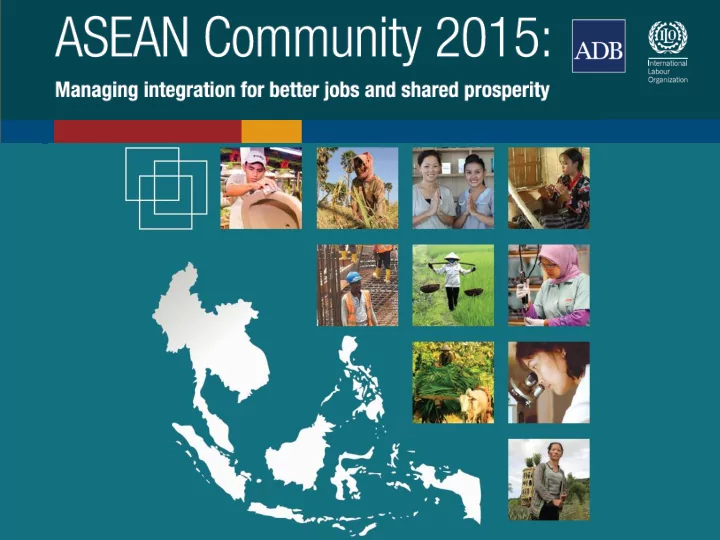
2 Overview Background Findings of the study Current situation AEC impact Priorities for action 3 Background Findings of the study Current situation AEC impact Priorities for action BACKGROUND Focuses on


slide-1
SLIDE 1
slide-2
SLIDE 2
  • Background
  • Findings of the study
  • Current situation
  • AEC impact
  • Priorities for action

Overview

2

slide-3
SLIDE 3
  • Background
  • Findings of the study
  • Current situation
  • AEC impact
  • Priorities for action

3

slide-4
SLIDE 4
  • Focuses on how AEC 2015 affects people through the

labour market

  • How can integration be managed to ensure inclusive growth?
  • What will be the impact on job creation, job quality, women?
  • What kind of skills will be in demand?
  • What will be the effect on productivity and wages?
  • What will be the implication for labour migration?
  • Draws on CGE model simulations, occupational

projections, policy analyses, ASEAN employers’ survey, extensive consultations

BACKGROUND 4

slide-5
SLIDE 5
  • Background
  • Findings of the study
  • Current situation
  • AEC impact
  • Priorities for action

5

slide-6
SLIDE 6

IMPRESSIVE ECONOMIC PERFORMANCE, BUT POOR QUALITY JOBS AND GENDER GAPS PERSIST

6

slide-7
SLIDE 7
  • US$2.4 trillion GDP in 2013; 300 million labour force
  • Relative resilience to global economic crisis
  • Between 2007-13, ASEAN economies grew faster than global average
  • Changing trade and FDI flows
  • Rising FDI inflows relative to rest of the world
  • Rapidly growing middle class
  • From 1991-2013, 83 million workers joined the middle class;

number expected to reach 144 million by 2017

  • But rising inequality is a major concern

CURRENT SITUATION

ASEAN integration in the global context

7

slide-8
SLIDE 8
  • Considerable labour market deficits
  • 2 in 5 workers in low-productivity agriculture
  • 3 in 5 workers in ‘vulnerable’ employment (own-account plus unpaid

family workers)

  • High informality, with low social protection coverage
  • 13% youth unemployment
  • Persisting gender disparities in the labour market

CURRENT SITUATION

ASEAN integration in the global context

8

slide-9
SLIDE 9
  • Background
  • Findings of the study
  • Current situation
  • AEC impact
  • Priorities for action

9

slide-10
SLIDE 10

AEC WILL DELIVER BENEFITS TO THE REGION, BUT RISKS LEAVING SOME BEHIND AND AGGRAVATING INEQUALITIES

1

slide-11
SLIDE 11
  • AEC could increase GDP by 7.1% and add 14m net jobs by 2025
  • Gains and losses will be uneven – varying by country, sector, gender

AEC IMPACT

Managing structural change for decent jobs

1 1

Change in employment under the AEC relative to baseline, 2025 (000s and % of total employment)

2 4 6 8 10 12 14 1 000 2 000 3 000 4 000 5 000 6 000 7 000 Cambodia Viet Nam Philippines Thailand Lao PDR Indonesia Change in thousand, female (left axis) Change in thousand, male (left axis) Change in per cent of total employment (right axis)

slide-12
SLIDE 12
  • Sectors likely to grow include trade, transport and construction
  • New jobs could be in sectors that are vulnerable and informal

AEC IMPACT

Managing structural change for decent jobs

1 2

Vulnerable employment as a share of additional job gains under the AEC scenario, 2025 (%)

20 40 60 80 Philippines Cambodia Lao PDR Thailand Indonesia Viet Nam

slide-13
SLIDE 13
  • Different skills demand: high (+41%), medium (+22%) and low (+24%)
  • Skills gaps likely to worsen: high-skilled jobs filled by underqualified

AEC IMPACT

Moving up the skills ladder

1 3

Estimated skills and educational mismatch in high-skilled occupations, 2025 (000s and %)

20 40 60 80 4 000 8 000 12 000 16 000 Lao PDR Cambodia Viet Nam Thailand Philippines Indonesia Additional underqualified workers under AEC in thousand (left axis) Underqualified workers under baseline in thousand (left axis) Total underqualified workers as per cent of high-skill employment (right axis)

slide-14
SLIDE 14
  • AEC could create productivity gains – and scope for higher wages
  • Wages of skilled workers likely to increase most from AEC

AEC IMPACT

Linking wages to productivity

1 4

Change in labour productivity under the AEC, 2010-25 (%)

  • 20

20 40 60 80 100 120 140 Agriculture Industry Services Total Agriculture Industry Services Total Agriculture Industry Services Total Agriculture Industry Services Total Agriculture Industry Services Total Agriculture Industry Services Total Cambodia Indonesia Lao PDR Philippines Thailand Viet Nam Change under baseline Additional change under AEC

slide-15
SLIDE 15
  • Intra-ASEAN migration increased from 1.5m to 6.5m (1990-2013)
  • Mostly medium and low skilled workers
  • Concentrated in construction, agriculture and domestic work
  • AEC provisions on skilled labour mobility likely to have little impact

1 5

7 high-skill occupations under AEC, various years (000s and % of total employment) Employment in the seven occupations (thousand) Share of seven occupations in total employment (%) Total Male Female Total Male Female Cambodia (2012) 70.1 45.5 24.7 1.0 1.2 0.7 Lao PDR (2010) 37.8 21.2 16.6 1.3 1.4 1.1 Viet Nam (2012) 735.7 345.2 390.5 1.4 1.3 1.6 Indonesia (2010) 355.3 203.9 151.5 0.3 0.3 0.4 Philippines (2011) 454.5 209.5 245 1.2 0.9 1.7 Thailand (2010) 295 124.6 170.4 0.8 0.6 1.0

AEC IMPACT

Reaping the benefits of labour mobility

slide-16
SLIDE 16
  • Background
  • Findings of the study
  • Current situation
  • AEC impact
  • Priorities for action

1 6

slide-17
SLIDE 17

TO REALIZE THE FULL POTENTIAL OF THE AEC AND DELIVER SHARED PROSPERITY, ASEAN MUST TAKE DECISIVE ACTION… NOW

1 7

slide-18
SLIDE 18

PRIORITIES

Decent work in an integrated ASEAN

  • A. FACILITATE AND MANAGE STRUCTURAL

CHANGE

  • B. ENSURE THAT ECONOMIC GAINS LEAD

TO SHARED PROSPERITY

  • C. STRENGTHEN REGIONAL COOPERATION

1 8

slide-19
SLIDE 19

Ultimately, the success of ASEAN regional integration will depend

  • n how it affects the labour

market – and therefore on how it improves the quality of life of women and men in the region.

The full report “ASEAN Community 2015: Managing integration for better jobs and shared prosperity” can be accessed at: www.ilo.org/asia

1 9